
10WZC
Fertility to the fore
Whilst community activists are keen to arrest the declining birth rate, young couples have other priorities
The world population of Zoroastrians that was estimated at 124,953 in 2004 is believed to have come down to 111,691 in 2012. "How can we sustain a loss of 13,262 in less than a decade?” enquired Roshan Rivetna of Chicago when chairing the session on "Demography and Way Forward: Issues of Fertility and Solutions.” Although it was the first session on the third day of the 10th World Zoroastrian Congress (10WZC), due to delays the organizers wanted her to keep a tight rein on the time permitted to her six co-panelists to keep on track the afternoon program at the Race Course.
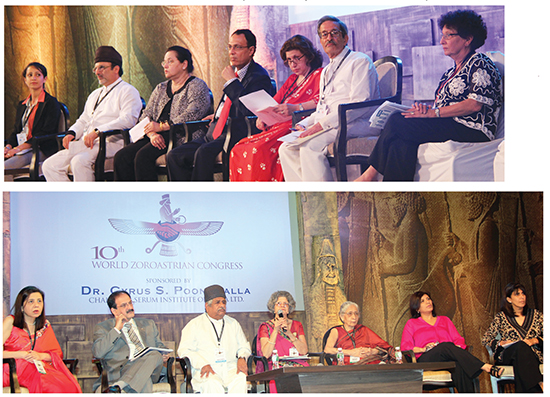
(From left,1st row): Tinaz Karbhari, Firoz Pestonji, Meher Bhesania, Neville Shroff, Meher Noshirwani,
Rusi Dalal, Dr Dolly Dastoor; (2nd row) Dr Zinobia Madan, Dr Nozer Sheriar, Dinshaw Mehta, Roshan Rivetna,
Armaity Desai, Dr Pervin Dadachanji and Dr Anahita Pandole
Describing demography as a "nightmarish, burning issue,” Bombay Parsi Punchayet (BPP) chairman Dinshaw Mehta continued, "If we don’t confront it upfront, we will be wiped out much sooner than expected. There will probably be more houses and no Parsis left to occupy them.” Referring to the different incentive policies adopted by the Punchayet like out-of-turn housing allotment, free fertility treatment for those unable to conceive, monthly subsidy of Rs 3,000 for the second child and Rs 5,000 for the third child to induce youngsters to marry and procreate early, Mehta felt the need to "come up with pragmatic and out-of-the box thinking… We are willing to do everything within our means…We want youngsters to realize that they must marry young,” he stressed before addressing his co-panelist Armaity Desai, "Maari chaar minutes baaki chhè, tamé vaaparjo (from the time allotted to me four minutes are remaining which you can use).”
Former director of the Tata Institute of Social Sciences (TISS), Desai cited some relevant statistics: Our birth rate that was 24 per 1,000 in 1900 had come down to six per 1,000 a century later. Only 12.4% of the Parsi population is below 14 years of age. Whilst the community requires a fertility rate of 2.1 as the minimum replacement level, we were down to .94 in 2001 and it is expected that in 2011 it must have further reduced to .89.
Desai cited three recent studies conducted by TISS personnel, one financed by the Dorabji Tata Trust and two by the BPP, to indicate the factors responsible for a low birth rate in the community: emphasis on a higher standard of living, protracted education, pursuing a career and improving job prospects. Whilst most respondents indicated it would be ideal to have two children, in actuality they had only one, stating they wanted the best for their child. Except for 12% who would have appreciated childcare, most rejected the idea of incentives. "The major consideration was attitudinal,” summed up the researcher.
In a community that is known for a high degree of individualism, the major reasons for remaining single are lack of parental push and general acceptance of those remaining unmarried.
When it comes to selecting a marriage partner, rated more important than looks or the financial health of the candidate was suitability and companionship.
To indicate the seriousness of the situation, Desai reported, "One in every 10 Parsi women is childless as compared to one in 20 in India. This is an appalling figure. Although the average age of conception was 27, amongst those unable to conceive, only 25% took treatment for childlessness. Two-thirds of the couples were using contraceptives, half the women had two conceptions but one out of three conceptions resulted in no delivery. "There is need for further studies on the reproductive health of the community,” she stressed.

(From left) Dinshaw Mehta, Roshan Rivetna, Armaity Desai, Dr Nozer Sheriar, Dr Anahita Pandole,
Dr Pervin Dadachanji, Dr Zinobia Madan and Dr Shernaz Cama
It is not biological infertility that is vexing the community as much as late marriages and attempts to delay child birth, declared Dr Zinobia Madan, senior advisor in medico-marketing and clinical research, who stressed that an important part of the Jiyo Parsi program is advocacy and counseling rather than correcting infertility. Funded by the Ministry of Minority Affairs, Government of India to increase the community numbers which they feared could drop to 36,730 by 2050 unless urgent measures are implemented, the Jiyo Parsi scheme needs the support of the community. Conceptualized by Dr Shernaz Cama of Parzor, Desai, gynecologist Dr Anahita Pandole and Madan, and being pursued after the Ninth WZC in Dubai, this scheme will address the main issue of infertility by enrolling 150-200 couples, starting with the Jaslok Hospital where Madan and Pandole are based. They will subsequently cover "every city, town, village of India,” said Madan. "An only child is a lonely child,” reminded Madan whilst advocating that there should be a "family attempt to have a child/grandchild. Please support the young.” The responsibility should vest not only with the couple.
Having studied the reproductive health over the last seven years amongst his Parsi patients, gynecologist Dr Nozer Sheriar shared the findings of 173 couples, with 70% having both Parsi partners. When monitoring 200 pregnancies, he found that the average time to first pregnancy was 2.7 years, with 27.1% having conceived within the first year and 68% within two years. He reminded the community leaders that they "cannot buy reproductive behavior” with incentives. He did however feel it necessary for organizations to bring together the youngsters, introduce health clinics before marriage as do the Roman Catholics and offer quality childcare after birth, other forms of support for the family and reduction in rent slab with every additional child. In response to a question, he subsequently declared, "Everyone knows the problems and everyone knows the solutions but everyone thinks it does not apply to them.”
"Infertility is not a disease. Ninety percent of the cases are treatable,” reiterated Pandole who 10 years ago had started work on a fertility clinic for Parsi couples, a BPP initiated venture. Of the 680 couples who have come to the clinic, over 40% were in the 35-40 age bracket and 30% were over 40. The treatment that varied from couple to couple resulted in 230 live births. She found that "more often they need counseling” for there are social factors too that contribute to infertility like the woman being career oriented or wanting a house of her own before starting a family. Other interventions varied from making a study of the woman’s follicle cycle (growth of an egg in the ovary), intrauterine insemination, to more advanced assistance like in vitro fertilization, intra cytoplasmic injection, she revealed.
The first Parsi couple sent to her for counselling by the Fertility Clinic had the wife in a state of depression and the husband who was paranoid. In the second couple, one of the partners was schizophrenic, recalled Dr Pervin Dadachanji, a psychiatrist, sharing her fears on whether the community was "looking for quality or quantity.” Among several other couples that she counselled, she realized that non-consummation of marriage was a recurring feature in the community. She hoped the Jiyo Parsi program would "focus not only on treating the soma (body) but also the psyche… to ensure better quality of parents and children.” A premarital counseling program like the one insisted upon by the Catholics would help the couple have realistic expectations, she felt. The diagnosis of infertility often triggers a chain reaction starting with "grief, followed by denial, bargaining (at shrines), depression and finally acceptance” with the couple coming to her at different stages.
Having studied the reproductive health over the last seven years amongst his Parsi patients, gynecologist Dr Nozer Sheriar shared the findings of 173 couples, with 70% having both Parsi partners. When monitoring 200 pregnancies, he found that the average time to first pregnancy was 2.7 years, with 27.1% having conceived within the first year and 68% within two years. He reminded the community leaders that they "cannot buy reproductive behavior” with incentives. He did however feel it necessary for organizations to bring together the youngsters, introduce health clinics before marriage as do the Roman Catholics and offer quality childcare after birth, other forms of support for the family and reduction in rent slab with every additional child. In response to a question, he subsequently declared, "Everyone knows the problems and everyone knows the solutions but everyone thinks it does not apply to them.”
"Infertility is not a disease. Ninety percent of the cases are treatable,” reiterated Pandole who 10 years ago had started work on a fertility clinic for Parsi couples, a BPP initiated venture. Of the 680 couples who have come to the clinic, over 40% were in the 35-40 age bracket and 30% were over 40. The treatment that varied from couple to couple resulted in 230 live births. She found that "more often they need counseling” for there are social factors too that contribute to infertility like the woman being career oriented or wanting a house of her own before starting a family. Other interventions varied from making a study of the woman’s follicle cycle (growth of an egg in the ovary), intrauterine insemination, to more advanced assistance like in vitro fertilization, intra cytoplasmic injection, she revealed.
The first Parsi couple sent to her for counselling by the Fertility Clinic had the wife in a state of depression and the husband who was paranoid. In the second couple, one of the partners was schizophrenic, recalled Dr Pervin Dadachanji, a psychiatrist, sharing her fears on whether the community was "looking for quality or quantity.” Among several other couples that she counselled, she realized that non-consummation of marriage was a recurring feature in the community. She hoped the Jiyo Parsi program would "focus not only on treating the soma (body) but also the psyche… to ensure better quality of parents and children.” A premarital counseling program like the one insisted upon by the Catholics would help the couple have realistic expectations, she felt. The diagnosis of infertility often triggers a chain reaction starting with "grief, followed by denial, bargaining (at shrines), depression and finally acceptance” with the couple coming to her at different stages.
Dissecting demographics
In India, the population decline from 69,601 in 2001 to an estimated 61,000 in 2011 indicates a 12.4% decline. In Pakistan, from 2,831 in 1995, to 1,675 in 2012, there has been a 21% drop. From 66 to 37 between 2004 and 2012, Sri Lanka showed a decline by 43.9%. In Iran, the Zoroastrian population that numbered 27,920 in 1996 had come down to an estimated 15,000 in 2012, a decline of 37.5%, although the census data claimed there were 25,271. The UK community has been stable at around 5,500 over this period. Canada has shown a growth of 12% from 5,975 in 2004 to 6,422 in 2012 and USA of 33.5% from 10,794 to 14,306. In the Middle East the community numbers have reduced from 2,200 to 2,030. New Zealand shows a count of 1,230 from 900 in 2004 and Australia of 2,577 from 2,601. Hong Kong has shown an increase from 210 to 220 whilst Singapore has recorded a 130% increase from 162 to 372. Rivetna provided these highlights in her presentation on "The Zoroastrian World — a Demographic Picture,” during the evening slot assigned to her on the second day but which too had to be truncated as the programs were running late by nearly two hours. For most of the regions, census figures are not available and Rivetna had to depend on data provided by community leaders and associations.
In India, the population decline from 69,601 in 2001 to an estimated 61,000 in 2011 indicates a 12.4% decline. In Pakistan, from 2,831 in 1995, to 1,675 in 2012, there has been a 21% drop. From 66 to 37 between 2004 and 2012, Sri Lanka showed a decline by 43.9%. In Iran, the Zoroastrian population that numbered 27,920 in 1996 had come down to an estimated 15,000 in 2012, a decline of 37.5%, although the census data claimed there were 25,271. The UK community has been stable at around 5,500 over this period. Canada has shown a growth of 12% from 5,975 in 2004 to 6,422 in 2012 and USA of 33.5% from 10,794 to 14,306. In the Middle East the community numbers have reduced from 2,200 to 2,030. New Zealand shows a count of 1,230 from 900 in 2004 and Australia of 2,577 from 2,601. Hong Kong has shown an increase from 210 to 220 whilst Singapore has recorded a 130% increase from 162 to 372. Rivetna provided these highlights in her presentation on "The Zoroastrian World — a Demographic Picture,” during the evening slot assigned to her on the second day but which too had to be truncated as the programs were running late by nearly two hours. For most of the regions, census figures are not available and Rivetna had to depend on data provided by community leaders and associations.

From left: Dr Dolly Dastoor, Rusi Dalal, Meher Noshirwani, Firoz Pestonji, Meher Bhesania, Neville Shroff, and Tinaz Karbhari
To authenticate the figures she was presenting, Rivetna had representatives of different regions share the podium with her but due to paucity of time they were asked to condense their summaries to a couple of minutes and finally even a fraction of a minute. Meher Noshirwani of Pakistan read from a brief prepared by Toxy Cowasjee that in the last 12 months they had lost 146 members and their strength now stands at 1,529. The average age of the population there is around 60. Those who have married out of the community are not ostracized and in fact outmarried "women who have not changed their religion are welcome in our agiary.” The community’s low rent accommodation is lying vacant in Karachi but the Cyrus Minwalla Colony and the Dinshaw Avari Colony are doing well. The most dire need is a home for the aged.
"We may be the smallest religious community in the UK but our representation at the government and nongovernment bodies is at the highest level,” said Rusi Dalal, former president of the Zoroastrian Trust Funds of Europe. In the 1950s there was a considerable influx of Zoroastrians from India and in the 1960s from Africa. This segment of the population is now in their 80s. "Externally we are doing excellently although internally we may have concerns about retaining our identity.”
Reporting on the community in the rest of Europe and Central Asia, Dr Dolly Dastoor, past president of the Federation of Zoroastrian Associations of North America (FEZANA) and editor of FEZANA Journal, shared recent experiences of her trip to Uzbekistan when they learnt that only 34 and not 6,000 wanted to return to their Zoroastrian roots. When they visited Termez, the cradle of Zoroastrianism, they found a very ancient fire worshiping cult.
In Hong Kong, the age span of the Zoroastrian population ranges from seven months to 96 years with 16% being over the age of 65, conveyed Neville Shroff, president of the Zoroastrian Charity Funds of Hong Kong, Canton and Macau. The intermarriage rate has increased, reflecting the situation around the world where it is difficult to find prospective Zarathushti spouses although they have formed a youth group and with social networking they are encouraged to meet each other. Property prices being very high in Hong Kong, youngsters who come there should do so only if they have secured a job, advised Shroff. Their 23-storeyed Zoroastrian Building in Hong Kong that is valued at HK$ 200 million is believed to be "the most valued Zoroastrian asset in the world today,” conveyed Rivetna. (Doongerwadi would be worth more but it is not a saleable asset. The land has to be used for disposal of the dead — editors)
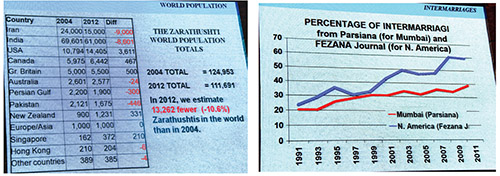
Demographic figures presented at the Congress
Australia has a very high percentage of elders with over 20% of seniors in their population as compared to New Zealand that has around 3.2% seniors and about 40% children. The New Zealand data prepared by Tehmus Mistry was read by Tinaz Karbhari. "The intermarriage rate in Australia is only three percent,” reported Firoz Pestonji, president of the Business Association of Western Australian Zoroastrians. The majority of the emigrants are from India with barely two percent from Iran and the Middle East. "No one wants to leave the Gulf,” commented Meher Bhesania of Dubai. Even after retiring at the age of 65 "they stay back on their children’s visa or have their own business.”
There are 28 associations and 11 darbe mehrs in North America, reported Rivetna. "The major challenge for the community is dispersion and ethnic diversity.” She also outlined a brief sketch of Zoroastrians scattered across the globe, including the 21 remaining in Seychelles where Temoljee and Company run by 80-year-old Soona Oliaji is the largest general store in Mahe Islands. In Zanzibar, the last two Parsis are Diana Darukhanawala and her 83-year-old father.
◆ ◆ ◆
From the archive