
Cover Story
Medicos lend momentum
A distinguished team of doctors analyzed the medical problems of the community on the third day of the Ninth World Zoroastrian Congress
On hand were multiple sessions to choose from. Out of hand was time management. "Hands across the oceans” was the main draw on the third day, December 30, 2009, of the Ninth World Zoroastrian Congress (9WZC) at the Crowne Plaza hotel in Dubai when a high-level medical team commenced the morning symposium. Through the day, representatives from different countries attempted to focus on the efforts of their team in knitting the community in their respective regions. But most of the delegates were distracted by the desert adventures promised that evening!
Looking at the 8.81 percent negative decline of Parsis in India, the five doctors shared their knowledge of the medical problems in the community that could be resolved through prevention, early detection and treatment, and realistic goals. The impact of declining numbers has been evinced in the medical fraternity too with but a handful joining the profession each year. The current scenario is quite different from the year 1926 when 75 percent of the total number of medical students at Bombay’s Grant Medical College were Parsis, remarked eminent ENT surgeon Dr Pilloo Hakim who was moderating the symposium.
Clinical researcher Dr Zinobia Madan commented on the profile of the community that is "relatively affluent and has ready access to medical care.” While there are some who are energetic into their 90s there are others who suffer from ailments like allergies, cancer, hypertension, diabetes, fatigue, osteoporosis, psychiatric disorders, making her view Parsis as a "medical paradox.” As against 12-14 percent males who are carriers of the G6PD deficiency enzyme, only one percent females carry this genetic deficiency. Hypertension plagues 36.4 percent of the Parsi population with its prevalence being higher among women. For Parsi women, the mean age at marriage is 27 and for men, 31, she noted.
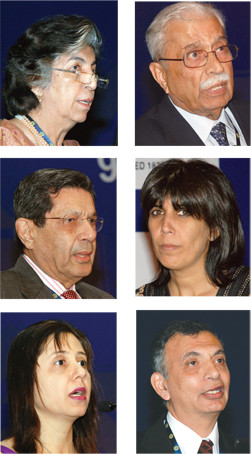
Committed doctors (clockwise from top left): Pilloo Hakim, Noshir Wadia, Anahita Pandole, Behram Pastakia, Zinobia Madan and Rus-tom Soonawalla
"Ten to 14 percent of (Parsi) couples suffer from infertility. Ninety percent of infertility is treatable today,” commented gynecologist Dr Anahita Pandole who is trying to determine whether infertility is Parsicentric. The community’s success rate and prolonged use of contraceptives aggravates the infertility problem, she observed, adding, "By mid-30s, the infertility rate rises to 30 percent. Can we halt the biological clock?” Would freezing of embryos and sperm banking help to preserve fertility? she wondered.
"Ten percent of the community suffered from neurological disorders,” neurologist Dr Noshir Wadia informed the gathering. He particularly referred to the high incidence of Parkinson’s disease which showed up 328 cases in a study by Bharucha et al of neurological disorders in the Parsi community — results of survey of frequent diseases per 100,000 population. As against this the all-India figure was 14-27 and the prevalence in Europe, 100-250. For essential tremors, the figure was 1,592 among Parsis, 351 in the general population in Calcutta and 500-5,000 in Europe. Most alarming was multiple sclerosis that was prevalent among 21-26 Parsis whilst the rest of India showed 0.5-2. The Parsi figure was comparable to the 30-50 cases in a population of 100,000 Iranians. The DNA profile showed "a genetic relation among Iranian subpopulations and South Asians.”
Considering Zoroastrians as vulnerable to breast cancer, radiologist Dr Behram Pastakia was in favor of periodic screening every two years. Specialized clinics at one or two hospitals in Bombay or an OPD (outpatients department) facility at different baugs where medicos could render honorary service would help the community, he believed. He recommended the establishment of a medical center for surveys, scientific research and data collection, the development of a website to answer medical queries. Reference clinics, home help for those requiring nursing and medical care, convalescent homes, homes for senior citizens, a panel of doctors and volunteers to help the aged pensioners were the other recommendations. "The medical fraternity does the maximum free work among professionals in India,” commented Hakim.
Renowned gynecologist Dr Rustom Soonawalla being present in the audience, Hakim briefly called him on stage to emphasize that "prevention is better than cure… Just as a building requires a strong foundation so also the early months of pregnancy are important.” Before starting a pregnancy a woman should take supplements to give the body the necessary minerals and nutrition to prevent onset of diseases in the nascent stage.
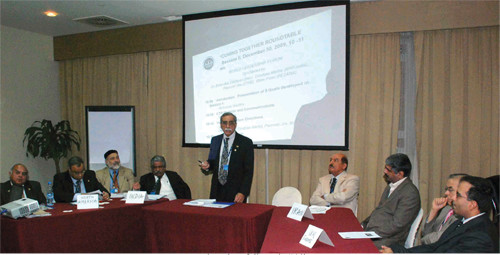
At the Round Table Meeting (from left): Firdosh Mehta, Bomi Patel, Khojeste Mistree, Dinshaw Mehta, Rohinton Rivetna, Iranian delegate,Dr Esfandiar Ekhtiyari, Dorab Mistry and Paurushasp Jila
While the doctors were educating the delegates, there was a concurrent session, "Coming together Round Table Meeting,” a world leadership forum presided by Rohinton Rivetna who had conceived this global assembly. Rivetna handed over the mantle of leadership to the four main blocks: Dinshaw Mehta, chairman of the Bombay Parsi Punchayet (BPP), Dr Esfandiar Ekhtiyari, Zarathushti Member of Parliament in Iran, Paurushasp Jila, vice president of the Zoroastrian Trust Funds of Europe (ZTFE) and Bomi Patel, president of the Federation of Zoroastrian Associations of North America (FEZANA). All the leaders present said they would enunciate future plans only after consulting their respective associations.
As commented Mehta in the course of the BPP presentation that followed, "All congresses and Round Table conferences are of little benefit to the community if the antagonism, distrust, suspicion and unwillingness to listen continues to be at the core of issues at hand… Let change come as a natural flow of evolution and not as radical reforms.”
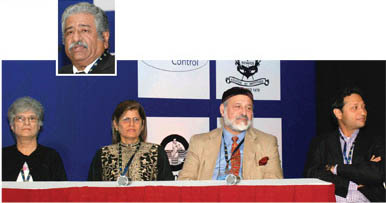
BPP team: (from left) Armaity Tirandaz, Arnavaz Mistry, Khojeste Mistree, Jimmy Mistry and (inset) Dinshaw Mehta
BPP bonhomie
The BPP presentation commenced with an orientation on ZYNG (Zoroastrian Youth for the Next Generation), launched in December 2009 by a core team of 25 members to promote interaction among those in the 15 to 40 age group, offer them a platform to voice their opinion, create a website, serve as an educational initiative and raise awareness of a social obligation. In the course of the trusteeship election fervor they realized that "60 percent live outside baugs and colonies,” noted Viraf Mehta. Observing that the youth were largely "complacent and indifferent,” ZYNG hopes to involve them in community developments. Even the sessions at the Congress are "too serious. The proceedings should be more fun…” urged the three members of the ZYNG team who had strategically positioned themselves on the dais. Some of the senior delegates though were disappointed that the youth were absent from the morning sessions after having partied late into the night. And considering that many youth had availed of subsidies from their anjumans/associations to attend the 9WZC, they expected the youth to be more responsible.
Dwelling on the BPP’s "multifarious activities,” Dinshaw Mehta elaborated on the 60 million rupees spent on the objects of the Trust and referred to their plans to create 2,257 new flats for community housing so that those in the "far off suburbs could be assimilated in the baugs where they can live, pray and marry within themselves.” He appealed to the NRIs (non-resident Indians) who keep flats locked in Parsi colonies to release their possession on adequate compensation. The mammography project suggested by Pastakia "will be taken up very seriously,” Mehta promised.
"The place where mobedi can grow from is Bombay,” mentioned BPP trustee Jimmy Mistry referring to the efforts of his Parsi Resource Group (PRG) to ameliorate the condition of the poor mobeds many of whom earn a daily wage of Rs 130-150. "How then can we expect enlightened, knowledgeable mobeds? Without rituals a community is hollow,” believed Mistry alluding to the Dadar Athornan Institute which now has only "13-15 students on its rolls (the Institute website lists 18 school-going students and four in college for the academic year 2009-2010). The PRG’s mediclaim facility for the priests requires infusion of funds as the insurance company has raised the premium by three times following the regular claims made by priests for whom knee replacement surgery and cataract operations have become a routine affair. On behalf of the B. D. Petit Parsee General Hospital, committee member Hector Mehta clarified that the Hospital offers free treatment to mobeds in its general ward and concessional treatment to those who opt for better facilities.
"The previous generation kept the youth at arm’s length. We need to learn from the Aga Khanis, the Swami Narayan sect…” reiterated Mistry. In the 60-year period from 1941-2001, the community numbers in India have dropped from 114,000 to 69,601, reported BPP trustee Arnavaz Mistry, adding, "Every fourth Parsi is above 65 years of age.”
UK’s youth celebrate similarities
Navroji Rustomji Seth was the first Parsi to arrive in the United Kingdom in 1724, reported Jila in his presentation on "Zoroastrians in UK and future vision.” Established in 1871, over the years it has pursued key objects like study and dissemination of the Zoroastrian faith, promoting academia, maintaining separate burial grounds for the community, looking after Zoroastrians throughout the world… Presently looking after its affairs are 12 managing committee members and three trustees. "More than half the members are below the age of 40,” mentioned Jila, referring to their "constantly changing leadership.”
One of the nine recognized religions of UK, they promote interfaith activities whereby they can "celebrate the similarities and differences of religions.” To nurture the religious needs of the community they organized 35 jashans during the year according to the Parsi and Irani Zoroastrian calendar. Their Fun Club attempts to make religion meaningful to the Young Zoroastrians (YZ) in the 15 to 25 age group, and leaves it to them to impart lessons to the XYZ (extra young Zoroastrians in the four to 15 age group). The youngsters should "understand their faith and culture,” believe the committee members who seek to "capture and educate the youth to make their own decisions.” The WZCC (World Zarathushti Chamber of Commerce) UK chapter focused on entrepreneurship within the community.
Enchanted with the East
"For most of us our first introduction to Australia was through Kraft cheese, kangaroo and cricket,” summed up Phil Madon who has been residing in Australia for the last 29 years. The session on "The Zoroastrians in the Far Eastern countries,” had Madon speaking on Australia, pre-lunch and Vicky Mistry on New Zealand, post-lunch. "Where in the world are you paid $ 5,000 for every baby born? Where does the government give financial assistance of $ 7,000 to build your first home? Where do you enjoy a public holiday for a horse race?” Madon painted a rosy picture.
Sydney has its own Darbe Mehr "on five acres of lush woodlands,” and recently the Parliament of World Religions was held in Melbourne. The community of "3,000 Zoroastrians is doing well with its doctors and specialists, accountants and bankers, industrialists and a few budding entrepreneurs.” The Aussie and Kiwi pockets are growing, he mentioned. Whilst conceding that "The future generation will not be Parsis, they will be Aussi and Kiwi Zoroastrians,” Madon added, "We are setting the foundations for future Zoroastrians, ensuring that the children are brought up in the same way. In Zoroastrian homes religion should not take a backseat.”
The first Zoroastrian to arrive in New Zealand was Hormuzji R. Shroff in 1877 with his wife and three children. Their firm Shroff and Sons is still run by his descendants. The Zarathustrian Association of New Zealand is raising funds to establish a community center in Auckland from where they can conduct their activities.
Think big, hard and long
"Success is determined by the size of one’s thinking,” and not hard work, good luck or the size of one’s brain, expressed moderator Rustom Engineer of Houston at the youth forum on "Think BIG.” Wondering "Why doesn’t everyone think big?” he continued, "We are the products of our thinking… Fear of failure makes people operate from a fraction of their abilities.” Whether it is a friend, a relative or one’s own mind that is "trying to pull us down,” we have to watch our thoughts before they lead to actions, thence habits, character and destiny, he reminded.
"Think big from childhood. Don’t confine yourself to a specified curriculum. Learn your field end-to-end. Embrace curiosity. Participate in big projects,” recommended Firdosh Bhesania, director USB, Microsoft and vice chairman of the board of directors, Bluetooth, USA. He recalled how his own goal in life had been to join Microsoft and how he wasn’t disheartened when after 20 minutes of the first interview he was shown the door. He was determined to try a second time after he graduated, little realizing that he could be facing the same interviewer who, impressed with the growth he saw in the interviewee, recognized in him the seeds of a visionary! He emphasized the need for "vision… passion… integrity… empowerment… mentors to inspire and help you grow.” As second moderator Behroze Daruwalla of USA commented, Bhesania may be "Micro… but thinks big.”
Multi award singer and song writer Shayan Italia who has his roots in Hyderabad referred to the travails of his life — losing his mother to cancer, his father to multiple sclerosis — and finding the solace and triumph of music in his tragedy. "I can put a 75-piece orchestra together without having studied music,” the young heartthrob told his audience. Although he discovered his flair for music only on the death of his mother the songster has impressed his admirers and critics. Determined to come out with an album he is raising funds at a time when "markets are very bad” by inviting well-wishers to fund a song at £ 6,000 (Rs 4.5 lakhs). So far he has found sponsors for six songs, four of them being Zoroastrians who "even without knowing what I’ve done have put their faith in me.”
There is no need to work hard,” think hard and smart, recommended 22-year-old Lara Balsara of Madison World, India who has helped her father’s advertising agency grow to a 23 billion company. Focus on outcome and not output, she added. "Education is not important,” what remains after you have stopped learning is of consequence for one should never stop learning. "Your disadvantage is your advantage,” work harder to overcome it. "Let your opponent win,” but make sure you win as well for there should be a win-win situation for all. "The world is constantly changing,” so must you adapt, innovate and change without altering your values and principles. "You get only one opportunity to make a last impression,” she stressed. "Pray and have faith, it works,” she urged. "Be consistent, focused and visible,” but above all "be yourself,” she advised.
The ability of the youth to "think outside the box” ultimately determines their success, concluded Daruwalla.
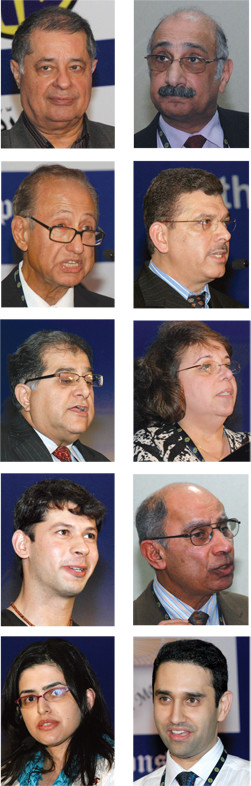
(Clockwise from top left): Alayar Dabestani, Darayus Motivala, Vicky Mistry, Behroze Daruwalla, Jehangir Sarosh, Firdosh Bhesania, Lara Balsara, Shayan Italia, Rustom Engineer, Phil Madon
Respect for Zoroastrian voice
After ‘think big,’ the mandate was to ‘talk small’ so that the sessions could end on time. The rest of the afternoon saw concurrent sessions on "Achievements of Youth in Iran” where Ekhtiyari and Alayar Dabestani from the Dabestani Group of Companies participated in the session in Farsi; "Opportunities for Zoroastrians to serve as bridge builders worldwide” was addressed by Jehangir Sarosh, European president of Religions for Peace. "Community Cares” saw presentations by representatives from the World Zoroastrian Organisation (WZO), BPP, FEZANA, ZTFE, Zoroastrian Charity Funds of Hong Kong, Canton and Macau, Australian Zoroastrian Association and Zoroastrian Association Singapore.
"As the world is changing and moving towards being a ‘global village’… the Zarathushtis need to gain recognition at world level as a community to be an effective body for global peace and prosperity. The new diaspora requires the community to evolve,” observed Sarosh who was recommending the formation of the International Network of Zarathushti Organisations "to ensure the Zoroastrian voice is heard and respected in the secular world” whilst granting autonomy to Zoroastrian associations and religious freedom to every individual Zoroastrian.
Care and concern
Apex community bodies reported on their endeavors to assist the disadvantaged in the session "Community Cares.” Believing in being "innovative in our approach to charity,” WZO has been focusing on uplifting the priests, granting educational loans, promoting talent in art, founding senior citizens homes, assisting in times of catastrophes and disasters, conducting other charitable activities and ensuring that "donors have a chance to see the work we do firsthand.”
"Our task is not to fix blame but to fix the course for the future,” reported BPP trustee Armaity Tirandaz referring to their projects for the youth, sports, housing, fertility, dakhmenashini, education, and children in need of special care "with a support group for such children being spearheaded by me.” Hoping to involve ZYNG volunteers in this effort she quoted, "Education is liberation from the shackles of ignorance.”
Speaking on behalf of the "200 Parsis of Hong Kong,” president Jal Shroff referred to the help they extend to hospitals, schools, the priests, the aged and the needy "without distinction of race or caste… We do not want fame or recognition… We have no quarrels with any organization. We are free and independent. Every organization doing good for the Parsis deserves our support.”
The 200 strong Zoroastrian community in Singapore is well placed and willing to raise funds when appeals are received from India or the WZO, conveyed Rusi Ghadially. Referring to their large youth component, he stated that the small community is very active and was happy to announce that the Government of Singapore has accepted Zoroastrianism as one of the 10 religions. For the 10th WZC that they were hoping to host in Singapore, 80 percent of the funds would have come from the government, he mentioned.
On charitable objects the members of the ZTFE expended £ 284,000 (around Rs 2,27,06,000) last year, stated Jila. While they do not have a medical endowment, they set aside funds for religious activities and educational work.
The Welfare Committee of FEZANA helps different regions throughout the world. Team FEZANA induced 17 youths to attend the Dubai Congress by giving each of them financial assistance of $ 5,000. Digitizing the sacred texts like the Yasna has also been a priority with them.
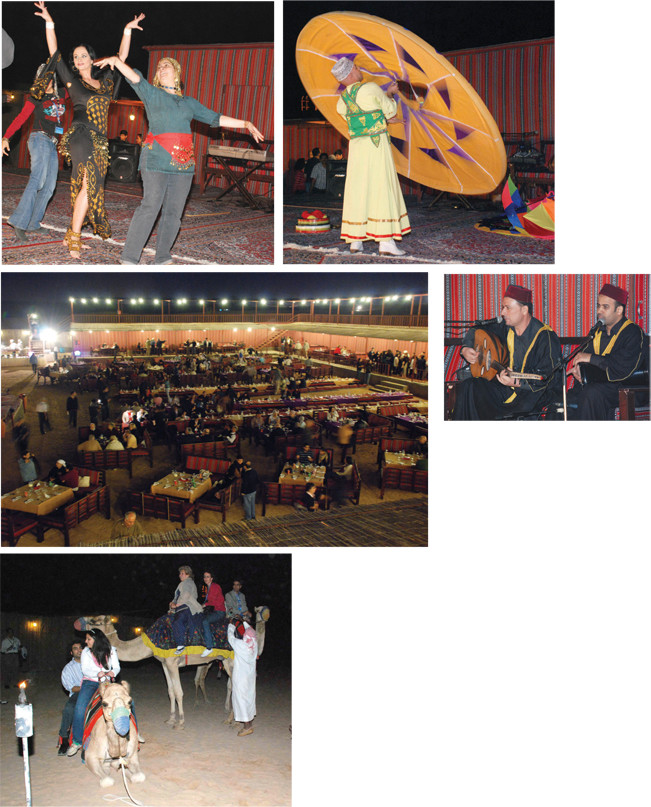
The Bedouin tent site where delegates were entertained with dances, live music, Hubbly Bubbly and camel rides
Spice on the sands
With strict instructions that all talkathons should end early such that the delegates could assemble in the Jumeirah Ballroom at 4.30 p.m. prior to undertaking the Desert Safari, this was one commandment that was adhered to religiously. At lunch time the organizers had to repeatedly remind the delegates to eat a light meal so that the ride over sand dunes would not cause any sickness. But known for their love for good food, the hard core Parsis were unable to resist the lavish spread before them until ultimately the organizers decided to spare them the thrill ride and lead the 16 bus loads directly over level land. For those fortunate to travel in the same bus as the Parzor director Dr Shernaz Cama, a monotonous journey was made memorable with the singing of monajats.
At the Bedouin tent site entertainment of a different kind awaited the guests. The much hyped belly dancer paled in comparison to Hubbly Bubbly who whilst continuously twirling for over 20 minutes on stage would effortlessly transform his attire and his accoutrements. The Persian dance show, live music, camel ride, henna lady, Arabic spice and perfume market were the added attractions there, and for the youth, the hookah session at the venue.
(The next report on the 9WZC will appear in the February 21, 2010 issue of Parsiana.)
◆ ◆ ◆
From the archive