
Funding faith and fertility
Deliberations on the first day of the Federation meet focussed on increasing community numbers and encouraging priests
When it was suggested that outmarried Parsi females too should be brought within the purview of Jiyo Parsi, Cama was emphatic that she did not want to enter into a controversy. This being a Government grant she felt it necessary to follow the definition of a Parsi as legally accepted in India today. Hence up to five lakhs per couple will be extended for assisted reproduction only where both the partners are Parsis or where the father is a Parsi. "We have no time for quarrel… There is danger of us exterminating ourselves,” she maintained.
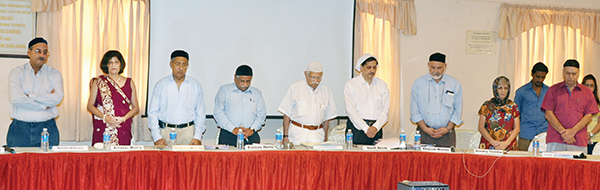
From left: Mancher Mubarakai, Arnavaz Mistry, Tehmton Anklesaria, Dinshaw Mehta, Dadi Mistry, Yazdi Desai,
Farzan Mazda and Dr Shernaz Cama
Dr Katy Gandevia, former professor at the Tata Institute of Social Sciences who is working as project coordinator of the advocacy component of the Jiyo Parsi program, commented on the "high expectations of parents who want the best school and the best of everything” for their child because of which the fertility rate in the community is less than one. The average age at marriage being 27 for women and 30 for men, they think of starting a family only in their early 30s when their biological clock is ticking away. Yet another development is "the high rate of divorce that is really troubling us,” she said.
Citing projected figures of the community numbers dwindling to 34,000 by 2051 and to 19,382 by 2100 at the current decline of 12% per decade, Gandevia said "the primary objective of the Jiyo Parsi scheme is to help 150 to 200 couples to overcome fertility issues for the first/second/third child. The program is being conducted in two parts, with the initial stage being advocacy through counseling and outreach programs. The Jiyo Parsi team is visiting baugs and colonies in Bombay to spread the word. They are also taking the help of Sam Balsara, chairman and managing director of Madison World, to create a national campaign to cover Zoroastrians in the rest of India. Popular cinestar Boman Irani has consented to be their brand ambassador.
The next step is sanctioning aid for medical assistance after gynecologist Dr Anahita Pandole studies the medical history of the couple. Whilst originally the couples could only avail of help at government hospitals, they are now permitted to pursue treatment at other medical centers after their case is approved by one of the empanelled doctors. The government grant is to be used within five years, reminded Bombay Parsi Punchayet (BPP) trustee Armaity Tirandaz who is authorized to "authenticate genuineness” of the couple to ensure that "no one is out to make money.”
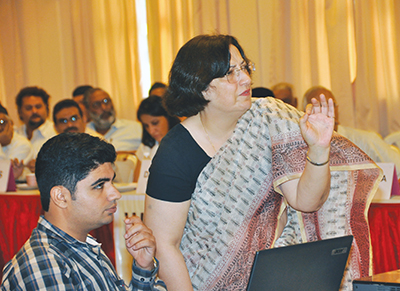
"Jiyo Parsi is not the be all and end all for those unable to conceive. This is only one aspect. The main issue is for parents to get their children married early,” asserted Federation president and BPP chairman Dinshaw Mehta. Supported Cama, "Be firm with your children. Don’t tell them ‘marriage can be your last priority.’” She referred to their efforts to promote matrimonial alliances under the Chaalo Kaaj Kariye (Let us matchmake) initiative that has met with only limited success and appealed to the anjuman representatives to send her two copies of their directories so that those single or married without issue can be directly approached by her team. "If you don’t come to us, we will come to you” is the approach they are adopting. Despite 30% of the Parsi population never marrying, Gandevia believed there is still hope for the community although one of the youngsters candidly said, "I don’t mind becoming a dinosaur. They died in grace.”
In the desperation to increase numbers, "the quality of Zoroastrians is being completely forgotten. Look at the kind of Zoroastrians we are bringing up today… I don’t see them becoming adventurous, entrepreneurs or going ahead in life,” regretted Cdre Medioma Bhada representing the Belgaum anjuman. Responded Cama, "If there is no quantity, how will you get quality?”
Subsequent to Bhada’s concern, Jamsheed Kanga representing the Satara anjuman opined, "Parsis seem to have become under-achievers… We are lacking in example. Earlier we used to look up to the trustees of the BPP. Today seven intelligent people cannot talk to each other in decent language… They have to learn not to be petty. To behave like adults, not children… You have been elected to lead the community and not defame it. Remember you are the akabars of the community, examples for the rest of the community.” Since Cama had earlier said a change in mindset is necessary, Kanga insisted, "A change in mindset is required not only in couples but also in the bigoted attitude of our leaders.” He was keen to know to know the statistics "of children (of outmarried) Parsi women lost to the community because we are going by the legal definition of a Parsi.”
Commented Cama, "We are cutting our nose to spite our face all the time...” Referring to her father, the late Lt Gen Adi Sethna working for the community when he was on oxygen in the Intensive Care Unit, she added, "We don’t need to wash dirty linen in public. This is the forum for us to talk.” She was impressed though that in her dealings with the BPP trustees, "everyone showed us maturity.” Responded Kanga, "They are so nice to you because you are so charming!”
By keeping out children of Zoroastrian women married to non-Parsis, "we are not losing thousands of children as is believed” but around 400 in 10 years, BPP trustee Khojeste Mistree cited the findings of Dr Zubin Shroff’s study at the Harvard School of Public Health.
Under the Return to Roots program promoted by Parzor, where young Zoroastrians from overseas were brought to India to familiarize them with their roots, the Track A program conducted in end 2013 was restricted to children of both Zoroastrian parents who compulsorily had to wear the sudreh kusti throughout the trip. Kurush Charna of Trail Blazer Tours gave the highlights of the tour in Bombay and Gujarat for which the program had been drawn up by Khojeste and Firoza Mistree. Track B which will be a religious cum cultural tour in March 2015 will be open even to navjoted children of outmarried Zoroastrian mothers as "I have to abide by the UN rule of gender equality,” said Cama. Plus such inclusiveness will also be "satisfying the FEZANA (Federation of Zoroastrian Associations of North America) and WZO (World Zoroastrian Organisation) conditions for funding.” Farzan Mazda of Dahanu outlined the activities he had planned to expose the group to a rural ambience.
Payments to priests
Another topic, though not on the agenda, that saw participation from several representatives on the first day was the BPP’s Mobed Amelioration Scheme (MAS) introduced last year under which full-time practising mobeds are given monthly assistance of Rs 10,000. As payments have been made until June 2014, Mehta insisted "the scheme is not closed” despite there being "no revenue and no source of income last month.” Barring former BPP trustee Burjor Antia who donated one crore rupees for mobed amelioration, no other help has been forthcoming from community members and the "BPP had to break fixed deposits to continue with this scheme,” he added. The BPP now plans to appeal to other community trusts to donate towards this cause.
Some outstation anjuman representatives like Bomi Heerjee of Indore felt that "the scheme was slightly skewed” because it is not helping smaller anjumans find mobeds to work with them. He recommended there be a website or data bank on mobeds to help anjumans find out which of the mobeds are free and available. Vice president of the East Zone, Russi Jeejeebhoy regretted that despite offering a pay of Rs 4.5 lakhs a year they have been unable to find a priest for Calcutta. Shiraz Doongaji of Nagpur wondered whether the BPP trustees were "so shortsighted that within one year they are facing a shortage of funds.”
Ervad Yezdi Panthaki of Saronda felt the subsidy to the priest should be linked to the higher liturgical ceremonies he performs. Baman Cama of Vadodara enquired whether the scheme was helping those who are genuinely needy or every full-time mobed. Pareecheher Davierwala of Davier recommended that instead of giving aid directly to the priest, it should be routed via the anjuman to ease their monthly financial burden.
When Kanga suggested the earlier paramobed scheme of the Federation should be reactivated, Mehta mentioned that in the month of May for the last several years the M. F. Cama Athornan Institute’s Ex-Students’ Association has been conducting a refresher course for ostas, ervads and behdin pasbaans. Marazban Wadia of Davier believed that one trustee of every small anjuman should receive behdin pasbaan instructions just as he had been trained to help his Davier agiary and other fire temples like the one in Kanpur which offers Rs 25,000 per month to behdin pasbaans. Earlier it was the community members who looked after the mobeds and it was common to see businessmen supply rations and provisions to mobeds who did not need to spend on any necessities, commented Brig Jahangir Anklesaria, president of the Ahmedabad Parsi Panchayat, adding, "We have failed in our duty to look after our mobeds and nassessalars.” North Zone vice president Tehmton Anklesaria felt financial incentives were not enough, the system needs to be reformed such that "their mentality, religiosity and cleanliness” improves.
With Poona industrialist Dr Cyrus Poonawalla having recently announced his scheme to assist every mobed with Rs 10,000 per annum, Mehta was hopeful that the applications received will yield considerable data on the priests. In response to all the misapprehensions about the BPP scheme, Mistree insisted "The scheme is not skewed. A lot of thought has gone into it.” He pointed out that "it is administratively impossible” to link the quantum of aid to the ceremonies performed. Further since some anjumans don’t give regular salary to their priests, or were considering reducing the anjuman contribution allowing for the aid promised under the MAS, the BPP trustees were advised to send the monthly aid directly. Supplemented Mehta, Rs 10,000 given by the BPP "is in appreciation of the work they put in to tend the holy fire despite smoke and other health problems they encounter.”
Post-lunch, the first contentious issue that erupted had its origins in a bilingual circular in English and Gujarati, distributed without the consent of the Federation president, by former Mhow resident Pervin Jehangir. She wrote: "Mhow is the first anjuman to sign the custodian trusteeship agreement in 1995. The FPZAI has become more active in the affairs of the anjuman since 2011 at the request of the community…Instead of the anjuman properties and assets being protected by such presence, we find that the FPZAI vice president (North Zone) and the president of the Parsi Zoroastrian Anjuman, Mhow (PZAM) cum member selected onto the FPZAI executive council actually signed an MOU (memorandum of understanding) and accepted earnest money, alienating two trust properties measuring 13,128 sq ft at the standing price offered for one property — supposedly measuring approximately 6,000 sq ft… The said property was saved by the intervention of the Registrar of Public Trusts which led to the cancellation of the deal.” The introductory paragraph of the circular stated, "To avoid litigation of the type that the PZAM and the FPZAI are currently involved in, I strongly recommend that any anjuman considering signing the custodianship agreement must, before signing, become aware of the problems and issues, the handling of which has led to such an unfortunate state of affairs.”
Tehmton Anklesaria who as North Zone vice president takes his duties seriously by visiting the anjumans periodically to keep himself abreast of developments was incensed with Jehangir’s insinuations. As per his explanation, the property in question in the cantonment area of Mhow is over 100 years old which requires maintenance costs of seven to eight lakh rupees. The multi-storeyed building has a rental value of zero. They accepted the highest bid of Rs 4,01,51,000 for which Rs 40,00,000 as advance was accepted. Jehangir filed her objections with the Registrar and had the sale proposal dropped. "Unfortunately we are not able to do anything for the last four years... Non-Zarathoshtis will encroach and become owners,” feared Anklesaria, adding, "I am greatly satisfied with the performance of Mhow... They have a good team, very systematic. There is transparency in their accounts... On one side Parsis don’t come forward to work... for a trifling issue the lady has gone to the charity commissioner.”
Elaborated PZAM president Cyrus Mancherji, the democratic elections of 2011 which saw a new committee in place has "not been acceptable to Jehangir” who has in the last three years recorded several objections. He conceded that there was a lapse on their part in not listing the property to be sold as "13/14” Main Street and stating only "13 Main Street” as it is commonly referred to. However since the description clearly appertained to both the properties, Mancherji sought to explain that there was no fraudulent motive. "The shrewd, cunning politician that she is,” Jehangir has tried to show "as if she has done a great service to the Mhow anjuman. Actually she has done nothing more than use the veto power granted to every trustee” to stop a land sale. "She has misrepresented to the charity commissioner and courts in Madhya Pradesh...I am strong enough, honest and faithful to my creator. My support comes from my colleagues.”
Believing that "such divisive elements… need to be defeated” especially since her circular "now accuses the Federation structure for being complicit” with PZAM in a land transaction and implies that there is a legal battle facing these two bodies, Mancherji demanded, "Where is the litigation?” Responded Mehta, "We are working in complete unison with Mhow.” Jehangir’s attempt to address the Federation body was thwarted by Mehta: "You will not be permitted to speak anything about Mhow. You are representing Illav at this meeting.”