
A hard day’s night
With indoor and outdoor events, it was an eclectic mix of entertainment at the 10th World Zoroastrian Congress
"The Entertainment Committee worked tirelessly as a team for one year,” says Cawas Billimoria, who was on the Committee along with several others. "It was challenging dealing with the larger logistical changes such as the change in venue (from the original National Centre for the Performing Arts at Nariman Point to the NSCI at Worli) and subsequent and frequent changes in the dates and venues of the evening programs. This worried us a bit but was not a great impediment though,” observes Diana Marfatia, who was also on the Committee. Internal dissensions among the Bombay Parsi Punchayet (BPP) trustees and the on/off syndrome regarding the staging of the Congress provided the "challenging twists and turns of a roller coaster ride till some clarity emerged once Dr Cyrus Poonawalla, Nadir Godrej and Maneck Davar took charge,” asserts Billimoria.
This was not the first time the Paranjoti Choir sang in front of the President of India, conductor Wadia told Parsiana later. "My Choir and I had performed at the Rashtrapati Bhavan in New Delhi when Pratibha Patil was President. We sang at the Presidential Christmas Concerts in 2009 and 2011. At the WZC, it was my intention to present mainly universal (non-denominational themes) as my Choir is composed not only of Zoroastrians but also other communities. We also tried to keep the works Indian for the most part, as that would be of greater interest to the international audience.” Harmonization began with a Sanskrit invocation Asathoma sat-gamaya which appealed to God to "lead us from falsehood to truth, darkness to light and mortality to immortality.” "The Ashem Vohu by Meher Madon-Jansen was somewhat rearranged by us to suit unaccompanied voices. Payal by the well-known South Indian film musician J. Amaldev is a wordless song celebrating the sounds of the ghungroos on the ankles of dancers,” she explained. The spiritual He’s Got the Whole World in His Hands rounded off the Choir’s performance.
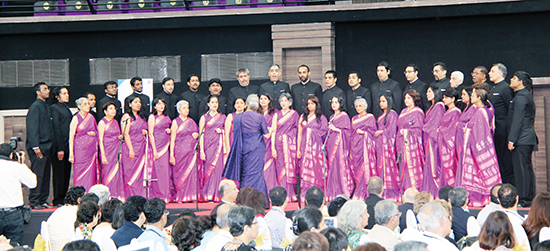

Did the mix-up about the announcements of their songs halfway through their program (which interrupted their performance and meant that the Choir had to remain motionless on their stand for quite a while) unsettle the singers? we asked. "We have given no less than 11 concert tours all over the world in different concert halls and under vastly differing conditions in Europe, America and the Far East. So we take these things in our stride. The demeanor of the Choir mirrors that of its conductor at all times. If the conductor remains unfazed, so does the Choir. One of our members slipped backstage (just before the show) but things were very speedily on track again. In common terms: ‘It was not a big deal.’”
Regarding the uncertainty about whether the Congress would actually be held, Wadia says: "My Choir and I were certain the show would go on, that someone from our community would definitely rise to the occasion and all would be well. The strength of the Entertainment Committee has to be praised. Kudos to them as they were full of confidence. As for myself, I tend to look always to the positive side. I have no use for negativity.” Yes, it was a mainly Zoroastrian crowd but quite international and diverse in its composition, she adds. "We were thrilled and all in all it was a wonderful experience. I thank the organizers for this opportunity and wish to place my gratitude on record.” Meeting people at the Congress made her realize, however, that "the Zoroastrian community as a whole, not merely the section that normally forms much of the Western music audience, did not seem to be aware of our work over the past almost 50 years. I wish they were!”
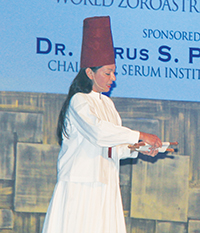
Mallika Sarabhai
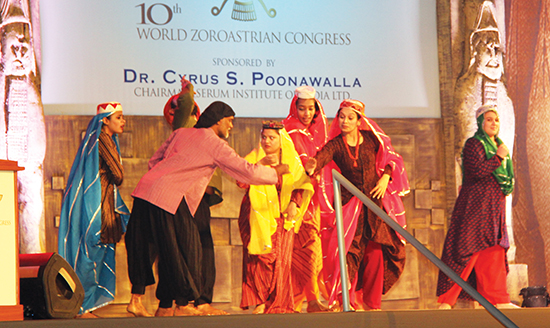
The dance drama And Then They Came to India by Ahmedabad-based dancer and choreographer Mallika Sarabhai and her Darpana Academy of Performing Arts was first commissioned some years ago by Avesthagen’s Dr Villoo Morawala-Patell of the Parsi Genome Project. Depicting as it does tales from early Persian history, the arrival of Islam and the emigration of Zoroastrians to India, "most of our audiences for this show have in fact been Parsis. But this being a serious conference was challenging. It was lovely having so many people come and tell us that the show informed them of much they didn’t know,” Sarabhai said to Parsiana on the email.
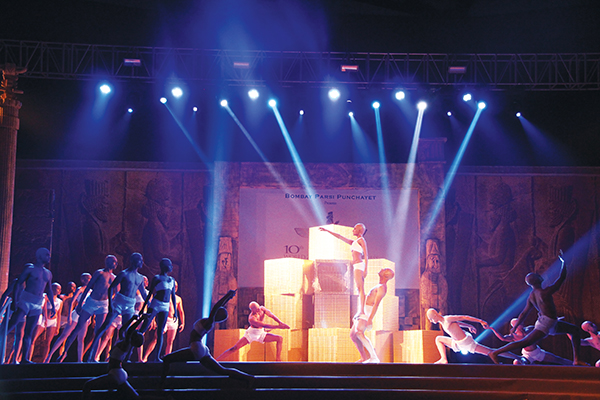
The dancing was dramatic and disciplined, the set and costumes spartan, the lighting and effects spectacular. "We decided to present Selcouth at the Congress for everyone to watch something that is new, rare and unusual,” Davar told us in an e-mail response to our questionnaire. "The show presents pure dancing… the strength lies in the dance movement. The video was meant to startle people and show the grave reality. I didn’t want to present a subtle video that makes people believe that the discrimination (against women) isn’t all that bad…
"Every time we present a show at a new venue/stage, the performances have to be tweaked using the spaces available, whether open or constricted,” he stated. "The stage at the NSCI was big and sufficient to present the show. Various aspects were added to use the stage aesthetically.” With dangerous lifts, running leaps, backbends and balances, the large group of athletic young men and lithe, supple girls sported the skinhead look and made full use of the stage, side and center aisles, running full tilt over wires and up and down the stage steps, portraying the geometry of dance seamlessly!
Originally choreographed for students of his OYC (One Year Certification) program, Davar believes that what the same piece of choreography does to one person can generate a different emotion in another. "There was a strong social message that came through Selcouth and the primary purpose was to make people believe that they have a voice and the time is now to speak up,” he asserted. Selcouth was sponsored at the Congress by the Rustomjee Group.
Racy recreation
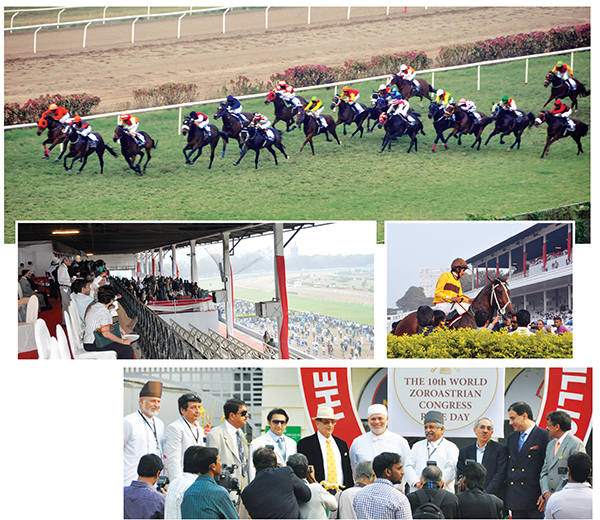
It was a new record at the race course — the first time the RWITC (Royal Western India Turf Club) dedicated an entire race day in honor of a community, filled with a record number of eight million/multi million races. Duglis and kor wali (Parsi-bordered) saris, suits and jackets (but few hats!) were much in evidence on the special Sunday called The 10th World Zoroastrian Congress Race Day (December 29). "The Parsi community has been closely associated with horse racing in India, especially at the Mahalaxmi Race Course and the contribution of Sir Cusrow N. Wadia is legendary. (Wadia donated in 1878 what was then marshy land and the course was built. Racing started there in 1883, as per the RWITC website.) The RWITC has a rich heritage of several Parsis as members, owners and also past chairmen of the Club and it is heartening to note that illustrious Parsi families have come forth to support this spectacular day,” noted Vivek Jain, RWITC chairman, in the little book called Cole Race Card. Rookie race goers among the delegates pored over its contents, trying to make horse sense of Super Jackpot Pool, Tanala Pool and Forecast Pool or whether Adam or Aviator, War Command or Be Safe carried fortune in their feet!
With special seating and snacks provided in style at the elegantly decorated Seaview Lounge, Grandstand, delegates strolled around paddock and park. Racing stalwart Dr Cyrus Poonawalla, chairman, sponsor and savior of the 10WZC, sponsored two races — The Villoo Poonawalla Foundation Million and The Zoroastrian Multi-Million. The Gool and Soli Poonawalla Memorial Million was sponsored by his brother Zavaray Poonawalla. The Shapoorji Pallonji Infrastructure Million, The Darashaw Million, the Nanoli Stud Million, The A. C. Ardeshir Trophy, The Talati & Panthaky Associated-Architects Zoroastrian Trophy and the 10th World Zoroastrian Congress Trophy were the other featured races, thanks to the generosity of their respective donors/sponsors.
The RWITC had been approached about one-and-a-half years ago by the BPP (for a special race day), Jain told Chaiti Narula of The Winning Post, recorded live at the venue. Khushroo Dhunjibhoy was the chairman at that time. "We are highly obliged to the present and past chairmen for giving us this honor. It is befitting that a man of Cyrus Poonawalla’s stature is chairing the Congress,” BPP chairman Dinshaw Mehta told Narula. "I wanted to support the Congress as it was coming to Bombay after a lapse of 23 years,” said Poonawalla. "The contribution of the Parsi community to racing has been disproportionate to its size. The Zoroastrian population in Bombay is only about 39,000,” legal eagle and racing enthusiast Berjis Desai told the reporter. Among the crowd were several owners, trainers and jockeys from the community.
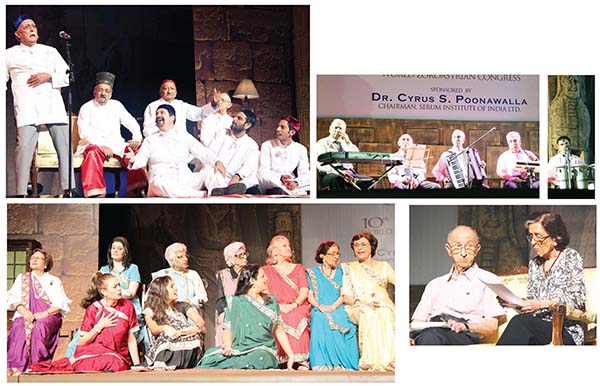
Burjor and Ruby Patel (2nd row, ext right) with veterans of Parsi theater in Laughter in the House
Unlike a normal theater, the seating at the NSCI was spread over a large flat area, requiring the stage to be at a higher level for proper viewing. "This meant a long flight of stairs for the artistes to go up. With all the quick changes, running to the green rooms, changing and running back again, it was tiring, to say the least. It’s tough enough for a 30-year-old… imagine doing this at the age of 80!” stated Burjor Patel, veteran theater artiste about the presentation of Laughter in the House at the Congress. "For the sound to reach out to the end of the hall, everyone had to wear head mikes, that is, mikes that go around the ear with a battery pack fixed to your trousers or petticoat with a wire running down your back. This was a first for most of the actors especially the ‘golden oldies’ who had been used to conventional standing mikes all their lives or none at all! Besides, everyone had to learn to stay silent before and after the scenes as these mikes would pick up every tiny sound!”
Through typical bawa dialog (maréré mua), double entendre, song and slapstick, thespians like Burjor and his wife Ruby, Dolly and Bomi Dotiwala, Scheherazade and Rohinton Mody, Villoo Panthaky Kapadia, Moti Antia, Jerry Kumana, Pervez Mehta and others re-lived the pages of Adi Marzban theater. Being octogenarian or septuagenarian was no barrier to their crisp entries/exits, quick repartee and energetic singing which stole the thunder from youngsters half their age. "Maneck Davar (organizing secretary of the Congress) did have some reservations when he first met me and director Sam Kerawalla to discuss presenting this at the Congress since the show had already had a good run. We pointed out that for the large number of outstation delegates this would be a welcome nostalgia event and we were pretty sure those who had seen it would welcome a second viewing,” Patel elaborated. The change in venue and the corresponding increase in expenses were overcome as "Adi Dubash who was the producer of the show (and a relative of Marzban) agreed to meet the cost as his contribution to the Congress.”
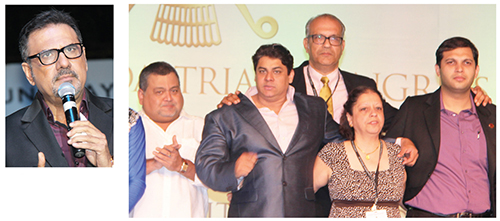
It was Broadway, Bollywood and Zoroastrian prime time for the finale on the Turf Club lawns. "Sahèbji, kèm chèo (hello, how are you),” actor Boman Irani’s arrival on stage as anchor brought forth the few Gujarati words heard during the entire duration of the Congress! "Baap ré, bo serious chhè badhaa, (goodness, everyone is so serious),” he deep-throated, peering deadpan at the audience. "Jaraa aawaaj karo (make some noise)!” Celebrity host Cyrus Broacha’s ‘The week that wasn’t’ brand of humor was complemented by friend and rotund comic man Kunal Vijaykar, dressed in a dugli! He (Vijaykar) walks, talks and behaves like a Parsi, ask dasturji to do his navjote, but first find a kusti that fits! quipped Broacha as their facile stand-up comedy continued for a while.
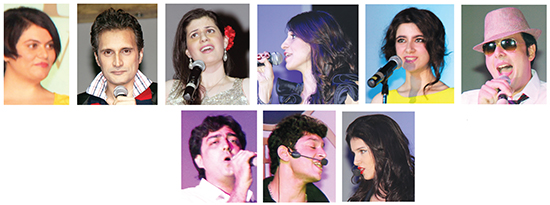
Singing stars like Shazneen Arethna, Delna Mody, Tara Sutaria and Khurshed Mogrelia (who danced as well) had the audience tuned in to their numbers! Red hot rhythm was provided by the all-Parsi band called The big red bus which rocked and rolled with vocalists Hormuz Ragina, Sarosh Nanavaty and Sarfaraz Irani. "Bboying (dance form) and ballet, it’s a confusing concept, idli sambar par eedu,” quipped Irani, adding after the item that the Bboying group Style In Work and young ballerina Pia Sutaria are "superbly talented.” With Kainaaz Master Unwalla (jazz), Arnaz Irani (contemporary) and Pearl Tirandaz (Bollywood) showcasing their choreographic skills, young dancing queens in gorgeous, glittering costumes performed their shimmer and shake with infectious, unbridled enthusiasm!
"The Entertainment Committee was keen to have some element of Western classical music as part of the scheduled entertainment and did a lot of spadework trying to coordinate with Parsi/Irani musicians from overseas and India. Unfortunately there weren’t a sufficient number of musicians to form an orchestral complement and the idea had to be dropped,” Marfatia gives us the background. "Sourcing out dancers for the last evening’s performance was also a challenge. Two auditions in different parts of Bombay were organized to identify talented dancers. Sadly, the response to both auditions was very disappointing.” With regard to the singers, she adds, there was enough and more talent in the community. "But despite being big in the business, they did not give us any grief. A huge asset was the involvement of Boman Irani who not only agreed to anchor the show, but was also present for some of our meetings and at the final rehearsal. Through his good offices we also got Broacha and Vijaykar. Every performer on the last day (whether established or budding) sang, danced, acted, anchored completely free of cost. The Entertainment Committee and members of the community at large are truly thankful to them for that.” The Committee was also grateful, she added, to the trustees and principals of the J. B. Vachha Girls High School and the Dadar Parsi Youths Assembly school as run throughs and meetings were held there. "Overall it was a great feeling and we thank the main Organizing Committee (mainly Davar and Mehta) for reposing faith and confidence in us,” says Marfatia.
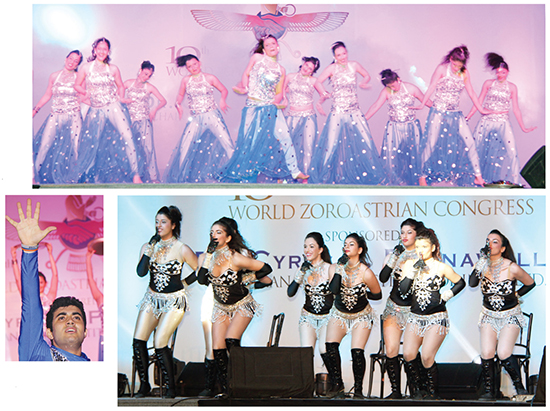
Glitter and posh spice with Bollywood and Broadway
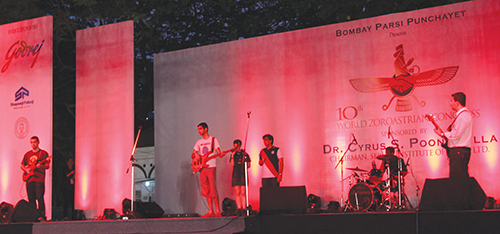
Musical moments with the all-Parsi band The big red bus
"The item we presented was a 100 percent original item,” states Darayus Dhabhar of Style In Work. "We took up this concept of fusion of Bboying plus ballet (two dance forms quite opposed to each other) to show that Bboying is not just about moves but also contains an equal quantity of pure dance. Vishtasp Kothavala, our mentor and teacher (who is also part of the group), choreographed the dance and Pia did so for her individual ballet portion.” "We rehearsed for almost a month, every single day for about six to eight hours daily. Closer to the show we pulled all night rehearsals as well,” adds Pia. With some difficult lifts and step sequences as part of the choreography, "I assured Pia that she would be safe, no matter what,” Dhabhar asserts. Bboying involves a lot of trust in your own body. A bit of imperfection and your body can go for a toss, he declares.
"I was asked to book the date for my performance around eight months in advance, and that itself showed how much hard work went into organizing this event,” Arethna, who is a former cycling champion and now a professional singer, told Parsiana on the e-mail. "It was a great feeling and an honor. I was delighted to close the show with a song by apro Freddy Mercury and it was overwhelming to have the entire crowd singing along to We are the Champions.”
With the members of the Entertainment Committee, performers, BPP trustees and WZC organizers gathered on stage at the end, Poonawalla took the mike to say that it had really "touched my heart to know that you and your magnificent team have performed free of cost. This is real Parsi magnanimity.” With the smile train getting wider, bodies swaying to the melody and some fist pumping, worries and strife were momentarily forgotten in the son et lumière of entertainment!