
Zoroastrians Abroad
Raising the bar
With 90% of overseas clients, Sarosh Zaiwalla's London based legal firm is gaining in reputation
"The color of the heart is important; not the color of the skin or the flag,” believes Sarosh Zaiwalla who is reportedly the first Indian to establish a legal firm in the city of London. During the 32 years since he founded Zaiwalla and Company, in his role as solicitor, counsel or arbitrator he has been involved in over 1,000 international litigations and arbitrations in the fields of energy, maritime and construction. "If you have a clean heart you will rise despite opposition,” maintains Zaiwalla recalling the familiar words "raakhiyé neebhaaviyé ték” from the popular anthem Chhaiyé Hamé Zarthoshti to reiterate that "keeping one’s word is most important. With that comes integrity.”
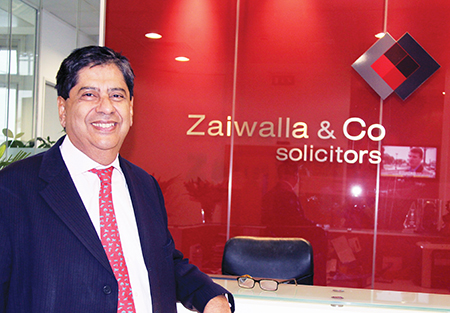
Sarosh Zaiwalla: "keeping one’s word is most important"
His reputation in the legal fraternity has earned him clients like the President of India, the government of the People’s Republic of China, the Iranian government… "We are a medium sized firm. No other firm accepts international cases against top law firms,” states Zaiwalla. Since the top Magic Circle firms have high overheads that they pass on to the clients, Zaiwalla is able to undercut the larger companies. "We are doing a lot of international work,” he adds. With 90% of their clients based outside the UK, their team of 18 legal experts who amongst them speak 12 languages, take pride in covering "both contentious and non-contentious law, including domestic and international litigation, international commercial arbitration, shipping, banking, project finance, energy, company, commercial, property and immigration.”
For a firm in Kazakhstan, Zaiwalla and Company is involved in a financial claim of $ 144 million; for a Kenyan company, a claim of one billion dollars, Zaiwalla lists recent cases that have preoccupied their solicitors. In Kazakhstan, the government has invited him to open an office in the expectation that the competition he offers will bring down the cost of legal services there.
As part of their commercial services, they advise international companies from India, China, Iran, UAE, Qatar, Nigeria that are entering into joint ventures with businesses in the UK, as also companies based in the UK and Europe that wish to promote their financial interests in Asia, the Middle East and Africa. Besides acting for the Chinese government in its first five arbitrations in London, as claims their bilingual English/Russian website, "No other British law firm can match our influential contacts within the Indian legal community and our client list includes such Indian high profile names as the Indian Oil Corporation (a Fortune 500 company), the Indian government, Congress leader Sonia Gandhi, the Bachchan brothers… Our new offices were opened by the Chief Justice and President of India.” In fact his first clients were the Hinduja brothers and Zaiwalla had helped them start their bank business in Geneva. Among his clients feature eight banks.
Last year the firm’s landmark victory in the Bank Mellat Case had earned Zaiwalla substantial recognition when he successfully challenged the British government’s sanctions and freezing of the Iranian Bank’s assets. He was able to show that the UK government’s sanctions were a discrimination against people and institutions operating under an unpopular regime and that Bank Mellat had no role to play in Iran’s nuclear program. As Zaiwalla had then acknowledged, "The judgment will put enormous confidence in the independence of the British judiciary (see "Confidence in the Court,” Zoroastrians Abroad, Parsiana, June 21, 2013).” Subsequent to the Supreme Court verdict, in mid-February 2014 Zaiwalla filed a claim of US $ four billion against the UK government on behalf of Bank Mellat in the Commercial Court. "This happens to be the largest claim ever filed against the UK government,” Zaiwalla’s personal assistant Charlotte Webb sent Parsiana an update.
With more work from Iran coming his way, Zaiwalla’s trips to that country have increased in frequency. When Parsiana interviewed him at his office on October 14, 2013 he referred to his fourth visit to Iran that year. Always happy to return to his "Iranian roots,” he felt all Zoroastrians could consider themselves Iranian, but clarified, "I believe in one world and one mankind. I am a citizen of the world, a national of Britain and a native of India.”
Having "reached a level” where he is respected both within and without the legal fraternity, it was at the House of Lords that the firm celebrated the 30th anniversary of its legal practice in 2012. A decade prior he was given India’s Annual National Law Day Award by the Indian Prime Minister for his outstanding contribution to the field of international arbitration law. He also enjoys the honor of being made a Freeman of the City of London, his accomplishments are listed on the firm’s website. As explained on Wikipedia, "The granting of the Honorary Freedom (or Freedom Honoris Causa) of the City of London is extremely rare and generally awarded today to Royalty, Heads of State or to figures of global standing. It is the highest honor which is in the power of the City of London.”
Zaiwalla, aged 64, declared that he would now prefer to lead a relatively "calm life” by focusing on arbitration work. A former member of the International Court of Arbitration of the International Chamber of Commerce, Paris, Zaiwalla is also an accredited mediator with the Centre for Effective Dispute Resolution, has been appointed to the Panel of Arbitrators by the Korean Commercial Arbitration Board and as representative of the Union of Comoros to the International Maritime Organisation.
From the time he appeared for his solicitor’s examination and trained at the maritime law company Stocken and Company in Fleet Street, Zaiwalla has made London his home. He remembers well the renowned maritime arbitrator Cedric Barclay cautioning him early in his career against joining a top legal firm. In an interview with The Telegraph of February 2, 2014, Zaiwalla recalled Barclay’s words: "You are good. One of the big firms will take you and a senior partner will take you for lunch at the end of your first year and say, ‘good job, old boy.’ Every year he will take you for that lunch and say the same thing and after 10 years you will still be in the same position.”
Operating from his office in Chancery Lane, a street historically associated with the legal profession since the 12th century, Zaiwalla soon became popular among wealthy foreigners who were excluded by the closed Oxbridge communities in London. The Company website further mentions how the firm hired a young barrister Tony Blair in 1983, "the only occasion when the three-time Prime Minister appeared in the Law Report.”
Bombay born Zaiwalla who had studied at St Xavier’s School and H. R. College of Commerce would earlier make three to four trips annually to India but after the passing away of his mother Nargeshbanoo "it has lost some of its attraction,” he confesses. Currently he is happier interacting with his brothers Dinsoo, Bomi, Dara and Khushroo, all in the legal field in India, when they make their summer trip to London. Whilst Dinsoo manages the legal firm started by their father Ratanshaw who had graduated in law from the UK in 1925, Bomi and Dara have their counsel practice and Khushroo combines both farming and law. Their sister Zenobia Zaiwalla Deal is a medical practitioner. They derive their surname from the village of Zai, neighboring Davier in Gujarat where the family were feudal landlords, he mentions. Their mother who was from Ankleshwar always advised the sons never to sell the family property.
"I am proud to be a Parsi from a cultural point of view,” says Zaiwalla recalling the legal expertise he lent when the World Zoroastrian Organisation had to obtain a commencement certificate before proceeding with its activities. Whilst community members who are emotionally involved may "enjoy fighting,” Zaiwalla prefers to maintain a distance saying that rather than get involved in internal squabbles that are inconsequential he would prefer to "be friends with everyone.” He has little time left "after running a busy practice from Monday to Friday. Life in London is very competitive for professionals. You have to do your best.” Married earlier to a Gujarati girl, he is now single but takes pride in mentioning that his daughter Freya who works in his firm has handled a variety of cases ranging from judicial reviews, company disputes and serious fraud office investigations. She is currently acting on six separate litigations in the General Court of the European Union (EU) in Luxembourg as also for a claimant in a trademark dispute in the English High Court and the Court of the EU against a well-known energy drinks brand. Besides English, Freya is conversant with Spanish and Portuguese. Son Varun had qualified as a barrister only three days prior to our interview. Lest Varun be considered a Hindu name, the father reminds us that it features among the 101 names of Ahura Mazda. Zaiwalla says he does "a lot of reading.” Books on religion, philosophy, history keep him company when on weekends he travels by train to his country house, willfully distancing himself even from his phone calls. "I like to be with nature,” he mentions.
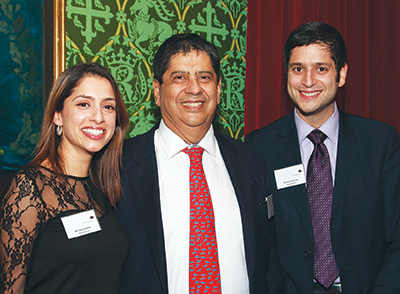
From left: Freya, Sarosh and Varun Zaiwalla
"I pray, talk to God but don’t wear the sudreh kusti. I would rather say prayers that make sense to me. If Zarathushtra were here he would probably say ‘Why not have prayers you can understand and not mumble?’ I believe in God. I call God ‘universe,’” he reveals. With his mother he would regularly visit the Vachaghandhy Agiary in Bombay. He has no compunctions about praying at the shrine of any faith declaring, "I believe in all religions.” Familiar with the philosophy of different religions he cites the Gita which states "‘The way to God is pathless.’ To answer the query ‘Who am I?’ Ramana Maharshi explains, ‘Part of the God soul,’ while Christ states, ‘Man is made in the image of God.’ Whether it is Abraham, Moses, Jesus, Zarathushtra or Krishna, no one is higher than the other. I am also impressed by the Baha’i faith although I don’t go for their religious functions either. The Baha’i faith has no conversion, no navjotes, only a willingness to follow the principles... Religion is the cause of so many wars now although the essence of all religions is to bring everyone together...
"The Zoroastrian religion does not forbid proselytization. We need to study the customs. How did the practice arise? Those who have married into the community and want to come in should be permitted… If you go to Iran there are no restrictions” on entry to the fire temples. In Isfahan, it is not wood but gas that is used to keep the fire burning, he points out. "Should we not change with the times?” he asks rhetorically.
The laws that govern the community may need reshaping. Having been in the legal field for a considerable duration, Zaiwalla remarks, "It takes a lot of money to get justice… Law is becoming the monopoly of the giants.” He would rather ensure that "Law is for justice…”
◆ ◆ ◆
From the archive