
10WZC
Immunity, Infertility,Insecurity
The concept of wellness and a holistic approach can help allieviate the many ills that beset the community
In the session "Hands across the oceans” on the third day of the Ninth World Zoroastrian Congress, five eminent members of the medical fraternity had analyzed the ills facing the community and suggested measures to deal with these problems. On the previous day Dr Farokh Udwadia had spoken on "The care and the problems of the elderly.” Since the Parsiana reports "Trade and the titans” (January 21, 2010) and "Medicos lend momentum” (February 7, 2010), had been unable to give comprehensive coverage to the sessions, carried here are the salient features of their presentations that were not referred to earlier.
Into the health profile of the Parsi community delineated by Dr Zinobia Madan, Parsiana has incorporated references to allergy that were part of Dr Pilloo Hakim’s domain, facts on fertility revealed by Dr Anahita Pandole, neurological findings alluded to by Dr Noshir Wadia, insights into breast cancer prevention recommended by Dr Behram Pastakia and the perspective on treating the elderly by Udwadia.
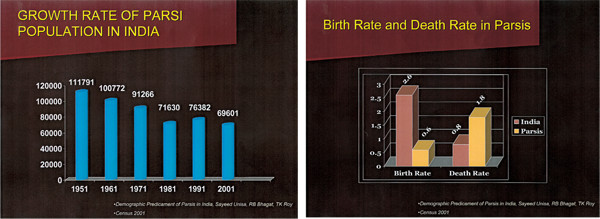
Parsis constitute 0.007 percent of the Indian population. As against the all-India population growth rate of 21.34 percent over a decade, Parsis recorded a negative decline of 8.88 percent. The sex ratio is in the proportion of 1,050 females to 1,000 males. A disturbing feature is that 30.9 percent of the population is aged over 65 as against eight percent of the general India population. These statistics were gleaned from Demographic Predicament of Parsis in India by Sayeed Unisa, R. B. Bhagat and T. K. Roy as also Census 2001.
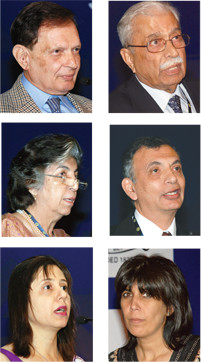
Clockwise from top left: Drs Farokh Udwadia, Noshir Wadia, Behram Pastakia, Anahita Pandole, Zinobia Madan and Pilloo Hakim
The strength of the Parsis who numbered 1,11,791 in 1951 came down to 69,601 in the next five decades by 2001. As against the all-India birth rate of 2.6, Parsis show 0.6 and the death rate that is 0.8 for India shows 1.8 for Parsis.
The Parsi community in India is perhaps the only community outside Europe to have experienced dramatic population and fertility decline. It is interesting to note that the age at marriage among Parsi women is about 27 years and among men is about 31 years.
According to a survey conducted by the Tata Institute of Social Sciences (TISS) in 1999, 20.6 percent of Parsi males in the age group of 50-54 remained unmarried as compared to 1.3 percent of the general male population in India. Among females, 9.4 percent Parsis remained unmarried as compared to 0.6 percent of the general female population in India.
Along with late marriage, voluntary and involuntary childlessness is another important factor for the low fertility among the Parsi community. One out of every 10 Parsi women is childless in the age-group of 45-49 compared to one among every 20 women childless for the total Indian population, as per the 2001 census.
Infertility is an extraordinarily common medical problem. This inability to conceive after more than two years of unprotected intercourse could be due to male factor infertility (40 percent) or female factor infertility (40 percent). Among males the reasons could be poor sperm quality, quantity or motility (capable of movement), zero sperm count or abnormal types of sperm. Among females the reasons could be blocked fallopian tubes and other pelvic factors, absent and improper ovulation, cervical and vaginal hostility. Immunological factors too could account for both male and female infertility. The reasons for 20 percent of infertility may also be inexplicable.
A PARZOR funded survey conducted by TISS, involving 60 general practitioners and 100 specialists from all over Bombay who had a significant Parsi practice, revealed certain major illnesses to which Parsis are prone: cardiac problems including hypertension, heart disease and blockages; cancer, especially of the breast and uterus among women and the colon for men; a rising incidence of diabetes including juvenile diabetes; osteoporosis; and stress related problems and psychiatric related problems. The cause of ill health was attributed to loneliness and insecurity, sedentary lifestyle and food habits.
As per the Expert Group Analysis of the 2001 Census, the major health problems reported by the community elderly included change in vision, hypertension, diabetes, tiredness, cardiac problems, osteoporosis, depression, anxiety and other psychological problems. According to a study by the UNESCO/PARZOR Foundation the main problems of the elderly Parsis are poor motivation and weakness — 58 percent, joint problem and disabilities — 40 percent, ENT (ear, nose and throat) complaints — 39 percent, respiratory problems — 21 percent.
A study conducted by Dr J. V. Undevia at the Tata Memorial Hospital on G6PD deficiency in Parsi population versus Indian population revealed that the Parsi males had 12-14 percent incidence of G6PD deficiency which is very high, compared to the Indian population which showed 1-3 percent. In Parsi females the incidence is only 1 percent. The incidence in Punjabis is 5-6 percent and in Sindhis, 4-5 percent.
People with G6PD deficiency are at risk of hemolytic anemia in states of oxidative (to undergo or cause to undergo a chemical reaction with oxygen) stress. Oxidative stress can result from infection and from chemical exposure to medication and certain foods. Symptomatic patients are almost exclusively male, due to the X-linked pattern of inheritance.
The diagnosis is generally suspected when patients from certain ethnic groups develop anemia, jaundice and symptoms of hemolysis after any challenges or causes including illnesses, drugs or food especially when there is a positive family history.
Take heart
The commonest cause of sudden death is often the heart. There are disturbances in the rhythm of the heart, some of which are dangerous. While the term dorora pectoris means pain in the chest, angina pectoris signifies a strangling pain in the center of the chest, often caused by exertion. Just as heart can be a killer for the aged, hypertension is also a killer. A paralytic stroke can affect the functioning of all parts of the body including the muscles of the throat, face, eyes.
If one survives a heart attack and hypertension is in control, cancer or the Big C may invade. Each one of us has cells which go mad (cancerous) but the body has a remarkable ability to recognize those which deviate and to destroy such cells. If the body loses memory of what is right and wrong, these cells proliferate. Oncologists say cancer is not one but many diseases. While localized cancers are curable, even blood cancers have a cure rate of 80 percent.
Hypertension or sustained high blood pressure is a leading cause of cardiovascular disease worldwide. Today, it poses an important public health challenge in developing/developed countries. Therefore, prevention, detection, treatment and control is a priority. An analysis of the worldwide data on the global burden of hypertension predicted the number of adults with hypertension in 2025 to increase to a total of 1.56 billion.
In a study carried out by Dr Nadir Bharucha on the prevalence, awareness and compliance to treatment in about 2,879 Parsis, the overall prevalence of hypertension in the community was 36.4 percent, in males it was 32.8 percent and in females it was 39.4 percent. Nearly half of those having hypertension are unaware of their illness. Compliance to medication is poor and only a small minority have optimally controlled blood pressure.
India is the diabetes capital of the world with 41 million Indians having diabetes. Every fifth diabetic in the world is an Indian. By 2025, the number is expected to rise to 68 million. Diet, medicine and exercise together create a powerful synergy for managing diabetes.
One-fourth of the Indian population suffers from one or more allergic disease. The four major forms of allergy are eczema, nasal allergy, respiratory and drug related (associated with G6PD deficiency.) Among these allergy patients, 55 percent have rhinitis that is most prevalent in the 18-45 (productive) age group. Infantile eczema/food allergy progresses to allergic rhinitis and asthma after early childhood with the incidence of rhinitis increasing from 10 percent to 30 percent in adolescence.
Neurological problems involve slow dissolution of bodily functions, loss of special senses, friction of joints affecting mobility. There is a tremendous disadvantage. When the individual is cut off from his environment it can have the most crippling effect with depression aggravating the condition. Many such individuals pass life in utter silence. This illness breeds more problems particularly among the poor when there is no one to look after the patient, poor nutrition and no wherewithal. Life is precious, more so to an ill patient. One who may earlier declare, "Do not use a ventilator on me” will, when struggling for breath due to pneumonia, enquire whether a ventilator will offer relief.
In a pilot survey of the prevalence of neurological disorders in the Parsi community of Bombay, Bharucha et al (1987) reported 10 percent neurological illness in a cohort (a taxonomic group that is a subdivision of a subclass) of 851 persons living in a community colony. Bharucha et al conducted a door-to-door survey to screen a community of 14,010 persons living in Parsi colonies of Bombay for possible neurological diseases. The survey was carefully designed and results published in a number of medical journals in 1988 which highlighted five frequent neurological diseases: Parkinson’s disease, epilepsy, essential tremors, stroke and multiple sclerosis.
This study concluded that there was a clearly higher age-adjusted ratio of Parkinson’s disease in the Parsi community of Bombay, slightly higher than the highest prevalence ratios reported in Europe. The prevalence of epilepsy is somewhat lower in Parsis than amongst other Indians or the world over. The most frequently associated conditions were cerebral palsy and mental retardation. The frequency of essential tremors is clearly more in the Parsi community than other Indians but no more than in many other communities the world over. Stroke prevalence is clearly higher amongst Zoroastrians than other Indians, especially in the aged. It is the same as the world population.
The relative incidence of multiple sclerosis, from amongst other neurological illnesses, is higher in Parsis. The prevalence of multiple sclerosis in the Parsis of Bombay is much higher than among other Indians. Also, the high prevalence of multiple sclerosis among Parsi immigrants to England, by contrast with the very low prevalence among ethnic Indian immigrants, may be an important clue to the genetic and environmental factors responsible for the disease. Among the Central Asian countries, the prevalence of multiple sclerosis is highest in Cyprus, followed by Israel, Jordan, Georgia and Iran.
Cancer care
Cancer prevalence in India is estimated to be around 2.5 million, with over 8,00,000 new cases and 5,50,000 deaths occurring each year due to this disease. The impact of cancer is far greater than mere numbers. Its diagnosis causes immense emotional trauma and its treatment, a major economical burden, especially in a developing country like India.
Dr B. B. Yeole presented the data of the Mumbai Cancer Registry between 1993-1997 in Asian Pacific Journal of Cancer Prevention, 2001. The data which compared age-adjusted cancer incidence in Parsis versus non-Parsis revealed higher incidence of cancer of buccal cavity and pharynx, digestive organs, respiratory system and genital organs in non-Parsis compared to Parsis in both sexes. However a higher incidence of cancer was observed for cancer of urinary organs, lymphomas and leukemias in Parsis versus non-Parsis.
Parsi females had a higher incidence of breast cancer compared to non-Parsi females. Also, the rates for testicular cancer were much higher in Parsis than in non-Parsis. The rates of prostate cancer are somewhat similar in Parsis and non-Parsis.
The initiative to mount a worldwide campaign to benefit women at risk for breast cancer, using available tools of technology (viz screening mammography) was well received. It is recognized that the issue for our community in major metropolitan areas is not the lack of available facilities. Nor is it financial barriers that keep women at risk from participating in periodic screenings. It is a lack of awareness that in cancer care, delay is dangerous.
Adverse outcomes which emotionally and financially impact young families and children can be mitigated if eligible Parsi women are made aware of the options available. The solution is for us all to find ways to reach out with an educational campaign so that they start taking care of themselves. There is no place for coercion in this campaign. It is for each woman to make an informed decision for herself. Recommendations culled from peer reviewed published medical literature can be shared. For starters, a power point presentation put together from material in the public domain which addresses some common concerns is uploaded at www. zoroastrians.net under the CTR tab. Websites which provide relevant information on breast cancer are available from the World Health Organization: Breast Cancer Screening — IARC http://screening.iarc.fr/breastindex.php; National Cancer Institute http://www.cancer.gov/cancertopics/types/breast; Join the Global Breast cancer Movement http://ww5.komen.org/Global/OurGlobalReach.html; The Breast Health Global Initiative http://www.fhcrc.org/science/phs/bhgi/index.html; Cancer Control: Knowledge into Action http://www.who.int/cancer/modules/en/index.html
In the final analysis, it is up to community leaders, social workers and volunteers in each geographic area to create ways to reach out to eligible women, since they know the local ground realities the best. What is proposed is an international collaboration where knowledge, expertise and best practices are shared for the betterment of our community. It is not a top down approach. The offer from the Bombay Parsi Punchayet to work proactively on this issue for the common good is heartening.
Screening mammography is not a perfect tool; however it is the best we have available at present to deal with the problem. The guidelines for frequency of screening for women with a family history of breast cancer are different from those at average risk. Screening for this high risk category of women should begin at an earlier age and be sustained with greater frequency between follow-up mammograms than for the population at large. Also, a baseline mammogram available for comparison with those obtained subsequently is of great value in providing an accurate interpretation. If analog films have been obtained, they should be kept carefully and used in subsequent interpretations. If the images are acquired using digital mammography machines which are now coming in the market, and the studies are appropriately archived in cyberspace, logistically this will become less of an issue.
Living well
Lifestyle diseases are also named as diseases of longevity or diseases of civilization. The fact that our diet is changing, from high nutritional food towards junk food, has contributed to the era of lifestyle diseases.
Reduction in physical activity and exercise has also added to the scenario. Substance abuse, especially tobacco smoking and alcohol drinking may also increase the risk of certain diseases later in life. But unlike other diseases, lifestyle diseases can be prevented by changing our lifestyles, improving diet and making the environment healthier.

The World Health Organisation (WHO) has warned that more than 270 million people are susceptible to diseases linked to unhealthy lifestyles. Most of these people are thought to come from China, India, Pakistan and Indonesia.
Wellness today is emerging as a very interesting concept with a multidimensional and holistic approach to living. Each of us can improve our state of wellness with appropriate lifestyle modifications such as preventing obesity, hypertension, diabetes and coronary artery disease, avoiding sedentary lifestyle, making healthy dietary choices — low saturated fat, low cholesterol, high fiber, plenty of fruits and vegetables, nuts, whole grains, and limited sodium, periodic gynecological and overall health checkups, compliance to medicines. Nothing works better than laughter in contributing to good health and being unhappy only makes things worse.
Many of the community ailments can be alleviated by setting up of specialized clinics: breast clinic; endocrine clinic for thyroid, diabetes, osteoporosis; cardiac clinic for blood pressure, electro cardiogram; infertility clinic; and neurology and psychiatry clinic. These specialized clinics could help in prevention, early detection and management, data collection and surveys and regular follow-ups. For the medical care of the elderly there could be reference clinics, either free or at low-cost, home help for nursing and medical care, convalescent wards, hospices, homes for senior citizens — joint and individual apartments, panels of doctors and volunteers ready to help old age pensioners, assistance along the lines of "Helpage,” regular monitoring of their nutrition and adequate intake of calcium and vitamins.
Life unfolds in seven stages, as described by the Bard in As You Like It. It begins with the infant, mewling and puking in the nurse’s arms, thence to a whining schoolboy with his satchel, later a lover whom the whole world loves, thereafter a soldier and a magistrate, strong in body and mind. Then sets in the decline, when he withdraws from the humdrum of life, approaches the second childishness, and mere oblivion, sans teeth, sans eyes, sans taste, sans everything. As Disraeli said, "Youth is a blunder, manhood a struggle, old age a regret.”
◆ ◆ ◆
From the archive