
In Memoriam
The stimulating savant
Died: Dr Sheryar Kavas Ookerjee, 88, leading educationist and author of philosophical works, on December 3, 2013 following cerebral hemorrhage.
"Who is the professor who looks like Socrates?” was the query posed by many newcomers to Wilson College. On learning that the educationist sporting a goatee was the head of the College’s Department of Philosophy, many were in awe of him but those who studied under him feared not his "sharp tongue and wry sense of humor… He encouraged philosophical dissent rather than obedience,” commented Shehernaz Nalwalla, vice principal of Wilson College at the memorial meeting held in his honor at the College hall on December 7. She recalled his words, "‘We may love Plato but we should love philosophy more.’ He pushed us mercilessly into dissecting and criticizing Plato.” She commended his "intellectual honesty” and that he never made "a pretence of being a ‘know-all.’”
"Who is the professor who looks like Socrates?” was the query posed by many newcomers to Wilson College. On learning that the educationist sporting a goatee was the head of the College’s Department of Philosophy, many were in awe of him but those who studied under him feared not his "sharp tongue and wry sense of humor… He encouraged philosophical dissent rather than obedience,” commented Shehernaz Nalwalla, vice principal of Wilson College at the memorial meeting held in his honor at the College hall on December 7. She recalled his words, "‘We may love Plato but we should love philosophy more.’ He pushed us mercilessly into dissecting and criticizing Plato.” She commended his "intellectual honesty” and that he never made "a pretence of being a ‘know-all.’”
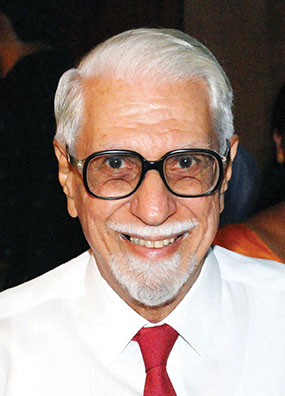
Dr Sheryar Ookerjee
"Three things mattered to him: philosophy, teaching and Wilson College. He was fiercely independent in his thinking and seldom surrendered his right to disagree,” acknowledged principal of Wilson College, V. J. Sirwaiya. "His department became famous in philosophical circles.” He also gave Ookerjee credit for heading the Debating Club and editing the "Wilsonian magazine, a testimony of his writing skills…The staff room would witness vibrant teaching debates.”
He may have taught philosophy for over six decades but he believed that a teacher has to come well prepared for every class otherwise the teaching becomes stale. "The Department of Philosophy at the Bombay University has only completed 25 years but Ookerjee’s association with the University was longer than that,” stated Dr Shubhada Joshi who currently heads the department at the University and referred to him as being "regular, punctual, meticulous” and ever keen to learn more. "I would wonder at his enthusiasm at his age,” stated Joshi at the memorial meet.
"He believed in completing every task he undertook, however difficult” it turned out, stated Dr Kanchana Mahadevan, professor of philosophy at the University of Mumbai. When the Bombay University and College Teachers Union was formed that was anathema to the management "he gave us support, gave us prestige,” recalled Prof K. K. Thekedath appreciating that Ookerjee had convened a meeting at his residence to raise funds for Thekedath who had been imprisoned during the Emergency imposed by Prime Minister Indira Gandhi.
His wit and wisdom were attested by several other speakers as also his "strong sense of ethics.” Commenting on the "passing away of the polymath… always evolving in his thinking,” Yogesh Kamdar, joint director of Bharatiya Vidya Bhavan referred to Ookerji as being "very curt, very direct… He was one-handed. There was nothing like ‘on the other hand’ for him.”
A member of the governing body of the K. R. Cama Oriental Institute, "He brought academic rigor and distinction to his position at the Institute and always discharged his duties effectively,” noted a communiqué from the Institute. He was a member of the Asiatic Society of Bombay for almost 70 years.
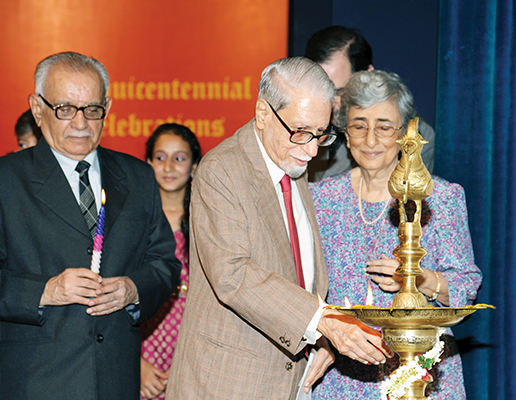
Dr Sheryar Ookerjee flanked by Prof Khurshed Sheriar and Keti Mehta at the
sesquicentennial celebrations of The Alexandra Girls’ English Institution
In 2009 at the launch of his book Human reason and its enemies: A rigorous critique of postmodernism, Ookerjee had humorously commented, "At 84, I’m writing a book for the first time,” wondering aloud whether it was "a result of senility” (see Books, Parsiana, June 7, 2009). Although suffering from multiple myeloma (malignant tumors that develop in several places at the same time) for the last five years, he published in 2011 his next work, Plato and the Arthasastra: Plato’s Political Philosophy and Indian Political Thought. This was a subject he had analyzed when he was appointed University Grants Commission scholar after his retirement from Wilson College in 1985. Yet another compilation was titled, The Limits of Reason and Other Essays. His last book, Altamont Road and Other True Stories that carries amusing anecdotes from his life will be released this year.
Principal of The Alexandra Girls’ English Institution Freny Mehta described their chairman Ookerjee as "a true educationist, he led the school with his vision and leadership.” At the memorial meeting held at the Alexandra school on December 16, Mehta had made a Power Point presentation to highlight his presence at milestone events in recent times, whether it be at the inauguration of the school’s gymnasium when at the age of 83 he was willing to try the exercycle (a stationary bicycle) and treadmill or when he, as the great-grandson of the founder of the school Manockjee Cursetjee, received Prince Michael, the great-grandson of Princess Alexandra after whom the school is named. Mehta’s poetic tribute to "Sir” under whom she had studied came to a close with the lines, "For almost two decades chairman on the Alexandrian board/ The well-being of staff and students he sought/ A father-figure he was to us all/ Our backbone, that made us stand up tall./ An upright gentleman with old world charm/ A principled human being, yet very humble, kind and calm.”
Ookerjee’s own schooling was at the Cathedral and John Connon School after which he joined Wilson College in 1942 as a student and became a teacher there in 1949. His wife Amy taught English at the same College. The subject of his PhD thesis was "F. H. Bradley’s Approach to Logic.” The professor who took pride "in professing my beliefs and leading a life accordingly,” would get "enraged at any hint of corruption,” recalled his step-daughter Pervin Mahoney quoting his advice, "If you cannot do it ethically or legally, don’t do it.” Whilst he may have inadvertently jumped traffic signals he took pride in never having paid a bribe. "He was never a domineering father. There was always music playing in the house. Books were always open and discussed,” stated Pervin. Her husband Sean appreciated that in the 45 years he had known Sheryar he had "never heard him criticize anyone.” He was insistent that the In Memoriam write-up in Parsiana should "not be an obituary but a celebration of a good life exceedingly well lived.”
"He believed in a life force, but not a personal god,” clarified Pervin. The rationalist wore the sudreh because he considered it "a comfortable undergarment” but he neither felt the need for a kusti nor prayers. The Chandanwadi electric crematorium saw a large turnout of friends and admirers when instead of prayers, his colleagues from the education fraternity, friends and admirers recited verses and passages from philosophical texts as western classical music played in the background.
Known to have a sharp ear for music he had served as music critic, was a pianist and at the age of 50 became a self taught organ player who for several years gave organ accompaniment at the chapel and All Saints Church. The Bombay Chamber Orchestra was permitted early morning rehearsal facilities at the Alexandra school thanks to him, acknowledged his colleague from the music circle Bomi Billimoria. He remembered Ookerjee’s love for music bringing him to the weekly recorded music sessions of the Gramophone Society in the 1960s.
.JPG)
Ookerjee’s admirers at the Wilson College memorial meet
His art sketches that he sent as New Year greetings are now the prized possessions of family and friends. With his love for chocolates, interest in sailing, photography, botany and gardening, visiting the verdant environs of Khandala and Matheran, and enjoyment of Charlie Chaplin’s silent films, the raconteur was known for his versatile tastes.
One of his endearing loves was his ramshackle Fiat car. His colleague Prof Sheshadri referred to one of Ookerjee’s trips to Wilson College when he erroneously presumed that his senior had forgotten his walking stick in the car but learnt later that it was a security device installed in his jalopy, making Sheshadri marvel at his "typical bawa intelligence!”
Even when he was in hospital a month prior to his demise, the popular professor was sought by students who needed help with their PhD thesis, job applications. He was "one man who had defied Shakespeare’s seven stages of man,” commented senior counsel Navroz Seervai at the memorial meeting, reminded of the impression the family friend made of being "ageless, dapper, immaculately dressed, fit as a fiddle. I called him the Peter Pan of Bombay.” Seervai further described him as a "Renaissance man who wore his monumental scholarship lightly... Humble and unassuming to a fault, he hated trappings of pomp and show.”
As Ookerjee is known to have confirmed, "I don’t feel old because I have always been in the company of young people.”
The inspirational intellectual is survived by his step-daughter Pervin Sean Mahoney.
◆ ◆ ◆
From the archive