
Books
Evoking an extinct era
"A large part of this book is autobiographical but it is not an autobiography… It deals with parents, grandparents and time spent amidst his relatives,” stated senior counsel Navroz H. Seervai of the Bombay High Court as he released Altamont Road And Other True Stories by the late Prof Dr Sheryar Ookerjee at The K. R. Cama Oriental Institute (KRCOI) on April 28, 2014. Seervai lamented that it was "a world entirely disappeared just like the bungalow he (Ookerjee) was brought up in where a 14-storied building now stands.” The cover of the book incidentally is a sketch of this bungalow, illustrated by the writer. Ookerjee’s talents were not restricted to writing and sketching only, he was a former head of the department of philosophy at Wilson College, played the piano, the pump organ and was a western classical music critic for leading newspapers, in an era gone-by.
Seervai reminisced "how Sheryar narrated incidents of the wild and mild tempers of his family.” The corporate, constitutional and environmental lawyer recounted how he had heard tales of two reputed surgeons several times. Stories about the late Drs Hormasji Masina and Rustom Cooper who were family friends are quoted in the book — both surgeons with razor sharp tempers. Masina packed off his good friend and patient Cursetjee (Ookerjee’s maternal grandfather) home the very next day after an operation for disobeying his medical instructions.
Seervai reminisced "how Sheryar narrated incidents of the wild and mild tempers of his family.” The corporate, constitutional and environmental lawyer recounted how he had heard tales of two reputed surgeons several times. Stories about the late Drs Hormasji Masina and Rustom Cooper who were family friends are quoted in the book — both surgeons with razor sharp tempers. Masina packed off his good friend and patient Cursetjee (Ookerjee’s maternal grandfather) home the very next day after an operation for disobeying his medical instructions.
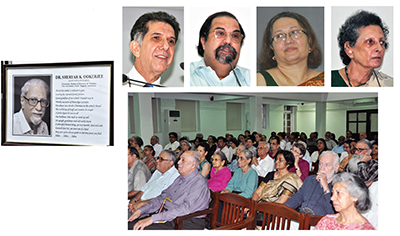
Clockwise from above left: Frame of Dr Sheryar Ookerjee; Navroz Seervai; Muncherji Cama;
Dr Shehernaz Nalwalla; Dr Nawaz Mody; members of the audience
The book launched posthumously was the academician’s fourth. Among those who were present were Ookerjee’s stepdaughter Pervin, her husband Sean Mahoney, "family, friends and those like family” (as well as admirers of the professor). Seervai added that this book was in stark contrast to the other three as Ookerjee had "let his hair down in writing a leisurely, light-hearted, amusing narrative in his inimitable and humorous style.”
Muncherji Cama, president of KRCOI mentioned in his welcome how Seervai, who is normally low profile and hesitates to talk at functions, agreed readily "and was so delighted that even before finishing the invitation, Navroz accepted.” Seervai’s delight seems to have sprung from the 70 years’ association of the two families from 1942 onwards. It continues with his son Riyad. Ookerjee was the upholder of ethics, which he also taught. Cama stated: "If it was not right, it was wrong — there were no half rights and half wrongs.”
Dr Nawaz Mody, joint honorary secretary of KRCOI gave the vote of thanks and recalled how she used to interact with the scholar in creating courses for human rights and how he was a member of research on the KRCOI governing body, guiding students who approached him at the Institute. She specially thanked the Institute’s librarian, Shobha Sahastrabudhe for all her hard work in readying the manuscript.
The book is the outcome of Cama’s urgings to Ookerjee, the raconteur. To recount family tales, as the author mentions in the preface, "The original plan was to write about the Cursetjees (among whom I was born). Family of course includes (as Gilbert and Sullivan state in their comic opera H. M. S. Pinafore), a man’s sisters and his cousins and his aunts, also his brothers and his uncles and their sisters, brothers, cousins, aunts and uncles.” There are also some stories about Cama’s own family woven into the narrative, it was mentioned.
Seervai remembered a story his father recounted of how Ookerjee was dispatched to the Bombay airport by his anxious wife, the late Amy, to see the lay of the land as stepdaughter Pervin was flying abroad for the first time ever. While he was diligently doing the recce as instructed, he bumped into a friend who showed surprise at the professor being there. When explained what his mission was, the friend added to the family’s existing trepidation with "glassy eyes and slow delivery to state ‘tell Amy we all have to die one day.’”
Seervai lamented how when the professor knew he had cancer he told Seervai not to inform Riyad who was leaving for further studies abroad. The son’s fondness for the philosopher-musician with whom he parleyed regularly on these two subjects and several other topics would have made it that much harder for the departing student. The lawyer, sharing an interest in western classical music with the professor, narrated how through his sessions of chemotherapy the bon vivant continued to attend concerts, went to the Mumbai University at Kalina, met friends even at age 83, and was actively involved as chairman of the Alexandra Girls’ English Institution founded by his mamavaji (great-grandfather) Manockjee Cursetjee 150 years ago. He also remained mentor to several students of philosophy, especially at the Wilson College, where he ended up as vice principal.
When Ookerjee realized that Riyad now knew about his disease he told him at their next meeting, "So your Peter Pan is not going to be young for long.” And he was right.
MEHROO KOTVAL
On the street where he lived
Altamont Road And Other True Stories by Sheryar Ookerjee. Published in 2014 by The K. R. Cama Oriental Institute, 136 Bombay Samachar Marg, opposite Lion Gate, Fort, Bombay 400023. Pp: 107. Price: Not mentioned.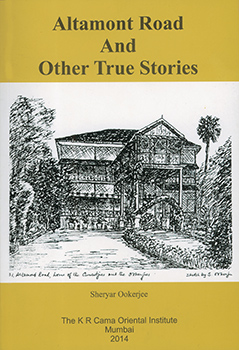
Altamont Road And Other True Stories by Sheryar Ookerjee. Published in 2014 by The K. R. Cama Oriental Institute, 136 Bombay Samachar Marg, opposite Lion Gate, Fort, Bombay 400023. Pp: 107. Price: Not mentioned.
If one could use the word "charming” without it sounding condescending, lightweight or trivial, it would be the word most appropriate to describe Sheryar Ookerjee’s Altamont Road And Other True Stories. The book has been handsomely published by The K. R. Cama Oriental Institute who, in their quiet and unobtrusive manner, have been producing several worthwhile books of Parsi interest over the years. The book is appropriately illustrated with photographs of several members of the family; there is a particularly colorful one of a pair of artistic cufflinks presented to Manokjee Cursetjee, Ookerjee’s great grandfather, by Empress Eugénie, wife of Napolean III of France. This is accompanied by fascinating handwritten as well as typewritten documents which explain the provenance and the authenticity of the same. The cover page has a loving sketch by the author himself of 31 Altamont Road, the home of the Cursetjees and the Ookerjees purchased in 1907 from a Portuguese family for Rs 60,000.
Family memories, like endless wedding photographs (and now DVDs), are often of interest only to the family itself and when one is forced to read anecdotes about people we do not know or have never met, the result is, as also in the case of wedding photographs, one of polite boredom. But Ookerjee’s engaging and lively manner of narration, his clear and concise style, and his abundant yet quiet sense of humor make this book a very interesting read. It is of utmost relevance that the title of the memoirs contains the words "True Stories,” else the reader would have found it difficult to believe that there are such an overwhelming number of eccentric characters in a dwindling Parsi population.
Family memories, like endless wedding photographs (and now DVDs), are often of interest only to the family itself and when one is forced to read anecdotes about people we do not know or have never met, the result is, as also in the case of wedding photographs, one of polite boredom. But Ookerjee’s engaging and lively manner of narration, his clear and concise style, and his abundant yet quiet sense of humor make this book a very interesting read. It is of utmost relevance that the title of the memoirs contains the words "True Stories,” else the reader would have found it difficult to believe that there are such an overwhelming number of eccentric characters in a dwindling Parsi population.
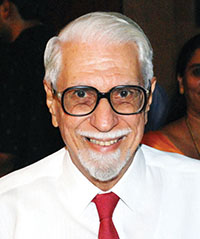
Dr Sheryar Ookerjee: author and raconteur
One of the outstanding qualities of the Parsi community is the ability to laugh at itself and there are several amusing incidents to support this trait. A wealthy Parsi asked Ookerjee’s grandfather to suggest a statue for his garden. Cursetjee thought that a copy of the Venus de Milo would be suitable. When the statue was installed and unveiled, the friend was red with anger as he thought he had been shortchanged and sent a "broken piece.” Another amusing incident recounted is of Pestonjee Wadia, a family friend, who had to visit the Towers of Silence for a funeral. Unable to recognize any of the family members, Pestonji strode from the verandah where he was sitting and made his way to the hall where the ceremony was about to begin. He peered at the corpse and in a loud voice summoned his wife saying, "This is somebody else; come, let’s go home.”
The eccentricities and the amusing anecdotes are not confined to the Parsis alone. There is the account of an Englishman who had been advised by his doctor to have donkey’s milk. He was distressed to see his "bearer” bringing a male donkey and instructed him that he did not want a donkey like himself but "I want a donkey like memsahib!” There is also an amusing account of a visit Ookerjee’s grandfather, a judge of the Small Causes Court, paid to Thomas Chisholm Anstey, a barrister and judge of the Bombay High Court. The Englishman was in bed covered up with blankets; it was not that he was unwell, but because both his suits had been sent to the dhobi.
Of particular interest is Ookerjee’s description of Altamont Road as it was during his childhood. The road was named "Altamont” and not "Altamount” as it is commonly referred to today. The chirping of sparrows, the shrill cries of kites, the tinkle of the donkey’s bell, the cries of vendors selling old shoes ("Na-boo”) and the one selling bamboo blinds ("Chickwalla memsahib”) have given way to "a symphony of horns ten times louder than music composer Gustav Mahler’s brass.” Ookerjee skillfully brings alive the street cries by etching a memorable image of the seller of doodh na puffs with the "‘puff’ echoed at a lower pitch” and the shrill voice of the woman selling vessels "as if in competition with a budding soprano practising her scales.” Most of the houses have given way to blocks of flats but it is consoling to know that the house of the general manager of the Western Railway built in 1928 still holds its ground. One of the photographs in the book is that of a solitary car parked outside the Ookerjee house in 1954. This has now been substituted by an "unbroken chain” of vehicles parked on both sides of a relatively narrow road. Though a few of the original houses do remain they are dwarfed by skyscrapers and "at the top of the hill stands Antilla, the Ambani abode, said to be the costliest private house in the world, incomprehensible in its architectural design…”
FIRDAUS GANDAVIA
The eccentricities and the amusing anecdotes are not confined to the Parsis alone. There is the account of an Englishman who had been advised by his doctor to have donkey’s milk. He was distressed to see his "bearer” bringing a male donkey and instructed him that he did not want a donkey like himself but "I want a donkey like memsahib!” There is also an amusing account of a visit Ookerjee’s grandfather, a judge of the Small Causes Court, paid to Thomas Chisholm Anstey, a barrister and judge of the Bombay High Court. The Englishman was in bed covered up with blankets; it was not that he was unwell, but because both his suits had been sent to the dhobi.
Of particular interest is Ookerjee’s description of Altamont Road as it was during his childhood. The road was named "Altamont” and not "Altamount” as it is commonly referred to today. The chirping of sparrows, the shrill cries of kites, the tinkle of the donkey’s bell, the cries of vendors selling old shoes ("Na-boo”) and the one selling bamboo blinds ("Chickwalla memsahib”) have given way to "a symphony of horns ten times louder than music composer Gustav Mahler’s brass.” Ookerjee skillfully brings alive the street cries by etching a memorable image of the seller of doodh na puffs with the "‘puff’ echoed at a lower pitch” and the shrill voice of the woman selling vessels "as if in competition with a budding soprano practising her scales.” Most of the houses have given way to blocks of flats but it is consoling to know that the house of the general manager of the Western Railway built in 1928 still holds its ground. One of the photographs in the book is that of a solitary car parked outside the Ookerjee house in 1954. This has now been substituted by an "unbroken chain” of vehicles parked on both sides of a relatively narrow road. Though a few of the original houses do remain they are dwarfed by skyscrapers and "at the top of the hill stands Antilla, the Ambani abode, said to be the costliest private house in the world, incomprehensible in its architectural design…”
FIRDAUS GANDAVIA
◆ ◆ ◆
From the archive