
Books
A sane philosophy
Dr Sheryar Ookerjee’s book emphasizes the importance of reason and scientific discourse
"We may have loved Plato but (Dr) Sheryar Ookerjee encouraged us to love philosophy more,” said Shehernaz R. Nalwalla, a professor at Wilson College (WC) referring to the 84-year-old former WC professor of philosophy. The occasion was the release of a book on March 14, 2009 at the refurbished Wilson College Hall written by Ookerjee, Human reason and its enemies: A rigorous critique of postmodernism and published by Promilla and Company in association with Bibliophile South Asia.
"For over six decades he added value to the College,” said WC principal, Dr V. J. Sirwaiya. "He brought excellence to his department.” Ookerjee headed the College’s debating society and when he edited the College magazine, it was "the best” in its genre, he added.
Dr P. Jetli from the department of philosophy, Bombay University described Ookerjee as "the most active philosopher in Bombay.”
Former municipal commissioner of Bombay S. S. Tinaiker recalled Ookerjee counseling his students to "ask questions. Don’t pretend to be wise.” Tinaiker remembered visits to Ookerjee’s bungalow on Altamount Road where he and fellow students were treated to western classical music records. Ookerjee "gave scholarship but he did not (give) any time limit,” said Tinaiker. He was always available for his students. "People in power don’t like to be asked questions but the Wilson College (culture) encouraged questions (as they believed) one learns by asking questions.” Ookerjee, he commented in conclusion, is "as handsome now as he was then.”
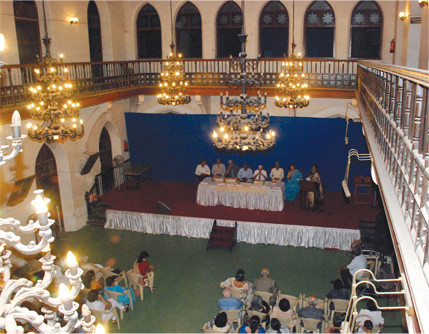
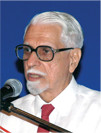
Top: Dr Sheryar Ookerjee. Above: Wilson College Hall
Ookerjee’s book "spares nobody,” said his friend Yogesh Kamdar, chief executive officer of the Indian Cancer Society and vice president of the People’s Union for Civil Liberties. Kamdar spoke of the "one handed man” who in any discussion states "on the other hand… Ookerjee has no ‘other hand.’ (He is) trying to bring in sanity...
"The book is a delight to read,” and dispels postmodernism as "fashionable nonsense,” said Kamdar who along with Dr Aspi Bilimoria, Profs Persis Kathawalla, Shirin Kudchedkar and John Lyle whetted the manuscript prior to publication. The book is priced at Rs 750.
Vice Chancellor of Bombay University Dr Vijay Khole terming Ookerjee "an 84-year-young professor” noted, "(we are) not able to (improve) the quality of teaching because of lack of teachers of quality.”
"It’s difficult to find teachers like Dr Sheryar. Difficult to find people with enough time to sit with students. The University has seed money for teachers to research (subjects) but it remains unutilized. Not enough come forward to ask for it.” He requested Ookerjee be associated with the University as an adjunct professor. "Come once a week to interact with students,” suggested Khole.
Dr Aroon Tikekar, president of the Asiatic Society of Bombay who released the book at the function said it was "an honor for a student to release his teacher’s book.” He recalled Ookerjee "never minced words… he carried his scholarship very lightly.”
He noted the book manuscript did not require any change, "Not even grammar. The manuscript was ready with him.” It is the first of 10 books to be published in a series, said Tikekar.
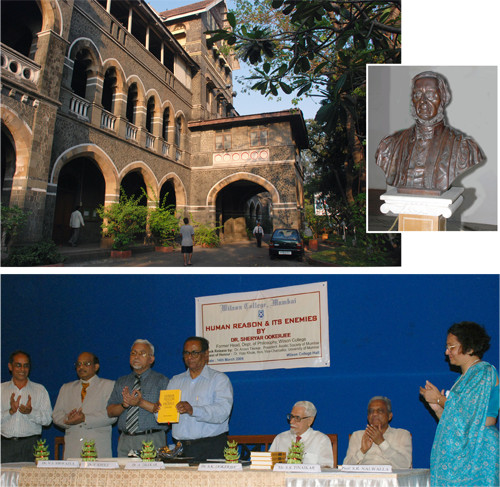
Top: Wilson College and bust of Rev John Wilson. Above (from left): Yogesh Kamdar, Dr V. J. Sirwaiya, Dr Vijay Khole, Dr Aroon Tikekar, Dr Sheryar Ookerjee, S. S. Tinaiker and Shehernaz Nalwalla
Three choices
"At 84 I’m writing a book for the first time,” confessed Ookerjee wondering whether it was "a result of senility.” He said there were three things he never regretted in life "his choice of college (Wilson), choice of subject (philosophy) and choice of profession (teaching). If I had to live my life again I would make the same choices. In Wilson College I enjoyed complete freedom as a teacher and as a student.”
His book is "the result of a two-year research project under a National Fellowship of the Indian Council of Philosophic Research,” notes the 370-page tome’s inner jacket.
Dr G. N. Lawande, head of the philosophy department, was an "eccentric man — unsystematic. (He) put forward ideas and asked students to contradict him… he always wanted us to write.” Lawande was demoted and "I was made to jump into that position, probably the youngest head ever.”
Some people dubbed WC "a Christian college (but) no one ever told us you cannot criticize Christianity,” said Ookerjee. Having spent half his life in WC Ookerjee termed his stint there as "one long piece of great happiness.”
Ookerjee joined WC in 1942 as a student and became a teacher in 1949. He retired in 1985. "Thereafter as a UGC (University Grants Commission) scholar he worked on the political thought of Plato and the Arthasastra (the ancient Indian philosophy by Kautilya). His PhD thesis was entitled ‘F. H. Braillye’s Approach to Logic,’” notes the book jacket.
Referring to his book Ookerjee said, "I chose the subject because I was perturbed that young people are terribly fascinated by postmodernism. It’s a disturbing trend. (People are) running away from… basic problems… postmodernism is basically the view that different cultures have their own view of truth.”
He cited the notion that spirits live in trees. "It is a false proposition” but in Africa certain tribes believe it to be so. People argue "what right do we have to pass judgment on different cultures… you cannot compare one culture with another.” They believe in "an alternative system of truth.” Scientifically it is not tenable. Postmodernists "have a love-hate relationship with science,” notes the professor.
Ookerjee noted he had envisioned the book launch as a "small, homely function… it snowballed into something huge… fantastic. I can hardly recognize myself. I thought I was a particularly nasty kind of fellow. I’m happy to know it is not so.”
Offering a vote of thanks Harsha Batker, head of the philosophy department at WC, said that if she was asked "three things I would never regret in my life, all three would be the same as yours.”
◆ ◆ ◆
From the archive