
Books
Two thinkers
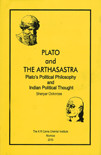
When Dr Sheryar Ookerjee decided to write another book on the 5th century Greek philosopher Plato, he was questioned, "Why Plato? Indian philosophers are not written about.” So the former head of the philosophy department at Wilson College and the Bombay Philosophical Society thought "Why not a book on Plato and Kautilya (or Chanakya as the author of Arthasastra is widely known)? Thus under the auspices of The K. R. Cama Oriental Institute (KRCOI) Plato and the Arthasastra: Plato’s political philosophy and Indian political thought was released on January 20, 2011 by Prof Richard Sorabji at the Institute’s Dr Sir J. J. Modi Memorial Hall.
Noting the book "is on philosophy, not history,” Ookerjee stated it was "a comparative study between these two thinkers.” Plato who grew up in turbulent times focuses "on what an ideal state ought to be. He describes the situation as is happens.” Indian philosophers derive inspiration from religious texts and refer to earlier philosophers. There is also mention of the tension between the powers of the king and the clergy. "Not so in Plato,” mentioned the author. But "in his old age Plato was keen about religion. He advocated severe punishment, even death for non-believers.”
Kautilya wrote the Arthasastra, the science and art of politics, in the 4th century. "Indian political thought is ultimately derived from and sanctioned by the Vedas and by dharma,” stated Ookerjee. "As such it is very different from Plato’s political philosophy… Even if the state visualized (in his Laws) is a theocratic one, there is nothing to suggest that he derived his political theories from Greek religion.”
Sorabji, who KRCOI president Muncherji Cama mentioned was the president of the Aristotle Society and a nephew of Cornelia Sorabji, the first woman graduate, stated he knew "nothing about Kautilya” till he read Ookerjee’s book. He noted that Kautilya "favored the interest of the ruler over dharma. Manu, the law giver, stressed the demands of dharma.”
In Plato’s ideal state, "laws will rule. The primary aim of the state is to make people good,” said Sorabji, an honorary fellow of Wolfsan College, University of Oxford. Aristotle believed "judges should be given discretion in applying laws.” He and Plato asked "what is the best constitution” for governing a country? Socrates emboldened his students to ask questions. He "encouraged people to be skeptical about what politicians do.” For this he was sentenced to death. For Jesus Christ, obeying laws was not enough, explained the professor. He referred to the rich man who gives away his wealth in order to seek salvation.
KRCOI honorary secretary Dr Nawaz Mody thanked Prof Shehernaz Nalwalla for managing to get Sorabji to launch the book as he was in town for only a few days.
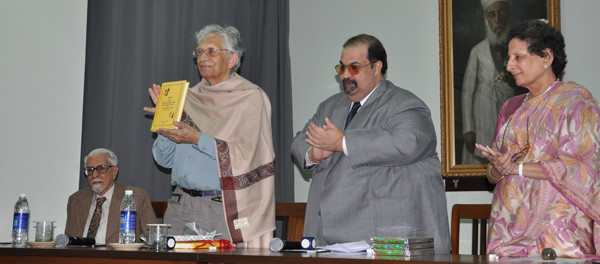
From l: Dr Sheryar Ookerjee, Prof Richard Sorabji, Muncherji Cama and Dr Nawaz Mody
The craft of kingship
Plato and the Arthasastra: Plato’s Political Philosophy and Indian Political Thought by Sheryar Ookerjee. Published in 2010 by The K. R. Cama Oriental Institute, 136, Bombay Samachar Marg, Bombay 400001. Pp: 248. Price: Not mentioned.
The study of Plato’s political philosophy and ancient Indian political thought is fascinating as it unravels richness of political thinking of earlier times and brings to the surface the yearning of philosophers and statesmen for better life of the people. Here one can find rules of administration and the norms of government and can also discern soaring idealism and stark realism. Dr Sheryar Ookerjee’s book under review is a thought provoking comparative study of Plato and the Arthasastra.
There may appear to be similarities between Plato’s political philosophy and ancient Indian thought. City states were present in both the countries. Further, against the prevalent idea of the divine origin of the state and kingship, the Buddhists in India had speculated about a fall from an ideal ‘state of nature’ and kingship by contract. This posed a challenge to the orthodox view just as the teaching of the Sophists threatened the traditional ideas of morality and religion. There are, however, some differences between Plato’s political philosophy and ancient Indian political thought. Ookerjee shows these throughout the book in a logical way.
The author points out that the main factors responsible for provoking Plato to think about political problems were: the engagement of the Greek states in wars, the upsurge of intellectual inquiry and skepticism of science, the rise of democracy and emergence of the Sophists and the decline of the city state. The political thought of ancient India arose under different conditions. In ancient India, as in Greece, a large number of small states existed. They, however, slowly grew bigger and most of them lived under great tension because of pulls in opposite directions. This situation is likely to have fostered the growth of Arthasastra — the science and art of politics. Moreover, it is important to note that Plato’s Republic owed nothing to any earlier thinking nor was it a sort of digest or reformed version of earlier philosophizing on the subject. In contrast, Kautilya’s Arthasastra is based on previous codes and texts. He frequently contests earlier views and offers his solutions.
Although Plato is fully aware of the circumstances in Athens and other city states, his writings are normative in character. Observing the defects and shortcomings that he found in the state of things around him made him work out his political theories in order to reform and rectify what actually prevailed in his time. One cannot say this about Indian writings. The line between what was or is and what ought to be, between the positive and the normative, is often not clear. There is no suggestion of a drastic change in the political set-up, no blueprint of an ideal state quite different from the actual one, no sweeping conceptual alterations.
Ancient Indian political thought assumes the monarchical state as the only kind of state worth considering and discusses the origin, status, qualities, functions and duties of the king, identifying him with the state. In Republic and Statesman, Plato also developed his political theories only in terms of monarchy. In Republic there are the philosopher kings. In Statesman he talks even more emphatically of an ideal king. But Plato’s views differ from the Indian view in two respects. He is dissatisfied with the forms of governments which had existed and had the experience of both the tyrannical and the democratic forms. Hence he is visualizing a form of government radically different from those which have ever existed unlike the Arthasastra author giving a refined version for the actually existing monarchies. The efforts of the Indian writers may be called ‘piecemeal engineering’ while Plato’s may, by contrast, be called ‘utopian.’
Dr Sheryar Ookerjee "philosophy, not history
Secondly, Plato’s kings are different from the Arthasastra kings in two respects. They are men (and, in Republic, women) who have not only studied some philosophy, as the Arthasastra kings are also expected to have done, but have "really and truly become philosophers.” They do not aim at doing what is "pleasing to the people;” they do what is best for the people. In Statesman, the king is to act according to the principles of the science of statecraft. Plato attempts a definition of the statesman and explores the nature of the knowledge of statesmanship. The political work of Plato’s that is closest to the ancient Indian political thought is Laws. Plato’s idea that the ruler should be a shepherd is similar to the oft-repeated idea of the king’s duty of protection in Arthasastra.
The author argues persuasively that despite this apparent similarity between Plato and the Indian thinkers there is a deeper dissimilarity: for Plato, the skill required in governing is not a fine art of balancing with its innuendo of intrigue and deception. According to Ookerjee there are highly romanticized expressions in ancient Indian political thought about the pivotal position of the king in his role of protector of his kingdom and his subjects and the inflictor of just punishment. There is a distinct Machiavellian creed in the Arthasastra: in Kautilya there is sacrifice of the principles of morality in the service of expediency. Kautilya gives details of the spies, secret servants, and their working. Mahabharata and Manu too have not outgrown the cult of expediency. The Arthasastra commentators write about treachery, intrigue and ruthless expediency in place of morality. As against this, Plato’s stance is completely moral.
According to the Arthasastra, the king is to be a paragon of intellectual and moral attributes and yet is to have some serpentine and foxy qualities. Much moral advice is often linked with some question of expediency, which not only robs it of real moral worth but also shows that these thinkers do not always keep their eye on the real problem of political philosophy, namely, what a king should be and do in his capacity as a king. For Plato, virtue is very important and so is his prescription for education.
A detailed examination reveals divergences. In Hindu political thought, the duty of protection is divinely ordained, while there is no such idea in Plato. The Arthasastra accounts, Manu and Mahabharata stressed the divinity of the king. For Plato, the rulers are chosen. They do not derive their power from the priests. According to Hindu thought, a ruler who pleases his people pleases himself and vice versa. His failure causes large-scale social disasters and even economic disturbances. There is nothing like this in Plato. The ruler does his duty because he is like any other expert put on the job, and expected to do his duty which is ruling. Doing his work well is his reward.
The Arthasastra commentators accept without question the existing goals of statecraft — aggrandizement of territory, increasing the treasury (by fair and foul means), making treaties, and indulging in every form of expediency — and only indicate crafty and subtle means of achieving them. Plato rejects the presently accepted political claims. He penetrates right down and opens up the whole question about the essential nature of society and the state. He reconstructs the state — rather, constructs an ideal state — from the basic elements. He is deeply concerned about preservation of stability and harmony in the state. His approach is different from that of the Hindu thinkers. Governing is a matter of justice and self-restraint, not of wealth and ambition. Plato is overly concerned about procuring the welfare of his citizens; and in doing so, he tends to overstep his limits as a lawgiver and becomes harsh in his methods.
The author examines the concept of a totalitarian set-up. He does not think that the Indian polity as pictured in the Arthasastra can, strictly speaking, be called totalitarian. With Plato the matter is more complex. Plato oversteps the boundary between law and morality. He seems unaware that, although the spheres of law and morality do intersect at a good many places, a large part of morality falls entirely outside the scope of law. The author cleverly examines what totalitarianism is and leaves it to the reader to decide whether Plato is a totalitarian or not.
This book is important, as it helps us in the formidable task of comparing Plato and ancient Indian thought. It draws our attention to the need to rethink the basic principles of ruling and the qualities of the rulers. Weaving the pattern of arguments with the threads of theoretical precepts, the book encourages the reader to a comparative study of the two important and distinctive political ideologies. The author has quoted from Plato’s writings. Quotations from the original texts of ancient Indian thought would have enhanced the importance of the book. The book will prove to be useful for students, scholars and all those interested in the basics of political philosophy.
USHA THAKKAR
◆ ◆ ◆
From the archive