
Cover Story
Enriched by the exhibition
The seven-week exhibition at the National Gallery of Modern Art familiarizes the public with the Parsi contribution in the last three centuries
Moving in pairs, students from The Sir J. J. Parsi Benevolent Institution were making the rounds of the four-tiered Sir Cowasji Jehangir Public Hall at the National Gallery of Modern Art (NGMA). They had been brought to view the exhibition "Across Oceans and Flowing Silks: From Canton to Bombay 18th-20th centuries” that was inaugurated on December 26, 2013 and will be open to the public until February 13, 2014. Portraits and bust of the founder of their institution, Sir Jamsetjee Jejeebhoy, first baronet, that may otherwise be overlooked on the school premises, acquired a new meaning when seen in the visual context of how he and other notable Parsis acquired their wealth and used it wisely for the common good.
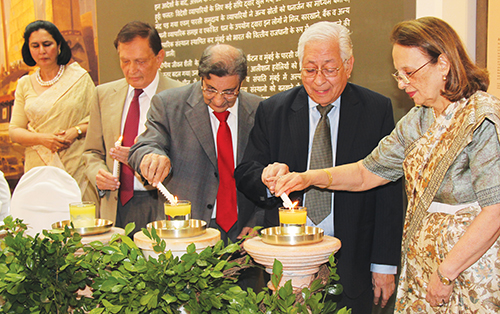
Firoza Punthakey Mistree, Dr Farokh Udwadia, Dr Cyrus Poonawalla,
Soli Sorabjee and Pheroza Godrej
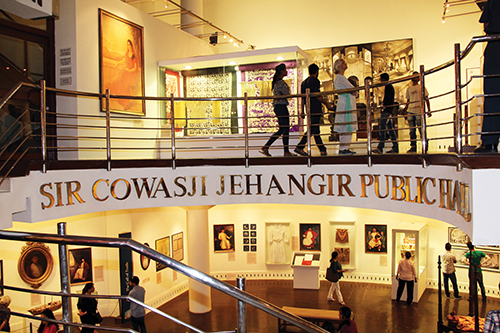
"Of Grandeur and Splendour" on the upper level
Conceived as a project to coincide with the 10th World Zoroastrian Congress (10WZC) that was held in Bombay in December 2013, the community’s trading, shipbuilding, banking and nation building activities have been brought to the fore through this exhibition curated by Pheroza J. Godrej and Firoza Punthakey Mistree. As explained by them in the 388-page vision book cum catalog, designed, printed and published by Spenta Multimedia, "This exhibition is planned in six sections, each highlighting a vibrant aspect of Parsi history and heritage.” It starts with "Yazd: The Land of Mountains and Pirs” where images of street scenes, the six great pirs or shrines in the city that regularly draw Zoroastrians and the wish-fulfilling sofreh ritual, with an elaborate floor spread, performed by Iranian women to seek blessings of Shah Pari are shown, along with yesteryear worthies, the traditional adobe homes, vestments and utensils.
The next section briefly alludes to "The Shores of a New Homeland – Parsi Arrival” where early Portuguese maps of Hormuz, Dio (Diu), Chaul and Tana (Thana), etchings and photographs show the arrival of Parsis in India and their inroads into Sanjan. From craftsmen and artisans, the community in Surat established itself as ship builders and brokers to the Dutch and English East India Company as explained in the third section on "The Gateway to China Trade.” Of considerable interest on the ground floor is the Tanchoi loom from Benares that took four-and-a-half days to assemble. There are also samples of the prized Tanchoi material woven by master weaver Kaikhushro S. Joshi. This form of Chinese brocade weaving had so impressed Jamsetjee Jejeebhoy that he sent three (tan) brothers from India to learn this art from a Chinese master weaver Choii from whence this weave derives its name.
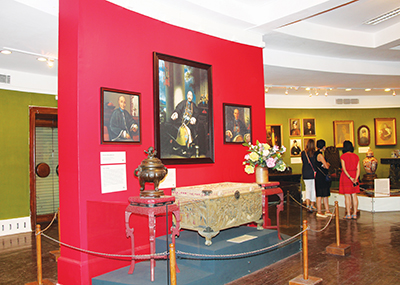
"The Call of Trade" below; (center): "Of Chests, Silks and Unfurled Sails;"
The next section, "The Call of Trade” beckons a visitor to the first floor level where he learns of Lowji Nusserwanji Wadia, a carpenter and shipbuilder from Suwali near Surat, who was invited by the British East India Company to build the docks at Mazgaon and a number of ships that plied between Bombay and Canton. Ship models and the implements used in their construction give an understanding of this growing industry. Another famous member of the Wadia family was the landowner Hormarjee Bomanjee Wadia who built the famous Lowjee Castle in Parel. A stained glass panel from the Lowjee Castle bearing the Wadia family coat of arms inscribed with their motto "Honor and Magnanimity” is on view at the exhibition.
There were many other Parsis too who seized this opportunity to gravitate to Bombay that was becoming a political and economic powerhouse. Sir Cowasji Jehangir Readymoney (a guarantee broker in whose honor was constructed the Hall showcasing this exhibition) came into prominence after he rescued the British during the Maratha Wars and even financed the Hong merchants in Canton. The best known though would be Jamsetjee Jejeebhoy who came from a poverty stricken background and emerged as one of the richest and most influential traders with even an opium clipper named after him that navigated the seas between Bombay and Canton. Images of opium production in India and consumption of the drug in China can best be understood against a detailed tabulation of the "Opium Time Line.” Equally fascinating are the pages from Jejeebhoy’s Trade Diaries that are now in the collection of the University of Mumbai Library.
.JPG)
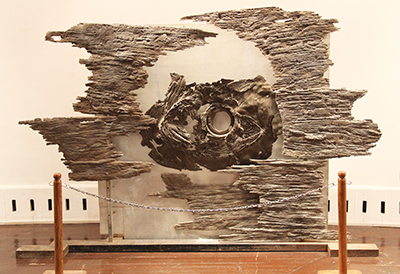
"No Parsi is an Island" and Piloo Pochkhanawala’s "Monsoon"
A major draw in the fifth section "Of Chests, Silks and Unfurled Sails” are the 19th century porcelain pieces that are borrowed from the F. D. Alpaiwalla Museum. Exquisite in shape, hue and design, they filled 20 pages of the catalog. Equally appealing are the Chinese carved chests, storage jars and red lacquer wooden stools. As explained here, "Fast moving clippers brought into China opium, indigo, cotton, salpetre…and a variety of other goods. On their return, the ships carried tea, large quantities of silver which paid for the opium, silks, porcelain and Chinese handicrafts. It was the opium trade that supported the colonial economy and brought untold wealth and social stature to the merchants who traded with China.”
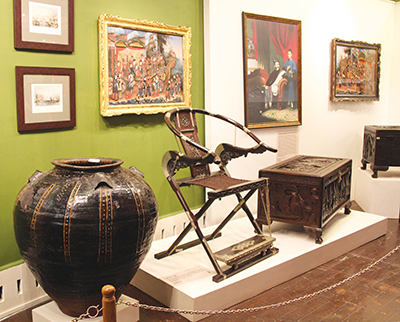
A glimpse into the drawing rooms of Jejeebhoy, Readymoney and Sir Dinshaw Petit, the carved furniture they used, the monogrammed porcelain in which they served their tea, and the glassware and stemware from which they sipped their wine is provided in the section "Of Grandeur and Splendour.” Students of history from St Xavier’s College who had come visiting the exhibition to better understand their paper on "Museums,” were at the second level of the exhibition but were clearly impatient to proceed to the third level to feast their eyes on the opulence in the homestead of renowned Parsis, as also the lavish display of garas, kors, ijars and jhablas with which the community is associated.
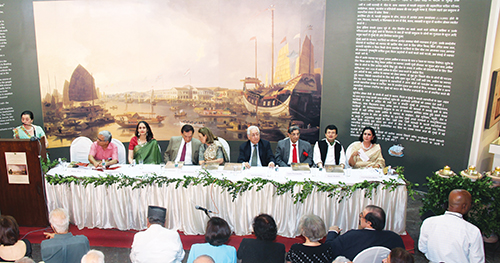
At the inauguration against William and Thomas Daniell’s painting
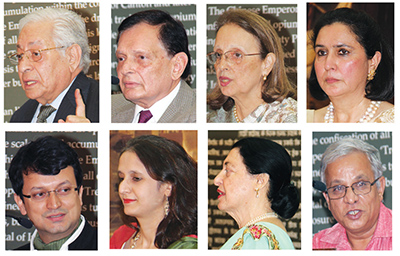
From left: Soli Sorabjee, Dr Farokh Udwadia, Pheroza Godrej, Firoza Punthakey Mistree,
Ranjit Hoskote, Nancy Adajania, Homai Modi and Shivaprasad Khened
This floor also accommodated a section on "Parsi Entrepreneurship and Philanthropy — Shaping a New World.” Amongst those featured here is Jejeebhoy who is known to have established a trust fund which by 1864 was administering 21 schools, had further started an art school, a hospital and even contributed to the construction of roads, wells and bridges. To Dinshaw Petit goes the credit of donating land for establishing the Bai Sakarbai Dinshaw Petit Hospital for Animals and making major donations towards the starting of the Victoria Jubilee Technical Institute as also a leper’s home. Readymoney may be best known in the city for the Cowasji Jehangir Hall but his major contributions were towards the building of the Civil Hospital in Surat, an ophthalmic hospital in Bombay, a civil engineering college in Poona, a lunatic asylum in Hyderabad, Sindh, the Elphinstone College and the University Convocation Hall in Bombay. The patriarch of the Tata enterprise, Jamsetji Tata started the Institute of Science in Bangalore and his vision and philosophy have led to the establishment of other institutions promoting skill building, health care and education.
In the Rotunda of the Cowasji Jehangir Hall lay a visual treat titled "No Parsi is an Island” as a tribute to the Parsi artists from the second half of the 19th century to the present, starting with Pestonji Bomanji who was born in 1851 when India was still governed by the East India Company and ending with Gieve Patel who being born in 1940 was a product of World War II. "Far from remaining anchored within the ethnic and religious harbor of their birth, they have charted vivid, memorable voyages across the ocean of cosmopolitan culture,” state the curators of this section devoted to art, Ranjit Hoskote, Nancy Adajania and Godrej. Besides Bomanji, were Manchershaw Pithawalla and his son Sorab who specialized in portraits, still life and everyday scenes as also Jehangir Lalkaka. From the late colonial to the post colonial period were painters like Shiavax Chavda, Homi Patel and Jehangir Sabavala to sculptors Adi Davierwalla and Piloo Pochkhanawala, weaver Nelly Sethna and filmmakers Jehangir Shapurji (Jean) Bhownagary and Homi Sethna. Thus whilst viewing the canvases of these artists, down a flight of steps one could see a Sethna/Bhownagary film being screened on a television set.
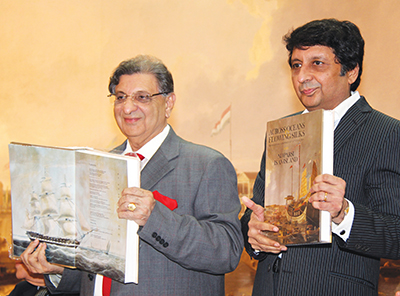
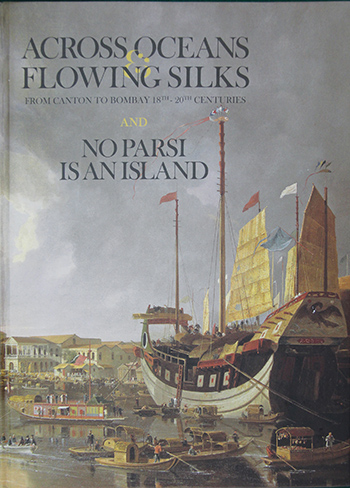
Dr Cyrus Poonawalla and Maneck Davar launch the catalog cum vision book
Besides essays by Ghulam Nadri, Jesse Palsetia, Amitav Ghosh, Tirthankar Roy, Rusheed Wadia, Mariam Dossal and the curators of the exhibition, the vision book carries a foreword by Dr Homi K. Bhabha where he writes of the Parsis, "Layered cultural traces mark the lives and times of a minority community that came from elsewhere and made its home where it found itself, amongst friends and strangers, and from there reached out to make the rest of the world its own.”
Bi-weekly guided tours in English and Marathi in association with the Museum Society of Bombay along with 18 outreach educational and musical programs on the exhibition premises sought to bring alive community contributions.
Daring to dream
"This story is not about religion but people who personify the epitome of resilience,” declared Godrej at the inauguration of the exhibition on the evening of December 26. Whilst master of ceremonies Homai Modi introduced Godrej as one "whose heart and soul has been in this exhibition for over a year,” Mistree gave her credit for "laying out the roadmap and daring to do it on a scale only dreamt of by others.” An exhibition "cannot take place on the shoulders of only one or two. We can only dream...” clarified Godrej before proceeding to name some of those who had contributed to its success including the trustees of the Bombay Parsi Punchayet (BPP) "for giving us an opportunity to put up this show.” Whilst officially the BPP were the co-hosts of the inauguration along with NGMA, it was Dr Cyrus Poonawalla, chairman of the 10WZC, who sat on the dais whilst the trustees of the fractured BPP board sat or stood at different ends of the Hall.
Those who arrived nearly half an hour before the scheduled start had a choice of seats but those who came in the last five minutes or later had to stand throughout the session. In his brief welcome to a "wonderful exhibition,” NGMA director Shivaprasad Khened remarked that they were "not prepared for this turnout” and regretted that the air conditioning "is not enough to cool us.” Hoskote jested that he got an "impression that I am at a navjote.” With 14 artists featured in the "No Parsi is an island” section of the exhibition he believed "the larger destiny of this community will connect with the larger destiny of the world.”
Appreciative of the support rendered by Khened and Chhatrapati Shivaji Maharaj Vastu Sangrahalaya (former Prince of Wales Museum) director-general Sabyasachi Mukherjee who loaned some masterpieces for this exhibition, Godrej further sought to give credit to exhibition designers Suranjana and Vikas Satwalekar, Sangeeta and Bidhan Sen, as also Ratan and Mehli Batliboi and their teams. She mentioned that when looking for chief guests to inaugurate this exhibition there was no dearth of dignitaries and members of the ministry of culture who came to mind. She opted instead to "call members of my own community, stalwarts in their fields but sons of India first:” eminent physician Dr Farokh Udwadia and former attorney general of India Soli Sorabjee.
Tracing the history of the community from the time "the specter of Islam” raised its head in Persia bringing "a band of hardy Zoroastrians” on the west coast of India who adopted the clothes, language and developed their own "fascinating dialect, flowery in more ways than one,” Udwadia progressed to the period when Parsis had trade links with China. He stated he was enjoying his Christmas lunch the previous day when he wondered about the privations and hardships the enterprising Parsis must have endured: "What must they have eaten in those barren areas?” Opium as a soporific and pain reliever had been introduced by the Arabs to China in the seventh century, stated Udwadia. When it started to serve as a passage to "a beautiful dreamland from which you never return,” affecting the administration and military functioning of the country, it was banned but trade continued surreptitiously for there was "as much corruption there as we have here today.”
"This story is not about religion but people who personify the epitome of resilience,” declared Godrej at the inauguration of the exhibition on the evening of December 26. Whilst master of ceremonies Homai Modi introduced Godrej as one "whose heart and soul has been in this exhibition for over a year,” Mistree gave her credit for "laying out the roadmap and daring to do it on a scale only dreamt of by others.” An exhibition "cannot take place on the shoulders of only one or two. We can only dream...” clarified Godrej before proceeding to name some of those who had contributed to its success including the trustees of the Bombay Parsi Punchayet (BPP) "for giving us an opportunity to put up this show.” Whilst officially the BPP were the co-hosts of the inauguration along with NGMA, it was Dr Cyrus Poonawalla, chairman of the 10WZC, who sat on the dais whilst the trustees of the fractured BPP board sat or stood at different ends of the Hall.
Those who arrived nearly half an hour before the scheduled start had a choice of seats but those who came in the last five minutes or later had to stand throughout the session. In his brief welcome to a "wonderful exhibition,” NGMA director Shivaprasad Khened remarked that they were "not prepared for this turnout” and regretted that the air conditioning "is not enough to cool us.” Hoskote jested that he got an "impression that I am at a navjote.” With 14 artists featured in the "No Parsi is an island” section of the exhibition he believed "the larger destiny of this community will connect with the larger destiny of the world.”
Appreciative of the support rendered by Khened and Chhatrapati Shivaji Maharaj Vastu Sangrahalaya (former Prince of Wales Museum) director-general Sabyasachi Mukherjee who loaned some masterpieces for this exhibition, Godrej further sought to give credit to exhibition designers Suranjana and Vikas Satwalekar, Sangeeta and Bidhan Sen, as also Ratan and Mehli Batliboi and their teams. She mentioned that when looking for chief guests to inaugurate this exhibition there was no dearth of dignitaries and members of the ministry of culture who came to mind. She opted instead to "call members of my own community, stalwarts in their fields but sons of India first:” eminent physician Dr Farokh Udwadia and former attorney general of India Soli Sorabjee.
Tracing the history of the community from the time "the specter of Islam” raised its head in Persia bringing "a band of hardy Zoroastrians” on the west coast of India who adopted the clothes, language and developed their own "fascinating dialect, flowery in more ways than one,” Udwadia progressed to the period when Parsis had trade links with China. He stated he was enjoying his Christmas lunch the previous day when he wondered about the privations and hardships the enterprising Parsis must have endured: "What must they have eaten in those barren areas?” Opium as a soporific and pain reliever had been introduced by the Arabs to China in the seventh century, stated Udwadia. When it started to serve as a passage to "a beautiful dreamland from which you never return,” affecting the administration and military functioning of the country, it was banned but trade continued surreptitiously for there was "as much corruption there as we have here today.”
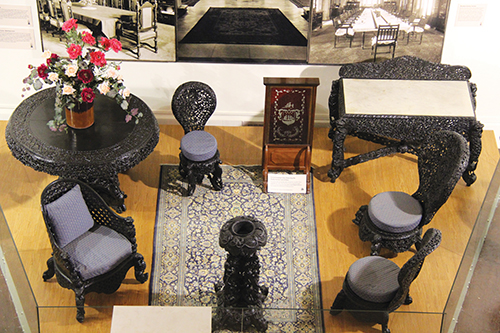
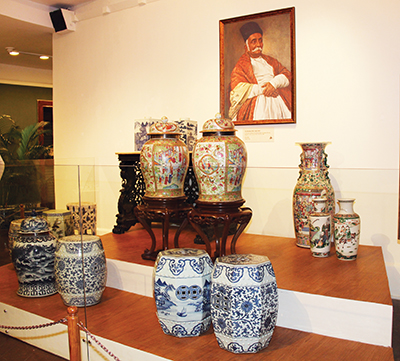
Porcelain vases and carved furniture feature in "Of Grandeur and Splendour"
He then proceeded to recall the philanthropy of yesteryear benefactors who contributed to a "great, glorious chapter in the history of the community” before asking, "Can we live on our past glory? We need to change, break the shackles of ethnicity. Let the winds from outside clear the cobwebs from our brains… The history of religion is in some ways a chronicle of change. If we remain cocooned we may well die. If we change for the better, we may survive or flourish.” The vices mixed up with virtues in the community are being "quarrelsome, cantankerous, short tempered… Genes that were suppressed, pushed into recession are now once again dominant,” he reminded the audience adding, "One of our best points is our humor. We love to laugh at ourselves.” Professing his love for "old artists,” Udwadia declared, "They are the pillars of our society. They see the world as it is not. They are the great forerunners of the future.” He concluded with the words of British poet John Donne: "No man is an island, entire of itself; every man is a piece of the continent, a part of the main;… any man’s death diminishes me, because I am involved in mankind, and therefore never send to know for whom the bell tolls; it tolls for thee.”
"Our numbers have dwindled because of the irrational mindset in certain sections of the society,” asserted Sorabjee who then proceeded to name the achievers in the science, military and industrial fields stating, "our achievements have not dwindled, they have grown.” Being the president of Capital Jazz in Delhi, he wanted the community to know that the famous tenor saxophone player Rudy Cotton is the stage name of Cawas Khatau. He then gave credit to Adi Marzban who "taught us to laugh at ourselves.” According to Sorabjee, "A person without humor has no proportion, no balance.” He reminisced of earlier times when Parsi festivities invariably had "Bhoot nu bhonu and Khodaiji nu band (food catered by Bhoot and music by Khodaiji).”
In Sorabjee’s opinion, "The outstanding quality of the community is its ability to integrate, to adapt… We don’t issue fatwas.” Citing the "geniuses, eccentrics and oddballs in the legal fraternity,” Sorabjee recalled how solicitor Pestonji Parakh was known as ‘dukhiyo (sad),’ Framroze Sukhia as ‘sukhiyo (prosperous)’ and Sir Dinshaw Mulla’s son Kawas as ‘bhukhiyo (ravenous).’ Sir Dinshaw Mulla himself, although a real genius, needed his daily fix of brandy and honey in court and even "made the right facial grimaces” when drinking it trying to give the impression that he was drinking medicine! Yet another Parsi in the legal field insists on keeping his watch 23 minutes fast, then tries to convince himself that it is 20 minutes fast and thus struggles to be in court on time. The identity of the last jurist was ultimately revealed by Sorabjee as "yours truly!”
When copies of the vision book were launched at the hands of Poonawalla, Udwadia and Sorabjee, Godrej acknowledged the efforts of Maneck Davar of Spenta Multimedia for his remarkable cooperation and continued, "The work should speak for itself.” On behalf of the co-curators she declared that what matters is "not where we stand but in what direction we will be moving” and their decision to dedicate this exhibition to "The future… to the children of all communities.” It was befitting therefore that some days later, visitors to the exhibition included the old and the young, and even a babe in arms, sound asleep on the shoulders of his caretaker.
◆ ◆ ◆
From the archive