
Zoroastrians Abroad
Antiquity and authority — III
Relegated as minorities after the Islamic conquest, the struggle to retain the Zoroastrian identity was discussed at the SOAS conference
"There is somebody missing… an elephant is missing,” announced Prof Alan Williams when giving his concluding remarks at the two-day conference on October 11 and 12, 2013 organized by the School of Oriental and African Studies. Revealing the identity of the absentee, Williams added, "I have rarely been to a conference (on Zoroastrianism) where Prof John Hinnells is missing.”
Having just moved residence, with his "papers and files still in storage,” Hinnells had sent a message befitting the theme of the conference "Looking back: Zoroastrian identity formation through recourse to the past.” Hinnells reinforced that "an identity is fashioned by memories (that) aren’t static… Different people have… a prism of memories depending on one’s country of birth, family life… colored by people one mixes with.” He was hopeful the conference would result in not only a "sophisticated” but also a "sensitive study.”
Having just moved residence, with his "papers and files still in storage,” Hinnells had sent a message befitting the theme of the conference "Looking back: Zoroastrian identity formation through recourse to the past.” Hinnells reinforced that "an identity is fashioned by memories (that) aren’t static… Different people have… a prism of memories depending on one’s country of birth, family life… colored by people one mixes with.” He was hopeful the conference would result in not only a "sophisticated” but also a "sensitive study.”
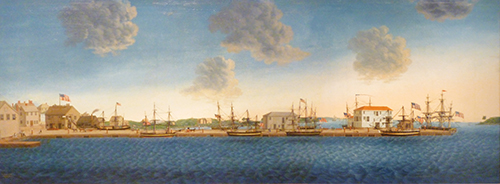
Crowninshields Wharf, Salem, 1805
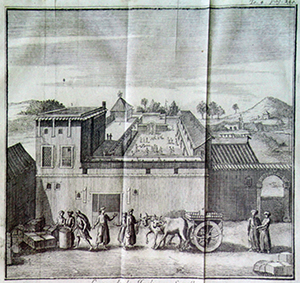
East India Company factory, Surat, 1751
The second day’s deliberations started with a session on "Cross Fertilization of Ideas between Pre-Islamic and Post-Islamic Iran.” Presenting papers on this topic were Albert de Jong who spoke on "The Denkard and the Zoroastrians of Baghdad;” Jamsheed Choksy who referred to "Zoroastrian Goodwill in Medieval Muslim Contexts;” and Dr Ashk Dahlen whose paper was titled "He addressed the Kayanian King: ‘I am a Prophet’ – the Image of Zoroaster in the Shahnameh (Book of Kings).”
Professor of Comparative Religion at the University of Leiden in Netherlands and academic director of Leiden Institute for Religious Studies de Jong’s field of research focuses on the religious history of the Iranian world that includes Zoroastrianism, Mithraism, Manichaeism and Mandaeism. According to him, the existence of Zoroastrians in Baghdad has been overlooked by most scholars although the Denkard is believed to have been readied in Baghdad, in the diwan of the Zoroastrians. Further, the third book of the Denkard includes many passages where Zoroastrian priests debate features of Islamic theology suggesting that there was an interaction among religious intellectuals of both faiths. The theory that Muslims cannot read Pahlavi and Zoroastrians cannot read Arabic is not true, he mentioned.
To determine how Zoroastrian ideas of friendship impacted Muslim notions in medieval times, Choksy referred to Kayanian wise men who influenced poets like Saadi and Hafez. They produced lines like "Anticipation (of a friend) is better than weariness of his company” or "Be each person’s friend because that is the test of your character,” or "A true friend is revealed in hard times.” Chairman of the Department of Central Eurasian Studies at Indiana University, USA plus professor of Iranian Studies, India Studies and History, and also adjunct professor of Religious Studies, Choksy cited the advice of Adurbad Mahrespand that is preserved in Pahlavi texts: "An old friend is like aging wine… becomes wiser with age.” By the ninth century with the spread of Islam came new sayings like "Ignorant Zoroastrians do not distinguish between friend and foe” or "The law of Ohrmazd requires friendship of humanity” and with the decline in the number of coreligionists came other lines like "Take one’s own soul as a friend.”
Known as Goshtasp in old Persian and Vishtasp in New Persian, it was during the reign of this Kayanian king that Zoroaster introduced his religion in the Iranian world, related Dahlen who is associate professor of Iranian Languages in the Department of Linguistics and Philology at Uppsala University in Sweden and founding president of the Scandinavian Society for Iranian Studies. He alluded to the Shahnameh initiated by the Persian poet Abu Mansur Daqiqi and continued by Ferdowsi where Goshtasp is described as "an ally of Zarathushtra.” The prophet who considers himself a visionary, invites Goshtasp to follow his teachings and familiarizes him with Mazda, the wise God. Power has no worth without divine authority, learns Goshtasp who is then forced into warfare in defence of the faith against King Arjasp of Turan. The most ancient elements of the Shahnameh comprise the old Iranian myths as recalled in the Gathas.
The second session of the day was devoted to "Minority Status: cultural/religious identity and relations with the majority religion.” The three speakers who submitted papers here were Khojeste Mistree, Dr Dan Sheffield and Dr Jenny Rose.
In his paper on "Collision, Conflict and Accommodation — A Question of Survival and the Preservation of the Parsi Zoroastrian Identity” Mistree recounted events that brought the Zoroastrians in conflict with non-Zoroastrians. Trustee of Zoroastrian Studies, Athravan Educational Trust, World Alliance of Parsi Irani Zarthoshtis and the Bombay Parsi Punchayet, Mistree sought to explain how the Parsis had to struggle to preserve their Parsi identity and protect their religious institutions. The Battle of Variav (11th century) where many Zoroastrian women lost their lives fighting against the Rajputs is commemorated to this day with the Val (hyacinth seeds) no gahanbar on mah Fravardin, roz Ashishvangh. Annual jashans and even a garbo (folk music that provides rhythm for a community dance) had been composed to record this Parsi sacrifice. A century later were the riots in Cambay or Khambhat between Parsis and Muslims whilst in the Kalian Rai incident (early 17th century) Parsis were accused of breaking into Hindu homes. But there seems to be an amnesia towards this episode and even when compiling the genealogy of the Bhagaria priests and the priests of Bharuch, there is no reference to the Cambay priests, said Mistree. The Parsi-Muslim riots of the 19th century commenced when a sloppily executed photograph of Prophet Muhammad depicted in a Parsi publication inflamed Muslim sentiments. In retaliation the Muslims attacked the J. J. Ilahibaug fire temple and others located in the heart of the city. In Bharuch, Bejonji Bharucha was accused of desecration and the resultant riots and roused emotions have been recorded in Kasmat-e-Bharuch. In the Babulnath Mandir land dispute, after 160 years Parsis had to ultimately surrender a part of their dakhma land.
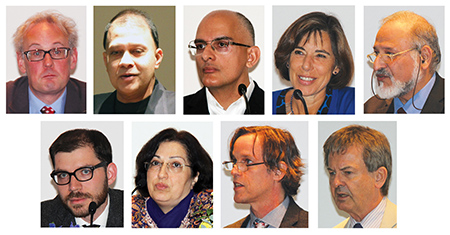
From left (top row): Albert de Jong, Jamsheed Choksy, Dr Ashk Dahlen, Dr Jenny Rose, Khojeste Mistree;
(2nd row): Dr Dan Sheffield, Dr Shernaz Cama, Richard Foltz and Alan Williams
With all these events, the brand identity of Parsis as a peace-loving prosperous community suffered. Their response to the riots was to seek the intervention of leading members of the community or petition the British government officials, ultimately retreat to create space for those hostile to them and commemorate these events lest they be forgotten, summed up Mistree.
A historian of the Zoroastrian religion, Sheffield sought to unravel the mysteries surrounding Azar Kayvan in his paper on "Magian Mystics? Azar Kayvan and his followers between Persianate Zoroastrianism and Imami Shi’ism.” With a doctorate in Iranian and Persian Studies from Harvard University, Sheffield is currently a Link-Cotsen Postdoctoral Fellow in the Princeton University and a lecturer in its Department of Near Eastern Studies. Citing Encyclopedia Iranica, Sheffield introduced Azar Kaywan as a Zoroastrian high priest (1533-1618), with origins in the Sufi order during the Saffavid dynasty, who emigrated to India.
Kayvanis who uphold universal oneness believe that God can be approached through every religion and thus one should befriend Hindus, Jews, Zoroastrians and Christians in addition to Muslims. According to them the teachings of Zarathushtra are allegorical and meant to be interpreted esoterically. Thus Ahriman was seen as materialism impeding a soul’s progress, and Zarathushtra and Abraham were believed to be the same person for there are references to both being thrown into fire and emerging unscathed. Although Azar Kayvan, whose philosophy bore a resemblance to Akbar’s Din-i-ilahi, is revered as a saint by Ilm-e-Khshnoomists, his Zoroastrian allegiance continues to be ambiguous with Sunnis believing he was a Shia and Shias assuming he was not a Muslim, noted Sheffield.
Referring to the key role played by Parsis in the mercantile activities of British India and subsequently the independent United States of America, Rose’s paper on "Riding the (Revolutionary) Waves between Two Worlds: Parsi involvement in the transition from Old to New” explored the contribution of the community to the material and intellectual culture of America. Rose, who holds an MA in Religious Studies from SOAS and a doctorate in Ancient Iranian Studies from Columbia University, lectures in Zoroastrian Studies at Claremont Graduate University in California. The Parsis’ shipbuilding skills that were encouraged by the British resulted in their services being commissioned by the Americans. Broker Nusserwanji Maneckji Wadia was promoted as was Jamsetjee Bomanjee Wadia. It was on the Wadia built warship HMS Minden that Francis Scott Key wrote his poem "The Defence of Fort McHenry” which later became the lyrics for the American national anthem The Star Spangled Banner. When the first Parsi Ardeshir Cursetji Wadia visited the USA in 1949, his mannerisms at the residence of Howard King of Salem made King’s daughter comment "It was rather a revelation to me that a fire worshiper could take tea like ordinary mortals.” She further cited Herman Melville’s novel Moby-Dick, written in 1851, that includes a character Fedallah, described as "a strange, oriental, old Parsi Persian fire worshiper.”
The post-lunch session on "Modernity: the use of the past in the balance of traditional Zoroastrian culture and modernity” saw the last two papers being presented by Dr Shernaz Cama and Richard Foltz.
The wearing of the sudreh-kusti in India probably encourages a sense of identity and social responsibility, helping individuals feel part of ‘one’ or different from ‘other’ communities, mentioned Cama, assistant professor of English at the Delhi University in her speech on "Sacred Armor: Relevance in a Changing World.” Honorary director of the UNESCO Parzor project that has been researching and recording Zoroastrian culture and traditions, Cama drew on analogies between the tying of the kusti and the yasna ceremony, both seen as symbolic acts to protect and energize the holy creation against destructive forces. With Zoroastrians being considered soldiers of truth, they arm themselves not with battle armor but sacred armor in defence of harmony.
When tying the kusti whilst praying the Yatha Ahu Vairyo prayer, the reef knot is made at the recitation of the word "shyaothenanam (meaning working)” because in the trilogy of good thoughts, words and deeds, actions are deemed the most important. Likewise in the yasna ceremony a strip from the leaf of the date palm is tied into a reef knot around the barsam (a bundle of sacred vegetable twigs in earlier times but since the exodus to India replaced with metal wires) at the word shyaothenanam. "Just as the kusti unites into a circle of harmony all those who wear it, the strips of the leaf of the date palm unite the barsam, signifying the unity of all nature,” explained Cama. The ritual practice of striking the pestle against mortar and various parts of the table is meant to drive away the wicked Ahriman just as the gesture of slashing the air with the sacred girdle is meant to smite the evil. The 72 threads in the kusti string symbolize the 72 Has or chapters of the Yasna that are chanted when performing the yasna ceremony during which two priests draw water from a well before dawn, bind together through prayer and ritual all the seven creations, and ultimately pour the spiritually charged water back into the well to signify that the circle is complete.
In his paper on "Zoroastrian Symbolism and Tajik Nation-building,” Foltz conveyed that after its independence in 1991 Tajikistan has drawn heavily on symbols of Iranian culture in an attempt to build a distinct national identity. Founder director of the Centre for Iranian Studies at Concordia University in Montreal, Canada and currently working on a volume of the Oxford New World History series entitled Iran in World History, he referred to the Tajik government news agency being called Avesto after the Zoroastrian holy text, one of the national airlines, Somon Air, adopting the symbol of seven stars on its aircraft to represent the Amesha Spentas, and Navroz being declared a week- long holiday. He also referred to the President of Tajikistan Emomali Rahmon cultivating relations with Parsis and the first Tajik contingent that came visiting India. In 1998 they established Anjoman-e-Mazdayasnov that offers classes in Avesta and Pahlavi. A growing interest in Zoroastrian rituals needs to be assessed in the context of perceived danger of Islamic revivalism, cautioned Foltz.
With SOAS planning to bring out a "most fascinating book” bearing the edited texts of the papers presented at the conference, the speakers were requested by Williams not to publish their papers or put them online. Thanking the audience for attending the sessions, some of which were comprehensible to the lay public and others only to the scholars, he continued, "The energy given back to the podium has given energy to the speakers.”
◆ ◆ ◆
From the archive