
Zoroastrians Abroad
Antiquity and authority — II
Scholars from 10 countries who had participated in the SOAS conference were welcomed at the Zoroastrian Centre
"Although we are a minuscule group, we have operated through persuasion. Unlike other faith communities we do not seek central or local government assistance,” announced Malcolm Deboo, president of the Zoroastrian Trust Funds of Europe (ZTFE), when welcoming visitors, particularly "first-time guests” to their Zoroastrian Centre in Harrow on October 11, 2013. This special reception was hosted in honor of the international scholars who had come from Spain, Sweden, Netherlands, France, Italy, Germany, Canada, USA, India, besides those from the UK, to participate in the two-day conference "Looking Back: Zoroastrian Identity Formation through recourse to the past,” organized by the School of Oriental and African Studies (SOAS), University of London.
ZTFE had arranged for a chartered bus to ferry the invitees from SOAS at Russell Square to the Zoroastrian Centre at Harrow at the end of the first day’s deliberations that saw papers presented by 10 speakers.
ZTFE had arranged for a chartered bus to ferry the invitees from SOAS at Russell Square to the Zoroastrian Centre at Harrow at the end of the first day’s deliberations that saw papers presented by 10 speakers.
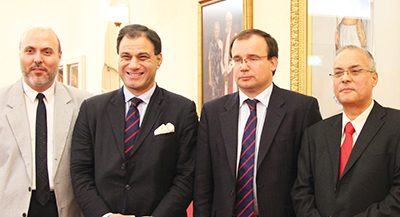
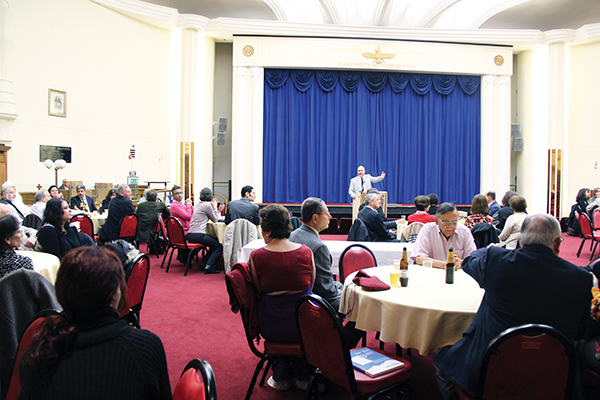
Above (from left) Malcolm Deboo, Karan Bilimoria, Gareth Thomas and Dorab Mistry;
(alongside) members and guests at the Zartoshty Brothers Hall Photos: Parinaz Gandhi
"You are extremely welcome in this constituency,” declared Member of Parliament from Harrow West Gareth Thomas who enjoys referring to himself as "a Zoroastrian MP” due to the strong Zoroastrian presence in his constituency with a "classy Centre in a classy area.” Happy to see Zoroastrians contributing to the "diversity in my constituency,” he urged those who had settled in the USA "to come back.” On behalf of the ZTFE, their sesquicentennial medallion was presented to Thomas.
Among the other sponsors and scholars who were conferred the sesquicentennial medallion were Homa Zartoshty, daughter of the late legendary philanthropist Mehraban Zartoshty whose munificent donations had made the Zoroastrian Centre a reality for the Zoroastrians in London. The family’s continued largesse had made possible the establishment of the Zartoshty Chair in Zoroastrian Studies at SOAS and the financing of the impressive catalog that accompanied "The Everlasting Flame: Zoroastrianism in History and Imagination” exhibition from October to December 2013 at the Brunei Gallery at SOAS.
Pointing out that the Zartoshty Brothers Hall at the Zoroastrian Centre is thanks to the "kindness and generosity,” of Mehraban and his brother Faridoon, Lord Karan Bilimoria, the first Zoroastrian to be appointed to the House of Lords in UK observed, "The whole attitude of the community is one of benevolence, of giving back. We live life to the fullest. It’s great fun to be a Parsi.”
Academics whose contribution was recognized with a medallion were Dr Sarah Stewart, currently secretary of the British Institute of Persian Studies in London who had curated "The Everlasting Flame” exhibition, her co-curators Dr Almut Hintze who is Zartoshty Brothers Professor of Zoroastrianism at SOAS and Firoza Punthakey Mistree of Athravan Educational Trust, Bombay.
ZTFE former president and current treasurer Dorab Mistry who was conferred the OBE (Officer of the Most Excellent Order of the British Empire) this year was felicitated on this occasion by his members. ZTFE past president Rusi Dalal and counsel emeritus Noshir Avari were presented medallions as were some of the key volunteers like Freddy Deboo and Nicholas Davidson who had contributed to the success of the SOAS functions.
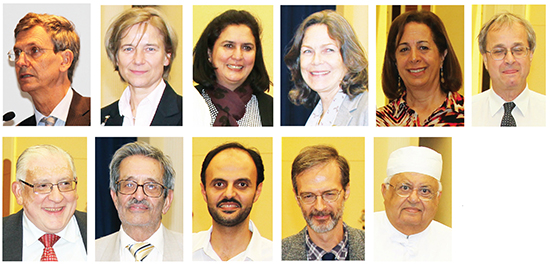
From left (top row) Philip Kreyenbroek, Dr Almut Hintze, Firoza Punthakey Mistree, Dr Sarah Stewart, Homa Zartoshty,
Dr Frantz Grenet; (bottom row) Noshir Avari, Rusi Dalal, Freddy Deboo, Nicholas Davidson and Ervad Rusom Bhedwar
On behalf of the Federation of Zoroastrian Associations of North America (FEZANA) its stalwarts Dr Dolly Dastoor and Aban Rustomji presented Malcolm Deboo a replica of the Cyrus Cylinder to appreciate the efforts of the ZTFE "to bring the community in focus in UK, in the Parliament and with the Royalty.” Deboo though gave credit "to the British (monarchy and the government) for what they have done for our community.”
The day’s deliberations at the Conference had ended with a keynote speech by Philip Kreyenbroek on "Return to the Past, in the Gathas and in later Zoroastrianism.” Professor of Iranian Studies at the Georg-August University, Gottingen, Germany, he has published widely on his field of research: ancient Iranian religions, and modern minority religions among the Kurds. Currently working on the implications of oral transmission for the interpretation of Zoroastrian sources, Kreyenbroek referred to scholars having "to infer a great deal of information” keeping in mind the country and context in which the prophet lived. He sought to differentiate "dynamic, ever changing reality” from "timeless, unchanging, absolute reality… The world that we live in is not as it was meant to be… Everything was ideal in the beginning,” Kreyenbroek shared the world view that sought to restore it "back to fundamental harmony.” Whilst the community started looking to Zarathushtra for anwers, Zarathushtra turned to the creator.
Zarathushtra was willing "to accept believers wherever they came from,” provided they accepted the philosophy as proposed by Ahura Mazda. Achemenians were profoundly influenced by Zarathushtra but after Darius, "Zoroastrianism became a religion for the elite.” Once the Achemenids were defeated by Alexander the Accursed, the ideal past ceased to exist. When the Sasanians became kings by military supremacy, they "presented themselves as true Zoroastrians, the only ones who could restore religion to its true form.”
Tansar and Kerdar were the two authorities who interpreted the religion. With Manichaeism and Christianity claiming to be direct revelations of God, from a "pivotal figure in the history of religion,” Zarathushtra became "a figure shrouded in mystery.” The study of the sacred Zend language being banned to the laity, the priesthood "claimed to have direct knowledge of the divine” and assumed the prerogative of being "the only body capable of religious authority.” After two and a half centuries, when the priesthood realized it was difficult to preserve religious knowledge they chose to commit oral tradition to a written form.
The Islamic influence subsequent to the Arab conquest brought back memories of "the bitter period” of Alexander but it was hoped that a savior would usher in a period of resurrection. Listening to the philosophical and mystical claims of Azar Kaiwan in the 16th century "some Zoroastrians became interested in the teachings rather than the rituals of the faith.” The appearance of new religious teachers provided fresh reference points. "Zoroastrianism has offered us lofty ideals; it is up to humans to restore it to its former perfect state,” concluded Kreyenbroek.
Just as the first day’s sessions included the keynote address by Kreyenbroek, in addition to the panel discussions on the second day was the address by Bilimoria. He spoke on "The Everlasting Flame of Zoroastrian Identity: An Unbroken Thread of Achievement from Cyrus the Great to Today.”
It is estimated that 50 million people lived in the Achemenid empire, approximately 44% of the world’s population, Bilimoria quoted Prof Ehsan Yarshater’s figures to show that the empire was "the largest ever in world history in terms of the percentage of the world’s population at the time.”
Commending Cyrus’ magnanimity he added, "Cyrus was determined to ensure that the territories that he conquered…had their traditional forms of worship and religious practices restored to the people who lived there. Although he was not the first Persian emperor to follow this route, he certainly went beyond the examples set by his predecessors.”
Bilimoria compared Cyrus to Akbar, another king bestowed with the title of "the Great” for his liberal approach when he established the universal faith of Din-I Illahi. The independent Crossbench Peer further alluded to the similarities between Zoroastrian and Vedic texts in their description of deities, and the Abrahamic faiths’ emphasis on forgiveness of sins in contrast to the Zoroastrian concept of performing to one’s full potential in the present life to prepare oneself for judgment in the next.
"So many Parsis have lived their entire lives reciting by rote and listening to prayers without understanding a word of the dead languages that the Gathas were originally written in, and yet the practices and entrenched behaviors have led to the community becoming one of massive achievers with a tradition of serving the wider community,” observed Bilimoria referring to Piloo Nanavutty-Jungalwalla’s The Gathas of Zarathustra that helped him gain considerable insights.
His multiple identities as an Indian, an Asian living in Britain, a British and a Zoroastrian Parsi brings him pride, said Bilimoria who believes it stems from "an unbroken thread from a community that was almost destroyed.” Regretting that Zoroastrians in Iran "have not been allowed to flourish unlike those in India and Britain,” Bilimoria exhorted the community to gain in integrity "through proper action and via a strong sense of heritage, identity and instinctive, un-arrogant humility and confidence without hubris over the generations.”
Bilimoria compared Cyrus to Akbar, another king bestowed with the title of "the Great” for his liberal approach when he established the universal faith of Din-I Illahi. The independent Crossbench Peer further alluded to the similarities between Zoroastrian and Vedic texts in their description of deities, and the Abrahamic faiths’ emphasis on forgiveness of sins in contrast to the Zoroastrian concept of performing to one’s full potential in the present life to prepare oneself for judgment in the next.
"So many Parsis have lived their entire lives reciting by rote and listening to prayers without understanding a word of the dead languages that the Gathas were originally written in, and yet the practices and entrenched behaviors have led to the community becoming one of massive achievers with a tradition of serving the wider community,” observed Bilimoria referring to Piloo Nanavutty-Jungalwalla’s The Gathas of Zarathustra that helped him gain considerable insights.
His multiple identities as an Indian, an Asian living in Britain, a British and a Zoroastrian Parsi brings him pride, said Bilimoria who believes it stems from "an unbroken thread from a community that was almost destroyed.” Regretting that Zoroastrians in Iran "have not been allowed to flourish unlike those in India and Britain,” Bilimoria exhorted the community to gain in integrity "through proper action and via a strong sense of heritage, identity and instinctive, un-arrogant humility and confidence without hubris over the generations.”
◆ ◆ ◆
From the archive