
Cover Story
Enthused by the exhibition — I
A series of events herald the launch of “The Everlasting Flame” exhibition at the School of Oriental and African Studies
"Never heard of Zoroastrianism,” responded the immigration officer at the Heathrow airport when we told her the reason for Parsiana’s eight-day business visit to London was to cover the exhibition on Zoroastrianism at the School of Oriental and African Studies (SOAS). Even before we could commence with an explanation, she had stamped our passport so we had no reason to tarry or to urge her to visit the two-month-long exhibition at the Brunei Gallery where admission is free. But she came to mind when we read the press release from SOAS: "‘The Everlasting Flame: Zoroastrianism in History and Imagination’ is the first exhibition of its kind to provide an in-depth visual narrative of the history of Zoroastrianism, its rich cultural heritage and the influence it has had on the major world religions of Judaism, Christianity and Islam.”
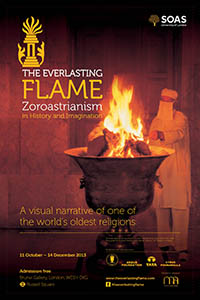
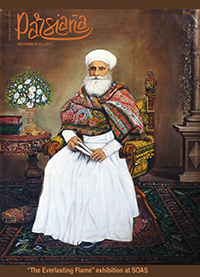
Poster announcing the exhibition;
Cover: Dastur Noshirvan Dastur Kaikhosrow Behram Framroz
(1822-1897), oil on canvas (Collection: Hameed Haroon)
Photo: Arif Mahmood, Whitestar Photo Archives (Pvt) Ltd
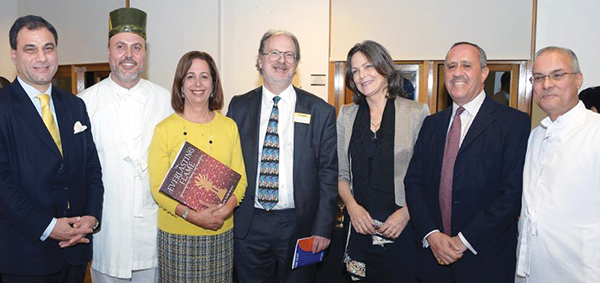
At the preview (from left): Lord Karan Bilimoria, Malcolm Deboo, Homa Zartoshty, Dr Paul Webley,
Dr Sarah Stewart, Zarir Cama and Dorab Mistry Photo: SOAS/ZTFE/Parzor
Over 300 artefacts, texts and paintings borrowed from prestigious institutions like the British Museum, British Library, Victoria and Albert Museum, Uzbekistan National Museum, The Chhatrapati Shivaji Maharaj Vastu Sangrahalaya (former Prince of Wales Museum), the F. D. Alpaiwalla Museum, the Tata Central Archives, Institute of Archaeology, Samarkand and the Samarkand National Museum, The Royal Asiatic Society, John Rylands Library and the David Khalili Collection plus the private collections will be on display until December 14, 2103. The Zoroastrian Trust Funds of Europe (ZTFE) and its members have not only loaned several historical documents, portraits and photographs, they also contributed to the seed capital of £ 100,000 for this exhibition.
Subsequently ZTFE "further increased the funding to £ 180,000 by sponsoring the exhibition poster campaign on London underground stations, organizing a reception in the House of Commons and the publication of the book… dedicated to the memory of the Zartoshty Brothers in which HRH The Prince of Wales agreed to write the foreword at the request of the ZTFE. According to a communiqué from ZTFE president Malcolm Deboo, the first three to locate all 150 posters at various underground stations in London would get a copy of the catalog that as an opening offer was being sold for £ 36 for a hardback edition and £ 17 for a paperback.
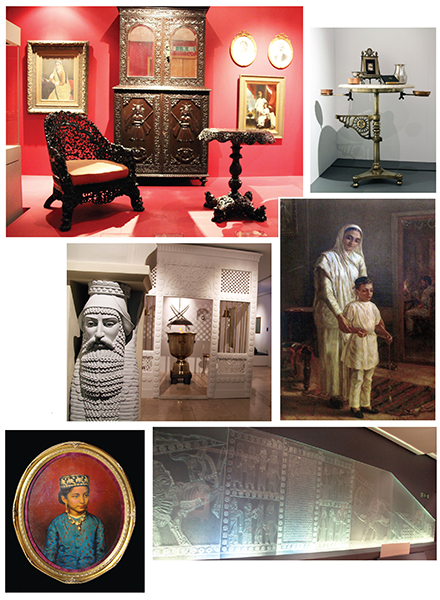
Clockwise from top left: Wooden cupboard with carving of Zarathushtra (Collection: Alpaiwalla Museum);
muktad table (Collection: Firoza Punthakey Mistree); M. F. Pithawalla’s painting (Collection: Franey Irani);
glass etching of stone relief on the western staircase of the palace of Darius at Persepolis; P. B. Hatte’s painting of Dhunbai Jamsetji Tata (Collection: Hameed Haroon) Photo: Hussain Afzal — Whitestar Photo Archives (Pvt) Ltd
and replica of fire temple
All photos by Parinaz Gandhi unless stated otherwise
As wrote Prince Charles in this compilation, "In an increasingly secular world, it seems to me to be vitally important that sacred wisdom accumulated over thousands of years is preserved for future generations. I could not be more delighted therefore that SOAS has mounted this important exhibition. It will, I hope, be a source of education and inspiration for all who visit it and a fitting tribute to an ancient faith which reveres the illuminated mind.”
A series of events served as the aperitif and starters for the exhibition that constituted the entrée. The Lord Michael Williams of Baglan was the first to host a reception in the Attlee Room at the House of Lords on October 9 to mark the opening of the exhibition the next day. A select 60 were present to hear Williams declare that having met some Zoroastrians he found them a community worthy of admiration. He further offered "to sign up for the Zoroastrian All Party Political Group in Parliament” initiated by Lord Karan Bilimoria (see "Presence in Parliament,” Parsiana, November 7, 2013).
"It has been my lifelong desire to be sandwiched between two Lords,” jested Dr Paul Webley, director and principal of SOAS, appreciating the cooperation extended by Williams as also Bilimoria. The gathering was further reminded that to Bilimoria too goes the credit for initiating the first debate on Zoroastrianism in the House of Lords and ensuring that the Zoroastrian community is represented at the National Ceremony of Remembrance at the Cenotaph.
"On my desk is Dadabhai Naoroji’s maiden speech that he made in Parliament in 1892,” revealed Bilimoria. He recalled Lord Salisbury’s skepticism to see "a black man,” Naoroji, contest the elections on a Liberal seat "even though Dadabhai Naoroji must have been fairer than Lord Salisbury.” The next two Indians after Naoroji to earn a seat in the House of Commons were also Zoroastrians: Mancherjee Bhownaggree who was a Conservative and Shapurji Saklatvala who was a Communist. With Bilimoria being an Independent, albeit in the House of Lords, as observed by him the four Zoroastrians in the British Parliament have covered the major political groups.
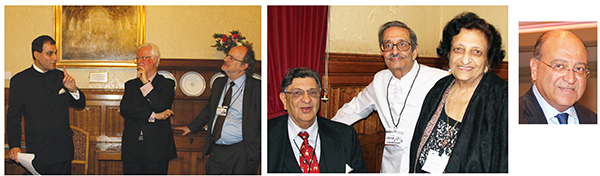
(Above) At the House of Lords (from left) Lord Karan Bilimoria, Lord Michael Williams,
Dr Paul Webley; Dr Cyrus Poonawalla, Rusi and Roshan Dalal; Farrokh Kavarana
"I see SOAS as the epicenter of Zoroastrian research worldwide,” commented Bilimoria and reinforced the need for everybody to visit the exhibition. The Zartoshty Brothers Chair in Zoroastrianism having been established at SOAS in 2011with a munificent donation from the benefactors, Bilimoria addressed Mehraban Zartoshty’s daughter Homa who had specially come from the USA, "Your father was an absolute inspiration.”
It is to the memory of Mobeds Faridoon and Mehraban Zartoshty that the 260-page compilation also titled The Everlasting Flame: Zoroastrianism in History and Imagination is dedicated. Edited by Sarah Stewart, the curator of the exhibition, sponsored by the ZTFE and published by IB Tauris, it was released by Homa at the preview of the exhibition on October 10 at the Brunei Gallery. The book is divided into two sections with the first 69 pages devoted to essays by Almut Hintze, Philip Kreyenbroek, Frantz Grenet, Anke Joisten-Pruschke, Albert de Jong, Alan Williams, Firoza Punthakey Mistree with Pheroza Godrej, and Stewart. As mentioned by Stewart in her Introduction, their contributions bring together "the most recent research…In the second part, the juxtaposition of text and images, commentary and analysis offers the reader the same journey through the history of Zoroastrianism that the visitor experiences in the exhibition.”
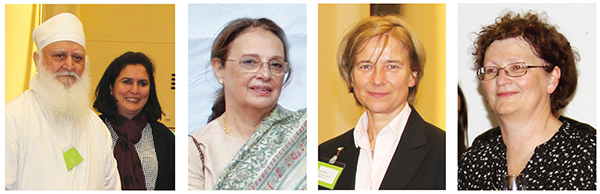
(From left) Dastur (Dr) Firoze Kotwal, Firoza Punthakey Mistree, Pheroza Godrej; Almut Hintze, Ursula Sims-Williams
An intellectual and spiritual treat
A video recording of Zubin Mehta’s welcome message greeted the excited crowd at the preview of the exhibition. Named patron for the event, Mehta described it as "an incredible exhibition of such depth.” Congratulating the organizers who "worked so much” to see it to its fruition, he hoped it would be a learning experience for all admitting that he was amongst the members of the community who knew "so little about the religion.”
Referring to the exhibition as "a real treat” Webley described it as "marvelous for four reasons.” He valued the opportunity for SOAS to closely work with partners, particularly "sponsors who have been generous and flexible.” There are many exhibits that are "evocative and haltingly beautiful,” his personal favorite being the 30-foot glass etching that is a replica of the British Museum’s 10 m cast of the western staircase from the palace of Darius at Persepolis detailing the magnificent lion and bull motif. The two-day conference on "Looking Back: The Formation of Zoroastrian Identity Through Rediscovery of the Past” organized on October 11 and 12 by the Centre for Iranian Studies at SOAS had brought together international scholars from across the world. "The exhibition is not only intellectual but also spiritual…evoking the true spirit of Zoroastrianism.”
To depict "the extraordinary reach of Zoroastrians throughout the world,” the exhibition relates "the journey as a historical narrative in 10 sections,” specified Stewart at the preview. Whilst appreciating the efforts of her co-curators Prof Almut Hintze of the Department of the Study of Religions at SOAS, Ursula Sims-Williams, curator of Iranian languages at the British Library, Firoza Punthakey Mistree of Zoroastrian Studies and Pheroza Godrej, art historian and environmentalist, Stewart specially singled out Mistree "my counterpart in India… who monitored and managed to oversee” the progress of the specially commissioned installations. The museums, archives and collectors who trusted their treasures in the care of SOAS were also acknowledged by Stewart who recounted how a small lizard too managed to find its way inside a consignment! Special credit was given to the exhibition designer Colin Morris of Morris Associates for "creating a reality from our aspirations and dreams on a scale and elegance by which you will be bowled over.”
Congratulating Stewart "for her landmark achievement… the first of its kind in this country,” Deboo further appreciated the efforts of the co-curators and other people "behind the scenes who constituted the backbone” for this exhibition. He mentioned how in 2011 he was able to persuade his ZTFE co-trustees to co-fund this exhibition since it met their organization’s objective "to advance the study and dissemination of information” on Zoroastrianism. As acknowledged in the September issue of ZTFE News "quite a few ZTFE members came forward with their donations towards the exhibition. Without this core funding it would have been challenging to commence organizing this exhibition which was the catalyst to persuade other international donors to make sizeable contributions.”
A video recording of Zubin Mehta’s welcome message greeted the excited crowd at the preview of the exhibition. Named patron for the event, Mehta described it as "an incredible exhibition of such depth.” Congratulating the organizers who "worked so much” to see it to its fruition, he hoped it would be a learning experience for all admitting that he was amongst the members of the community who knew "so little about the religion.”
Referring to the exhibition as "a real treat” Webley described it as "marvelous for four reasons.” He valued the opportunity for SOAS to closely work with partners, particularly "sponsors who have been generous and flexible.” There are many exhibits that are "evocative and haltingly beautiful,” his personal favorite being the 30-foot glass etching that is a replica of the British Museum’s 10 m cast of the western staircase from the palace of Darius at Persepolis detailing the magnificent lion and bull motif. The two-day conference on "Looking Back: The Formation of Zoroastrian Identity Through Rediscovery of the Past” organized on October 11 and 12 by the Centre for Iranian Studies at SOAS had brought together international scholars from across the world. "The exhibition is not only intellectual but also spiritual…evoking the true spirit of Zoroastrianism.”
To depict "the extraordinary reach of Zoroastrians throughout the world,” the exhibition relates "the journey as a historical narrative in 10 sections,” specified Stewart at the preview. Whilst appreciating the efforts of her co-curators Prof Almut Hintze of the Department of the Study of Religions at SOAS, Ursula Sims-Williams, curator of Iranian languages at the British Library, Firoza Punthakey Mistree of Zoroastrian Studies and Pheroza Godrej, art historian and environmentalist, Stewart specially singled out Mistree "my counterpart in India… who monitored and managed to oversee” the progress of the specially commissioned installations. The museums, archives and collectors who trusted their treasures in the care of SOAS were also acknowledged by Stewart who recounted how a small lizard too managed to find its way inside a consignment! Special credit was given to the exhibition designer Colin Morris of Morris Associates for "creating a reality from our aspirations and dreams on a scale and elegance by which you will be bowled over.”
Congratulating Stewart "for her landmark achievement… the first of its kind in this country,” Deboo further appreciated the efforts of the co-curators and other people "behind the scenes who constituted the backbone” for this exhibition. He mentioned how in 2011 he was able to persuade his ZTFE co-trustees to co-fund this exhibition since it met their organization’s objective "to advance the study and dissemination of information” on Zoroastrianism. As acknowledged in the September issue of ZTFE News "quite a few ZTFE members came forward with their donations towards the exhibition. Without this core funding it would have been challenging to commence organizing this exhibition which was the catalyst to persuade other international donors to make sizeable contributions.”
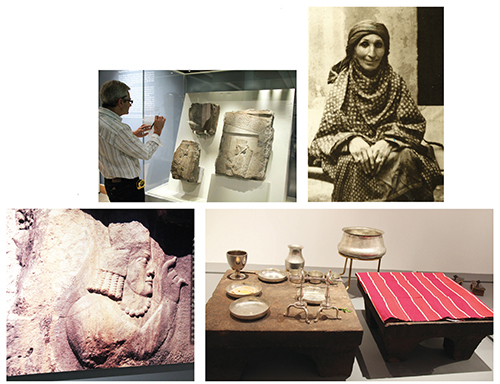
Clockwise from below left: Legend being affixed for carved limestone reliefs
(Collection: British Museum); Zoroastrian lady in traditional dress (Collection: Fereydoun Ave);
ritual implements; Kirdir inscription at Naqsh-e Rajab
Among the principal sponsors for the exhibition whose largesse was recognized at the preview function were the ZTFE and Aequa Foundation as also Cyrus Poonawalla, Tata Enterprises, Farrokh Kavarana, Vahid Alaghband and Zarir Cama. Deboo appreciated that Dastur (Dr) Firoze Kotwal had come from Bombay to participate in their events. As reminded Deboo, this is not the first time that the ZTFE, the Bombay Parsi Punchayet and the Tatas have come together. Way back in 1929 these organizations had helped establish the Parsi Community Lectureship with Sir Harold Bailey delivering the first lecture.
"How tough Sarah is can be vouched by me and Farrokh,” acknowledged Zarir Cama who added that as a banker he was able to recognize her bargaining power. He also chose to reinforce the Zoroastrian ties with Iran. "We are all here because of that country… We must never forget this,” he added referring to the historical links and the invitation of the supreme leader of Iran Ali Khamenei who urged, "You must come here to see where you came from.” Through the Iran Heritage Foundation and the conference that is being organized in India next year he hoped the bridge between the two countries becomes stronger. He then added, "India is the home which gave us our greatest home. That is the only reason why we are all standing here.” Seeing Zoroastrian Studies founder Khojeste Mistree in the audience, Cama gave him credit "for reviving Zoroastrianism in India” four decades earlier.
Whilst the Press and some of the dignitaries had been permitted to familiarize themselves with the displays on three floor levels prior to the exhibition, to those keen on getting their first glimpse but whose enjoyment might have got restricted in the midst of a crowd, Cama advised, "The exhibition is stunning… come back.”
"How tough Sarah is can be vouched by me and Farrokh,” acknowledged Zarir Cama who added that as a banker he was able to recognize her bargaining power. He also chose to reinforce the Zoroastrian ties with Iran. "We are all here because of that country… We must never forget this,” he added referring to the historical links and the invitation of the supreme leader of Iran Ali Khamenei who urged, "You must come here to see where you came from.” Through the Iran Heritage Foundation and the conference that is being organized in India next year he hoped the bridge between the two countries becomes stronger. He then added, "India is the home which gave us our greatest home. That is the only reason why we are all standing here.” Seeing Zoroastrian Studies founder Khojeste Mistree in the audience, Cama gave him credit "for reviving Zoroastrianism in India” four decades earlier.
Whilst the Press and some of the dignitaries had been permitted to familiarize themselves with the displays on three floor levels prior to the exhibition, to those keen on getting their first glimpse but whose enjoyment might have got restricted in the midst of a crowd, Cama advised, "The exhibition is stunning… come back.”
A ringside view of the exhibits will appear in the next issue of Parsiana.
◆ ◆ ◆
From the archive