
Cover Story
Holding the reins
But for Dr Cyrus Poonawalla’s intervention and mediation, along with Nadir Godrej and several others, the 10WZC may have been in limbo
The two smartly attired security guards standing vigil before the closed metal gates are intimidating. Once you inform them of the purpose of our visit, you are directed to another guard who directs you across the courtyard to the two large, imposing doors of the impressive four-storyed Poonawalla House, situated off Warden Road (now Bhulabhai Desai Road).
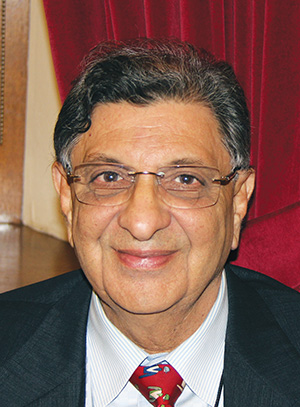
Dr Cyrus Poonawalla
A pleasant staff member later escorts you to the third floor. The lift opens into a lived-in drawing room with a few papers, envelopes and other stationery items strewn on a coffee table. You feel at ease. Next to the large sofa in the center of the room is a three-foot, ornate, gold colored clock atop a table. Not surprisingly some of the other art and silverware depict horses. Dr Cyrus Poonawalla has an abiding interest in breeding and racing horses. In 2007 he was the chairman of the prestigious Royal Western India Turf Club and vice president of the Asian Racing Federation. The family also runs a reputed stud farm while Cyrus and his son Adar run the profitable Serum Institute of India Ltd whose manufacture of vaccines at half the prevailing market prices drove out competitors and made him, according to Forbes May 2013 ranking the 14th richest person in India and 346th in the world. His wealth according to the publication is US $ 3.9 billion (The October 2013 listing puts the amount at four billion dollars.)
He enters the lounge, cigar in hand. His style is informal, congenial and to the point. He had been prompt in replying to Parsiana’s emails requesting an interview but made it clear he was "going to be extremely busy…I must stress that the interview will have to be very brief, to the point and short. I would be inclined to answer just a few of your points such as reasons for ‘generously agreeing to sponsor the Congress’ and (my) growing commitment to the community. (The interview) should concentrate on the 10th World Zoroastrian Congress for which I have been unanimously appointed as president.”
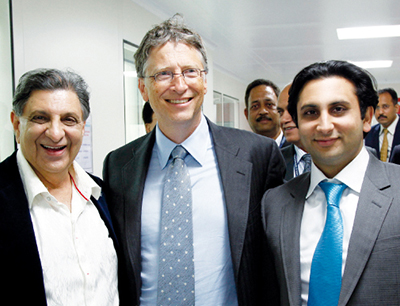
Dr Cyrus Poonawalla with Bill Gates and son Adar
Not known to be media shy, Poonawalla did not want to appear he was seeking publicity for his sponsorship of the Congress or his role as mediator along with Nadir Godrej (Godrej are the events sponsor). "I don’t want to blow my trumpet,” he noted. Poonawalla’s largesse is expected to extend to two crore rupees (US $ 3,22,580) for the Congress, "The Everlasting Flame” exhibition in London where he was the principal sponsor (India), the exhibition of Parsi artefacts and paintings to be held at the National Gallery of Modern Art to coincide with the hosting of the Congress, bringing the Cyrus Cylinder to the Prince of Wales Museum and the restoration of the Alpaiwalla Museum.
He answered Parsiana’s questions thoughtfully, carefully wording his sentences, readily agreeing to the interview being recorded, but was not expansive in his answers. There was not enough time for that and twice or thrice he tried to end the interview stating it had "proceeded along the right lines” and one would be able to write it up accordingly. He however accommodated a determined Parsiana till he finally had to send for his Rolls Royce and, to save time, have his shoes put in the car so he could put them on there. He graciously inquired if Parsiana had a vehicle and when informed not, had one of his cars drop us off. He had extended similar courtesies to Parsiana earlier when he was interviewed at his sizable vaccine plant and stud farm on the outskirts of Poona (see article on his wife Villoo Poonawalla, "The quiet giver,” Parsiana, July 21, 2010).

Dr Cyrus Poonawalla with Prince Charles and son Adar
The morning of the interview, December 7, 2013, he had spent over three-and-a-half hours with the six warring Bombay Parsi Punchayet (BPP) trustees (trustee Yazdi Desai was absent) and publisher Maneck Davar, the global meet’s honorary secretary. (Godrej was unwell and did not attend the session.) The talks veered over the procedures to be followed, the role of the trustees and whether lawyer, horse breeder and The Bombay Samachar columnist Berjis Desai should be barred from participating as a panelist at the Congress. The World Alliance of Parsi Irani Zarthoshtis (WAPIZ) founder trustees on the BPP board, Khojeste Mistree and Yazdi Desai are upset with Berjis Desai for referring to them as "fruitcakes” (nuts) in his Sunday "Parsi Tari Arsi” columns in the past. (Berjis was retained as a panelist largely on Poonawalla’s intervention; but in exchange the organizing committee had to include tax lawyer and WAPIZ founder trustee Homi Ranina as a panellist.)
A mediation session such as that would tire the most energetic of people so it was no wonder that the 72-year-old, Poona based billionaire sometimes reclined on the sofa while speaking to Parsiana. Due to internal squabbling and their loathing for BPP chairman Dinshaw Mehta, four trustees of the BPP (Arnavaz Mistry, Jimmy Mistry, Khojeste Mistree and Yazdi Desai) had cancelled the global meet; it was put back on schedule thanks to the intervention of several community leaders with the understanding that Poonawalla and Godrej would have the final and binding say in case of any irreconcilable differences between the seven trustees. BPP trustees Armaity Tirandaz and Muncherji Cama had opposed the cancellation of the Congress along with Mehta.
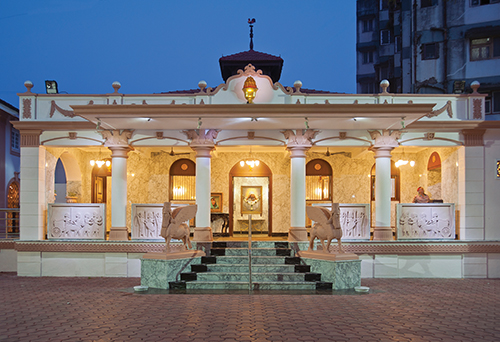
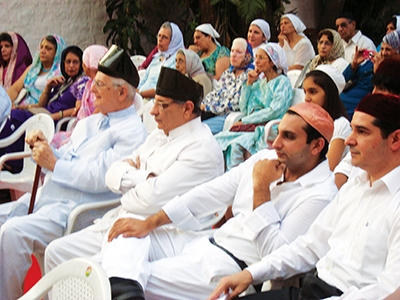
The Poonawallas at a jashan to mark renovation of
Komra Agiary in Poona sponsored in memory of Villoo
"Four years ago when the last Congress was held in Dubai, I was approached for sponsorship at which time I decided I would rather sponsor the next Congress to be held in Bombay and be the principal sponsor,” began Poonawalla when asked about his involvement. Accordingly two years ago he said he "made (his) intentions known to the BPP.” This "culminated with them meeting me at regular intervals over the last one year.”
What prompted him to get involved with community activities? we asked. Hitherto the bon vivant had refrained from participation on account of receiving "lots of reports of bickering (in punchayets). I stayed away from offers to elect me as trustee and chairman of Poona/Bombay Parsi Punchayet, which view I still continue to hold.” (The BPP chairman is determined by seniority and the Poona Parsi Panchayat chairmanship is by rotation — editors)
So why did he change his mind? "This was an international exposure which needed support by a large injection of money.” Earlier in 2011 he had given around two crore rupees for the construction of a wall around the Poona dakhma to prevent encroachment, and for the restoration of the Kadmi and Shahenshahi Anjuman Dar-e-Meher in Poona. "In the last few years I decided to contribute to Parsi community welfare activities…which I hope to continue to do.” One of his priorities is "supporting dilapidated agiaries” and other Zoroastrian causes like "The Everlasting Flame.”
The Cyrus Cylinder is expected to arrive in time for the Congress "but (other) exhibits (from ‘The Everlasting Flame’ exhibition) are going to be delayed (they) will arrive and be lodged at the Alpaiwalla Musuem” run by the BPP.
All the funds he has donated are from his personal assets, not from any trust, he replies to our query. The funds may also be partly funneled from one of his companies but they are all fully owned private companies, he clarifies. In addition to the Parsis, Poonawalla says he has been supporting "plenty of other causes over the years…Twenty years ago I was supporting the Poona Leprosy District Hospital where I was the vice president. At that time the driving force was the late Dr Jal Mehta” who was awarded a Padma Bhushan.
"I’ve been doing more public interest contributions such as for gardens, parks, development of roads in Poona… Baramati and other places.” He is also involved with AIDS (acquired immunodeficiency syndrome) research and has donated millions of dollars worth of vaccines to the Bill and Melinda Gates Foundation.
"Generally I had a philanthropic outlook right from the beginning… the Serum Institute of India had launched and continues to (introduce) serums and vaccines at half the price of what is prevailing in the market. This model of philanthropy I did not dream would end up wiping off the competition. This has led the company to become the world’s largest vaccine manufacturer in number of children that have been protected annually. (The vaccines are for) all communicable diseases such as tetanus, diphtheria, hepatitis, whooping cough..and also polio now… Mainly pediatric vaccines. Adults usually don’t take vaccines.”
Costs were kept down by a combination of low overheads, no wasteful expenditure on advertising and publicity which is substantial for pharma companies, high efficiency and technology upgradation. "We ventured into vaccines already in the market so the technology was available but (they) needed to be cast in a business transformation model: Good quality but at very reasonable prices with low profit margins. Apart from India we have a high global market share of 60 to 70%. It became a numbers’ game. Other companies followed suit but failed because the quality was not sustained and most of their approvals got derecognized globally.”
Their vaccines are sold in 140 countries, barring "the developed world…America, Europe, Japan where they have created artificial barriers to prevent developing country vaccine manufacturers from entering. Their game plan is (to require) a huge clinical trial to be done in their country which costs at least a quarter of a billion dollars (Rs 15,500,000,000), ignoring the fact that 100s of million children have already been protected elsewhere safely. Measles vaccines in America cost 20 times what they cost in India. The World Health Organisation requires you do a trial in your own country and prove that your product is safe and is comparable to an international product. Their rules are created to protect their own industry.
"The Indian government is very slow in giving approvals, therefore new vaccines like newer drugs are becoming exceedingly difficult to launch. New vaccines (have been produced to counter) pneumonia, rotavirus (diarrhea,) dengue fever, rabies. Huge support is given by the Bill and Melinda Gates Foundation which finally (results) in producing cheaper, newer vaccines which are required by UNICEF.”
Terming Gates a genuine philanthropist, Poonawalla adds, "He is the only person I have known who is retired and is spending his full time for the cause of saving children and improving their general well-being. This is very rare. Actually this is the job of the health ministries of the 140 countries. But it is because of his initiative that the entire global fund has now swelled to help eradicate all these diseases including polio, measles and so many others.
"Ours was a traditional family. My wife’s side being Panthakis were extremely religious. And so was I in the beginning. But after seeing all the rascals doing well in India, I lost faith. Now that I’ve (become) a billionaire from nothing, I’ve resumed faith,” he says with a grin. Friends say they saw a change in Poonawalla’s outlook following the death of his wife Villoo in June 2010. His mother Gool would take him to the fire temple. His father Soli was in horse breeding and real estate though much of the property was lost. Serum was started by Cyrus. "I didn’t want to go into horse breeding. It was a business that was frowned upon by government, being a socialist country. (Vaccines) was a life saving foray which would be encouraged. But of course I emphasize I received no encouragement at all from the Government of India. Even now my constant fight with the government is that when I want to donate vaccines free of cost they don’t take them while there are so many other countries that are happy to receive them.”
He attributes the refusal to "no accountability.” The government has plants that manufacture vaccines "but most have shut down because they can’t compete with us.”
The community however has availed considerably of his largesse and is now availing of his financial clout and tact to put the Congress he sponsored back on track.
◆ ◆ ◆
From the archive