
Religion
Enthused by the exhibition - II
“The Everlasting Flame” exhibition in London creates an awareness of Zoroastrianism and its impact on other faiths
"The subtitle ‘Zoroastrianism in History and Imagination’ is well chosen. Never before has London or Europe for that matter seen in one place rock reliefs from Persepolis, Persian miniatures and illustrated manuscripts depicting hell’s inferno, let alone a fire temple, a tower of silence or a Parsi salon. Yet for me, it is in the smaller treasures that the history of a people is brought to life.” Dr Paul Webley, director and principal of the School of Oriental and African Studies (SOAS), was remarking on the depth and diversity of the displays at the ongoing exhibition "The Everlasting Flame: Zoroastrianism in History and Imagination” hosted at the Brunei Gallery at the heart of SOAS’ campus in Russell Square.
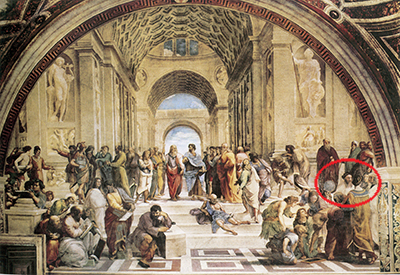
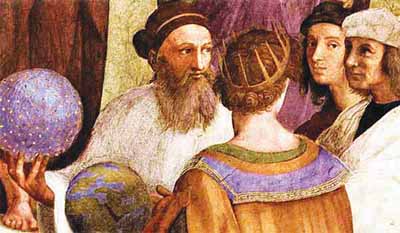
Raphael’s School of Athens with a close-up depicting Zoroaster, earlier identified as holding the
globe but recently as wearing a crown, Vatican Museums and Galleries, Vatican City/Giraudon/The Bridgeman Art Library
With the Zoroastrian Trust Funds of Europe (ZTFE) contributing £ 180,000 towards the cost of the exhibition, "which is over 45% of the overall budget, (it) has been beneficial not only to the entire Zoroastrian community but humanity, as the visitors to the exhibition are international,” commented ZTFE president Malcolm Deboo who urged "other Zoroastrian anjumans to follow our lead in being outward looking. These occasions not only boost our morale, but also propagate Zoroastrianism on a world stage.” He further clarified that "the entire ZTFE contribution to The Everlasting Flame exhibition was received from our members and well-wishers, to whom we will be eternally grateful, thus ensuring the exhibition did not have a negative impact on the ZTFE funds.”
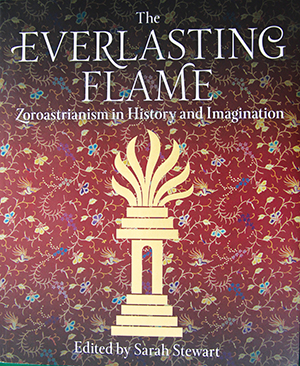
In fact the ZTFE largesse made possible the publication of a 260-page compilation that shares its title with the exhibition. Besides featuring expositions by leading scholars, it serves the dual purpose of an extensive catalog. "The catalog will be the legacy of the exhibition,” stated Dr Sarah Stewart, curator of the exhibition and editor of the compilation, in a brief interview with Parsiana. Having printed 5,000 copies, she hoped they would sell out fast and they could "go into a reprint in the next seven months.”
The publication starts with a laudatory message from Prince Charles: "For millennia, Zoroastrianism has had a profound yet often undervalued influence on cultures and societies around the world… Zoroastrianism’s influence on the teachings of Judaism, Christianity and Islam has been well documented. But what is perhaps less well known is the way in which the message at the very heart of Zoroastrianism — good thoughts, good words and good deeds — continues to offer an integrated response to the challenges of the 21st century where communities so often struggle to live together in harmony…”
Should one visit the exhibition first or study the compilation when both make compelling viewing and ignite "The Everlasting Flame” that promises to illuminate? To best appreciate the exhibition a viewer could study the catalog prior to and subsequent to observing the rare treasures and displays to understand the 10 stories that unfold within the main narration.
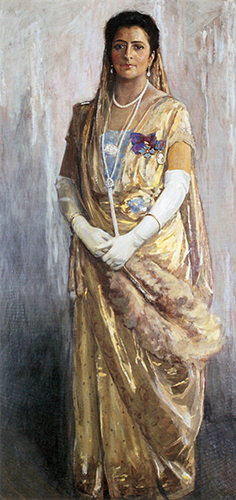
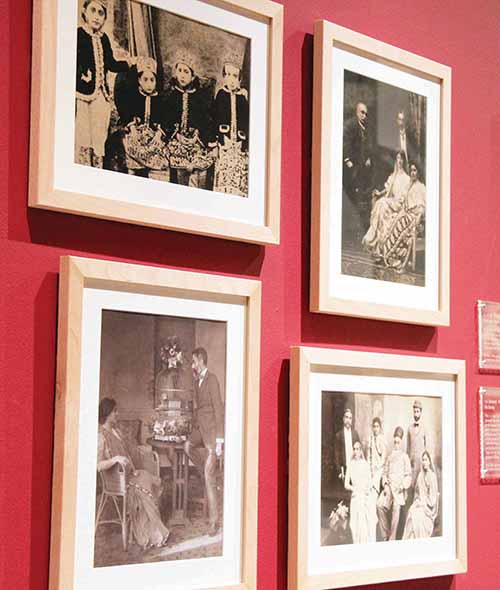
Portraits of Lady Meherbai Dorab Tata (CSMVS, former Prince of Wales Museum);
Dorab Jamsetji Tata and framed photos of Tata family (Tata Central Archives, Poona);
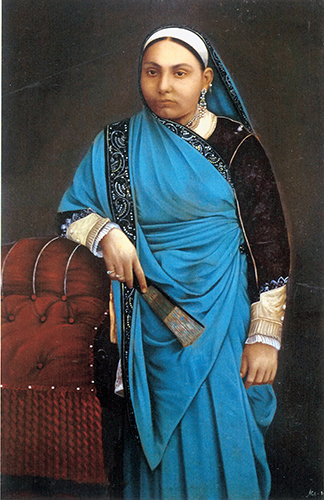
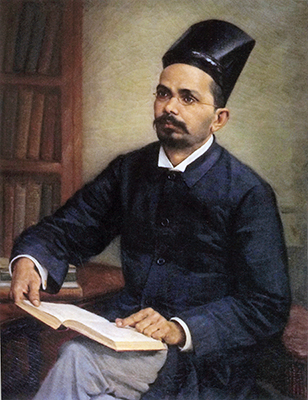
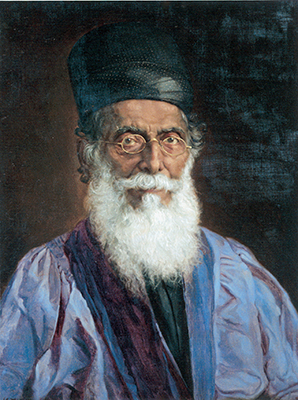
From left: Parsi lady in blue sari, painting by Aca Hosai
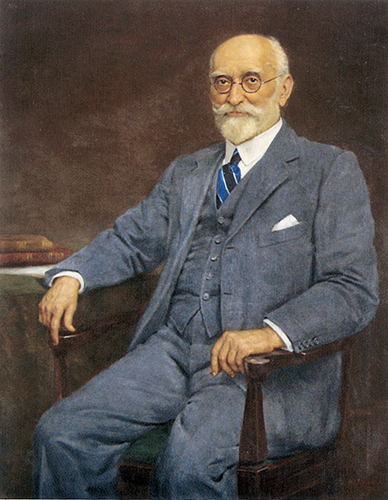
Rustomjee Pestonjee Karkaria painted by M. F. Pithawala
(Collection: Hameed Haroon)
Kharshedji Rustamji Cama portrait by M. F. Pithawala
(Collection: Zoroastrian Trust Funds of Europe)
The compelling stories
The first of the 10 stories related in "The Everlasting Flame” exhibition is "The Ancient World” which features Susa pottery and plaques, cuneiform tablets from Mesopotamia, metal work from Luristan. "The ancient cuneiform inscriptions…provide many insights into the history of their people, particularly with regard to the rulers and their divinities,” states Dr Jenny Rose in the catalog.
Verses from the Gathas of Zarathushtra inscribed as a series of calligraphic panels in Avestan script with their English translation greet a visitor progressing to the second part of the exhibition titled "Sacred texts.” The accompanying voice recording of the prayers offer an audio treat. Prominently displayed in this section are illustrated texts and manuscripts written in Avestan, Pahlavi, Persian and Gujarati indicating how oral tradition was committed to writing during the Sasanian and later periods. Treasures include the 16th century copy of the Yasna ceremony and an illustrated Videvdad Sadeh. "The Videvdad is chiefly concerned with reducing pollution in the material world and represents a vital source for our knowledge and understanding of Zoroastrian purity laws… The Videvdad Sadeh is the Avestan text without any commentary,” explains the catalog.
Also on view are other texts like Khordeh Avesta, Bundahishn and Menog i Khrad. It is interesting to learn in the explanation to the Pahlavi Rivayat accompanying the Dadistan i denig that in Zoroastrian manuscripts, the name of Ahriman is written upside down.
 More eye-catching than the religious texts are the dakhma chart and a line drawing of a cross-section of a dakhma as also the 100x150 cm creation of Rostam in the Dead of Winter, a painting by Fereydoun Ave in black, white and gold. As revealed by co-curator Prof Almut Hintze who holds the Zartoshty Chair in Zoroastrian Studies at SOAS, "It is not until the Islamic period in Iran that the widespread use of the dakhma…is attested. From the mid-18th century dakhmas in Iran were built on the Indian model.”
The third story that moves to "The Silk Road, Central Asia and China” shows a Zoroastrian prayer written in the Sogdian script in the ninth century, a Bactrian document of the fifth century addressed to Mihr Yazad, plus some other parchments of the fourth century. As stated Frantz Grenet, "Due to the predominantly oral transmission of Zoroastrian teaching in the pre-Islamic period, very few texts survive from Central Asia.” Besides a human headed mace and a wall painting, featured in this section are several ossuaries (containers holding bones of the dead). In fact the ossuary from Mullakurgan that was found by farmers near Samarkand, Uzbekistan, depicts two priests on either side of a fire receptacle and it is from this motif of the fire that the logo for the current exhibition has been derived.
"The Judaeo-Christian World” which is the subject of the fourth story demonstrates "the close contact between Jews and Zoroastrians from the sixth century BCE onwards.” From the accompanying write-up we learn that "because the Zoroastrian scriptures were transmitted orally, the earliest accounts of Zoroastrianism are in fact those preserved in Greek and Roman sources.” In the sixth century mosaic of the three magi in the Basilica of Sant’ Apollinare Nuovo, the magi are identified as Iranian by their Parthian attire of leopard print leggings, breeches, fluttering cloaks, Phrygian caps and shoes with upturned toes that were typically worn by Zoroastrian priests.
In Raphael’s painting of School of Athens, alongside Aristotle and Plato amongst the 23 characters identified was Zoroaster. Trésor des histoires, commonly known as the Chronicle of Baldwin of Avesnes that consists of 763 chapters, has the eighth one dedicated to Zoroaster and Hermes Trismegistos. Audiovisual recordings of The Magic Flute by Mozart and the opera Zoroastre by Jean-Philippe Rameau on the stairway leading to the exhibition’s lower level helped reinforce Zoroastrian influence on western art.
The first four stories related on the ground floor at Brunei Gallery give a historical perspective whilst the next four in the basement provide many new dimensions. Thus in the fifth section on "Imperial and Post Imperial Iran” are displayed fragments of limestone relief as also glazed brick with designs and Achemenid jewelry, sixth-fifth century BCE. Parthian terracotta figurines and Sasanian seals as also coins in vogue during the Achemenid, Parthian and Sasanian rule until the last ruler Yazdegerd III was deposed in 651 CE are explained at length.
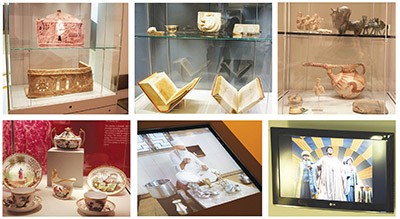
(top row): Yumalaktepa ossuary (above), Shahr-i Sabz Museumand Sogdian ossuary,
The State Hermitage Museum, St Petersburg;exhibits depicting Imperial Iran and Babylonia with the Videvdad and Talmud;
earthenware like the humped bull and spouted pot from "The Ancient World;"
(2nd row) Minton tea service; audiovisual presentations of yasna ceremony and The Magic Flute
A wall was dedicated to the specially commissioned glass etching of the 30-foot plaster cast in the British Museum that shows the western stairway of Darius’ palace. Climbing the stairs are gift bearers from different parts of the empire. The lion clawing the hindquarters of a rearing bull, an imagery oft repeated on the facades of Persepolis, is believed to signify an occurrence in astronomy. The glass etching was financed by the principal sponsor (India) Dr Cyrus Poonawalla, chairman and managing director of the Serum Institute of India Limited. It was executed in India and shipped to the venue in nine panels. "It will go now to the Alpaiwalla Museum,” mentioned Stewart.
Another object holding pride of place is the replica of the Cyrus Cylinder in the possession of the British Museum since 1880, specially commissioned by the exhibition organizers. The cylinder marks the capture of the city of Babylon by the Persian king in 539 BCE and bears an inscription in Babylonian cuneiform recording Cyrus’ benevolence towards the conquered subjects.
The sixth story on "Post Arab Conquest” refers to a proliferation of religious literature in Middle Persian in the ninth century reflecting on the pressing need to dissuade Zoroastrians who were being marginalized from converting to the religion of the Muslim rulers. Texts such as the Epistles of Manushchihr and the Dadestan i denig as also the Pahlavi text of the Arda Viraz Namag allude to the descent of evil upon the community and penalty for the sin of conversion.
Miniatures from Ferdowsi’s Shahnameh portray the myths and legends of the pre-Islamic period. A brass bowl from the Victoria and Albert Museum shows six scenes of horsemen based on the Shahnameh. In one of them is King Faridun riding an ox followed by a captive on foot who was identified as the evil king Zahhak who would daily feed on the brains of two Iranian boys.
The salwar kamiz and makhnun (scarf) worn by Iranians as also the Yazdi cloth of early 20th century have a bearing on the everyday life of Zoroastrians in the preceding century. A strict dress code was imposed on the Zoroastrian men who were compelled to wear garments of yellow ochre or unbleached cloth to distinguish them from the Muslim majority. Further, Zoroastrians were not permitted to buy cloth by the yard and hence shopkeepers in Yazd and Kerman would collect strips of leftover fabric and leave them in bins outside for Zoroastrians to buy. These were laboriously stitched together and often embroidered with a variety of patterns.
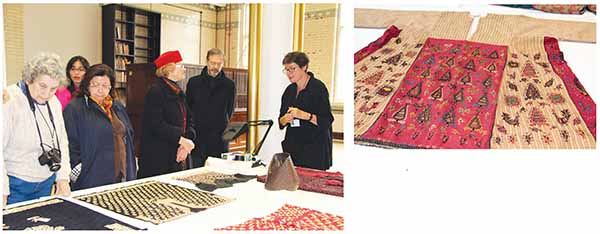
Rosemary Crill explains ancient Iranian garments to guests at The Clothworkers’ Centre for
the Study and Conservation of Textiles and Fashion at the Victoria and Albert Museum
Photos: Parinaz Gandhi
(Among the exhibition’s satellite programs was one at The Clothworkers’ Centre for the Study and Conservation of Textiles and Fashion at the Victoria and Albert Museum on the morning of October 14 when Rosemary Crill, senior curator for South and Southeast Asia, and Moya Carey, IHF curator for the Iranian Collections, gave a select 18 an opportunity to familiarize themselves with the garments worn by Iranians in the 19th and 20th centuries. The drab attire of the persecuted Zoroastrians made from remnants was embellished with laboriously embroidered motifs of birds, butterflies, trees and flowers. With the arrival of the Manchester fabric the cloth industry in Iran suffered a major impact. On another table were laid an array of gara samples, some rare jhablas and blouses.)
The condition of Zoroastrians improved after Maneckji Limji Hataria succeeded in getting the jizya tax abolished. Photographs of Arbab Jamshid Jamshidian who was appointed the first Zoroastrian representative on the National Consultative Assembly (Majles) in 1906, his successor Arbab Kaikhosro Shahrokh and other scenes of Tehran in the early 20th century are indicative of how Zoroastrians gradually managed to find their bearings.
"Journey and Settlement” is the subject of the seventh section which recounts, "Traditionally the history of Zoroastrianism in India begins, as related in the Qesseh-ye Sanjan with the story of Muslim persecution in Iran and the ensuing emigration that followed during the eighth to 10th centuries CE… In reality, Iranians had spread eastwards along established trade routes well before the advent of Islam and continued to settle long afterwards.” Featured in this section of the exhibition are several texts including the Zartosht Nameh, Qesseh-ye Sanjan, Sad Dar (100 doors) prescribing 100 Zoroastrian rules on different topics, Rivayats (responses from Iranian stalwarts to questions posed by Parsis in India) which served as an authoritative guide on ritual practice, Henry Lord’s The Religion of the Persees, Thomas Hyde’s Historia religionis veterum Persarum (History of the Persian Religion), and Anquetil du Perron’s Le Zend-Avesta. From Iran to India, the textiles, paintings, jewelry and furnishings from the 18th and 19th centuries are evocative of the role of Parsis in the China trade that included opium, silk and tea.
Whilst not everyone may show an interest in historical narratives, the section on "Parsi Salon” is sure to draw visitors. The walls are adorned with paintings of the Wadia shipbuilders, portraits of members of the Tata family, starting with the doyen Nusserwanji Tata, an ordained priest in Navsari who moved to Bombay, set up the firm Nusserwanji and Kaliandas General Merchants and traded with China, Framji Pestonjee Patuck, an engraving of Sir Jamsetjee Jejeebhoy, photographs of Dhunjibhoy Bomanjee who was one of the largest employers in western India and his wife Lady Frainy.
Evocative of the lifestyle in the 19th century are visuals of Jamsetji Tata’s dining room, Tata children dressed in embroidered jhablas and ijars, the 245-carat Jubilee diamond (named after the 60th anniversary of the coronation of Queen Victoria in 1897) worn by Lady Meherbai Dorab Tata. Also on display are an array of garas in different hues and embroidery, and carved furniture of that period that never fail to arouse admiration.
 For a non-Parsi visitor, a simulated fire temple consisting of a prayer room, sanctum sanctorum and ritual precinct offers a rare glimpse of the insides of an agiary. Stewart particularly was "determined” to have a fire temple replica realizing that it would be an unusual experience for the British audience to whom the "insides of a fire temple is something mysterious.” After December 14, this exhibit too, funded by Poonawalla, will find its way to the Alpaiwalla Museum.
The front entrance façade of the fire temple was modeled along the lines of the Manekji Sett Agiary in Bombay’s Fort area. As explained in the ninth section, "Fire Temple” it was "inspired by the Sasanian site of Taq-e Bostan in Kermanshah, Iran, and began a trend for fire temples to feature architectural motifs from the Achemenid and Sasanian periods.” Whilst it is not known when an ever burning fire first came to be permanently housed in a dedicated building, there are references in the Parthian period to "ever-burning fires being tended by a magus.”
Alongside the implements used in performing the yasna ceremony that are on display, there is an interactive panel showing Ervads Asphandiar and Hormuz Dadachanji performing the ceremony at the Dadar Athornan Institute. Oil canvases of eminent scholars are on view here as also some of the eminent dasturs of the late 19th and early 20th century.
On the steps leading to the first floor we get a glimpse of the final section of the exhibition that is dedicated to "Zoroastrian Communities around the World.” Starting with Europe which features a painting of Naoroji Rustomji Manek Sett, we learn that he was the first Zoroastrian to have visited England when in 1724 he brought a claim before the East India Company. Reportedly the first Indian to bring a case against the British, he surprisingly won it and was conferred a red robe of honor by the Company that is shown draped around his shoulders. A photograph of Dadabhai Naoroji in the House of Commons, Nowruz greetings sent by the Zoroastrians in Iran to Muncherjee Bhownaggree in London are some of the other exhibits in this section. Besides Europe the diaspora includes Sri Lanka, Pakistan, North America, Hong Kong and Singapore, Australasia, the Persian Gulf, East and South Africa, with a reference to Sir Hormusjee Cowasji Dinshaw (Adenwalla) whose family established consecrated fire temples in Aden and Zanzibar, the only ones outside Iran and the subcontinent of India.
As sums us Stewart in the compilation, "The subject of the modern diaspora could fill an entire exhibition and it is to be regretted that here we have room for only a glimpse of the various Zoroastrian communities around the world… The future of the religion is in the hands of young Zoroastrians and our postscript for them is to be found in the small collection of paintings and sculptures provided by the Iranian Zoroastrian artist Fereydoun Ave… through which is presented the doctrine of the seven creations together with excerpts from the ninth century Pahlavi book of the Bundahishn.
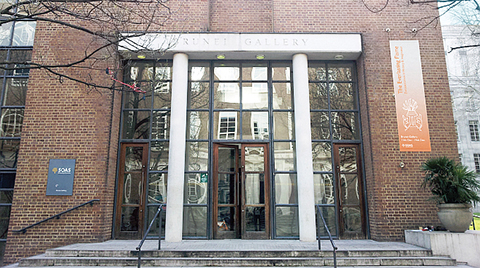
Brunei Gallery at the School of Oriental and African Studies
Executing the exhibition
In the course of the year, Stewart made two trips to India while co-curator Firoza Punthakey Mistree made three trips to London to coordinate the progress on this project. They were principally in charge of the entire show and were responsible from "conception to installation” and hence had to work systematically, sourcing objects, choosing them, arranging for the necessary permits and warranty, and weaving them together into a compelling narrative. The cost of the exhibition being nearly £ 400,000 Stewart appreciated that most of it was covered by donations. "We had to spend an enormous amount on insurance,” revealed Mistree.
Mistree gave credit to Stewart for her persuasive skills and persistence that finally helped her overcome even the bureaucracy in Uzbekistan to bring in some objects for the exhibition. The British Library loaning 26 valuable manuscripts for this exhibition was "amazing,” said Stewart who felt credit should be given to another co-curator Ursula Sims Williams for earning this confidence.
Just two days after the launch of the exhibition when the co-curators felt they could lie low, they were summoned to the Brunei Gallery on a wet Sunday morning because there was difficulty in controlling the volume for the audio recording of the yasna! The audiovisual recording of the yasna ritual had proved a challenge earlier too, mentioned Mistree pointing out that "it was not just a static layout.”
Strategically positioned posters on underground stations aroused interest in the exhibition. "It cost the ZTFE £ 33,000 to sponsor this advertisement campaign for the duration of the exhibition, a first in the UK for advertising anything Zoroastrian,” reported Deboo. The distribution of 20,000 flyers too helped publicize the event. Not only non-Zoroastrian visitors, even members of the community were in awe of the exhibits and information on display and were heard remarking that they would set aside time to revisit the Brunei Gallery before the exhibition comes to a close on December 14, 2013.
In the course of the year, Stewart made two trips to India while co-curator Firoza Punthakey Mistree made three trips to London to coordinate the progress on this project. They were principally in charge of the entire show and were responsible from "conception to installation” and hence had to work systematically, sourcing objects, choosing them, arranging for the necessary permits and warranty, and weaving them together into a compelling narrative. The cost of the exhibition being nearly £ 400,000 Stewart appreciated that most of it was covered by donations. "We had to spend an enormous amount on insurance,” revealed Mistree.
Mistree gave credit to Stewart for her persuasive skills and persistence that finally helped her overcome even the bureaucracy in Uzbekistan to bring in some objects for the exhibition. The British Library loaning 26 valuable manuscripts for this exhibition was "amazing,” said Stewart who felt credit should be given to another co-curator Ursula Sims Williams for earning this confidence.
Just two days after the launch of the exhibition when the co-curators felt they could lie low, they were summoned to the Brunei Gallery on a wet Sunday morning because there was difficulty in controlling the volume for the audio recording of the yasna! The audiovisual recording of the yasna ritual had proved a challenge earlier too, mentioned Mistree pointing out that "it was not just a static layout.”
Strategically positioned posters on underground stations aroused interest in the exhibition. "It cost the ZTFE £ 33,000 to sponsor this advertisement campaign for the duration of the exhibition, a first in the UK for advertising anything Zoroastrian,” reported Deboo. The distribution of 20,000 flyers too helped publicize the event. Not only non-Zoroastrian visitors, even members of the community were in awe of the exhibits and information on display and were heard remarking that they would set aside time to revisit the Brunei Gallery before the exhibition comes to a close on December 14, 2013.
◆ ◆ ◆
From the archive