
Cover Story
Rituals, restoration and relief
Three panel discussions on the third day of the XVI North American Zarathushti Congress studied the relevance of the navjote ritual, the need to preserve Iranian pilgrim sites and ways of combating community poverty
"O Mazda, how will I protect myself when deceit tries to overcome me and leads me astray from the path of Asha?” intonated Ervad Karl Khambatta when untying his kusti on stage. Instead of reciting the customary Kem Na Mazda and subsequent prayers in Avestan, he performed the entire kusti ritual with an English translation to give a novel and meaningful experience to the audience assembled at the XVI North American Zarathushti Congress in New York on the morning of August 4, 2012. Putting their mobiles on video mode, several members of the audience recorded Khambatta’s rendition that earned him a standing ovation.
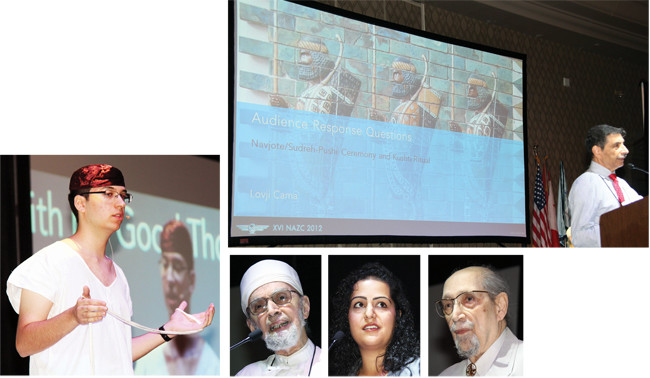
(Above): Dr Lovji Cama; (alongside, from left): Ervad Karl Khambatta, Ervad (Dr) Jehan Bagli,
Nahid Dashtaki and Prof Kaikhosrov Irani
Nahid Dashtaki and Prof Kaikhosrov Irani
Khambatta was the youngest of the four panelists participating in the session on "Rituals and Practices: The Navjote Sudreh Pushi Ceremony and the Kushti ritual.” Having been ordained as a navar at age nine and maratab at age 12, Khambatta has performed navjotes and jashans in California, Massachusetts and Ontario and although he has just started college, the young priest has been imparting his knowledge to children at the religion classes conducted by the Zoroastrian Association of Greater New York (ZAGNY). When performing the kusti each morning, consider it "as meditation, get up 10 minutes early,” he advocated.
The co-panelists who explained the significance of the navjote ceremony in the life of a Zarathushti and the meaning of the kusti prayers included another youngster Nahid Dashtaki, and veterans like Ervad (Dr) Jehan Bagli and Prof Kaikhosrov Irani. Moderating the session was Dr Lovji Cama, founder member of ZAGNY who has been instrumental in organizing religion classes for children since 1973 and sharing knowledge of the history, culture and philosophy of the faith. As mentioned by Cama, "Very often the child is too young” to understand the import of navjote for the "day is decided not on the readiness of the child but other family considerations.” Besides being "the most personal of Zoroastrian rituals,” a navjote serves to "bring together the extended family for a joyous occasion,” he added.
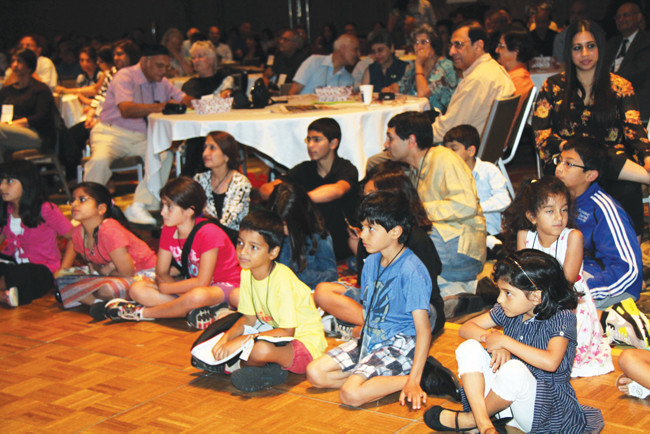
Above: A section of the audience including children who were specially invited towards the end
"The untying and tying of the kusti when performed with a focused mind…brings peace, clarity and enlightenment,” commented Bagli, immediate past president of the North American Mobeds Council and chairperson of the Research and Preservation Committee of the Federation of Zoroastrian Associations of North America (FEZANA). Besides being a socioreligious custom, a navjote is meant to "sow the seed of awareness of the innate divine spirit.” The significance of padyab or cleanliness by rinsing of exposed parts prior to performing the kusti is to be understood as "purity of mind and body to sustain life.”
The kusti prayers being composed in Sassanian times, the Kem Na Mazda prayer has lines from the Ushtavaiti Gatha, Hormazd Khodae from the Spentomad Gatha."The intuitive mind is a sacred gift and the rational mind is a faithful servant,” Bagli echoed Einstein’s sentiments. The all important prayer of Fravarane stresses, "I choose for myself to be a Mazda worshipping Zarathushti.” This commitment to the faith that the initiate makes in public with the use of his own free will is guided by the best (vahishtacha), purest (sraeshtacha) mind. "Is it rational to have the navjote at an early age when the child cannot comprehend the implications of the commitment?” he enquired.
At the time of their navjote, 50 percent in the audience knew their prayers but not their meaning with another 31 percent adding that they did what the priests and parents told them on the navjote day and only 19 percent realized they were making a commitment to their religion. This was conveyed through the electronic Audience Response System that the organizers had introduced for instant feedback from those assembled in the hall, this session having 72 percent aged over 50, as against 13 percent who were under 30 since the previous night the Congress organizers had arranged a special program for the youth. When asked to indicate their understanding of the role of the kusti ritual, 27 percent said it was not a part of their usual day, as against 24 percent who believed it makes them feel closer to Ahura Mazda; 35 percent noted it reinforces their commitment to good thoughts, words and deeds. To 27 percent, the sudreh-kusti was a badge of Zarathushti identity, to 20 percent it was not relevant to the identity, and 53 percent saw it as a part of Zarathushti religiosity. Sixty-four percent of the audience conveyed their belief that they can be good Zarathushtis without performing the kusti ritual daily. In the case of 66 percent, their navjote was performed when they were in the eight to 12 age group with 75 percent remembering being taught their prayers by their parents or family members.
The Zoroastrian religion offers no prescriptions or regulations like the Ten Commandments, pointed out Irani, emeritus professor of philosophy at the City College of New York. His areas of specialization being philosophy of science and philosophy of civilization including the philosophy of religion, Irani mentioned that Zarathushtra "presented a vision which you accepted of your own free will (at the time of your navjote). Enlighten yourself with this ideal of truth.” He then harked back to the time of his navjote when he was eight years old. "Today I am 90,” he declared. In response to the applause he received the nonagenarian clarified, "That is no achievement; that is accident.” Two days prior to his navjote when his father, noted scholar Dinshah Irani, had asked the young lad if he understood what lay before him, the young boy assumed he knew the answer because he had learnt his prayers and had read his father’s succinct book, Our Beautiful Navjote Ceremony. As reminded his father, an initiate announces to the congregation around him that he has made a choice of good thoughts, words and deeds. Irani remarked that most often, "the sacred congregational moment is lost. Often the focus is on the dinner that comes after it. Once a commitment is made, how do you follow it? (Make a) commitment to action that emerges from good thought.” He further questioned, "Where do we see truth?” before proceeding to give an answer, "We need a clear mind to be able to recognize it.”
Although her own navjote was performed when she was nine years old, Dashtaki has "many friends who have not had their navjote performed or knows of (Iranian) individuals in their ’60s participating in group sudreh-pushi ceremonies… I do not consider them any less Zoroastrian.” The age at which the initiation ceremony is done is not an issue for Iranians. Currently working for Los Angeles World Airports after completing her masters in dispute resolution and public policy, Dashtaki who is the FEZANA secretary recalled the time of her own navjote when although conversant with her prayers she was miserable that she had been unable to follow the intonations and pronunciation of the priest in charge. "I was convinced I had failed,” believed the tearful little girl although the priest gave his blessings and hugged her. "Neither the new dress nor the gifts were important any more.” All she sought was "acceptance from the community” more so because of the misapprehension that "I had missed my real commitment…to my faith…family and friends.”
In response to a question from the floor Bagli mentioned that although it is not clear when the navjote ceremony was introduced it is generally believed that the legendary monarch Jamshid was called upon to use it as a symbol of Zarathushti identity. Irani explained that every religion is constituted of three elements: personal faith, ritual, congregation of coreligionists. Navjote is a combination of all three. However even if the ceremony is not performed but an individual has faith and commitment, he can still be recognized as a Zarathushti. As stated by Zarathushtra in Yasna 30.2: "Think with a clear mind, each one of you individually… decide whether to accept or not…”
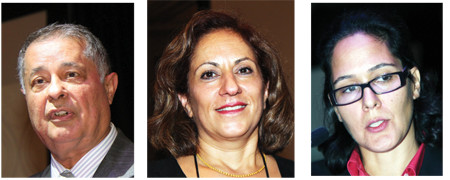
From left: Alayar Dabestani, Shirin Khosravi and Dr Talinn Grigor
Honoring their heritage
"The Iranians in North America are among the wealthiest immigrants. They came from Iran with the hope of going back,” stated Shirin Khosravi when moderating the session on "Preserving Persian Heritage” during the XVI NAZC on the afternoon of August 4, 2012. President of the Iranian Zoroastrian Association in New York for the last 10 years, she has noticed, "The second generation shows a great demand to know all about its Iranian heritage,” pre-Islamic Iran until the seventh century and then again from the first half of the 20th century when Iran witnessed a "supra-historical continuity of the Persian identity.” There is interest not only in "preserving the past but creating a Persian identity,” said the Iran born Khosravi who has spent almost three decades in USA. She graduated in economics from the Tehran University and subsequently completed her masters in urban planning from the National University in Tehran followed by another masters in computer science from the New York Institute of Technology. She currently works as director and solution architect at Merkle, Inc, reportedly the nation’s largest and fastest growing customer relationship management agency.
Participating in the panel were well-known businessman and real estate developer Alayar Dabestani who owns over 100 movie theaters across North America as mentions the Congress brochure, and Dr Talinn Grigor, associate professor of modern and contemporary architecture in the Department of Fine Arts at Brandeis University. The third scheduled speaker Behmard Khosravi who holds a masters in architectural engineering and whose research on Zarathushti religious buildings and cultural structures in Iran is featured in two books and several articles, was not granted the necessary visa in time to attend the Congress. He has designed the College of Science, one of the biggest educational complexes in Iran; the Iranian Ministry of Education, one of the biggest administrative complexes in that country; plus numerous theaters, residential towers, hotels, sports facilities in Iran and internationally. Among the founder members of a group of engineers who are working with Zarathushti anjumans in Iran, Behmard ensures that the historical integrity of Zarathushti sites is maintained during restoration. He has observed that many Zarathushti cultural and religious buildings in Iran and elsewhere are "built in a manner that misrepresent Zarathushti and Persian architectural elements.”
The physical state of each of the six sacred shrines in and around Yazd was detailed by Dabestani whilst reviewing its "management or mismanagement” so that improvements can be implemented. The Yazd Dar-e-Meher receives nearly 5,000 visitors each day with people standing in a queue for nearly a couple of hours but there are no washroom facilities. Narrow pathways, leaking water tanks, dilapidated roofs and columns are the problems facing the shrines of Peer-e-Sabz, Pir Herish, Pir Naraki, Pire Narestane and Pir Pars Banoo which are regularly frequented by tourists. During New Year time around 10,000 Iranians visit Peer-e-Sabz; Pir Herish is a favorite among students who come to offer their thanksgiving after succeeding in their examinations. When restoring Pir-e Seti "the significance of the pilgrimage place was lost. Originality should not be lost,” reiterated Dabestani.
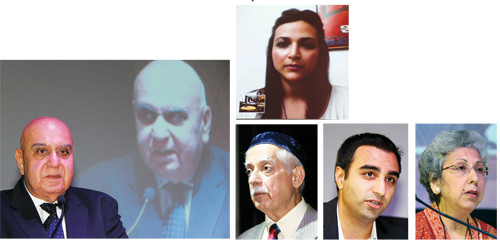
From left: Dinshaw Tamboly, Priyanka Sinha (above) Framroze Patel, Kaizad Cama and Armene Modi
Use of the Persepolis motif in official buildings from the 1930s to the celebration of the 2,500th anniversary of the founding of the Persian Empire by Cyrus the Great in 1971, Zarathushti art and sites were deployed as essential to national might and prestige, mentioned Grigor. "Zoroastrian artistic depiction enabled the Qajar empire (1785-1925) to transform itself to a modern state,” she added referring to Qajar houses following the Zoroastrian and western models. The reformists though tried to project the Qajar dynasty as a period of decadence with its extravagant and wasteful expenditure considering that Reza Shah Pahlavi is said to have sanctioned one billion dollars on the "biggest show of the century” in 1971 in a bid to propel himself to the world stage through the "West-toxicated event.” After the establishment of the Islamic Republic in 1980, "the authorities have devised an ambivalent policy of both preservation and neglect towards these archeological sites,” stated Grigor.
Through the Audience Response System it emerged that as compared to eight percent who knew of the problems in connection with the preservation of pre-Islamic historical sites in Iran at the start of the session, 29 percent said they did not know and 63 percent declared that although they knew, they did not think the authorities were doing anything. When asked regarding the effectiveness of the Iranian Cultural Heritage Tourism and Handicraft Organization, 36 percent said that they did not know of its existence, 21 percent thought the organization was doing what is possible and 43 percent expressed that they don’t think any government agency in Iran has done enough. Only eight percent advocated that Iran’s ancient treasures should return to Iran as against 49 percent who advocated that under the current situation they should be left abroad and 44 percent who felt that they should be returned to Iran after the government shows more consideration for pre-Islamic Iran.
Raise awareness
"Trustees in India are dormant for nine months and in the last three months of the year they disburse (monies) left, right and center,” stated Dinshaw Tamboly when participating in the panel discussion on the third day of the Congress on "Combating Poverty in Our Communities Abroad.” The founder trustee of three WZO Trusts in India was referring to the statutory requirement that charitable trusts expend 85 percent of the income accrued in the financial year ending March. "Trustees in India being usually trustees for life, they begin to think that they are the owners and not trustees (of the charitable organization),” conveyed Tamboly who is a trustee of several organizations, hospitals and an agiary. He also referred to the year 2007 when he was a trustee of the Bombay Parsi Punchayet and had invited 70 community trusts for networking over two days. Since only three trusts showed up, the interaction lasted for barely one-and-a-half hours.
To illustrate the extent of poverty within the Zarathushti community in India the organizers showed a video that was created by Freyaz Shroff. Many members of the audience felt compelled to assist on hearing incisive contributions by "anti-poverty veterans” Tamboly, Armene Modi, founder and chairperson of Ashta No Kai, a Poona based nongovernmental organization focusing on rural poverty and gender equality, and Priyanka Sinha who has contributed to development work in India by liaising with the government machinery and other welfare organizations to bring about meaningful change. The session was coordinated by Kaizad Cama, a management consultant who is passionate about international development and financial inclusion issues.
Many "economically vulnerable” in India sustain themselves on doles they receive from local charities varying from one dollar to $ 20 a month. The Zoroastrian Charity Funds of Hong Kong Canton and Macau though extends aid through the WZO Trust Funds such that 370 economically challenged families benefit by $ 60 a month. When the poor have to foot medical and hospitalization bills, they have to perforce liquidate their modest savings and take loans. Quality education becomes a distant dream for those unable to secure education in a good institution in India, reported Tamboly.
In the last 20 years The WZO Trust Funds, The WZO Trust for Women and Children and The World Zoroastrian Organisation Trust have been able to rehabilitate 436 Zoroastrian farmers in 177 villages, noted an appeal soliciting funds ranging from Rs 4,500 to feed one Zoroastrian family for three months to Rs 3,50,000 to convert one hut into a brick home. With many rural Zoroastrians living in "abject poverty” interest free loans are given to those interested in starting a business. Educational aid, medical reimbursement and assistance to senior citizens is also undertaken. With the general scenario having aggravated or stagnated usually the economic situation across three generations is average or poor. When young girls from the villages are enrolled at the Avabai Petit School in Bombay, the education gained helps them to secure a better future, mentioned Tamboly.
Often the indigent lose hope when after trying to get aid, the help meted out is "minimal or not as per their needs,” said Sinha who could not be present at the venue and thus participated in the discussions through Skype technology. A model charitable organization would offer immediate aid and in fact provide more than just monetary aid such that with necessary skills the community becomes self-sufficient and economically independent, she added.
"Could a viable ambassadorial program address the problem?” wondered Kaizad Cama. To gain firsthand experience those abroad were invited to "visit India and see for themselves the kind of poverty” experienced in the hinterland. "With new blood could emerge new ideas” for improvement. For long-term solutions the avenues that can be explored are vocational training, strengthening skills and capacities to tackle changes, behavioral changes, and motivation to articulate challenges.
By adopting a grandparent who is in institutional care or by adopting a family or by using the professional’s skills, talents and ideas on a project to project basis, the community in North America can aid those in distress in India. Experiential learning could break stereotypical ideas about India, make them revaluate their priorities in life whilst creating bonds that last for years, conveyed Modi. A cross-border volunteer program could facilitate those who want a career in development work. By introducing a website: z.volunteers.org coordination of manpower and resources could be undertaken.
In September the NAZC, the panelists and moderator as also Framroze Patel, who is involved with FEZANA’s critical welfare committee and Freyaz Shroff issued a joint email message: "What we wanted to do during the Congress was not only raise awareness about the socioeconomic condition of our community but also call people to action…We need to think through new approaches to lift our community members out of poverty and we need to support existing organizations like the World Zoroastrian Organisation Trust Funds to not only offer relief and immediate care but also make our community members self-sufficient and economically independent…We would like to extend the opportunity for other members to participate in this movement. As we carve out ways for us to support the underprivileged back home, we are looking to gather the time, skills and commitment of more individuals here in the North American community…Let us know your field of interest and how deeply you would like to be involved. We can be reached at nazc.poverty@gmail.com”
Reports on ancillary sessions and programs of the XVI NAZC will be carried in future issues of Parsiana.
◆ ◆ ◆
From the archive