
Zoroastrians Abroad
Fabricating for Ferrari
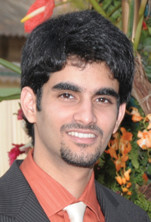
"Europe wants pure designs. No jazzy lines. Chinese, Indian, Korean customers like the jazzy look and styling extravaganza…” states Rustom Mazda on his brief visit home to Bombay from Turin, Italy where he is one of 18 designers at Italian auto designer Pininfarina.
"Since the 1980s Pininfarina has been consulted on industrial and interior design. It has been employed by a wide variety of high-end automobile manufacturers, including Ferrari, Maserati, Rolls-Royce, Cadillac, Jaguar, Volvo, Alfa Romeo, Honda, Fiat, Peugeot and Lancia,” the net informs. "It also has designed trams in France and Greece, high-speed trains in Holland, and trolleys in the USA,” we read.
There are only five Italians at Pininfarina; the others come from all over the globe. Mazda mentions that he is the only Indian and of course the only Zoroastrian — though his name is often connected with the Japanese auto manufacturer!
According to him, in India, "Many now know what car designing is. We are starting to design our own cars, more and more. We have more engineers than designers in India doing a really good job. Designing is maturing — we already have a first wave of designers with international exposure. There are lots of Indian designs and some designers today.” He is "optimistic about the Indian market,” saying, "things look good for Indian design...
"A super-rich economy does not affect the luxury car market,” states Mazda adding that "the largest world market for luxury cars is China, way more than Brazil and India. In fact China has overtaken USA in this category last year. There is a democratic spread now… national centric design is no more a truth.” Although there are cultural differences in lines, pure design remains fairly consistent worldwide.
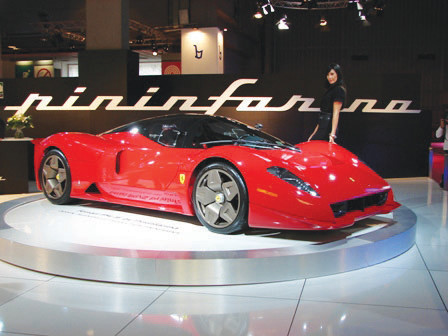
The auto designing manufacturer showcasing a Ferrari
The market is better understood and more homogenous now. Markets in Europe and America are mature, says the unassuming engineer as he goes on to quote research findings of the luxury car market in Europe. "Since Pininfarina is global, we are not affected by a downturn in economy. There is a hunger of developing economies taking over. Europe is now regularized,” he observes.
"The outer design of the car happens at the design phase — will it be boxy, low, what kind of engine, etc” the 26-year-old clarifies. "Then one looks at the interiors — seats, dashboard, fittings — which is five percent of the whole car on the road. The style freezes and then engineering takes over... Formerly designers were designers; they believed technical requirement was different. We now work hand-in-hand with engineers.”
The auto designing community globally is a small one with barely 1,000-2,000 professionals. Mazda is humbled at the international nature of this coterie. In fact he claims there are very few design students in India. His alma mater, the National Institute of Design (NID), Ahmedabad prepared him for choosing "the right material, right technology for the customer at the right time… The role of a designer in a product development project is crucial. I learnt the core basics at NID. Pininfarina improved my styling skills, today these are much better.” Mazda designs road cars — "hatchbacks, sports utility vehicles, sports cars and luxury sedans.”
From his youth Mazda painted ‘boys’ toys’ giving his parents Syrus and Hilla no surprises when he opted for automobile design. The budding artist drew cars that existed in his youth and as testimony has an oil canvas in his drawing room of a flaming red Ferrari. He heard of NID and found it was one of the few to offer car design. So in 2005 he wended his way to this prestigious school to study industrial design. There were seven other schools of automobile design (also termed vehicle or transportation design) at the time. As an individual project at NID, Mazda designed a rural car for India. On the basis of this Pininfarina offered the youngster a six-month internship with two others from the Institute – both of whom are pursuing their own paths elsewhere. These six months led to the international designers hiring Mazda.
.jpg)
Rustom Mazda (above and left) at his navjote with parents Syrus and Hilla and sister Freya
A far cry for the student "who hated text books and studying. I always wanted to do something creative… I was a very fidgety child, always wanted to do things with my hands” he claims.
To explain the excitement surrounding the presence of a Ferrari in India, he says, "It is a lot about status, not for driving pleasure. The cost of a Ferrari is two-and-a-half times more in India than Europe as the duty itself is about 130 percent.” A Ferrari available for three crore rupees in Europe costs eight crore rupees in India.
The automobile designer loves music — pop, rock, western and Indian classical; swimming; trekking; travel and meeting people. The multi-skilled youngster misses the "vibrancy and diversity of India” in Turin. "Our different cultures, sounds, food, religion — I miss all that.” He takes every opportunity to be back home with his pilot father Syrus and mother Hilla who does home catering. Sister Freya is doing a diploma in fashion marketing after her graduation.
Rustom believes Zoroastrianism is great but disapproves of "controlling people. Faith and God and religion are different. We pride ourselves as being liberal... If we want to be seen so, we should evolve, become liberal. Open your eyes. If we leave aside our religion so much is in common with each other. Let us follow human values.”
On the career front, he recommends, "Follow your passion and really work for it and get it. We (Parsis) are trained to become ‘a professional’ -- a doctor or scientist, etc. Our overall knowledge is much better. Go out there and find your own niche. There is only so much your parents can guide you. The world is looking at micro issues and we are losing the larger picture. Let’s not get caught up with propaganda. Just let’s open our eyes and see for ourselves.”
Mehroo Kotval
◆ ◆ ◆
From the archive