
Zoroastrians Abroad
Inspiration and involvement
The two panel discussions on the first day of the XVI North American Zarathushti Congress reflected on the need to convert beliefs into actions
Don’t ever set out saying ‘Our religion is better than others’,” stressed panelist Trity Pourbahrami at the session on "Intergenerational Dialog: Motivation, Inspiration, Action” on the first day of the XVI North American Zarathushti Congress in New York on August 2, 2012. She was responding to an interjection from the floor as regards "words of wisdom” panelists would like to share with young parents in the audience facing the challenge of raising their children as Zarathushtis.
Director of communication for the California Institute of Technology’s Division of Engineering and Applied Science, Pourbahrami has been active in the local and international Zarathushti community and had served as president of the Zoroastrian Youth of North America. Her husband Peter Capak being interested in the Zarathushti religion had converted before their marriage and with their two daughters now takes Farsi classes while Pourbahrami teaches the Gathas.
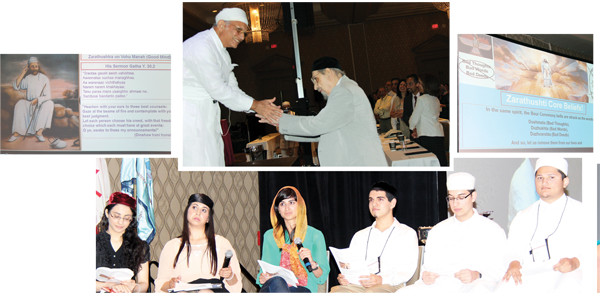
Ervad (Dr) Soli Dastur’s presentation including slides, demonstration of "Hama Zor...” handshake with Prof Kaikhosrov Irani (above center) and his young "hamkaras” (below)
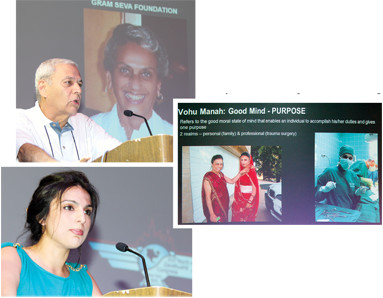
(Above left): Dr Khushroo Patel speaking while his wife Roda’s visage was flashed on the screen; (alongside) Dr Anahita Dua showing images from her personal and professional life
"Parents should be proud of who they are and where they come from,” recommended New Jersey resident Ervad Poruz Khambatta who was initiated as a priest at the age of nine. Having graduated in cognitive science, he is interested in studying decision making and the neural correlates of consciousness.
Since the panelists have been working actively within their own associations they were asked, "Have you ever thought that the whole world is your oyster? That there is more to the community than your local community?” Declared Khambatta, "There is need to preserve the core of our community, our traditions and heritage.” Responded co-panelist Farzin Avari who has been taking religion classes in Atlanta, and views herself "as a good sister to the kids, I would love to reach out to everyone.” Studying psychology at the University of Georgia, she is passionate about education and service.
The session was moderated by Navroz Gandhi, an investor and business consultant with an MBA from the Harvard Business School and an AB (Artium Baccalaureatus) from Brown University, currently living in Annapolis. Former secretary and joint treasurer of the Zoroastrian Association of Metropolitan Washington, Gandhi asked the panelists to state the key factors or elements that have played an important role in their growth. Pourbahrami acknowledged her parents’ decision to "move me out of Iran.” She further referred to the book Roots and Wings: Affirming Culture in Early Childhood Programs that kindled a "fire and freedom within me.” To Khambatta, it has been the influence of "my parents and family, first and foremost,” coupled with meeting "people of the same heritage and faith.” Avari remarked, "I am 24 years old and have 12 kids. They motivate and inspire me.”
Dogmas within a community can cause dissension whilst the tenets of good thoughts, words and deeds can inspire "unity, service and awareness,” stated Behrose Taraporewalla who completed her postgraduation in educational studies from the Claremont Graduate University and sees her life’s goal as narrowing the educational achievement gap. She referred to the Zoroastrians Stepping Forward social service project that was the result of "a dynamic inner change.” Encouraging donation of used footwear for use by those in need, in the course of 10 months they were able to gather 6,000 pairs of shoes with the coordination of 25 organizations. Although they have very little resources they keep the project moving forward. She referred to her philosophy of "setting goals, using collective leadership, enjoying the journey, believing that miracles do happen and you are in the world to change the world with your efforts.”
The first chapter of her married life commenced in Hawaii but after the couple relocated to California "we were able to reconnect with the Zarathushti community,” mentioned Pourbahrami. Whilst she conducts classes in religion for the older age groups, she is happy that her children are learning about traditions and history when interacting with other community peers. "We want our children to be inspired so that they are happy to be connected to the community,” she revealed.
Being a young Zoroastrian priest seemed like a "challenge without a reward. It felt like being a minority within a minority. It didn’t seem appealing,” admitted Khambatta. But once he understood that he could become a "superpower” whom people would respect, he wanted to be there for the community, to comfort them, to witness the full spectrum of humanity. His training as a priest in India has "shaped who I am and what I want to be be. It has widened my horizons, helped me experience new ideologies.
"ZAGNY has been an important part of my life,” added the young ervad. In the course of conducting religion classes for children he has realized that "When teaching others you learn a great deal yourself. Together we can keep the Zoroastrian fires burning for time to come. We can repair the fissures in our community by preventing ourselves from antagonizing other Zoroastrians… As young Zoroastrians who are we to change (the religion)? We can’t sink into apathy or despair but we can attend congresses, attend prayers to keep the chapter alive and contribute to one’s tradition and heritage.”
When children at Avari’s religion class say they are "having fun” and their parents state "they have learnt something,” her efforts feel rewarded, she mentioned. Once when brainstorming with her class on "What does Zoroastrianism mean to me?” the response she elicited from one five-year-old most impressed her: "Doing the right thing without asking for anything in return.” "After being the only Zarathushti or only Indian in their entire school,” it is good for the youngsters to be "amongst others just like them,” she realized. To remain motivated she feels it is necessary "to figure out what bugs you the most, reach out, be the change, fix a problem instead of whining or complaining.”
An audience poll at the end of the session indicated that 43 percent were willing to take on a leadership role in community affairs. Before hearing the panelists share their experiences this figure was 31 percent, making the moderator comment that "we have moved in the right direction.” When the proceedings came to an end, 41 percent stated that they would volunteer when asked (as against 35 percent earlier) and 16 percent maintained that they will probably not get involved in community activities (compared to 34 percent at the beginning).
Fifty-six percent of the audience felt that less than 25 percent of youths were involved in community affairs while 36 percent felt that about 50 percent youths are involved. To increase participation in community affairs, 31 percent recommended that there should be more activities geared toward the youth, 23 percent advocated the need for a central place to congregate, 22 percent felt the need for parental involvement, 13 percent believed that internal disagreements should reduce, and 12 percent stated that better transportation would help.
The core and the crux
In Zoroastrianism, Ahura Mazda is depicted as a friend, a hamkara. It is this fundamental aspect that differentiates this religion from all others, explained Ervad (Dr) Soli Dastur when initiating the panel discussion on "Zarathushti Core Beliefs,” the first among the panel discussions at the Congress. A retired chemical engineer, Dastur has been conducting Zarathushti religion classes in Tampa and Orlando and even introduced a teleconferencing version last year. Members in the audience were encouraged to exchange the greeting "Hama zor, hama Asho bade (may we be united in righteousness)” with those seated beside them with an appropriate handshake using the palms of both their hands, similar to the gesture adopted by priests in the course of a religious ceremony. Thereafter the congregation was urged to recite in unison the translation of the Jasa mé avanghé Mazda prayer (flashed on the giant screens before them) that is a declaration of faith by Zarathushtis.
The core beliefs of Zarathushtra are enshrined in 17 Gatha (celestial) songs divided into five Gatha groups. The 241 stanzas of the Gathas are incorporated into the 72 chapters of the Yasna (sacred liturgy), he conveyed through a simulated question-answer session where six youngsters on the dais would ask him premeditated questions for which he would have ready answers. When individuals perform duties with a progressive mentality, in accordance with righteousness, the Wise God grants wholeness, Dastur explained the first para of the Spentomad Gatha.
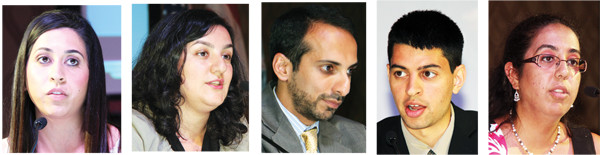
Panelists (from left) Behrose Taraporewalla, Trity Pourbahrami, Navroz Gandhi, Ervad Poruz Khambatta and Farzin Avari
To explain the concept of gender equality in the six Amesha Spentas, "the most powerful holy immortals,” which together with Ahura Mazda constitute the sacred seven, Dastur made the three male and three female youngsters on stage recite their corresponding attributes and the creations they represent. The masculine Amesha Spentas are Vohu Mana or the good mind; Asha Vahishta or absolute truth, righteousness and justice; and Kshathra Vairya or divine dominion, power and energy. The feminine divinities are Spenta Armaiti or divine service and devotion; Haurvatat or perfection; Ameretat or immortality. "Through righteousness may we see Thee, surround Thee and become one under Thee,” reinforced Dastur.
All of us can learn to shape our lives in accordance with Zarathushti core beliefs and principles, was the essence of Dr Anahita Dua’s presentation, citing recent instances from her life. A trauma surgeon who has travelled to India, Kenya, Palestine, Afghanistan, Peru, Haiti and the Congo on various medical missions, Dua appreciated that the Zoroastrian religion is characterized not by strict rules but by persuasive principles. Guided by Asha Vahishta she has taken decisions in the interests of her patients. In her quest for Kshathra Vairya she realized that she does not need to go abroad to make herself useful to society; she can make a contribution by taking care of Mother Earth. Showing images of her pitbull pup Chole, a stray dog, she explained how Spenta Armaiti guided her to take it under her care and tend to it. Aspiring to be the best in her profession with inspiration from Haurvatat, her goal for immortality or Ameretat she hopes to reach by performing deeds that will live forever, thereby multiplying good in the world.
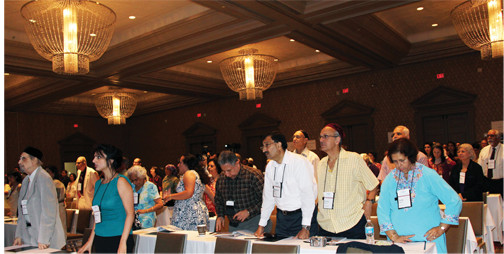
Audience on the first day of the Congress
"Service to humanity is service to God” and "Work is worship” are the two maxims that have guided Dr Khushroo Patel and his late wife Dr Roda. A pediatrician specializing in neonatology, Roda was diagnosed with cancer at the age of 43 but once she survived the disease she decided to share her medical skills with the poor children in the villages of Gujarat who had no access to healthcare, good nutrition, running water or electricity. For the cause of the Gram Seva hospital, children’s shelter and home she sold her own paintings to raise funds. From 1994 to 2011 she had collected $1.8 million for Gram Seva and as announced Khushroo, a cardiothoracic and vascular surgeon practicing in the US, his wife who "never wanted to touch a cheque became ‘a shameless beggar’ in her own words (exemplifying) her love for humanity in all forms.” Starting with 32 children, the Gram Seva project gradually expanded to cover over 5,000 children with Khushroo now serving on the board of Gram Seva Foundation, USA and Gram Seva Trust, Kharel, in Gujarat. Among their well-wishers is "one anonymous Parsi donor whom we have never met,” typifying the Zoroastrian value of charity.
The report on the second day’s panel discussion will appear in the next issue of Parsiana.
◆ ◆ ◆
From the archive