
Zoroastrians Abroad
Implications of identity
The panel discussion on the second day of the XVI North American Zarathushti Congress explored the practices and values that define a Zarathushti
"Is being Zarathushti a right or a privilege?” questioned Jimmy Kumana. He was the first of the eight panelists to share his views during the session on "Zarathushti identity” on the second day of the XVI North American Zarathushti Congress (NAZC) in New York on August 3, 2012. Joining him on the panel were Dr Ali Jafarey, Ervad Cawas Desai, Ferzin Patel, Ervad (Dr) Jehan Bagli, Ervad Kobad Zarolia, Mohsen Zandieh and Dr Parastu Dubash with Dr Keki Dadachanji serving as moderator. As explained in the Congress brochure, "This panel of eight Zarathushtis is a microcosm of the community at large, and holds diverse views on questions of Zarathushti identity. Over the last six months, these panel members have discussed the right questions to ask, listened to what others had to say, and in the end formed their own views. They will briefly describe this journey…”
The eclectic mix of progressive and traditional, male and female, Parsi and Iranian, priests, scholars and laymen on the panel was expected to help the audience "leave with a better understanding of issues,” as clarified Dadachanji, chairperson of the Congress Program Committee and a qualified mechanical engineer who gained diverse work experience after earning his doctorate in operations research. Teaching mathematics at High School in New Jersey following his retirement and taking a keen interest in the spiritual traditions of the world, Dadachanji mentioned that on the question of Zarathushti identity, "We become emotionally committed to our personal point of view. We draw boundaries instead of understanding others with complete attention and respect.”
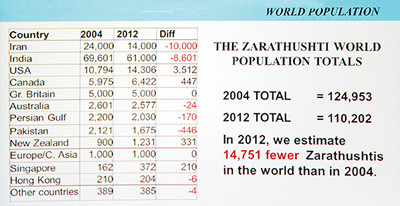
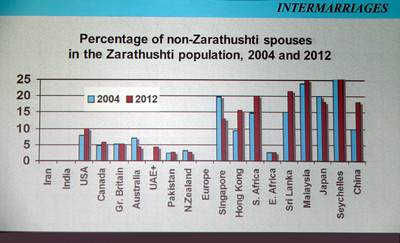
Some findings shared by Roshan Rivetna (for the bar chart, data for Iran and India was not available)
This session being intrinsically connected to the theme of the Congress "Zarathushti Existence in the Contemporary World,” the morning was reserved to understand different positions on the questions of "What is Zarathushti identity as defined in the Avesta? What are the attributes of an individual Zarathushti and of the community of Zarathushtis? What do we need to do to ensure that the teachings of Zarathushtra are understood and practised by future generations? What role does the navjote ceremony play in identifying a Zarathushti? How important are places of worship in strengthening our identity?” Prior to this Roshan Rivetna traced the growth of the community in North America and presented the results of the 2012 demographic survey of Zarathushtis worldwide.
Audience participation in this session was encouraged through questions from the floor as also the Audience Response technology when members of the audience were asked candid multiple choice questions, their clicker responses being instantly displayed as bar/pie charts on the giant screens before them to determine the pulse of the gathering. Whilst some feared that "giving voice to the audience could create chaos,” the organizers were convinced that collective deliberations would be welcome for "we are completely united in our goal of a glorious future for Zarathushtis.”
"Almost all religions convert,” pointed out Kumana, a chemical engineer with expertise in the field of industrial energy optimization who was actively involved in the organization of the last NAZC in Houston. Since all individuals are faced with multiple identities, he proposed that the primary identity should be Zarathushti and the sub-identity, Parsi. It is the intersection of three identities — religious, cultural and ethnic — that constitutes the Parsi identity, he explained, urging, "If we define ourselves in a different way we will find our numbers increasing. If you don’t broaden the definition you are finished.”
"Innate spirituality has no borders. Whilst borders separate mankind, spirituality molds behavior to oneself, to others,” declared Bagli, chairperson of the Research and Preservation Committee of the Federation of Zoroastrian Associations of North America (FEZANA) and immediate past president of the North American Mobeds Council (NAMC). According to him Zarathushtra was the first prophet to introduce the concept of one God as the creator of the universe. The Zarathushti identity would be typical of an individual who "expresses his religiosity through Vohu Mana (good mind)” and assumes the role of a "steward of the world, caring for the ecosystem, all creation, mankind, the underprivileged,” striving to promote "peace and harmony within and without.”
"Mankind is its own savior. Through self-correction one can become righteous,” reiterated Jafarey, co-founder of the Zarathushtrian Assembly and currently its honorary director of religious affairs. Believing that his main duty is to teach and preach Daena Vanguhi, the religion of Zarathushtra stressing on the good conscience, the nonagenarian has authored 23 books and booklets on the Zarathushti religion and ancient Iran with five new ones ready to go to press. "Don’t suppress the wrongful but try and win them over,” he enunciated the principles of existence with emphasis on Spenta Mainyu or the progressive mind as against Anghra Mainyu which should not be regarded as evil but retarding. Subsequently he mentioned, "We have forgotten how to be missionaries… We have to first learn the fundamentals of the religion, practise it and then teach another person.”
"All of us have an innate desire to belong… to develop an identity with distinctive traits and characteristics that are shared with others,” reminded Patel who initially worked as a clinician and healthcare administrator in the field of autism and developmental disabilities and is currently finance administrator in her husband’s law practice. Aspiring to bring the community together, she was earlier involved with the Zoroastrian Association of Greater Boston Area (ZAGBA) and subsequently on the board of the Zoroastrian Association of Greater New York and served as the Congress co-chair. In the course of her address the audience was asked "How recently have you attended a religious education class/presentation/lecture?” The responses indicated that 44 percent had attended over a year ago, 38 percent said in the last three months, nine percent stated in the last six months and 10 percent indicated in the last year. Referring to the "spiritual connection with people who share similar values and beliefs,” Patel recommended a "universal curriculum of core Gathic teachings for all regions” and noted that "positive religious experience starts at a very early age.”
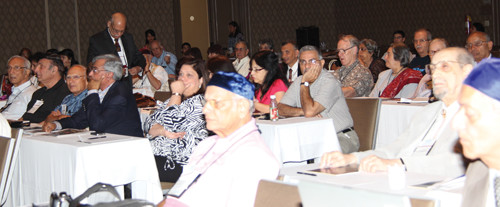
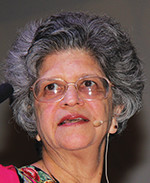
Roshan Rivetna (above) and a section of the audience on the second day
A navjote should be viewed as "a spiritual invitation to a lifetime of discovery,” conveyed Dubash who has taught at a number of colleges following her doctorate. Former president of ZAGBA, she initiated a successful fund-raising and community building calendar that is in its sixth year. The navjote ceremony should be expanded to make it more meaningful with the incorporation of an "address to the new initiate in the language of the family to make it more relevant and comprehensible.” Additionally "make the new initiate share thoughts and commitments with a promise of support for the journey ahead… If adults don’t have a strong background how can they expect the children to be passionate about their faith?” she questioned, supplementing, "In years to come we will be nothing more than a social dinner club unless we concentrate on our religious identity… No one can do everything, but everyone can do something.”
"We are the smallest religious community in the world. We are losing our members to other faiths in North America,” rued Zarolia, founder president of the NAMC, Ontario Zoroastrian Community Foundation and the Zoroastrian Cricket Club. Having twice served as president of the Zoroastrian Society of Ontario, the Toronto based priest knew of 65-75 people who have left Zoroastrianism to adopt the faith of their spouse. "Those who go to India, visit the agiary to get spiritually uplifted. Were our forefathers stupid to come to India and build so many agiaries? We were able to keep our identity as Zoroastrians otherwise we would have been Hindu or Muslim by now,” stated the strong advocate of a "place of worship in North America to which any Zarathushti can go.” Knowing of Zarathushtis in Canada who go to the Buddhist temple, Swami Narayan temple and churches for "spiritual upliftment” Zarolia added, "We have not given our children a place to do that. We should blame ourselves for having done the wrong thing for the last 50 years… A hundred years from today there will be no Zarathushti conferences because no Zoroastrians will be left.”
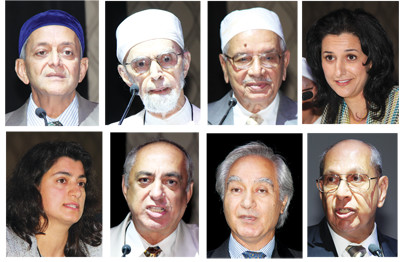
From left (top row): Jimmy Kumana, Ervad (Dr) Jehan Bagli, Dr Ali Jafarey, Ferzin Patel; (second row) Dr Parastu Dubash, Ervad Kobad Zarolia, Mohsen Zandieh, Ervad Cawas Desai; Dr Keki Dadachanji
"A Zoroastrian at heart,” Zandieh appreciated that 15-20 years ago he undertook the study of Zoroastrianism which he equated to "a journey,” under the inspiration of the Iranian Zoroastrian Anjuman, the California Zoroastrian Association and Jafarey. Owner of Arash Real Estate in New York and recipient of numerous community leadership awards including proclamation awards from the New York State Senate and Assembly and the New York City Council, Zandieh related instances from his personal life when he was witness to the Zarathushti spirit of performing good deeds through which he was able "to discover humanity.”
"Squandering our meager resources to build monuments to vanity would be a folly. Let us not languish in the ignorance of our religion but move forward in harmony,” asserted Desai who hails from the family that has served as ex officio trustees of the Navsari Bhagarsath Anjuman. A student of Zoroastrianism, Desai regretted that study books are either "too simplistic or abstruse. Have books translated from Gujarati to English so that the younger generation understands the grandeur of our religion.” How many in the audience have witnessed the performance of the ijashni ceremony? he enquired. When around five hands went up, he further probed, "How many know its metaphysical significance?” He further wondered how many youngsters can explain in a meaningful way questions in school concerning their faith. "We must be knowledgeable about the history and religion of our own community as also of the host community so that we don’t lose our religious identity in the host country in future,” he stated.
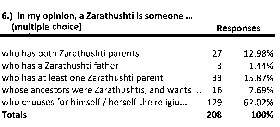
Through the Audience Response System it emerged that 67 percent of the gathering assembled in the Westchester Ballroom at the Hilton Westchester Rye Brook hotel were born in India or Pakistan as against 15 percent in Iran and 12 percent in North America. Although 76 percent were aged over 50, with 92 percent born to both Zarathushti parents, 39 percent viewed themselves as progressive, 37 percent as moderate, 13 percent as traditional and 11 percent not relating to any of those categories. When asked who should be recognized as a Zarathushti, 13 percent said those born of both Zarathushti parents, one percent felt at least the father should be a Zarathushti, 16 percent mentioned either parent could be a Zarathushti, eight percent believed those with Zarathushti ancestors and 62 percent opined that anybody who chooses for himself the doctrine of Zarathushtra.
The navjote ceremony can be performed at any age, expressed 62 percent of the audience whilst 38 percent felt that the upper age limit of 11 was appropriate for children of Zarathushti parents. If a person has not undergone a navjote but practices the Zarathushti way of life, 65 percent said he should be considered a Zoroastrian because he practices the tenets in his daily life, 29 percent stated that he is not a Zarathushti but they respect his way of life, and five percent mentioned that they cannot accept that person as a fellow Zarathushti.
When asked their reasons for following the Zarathushti religion, 36 percent said the teachings were uniquely suited to make one a better person, 30 percent stated it was as good as the other religions, 24 percent said because they were born in that religion, and 10 percent believed it is the best religion.
Regarding building of an atash kadeh in North America, 45 percent who favored the proposal felt it need not be consecrated, 27 percent supported the proposal but said it should be evaluated in relation to other priorities and resources, 23 percent felt it deserved the highest priority and four percent said it was not necessary.
Inability to attend religious education sessions for adults was primarily due to inconvenience of location and time, conveyed 37 percent. For 24 percent it was due to lack of interest, 15 percent said they don’t agree with the philosophy or ideology of the speaker, another 15 percent said the speakers were not knowledgeable and nine percent said the sessions were not interesting. If a monthly online course was introduced, 40 percent said they would definitely enroll and 45 percent mentioned that they would possibly enroll.
When asked to comment on the current trend of giving children unusual names, Zarolia responded that "we are massacring our own identity.” Although a name contributes "more to a cultural identity, when people know my name, dealings immediately change,” he added.
On the subject of Jews and Baha’is thriving vis-à-vis Zoroastrians it was explained that we could emulate the Jews who understand their religion and are able to pass on their learning to other members, and the Baha’is who are so welcoming that members of all races and colors are found among their ranks.
"How can parents be made to understand that a religion class for their child is more important than his baseball class?” enquired a religion class teacher. Another wondered how children can be expected to wear their sudreh-kusti when their parents don’t wear it. Advised Desai, "If you want to educate the children, first educate the mother otherwise we will end up as a footnote in history.”
"In Houston, priests don’t talk to each other because of religious beliefs. Religious leadership is missing,” conveyed a delegate from Houston. "We should be able to talk to each other without causing offence. We should feel love and empathy for anyone who wants to lead a life as a Zarathushti,” was the response. Spoke up Ervad Pervez Patel of New York, "Ours is not a missionary religion with priests taken care of from the cradle till the end of life. My dad as a full-time priest had a salary of Rs 75 after 60 years. Mobeds have come here (to the US) as professionals (in other fields). To expect them to deliver everything is not fair.”
Kaemerz Dotiwala of Texas noted that among Jews, those who marry out are lost to the community after four generations and the stream of Zarathushtis who proceeded to China don’t exist as Zarathushtis any more. He advocated the need for a safety net whereby the traditionalist view is safeguarded. Challenged Zarolia, "You cannot be a cafeteria traditionalist, keep what you want and throw out what you don’t. Where is your cap?”
When asked if the NAMC has prepared any blue print for building an agiary in North America, Zarolia informed that in "the last three years we have worked very hard and come out with a paper regarding consecration of an agiary. It is a collective decision. We don’t believe we need a Pope. We are respectful of each other and collectively decide what is good for the community.”
Demographic despair
"The world’s Zarathushti population has declined from 124,953 as estimated in 2004 to 110,202 as estimated in 2012. In 2012 our survey shows 14,751 fewer Zarathushtis in the world than in 2004, i.e. a drop of 11.8 percent in less than a decade,” declared Rivetna, former editor of FEZANA Journal and author of different FEZANA publications showcasing Zarathushti history, religion and culture. After earning her masters in nuclear physics she pursued a career at the Tata Institute of Fundamental Research, Argonne National Laboratory and AT&T Bell Laboratories. The decline in community numbers over the eight-year period is due largely to the estimated drop of 14,000 in Iran, 8,601 in India and 446 in Pakistan. The increase of 3,512 in USA, 446 in Canada, 331 in New Zealand, 210 in Singapore do not compensate for the losses "because the numbers in these countries are so much smaller compared to Iran and India.” The data that has emerged should "help community leaders in forecasting trends and formulating action plans,” it is hoped.
With the percentage of intermarriage in North America rising to nearly 60, the percentage of non-Zarathushti spouses in the recorded Zarathushti population has seen an increase in USA from 7.7 to 9.5 percent and in Canada from 4.7 to 5.6 percent. Other countries that have witnessed a significant rise are Hong Kong from 9.5 to 15.5 percent, South Africa from 14.9 to 20.1 percent, Sri Lanka from 15.2 to 21.6 percent and China from 10 to 18.2 percent. (The data for India was not available.) "It appears that there is a larger percentage of non-Zarathushti spouses in countries with smaller Zarathushti populations…” In Seychelles with a population of 21 Zarathushtis, there are nine non-Zarathushti spouses. They have 22 children in the community of which only three are brought up as Zarathushtis.
Countries with smaller Zarathushti populations (South and East Africa, Sri Lanka and Malaysia) also report much higher percentage of seniors, the highest being 60 percent in East Africa followed by 38 percent in Malaysia. In Mombasa (in East Africa) that has a population of 15 Zarathushtis, nine are aged over 65 and all are aged above 40. Countries reporting a much larger percentage of children (under 18 years of age) over seniors are New Zealand with 40 percent children and only three percent aged over 65, Singapore with 39 percent children as compared to nine percent seniors, Middle East with 30 percent children and seven percent seniors, and Hong Kong with 27 percent children and 16 percent seniors.
In the last 21 years there were 1,022 births as compared to 706 deaths in North America showing that the ratio of deaths per 100 births has risen from 51 to 104. In contrast the figures for Bombay show there were 3,456 births from 1992-2011 and 17,715 deaths giving a ratio that has risen from 303 deaths to 741 deaths for every 100 births. The fertility level of the community in India is 0.9 when required replacement level is 2.01.
Tracing the early history of Zoroastrians in North America by accessing the Peabody Essex Museum, Ellis Island Records, Caroline King’s memoirs, and other personal correspondence, Rivetna was able to ascertain that Ardeshir Cursetjee Wadia came to Boston in 1851 to start trade with the Americans, that US President Ullyses Grant had appointed Dossabhoy Merwanjee as vice consul 160 years ago, that Jamshed Pestonji Davar was the first Zoroastrian to be born in the US, that Bhicaji Balsara became the first naturalized US citizen in 1900, that 101 years ago inventor and medical healer Dinshaw Ghadiali carried a banner "Parsi Zoroastrian American Forever”… The subsequent decades saw Zarathushti academics, scientists, medicos, philanthropists, musicians establishing themselves on American soil making Rivetna comment, "In North America we have an awesome responsibility. Parsis and Iranians have to come together. We have the resources, do we have the will?”
Rivetna’s demographic profile has a separate section on "Zarathushtis by choice” wherein are shown 2,000 from Sweden/Europe and 1,832 in Belgium/Europe although she is not sure whether these numbers overlap. Her note at the end of the section quotes Mobed Kamran Jamshidi as estimating that "there are 20,000 Zarathushtis by choice in Europe and Central Asia who wish to be initiated.” As states Rivetna, "there is real need to do an in-depth analysis to obtain a count of the number of individuals in the world who have been initiated and follow the Zarathushti religion. This requires time and effort of developing and establishing reliable contacts…Whether we like it or not, there are people in this world who want to revert to their ancestral religion and practise the faith. This would include the Kurds who have set up a Kurdish Zoroastrian Temple in Sweden. They do not seek or need anybody’s permission to do so. The mainstream community needs to be prepared as to the numbers we are dealing with and our response to this phenomenon which is occurring and will continue to occur…We are truly becoming a world-wide community without borders and we need to know how many Zarathushtis are living and where within these invisible borders.”
The report on the third day’s panel discussions will appear in the next issue of Parsiana.
◆ ◆ ◆
From the archive