
Congress collage
Besides the main sessions, the concurrent programs and entertainment too amplified the theme of existence at the XVI NAZC
On offer through the concurrent session on the first day was "Zoroastrian Empires: Common Themes and Changing Circumstances” by Daulat Kotval and Dr Xerxes Kotval who have been conducting ZAGNY’s history class for teenagers. They analyzed the centralized government, religious and cultural tolerance, human rights and obligation to the people during the reigns of the Achemenid, Parthian and Sassanian rulers to determine how these factors led to the success or failure of these empires. Daulat who holds a Masters in Business Administration was working for the Chase Manhattan Bank and served on the boards of The Westchester Philharmonic Orchestra and The Guidance Center. An industrial engineer by training, Xerxes has spent the last 14 years as a researcher at Bell Laboratories.
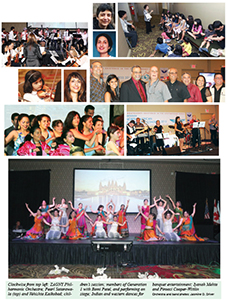
"The Effective Teaching of Religious Education” was handled at another interactive hands-on workshop where Daraius Bharucha delivered a brief lecture, then presented a lesson plan on a topic commonly taught to Zarathushti children, after which registered participants working in groups were encouraged to draw up their own model lessons. These lesson plans were shared with the rest of the participants so that at the end of the session all of them had classroom-ready resources. President of the Zoroastrian Society of Ontario (ZSO) and then chairperson of FEZANA’s North American Zoroastrian Congress Committee, Bharucha has been chair of ZSO’s Religious Education Committee and has been teaching religion for 17 years at community centers, schools and universities. Currently a high school history teacher with the York Region District School Board, he serves as a resource expert on the Zarathushti religion for school boards in the Greater Toronto Area.
Imparting religious education to children at separate sessions during the four days of the Congress were Pearl Satarawala and Vehishta Kaikobad. To match the agenda of the adult sessions, children aged five to 13 were made to do age-appropriate activities covering topics like ancient marvels, rituals and traditions with special emphasis on the navjote ceremony, Persian influence on ancient civilizations and world cultures. A teacher at the Montessori Children’s House in Verona, New Jersey, Satarawala has also been volunteering with the young children’s religious classes at ZAGNY. A Sunday School teacher for over two decades, Kaikobad serves as School Curriculum Coordinator and a Master Teacher for the Houston Montessori Center, and as a senior docent and teaching artist at the Museum of Fine Arts, Houston.
 The Zarathushti/Zoroastrian Women’s International Network (ZWIN) that has limited membership in 14 countries was seeking to reconsider its initiatives at its session "Our Vision Going Forward.” They were looking for audience feedback to expand their network, pursue their Elder Assistance Program, International Student Hospitality Program and creating an awareness of breast cancer prevention. A talk by counsellor Ushtavaity Davar Canteenwalla, who has experience in prenatal, pediatric, cardiac and cancer genetics, on "The Genetics of Breast Cancer — What You Need to Know” was scheduled to elaborate on the difference between sporadic, familial and hereditary cancers, when genetic testing and counselling should be considered, and when preventive measures adopted. Spearheading the discussion were ZWIN founder Dr Zareen Karani-Araoz who is a leading cross-border management consultant whose expertise on women’s issues has been sought by the United Nations, and Dr Dolly Dastoor, former president of FEZANA and currently editor-in-chief of the FEZANA Journal who attends meetings of the United Nations Commission on the Status of Women.
One of the suites in the vicinity was dedicated to Dr Saroja Voruganti, principal investigator from the Texas Biomedical Research Institute who was conducting a genetic study of Parsi Zarathushtis. In addition to administering questionnaires pertaining to the participants’ health habits, family and medical history, anthropomorphic measurements and blood pressure were measured during the Congress to identify genes that influence heart disease and other related conditions in Parsis residing in the US.
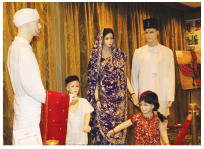
Whilst one room was reserved for the "Vendors” to market their wares, the Exhibit Room which had for its theme "From Then to Now” had a multitude of unique historical ceremonial objects, photographs and collages to relate the story of the Zarathushti religion, its core beliefs and heritage sites in Iran and India. A montage of photographs celebrated the success of different sections of the community in the diaspora and art canvases depicted the confluence of faiths in the contemporary world. A video offered glimpses of Zarathushti life and culture in India and the evolution of arts and handicrafts. In addition to a collage of North American darbe mehrs, there was also on display a model of the proposed Darbe Mehr in New York. The Exhibit Room was in the charge of Ashish Mirji, Percis Daruwala and Yasmin Pavri.
Inspiring interlude
For the FEZANA silver jubilee celebrations on the first night, Generation 1, the all Zoroastrian band from Houston provided non-stop music for almost three hours to keep the delegates entertained and dancing to a medley of songs that they had been practising for the last six months. Currently in its 10th year, Generation 1 was formed by Farrokh Firozgary, Rustom Challa, Aspy Jamshedji, Rustom Kanga, Raymie Daroga and Sonia Behrana to showcase the musical talent of the Zoroastrian community in Houston, according to a write-up by Aspi Colah. Due to relocation of some of the older members, new life was infused by male vocalist Eddie Behrana and young female rhythm guitarist and vocalist Ziba Colah. When Eddie was laid up after a major surgery, Nozer Buchia and his wife Persis stepped in.
 The "one-man band,” Dr Adi Tamboli entertained the audience on the second evening offering them a variety of Indian and western, jazz, hip-hop, movie themes and ballads. He is known to play up to eight keyboards at once, mixing a variety of musical genres. Settled in the US for the last nearly four decades, Tamboli has a thriving medical practice in pediatrics and allergy/immunology. It was his income from music that helped him pay his way through medical school in India, it was reported in the Congress brochure. Adding levity that night was stand-up comedian K-von, star of MTV’s hit show "Disaster Date.” With a father from Iran and a mother from middle-America, he is known to enjoy poking fun at himself to make people laugh.
For the final night banquet entertainment, the organizers had planned "A Hop-On/Hop-Off Tour of New York City,” with Adil Mistry and Freya Motafram serving as tour guides. "This customized, fully-guided tour will give you the total Big Apple experience and will include special performances dedicated to some of New York City’s greatest landmarks and neighborhoods,” announced the flyer inviting the audience to join them on "the ride of a lifetime.” Against the backdrop of the Darbe Mehr, Great Neck, Radio City Music Hall, Wall Street, Jackson Heights and Broadway, the young and enthusiastic dancers led by choreographers Natasha Dusaj, Tina Dukandar, Spenta Bamji, Zarina Bamji and Maryam Esmaeli covered the stage with verve and vivacity. Lending a professional ambience were Tara Jamshidian and Zal Shroff who sang with the Lincoln Center in the background, instrumentalists Neville Dusaj and Sarosh Mistry who showcased their talent with Carnegie Hall behind them, Shirin Kumaana-Wadia and Khan Hannan who performed their Latin American steps against the Spanish Harlem, and Cyrus Nentin and Neville Commissariat who performed their Letterwala Show amidst Midtown West.
At the closing ceremony on August 5, the highlight was the ZAGNY Philharmonic Orchestra performing under the baton of Piroozi Cooper-Wittlin, an oboist and English hornist who has played with several orchestras and currently teaches music in Hebrew and English at the Conservative Synagogue. What was particularly remarkable was that Piroozi had conducted the Orchestra 14 years earlier too when she ensured that no instrumentalist keen to perform was turned away. As noted the Congress brochure, "many who performed back in ’98 will play again...this time with their spouses and children!” Included in the Orchestra were 11 violinists, three cellists, eight keyboard players plus sole performers on the trombone, trumpet and viola. The youngest was little Iyanah Mehta who earned a special applause from the audience for joining the Orchestra in its rendition of Chhaiyé Hamé Zarathushti.