
Education
Ageless at the Alexandra
The Alexandra Girls’ English Institution steps into its 150th year with the launch of a special postal cover and other celebrations
The school opened with 13 girls (selected from 29 applicants!)on September 1, 1863, when the American Civil War was still on and slavery had not been abolished, when the British colonial masters had not brought even gas lights into the streets of Bombay and the first public transport — horse-drawn trams with horses wearing straw hats to shield them from the sun — arrived 11 years later!

On September 1, 2012, The Alexandra Girls’ English Institution entered the 150th year of its existence and kicked off its sesquicentennial (150 years) celebrations at the Y. B. Chavan Centre in Bombay with the release of a special postal cover at the hands of chief guest Darius Khambata, advocate general of Maharashtra, in the presence of guest of honor Abha Singh, director, postal services (headquarters) and invitees. On stage also were the founder’s great grandson Dr Sheryar Ookerjee, who is the chairman of the school board, and the other directors and trustees — Prof Khurshed C. Sheriar, Prof Aspi Doctor, Keti F. Mehta, Dr Jehangir B. Mistry and Dr Nawaz Mody. Seated on stage also were seven proud and happy Alexan-drians — one of them a spry 90, the others over 80 years old, whose association with the institution has spanned almost half the age of the school, both as students and staff!
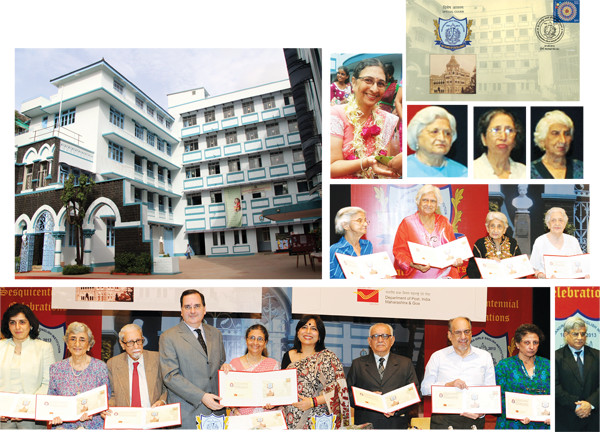
(Above) School crest; commemorative cover (ext right), school building (below) with old arches well preserved (Photo: Jasmine D. Driver), Freny Mehta (with garland), Dhun Khandalawala, Putli Pavri, Rati Hakim and (l to r displaying postal album) Silloo Billimoria, Freny Gimi, Nergish Patel and Villoo Mistry. (Bottom) At the release (from left) Kerman Khambata, Keti Mehta, Sheryar Ookerjee, Darius Khambata, Freny Mehta, Abha Singh, Khurshed Sheriar, Aspi Doctor, Navaz Mody and Jehangir Mistry (Photos: Nazneen K. Vajifdar)
The school had begun in an era when education for girls was greeted with closed minds and closed doors! The founder, Manockjee Cursetjee however was not a man to be daunted by the shrill screams of society or by the British raj! (It is pertinent to note that it was not till the 1880s that the education department of the government opened girls’ schools.) Manockjee’s own residence Villa Byculla became a small but secure alma mater to Indian girls from all castes and communities. His daughters, whom he had educated, were the teachers aided by an English head governess. With Cursetjee as president, the first board of directors comprised the cream of Indian society — K. R. Cama, E. D. Sassoon, Kursondas Mahdeodas, Cursetjee Nusserwanji Cama and Dossabhoy Ratanji Colah, who was honorary secretary. Through the years, eminent personalities have graced its board — Sorabjee Shapurji Bengali, Sir Pherozeshah Mehta, Justice K. T. Telang, Justice Badruddin Tyabji, Framjee Dinshaw Petit, Sir Ibrahim Rahimtoola, M.A. Jinnah who was a director around 1917 and many others.
As the arrow of time sped through 15 decades, the vocabulary, values and vision of education in India changed. The learning curve has moved from Shakespeare to Shivaji, three blind mice are long forgotten and replaced by the click of a mouse, nature study has come alive in high definition, worms and viruses cause not just people to be sick and monitors are screens, not girls! As part of the 150th year celebrations, Smart Class Technology has been introduced into classrooms from standard one to X, each class being fitted with an LCD projector, screen, computer and internet connectivity. The school has also launched its own website www.alexandragei.com
The challenges have been immense. Girls of sugar and spice and all things nice are constrained by the straitjackets of a marks-oriented educational system in India, leaving little room for creativity or individuality. Yet the school strives hard to provide its 1,100 pupils a few of their favorite things — bright and airy theme-painted classrooms with Disney, Jungle Book and fairy tale characters painted on the walls, the sound of music through the school band and choral singing, speech and drama as an integrated subject, judo classes, a gymnasium, sports, home science, the fun and discipline of its six Girl Guide companies (Girl Guiding having been introduced as early as 1924), camping and more. Cent percent SSC (Secondary School Certificate) results have long been a given — the highest this March was 93.09 percent and all 83 students secured distinctions or first class.
Despite the hurry and dash of everyday living, the school has a vibrant Parent Teacher Association which came into existence way back in 1955, among the earliest in schools in Bombay. For alumni, it’s back to school via the Ex-Students Association which was born in 1940!
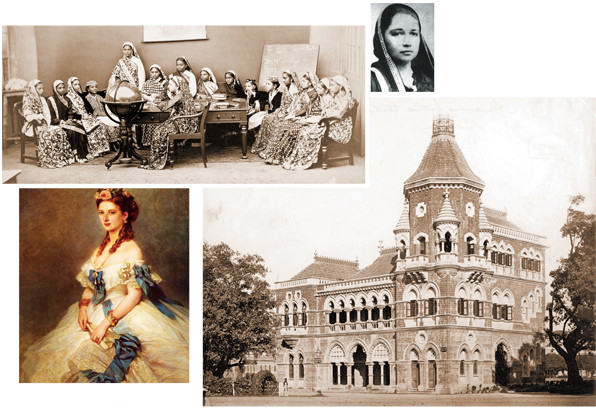
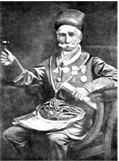
Founder Manockjee Cursetjee (above); class of 1873 in rich garas, famous alumnus Bhikhaiji Cama, old Albert Hall and Princess Alexandra
"I am humbled by the fact that I follow in the footsteps of Sarojini Naidu (who addressed the pupils on the school’s golden jubilee) and Dr S. Radhakrishnan (then vice-president of India, who presided at the annual prize distribution on March 26, 1960),” Khambata stated at the sesquicentennial inauguration. "The Alexandra Girls’ English Institution has played a critical role in the story of India. It has been liberal in outlook and modern in its methods.” Madame Bhikaiji Cama was a student of the school. "When she unfurled the flag (in Stuttgart), she risked her life to do so. There was the threat (of retribution by the British government) and she effectively sacrificed the rest of her life,” Khambata added. The advocate general also mentioned that he happened to read about another well-known student named Kamala Vijaykar who passed her matriculation in 1910. "She was the first female Hindu student of St Xavier’s College who went on to become an honorary magistrate, a rare achievement at that time, fighting prejudice and coming up the hard way.”
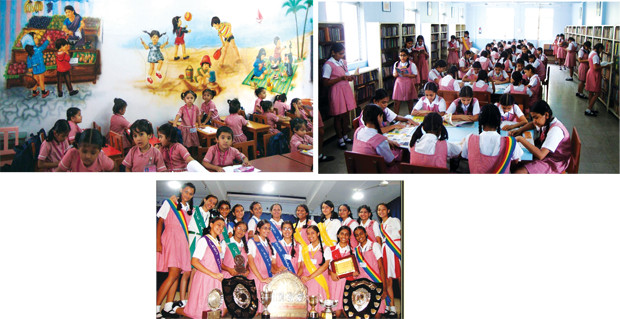
Bright and beautiful classroom, in the wonderland of library books, the joy of winning
Society still remains with strong gender bias, he told the rows of students seated up on the balcony. "I have no doubt about the emancipation of rural women who will be the fulcrum around which India will develop. They will be the key instrument of social and economic changes. The urban woman is the obvious mentor to whom rural women will turn,” Khambata observed. He briefly traced the landmarks in Bombay’s development — the establishment of Bombay University in 1857, the first street gas lights in 1865 and electrification in 1905… "Your girls were electrifying Bombay well before that! With age come history, tradition and responsibility. Solutions must no longer come from government. They must come from individuals. We go with folded hands to government saying ‘why has this not been done.’ In future it will be individual enterprise in agriculture, medicine, law, technology… that will see things done. We are so quick to hate, to highlight differences. We are still to shed bias even 150 years later. You (girls) will be equipped to demand what is your due. Burdens are made for strong shoulders and I’m sure the young ladies in the gallery can carry (the future),” the eminent lawyer asserted.
"The Bombay High Court has just celebrated 150 years, the postal department is older and like your school has a rich heritage. 150 years is not a small landmark,” Singh told the students. "If you were to ask for names of those who have made a mark in any field, eight out of 10 names even today will be men. Girls top in marks, but in the struggle for life, they often lack confidence. So make the best use of your education. Acquire knowledge and scientific temper.” Here is one girl, said Singh pointing to herself, whose parents taught her to gain a good education (and thus rise to a position of eminence in her career). Chatting (on Facebook) will not benefit you; use technology appropriately to get ahead in this male dominated world, the lady declared.
"It has indeed been a long and enriching journey for the institution we all love dearly,” stated Freny Mehta, who has steered the school as principal for 17 years. "I walked into its gates in 1995, straight from being just an ordinary teacher (in another school). I felt I was thrown into a deep ocean and that I would drown… (Slowly) I realized that this institution was different from others, it was very special, filled with warmth and affection and devotion and I felt reassured that I was indeed in the right place, among good people.” Alexandrians always were, and are, full of joie de vivre and mischief, she said. "Principals too have not been spared! Mani Engineer (who headed the school from 1974-1995 and had joined as teacher way back in 1948!) was fondly named ‘engine’ and ‘chook-chook’ and of course every time I tap the mike to make an announcement over the intercom, the students say ‘the FM (Freny Mehta) radio is on!”
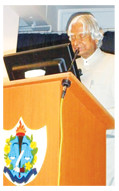
A. P. J. Abdul Kalam at peace meet
In his chairman’s address Ookerjee, who is himself an eminent educationist and professor of philosophy, commented on "the absurd teaching loads the government has imposed” on teachers. The situation can become worse in future, he believed, as "the recent Right to Education Act forbids denying promotion to any student from standard one to standard eight.” Irrespective of performance, the child has to be promoted to the next class. "This is a completely new concept in the field of education. But this is not Alice in Wonderland or a Gilbert and Sullivan opera. The reality is that this is being forced upon us. The children never had it so good; the teachers never had it so frustrating!”
The Right to Education Act also states that 25 percent of students have to be from economically weaker sections. "No doubt this is a laudable idea, that the less fortunate sections of society should receive a good education. But this is going to be a great financial burden,” Ookerjee stated. "Prizing our freedom from bureaucratic shackles, we have so far refused to take government aid. But if 25 percent do not pay fees, it will put a severe strain on our resources. Of course, the government will reimburse up to a point, but we don’t know when that will come.” Responding to this Khambata stated: "All major reforms start with controversy. Give it a go. We have to fashion and mold new solutions. Who knows, it might help the 25 percent underprivileged, but the 75 percent privileged could also benefit.” There are those who look at things the way they are and ask why; I dream of things that never were and ask why not? the advocate general concluded, quoting the famous words of Robert Kennedy.
The school’s history
In 1863, the school’s founder lost his eldest son Heerajee in a sudden death from cholera. At the uthamna on June 30, Manockjee (1808-1887) started a fund for the establishment of a school for girls, an idea he had been mulling for 25 years. Manockjee himself was the first Indian to be appointed to the uncovenanted civil service as assistant collector of customs in 1838. He then studied law and was one of the early Indian pleaders practicing in the Court of Requests and was later a judge at the Small Causes Court. He was the first Indian to be appointed sheriff of Bombay twice, notes the school’s history.
From its original location at Villa Byculla, the school moved two years later to hired premises on Hornby Road (now Dr Dadabhai Naoroji Road) in Fort, as Byculla was considered out of the way for a school to be situated! In 1878, Sir Richard Temple, Governor of Bombay, laid the foundation stone for the school’s new building known as Albert Hall, a stately structure in the neo-Gothic style, with its tall turret, elegant arches and ornate friezes, not forgetting the "jolly leering crocodiles” (gargoyles) on the façade! Albert Hall was ready by 1881 at Waudby Road (now Hazarimal Somani Marg) at the site where the school presently stands, with the Tata mansion next door. Interestingly, Albert Hall’s illustrious neighbors in the Fort area — the imposing edifices of Victoria Terminus and the Bombay Municipal Corporation — were completed in 1888 and 1893 respectively!
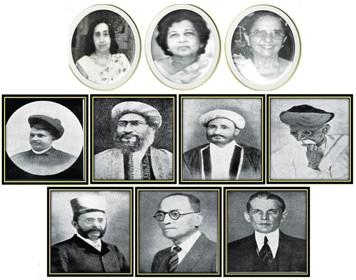
(Top row, from left) Gulestan Billimoria, Margaret Benjamin and Mani Engineer; (middle row) K.T. Telang, Badruddin Tyabji, Ibrahim Rahimtoola, Lallubhai Samaldas, (bottom row) Pherozeshah Mehta, Chunilal Mehta and M.A Jinnah
Manockjee had named his school not after himself but after the beautiful and gracious Princess Alexandra of Denmark who had in March 1863 married Albert Edward, then Prince of Wales (later King Edward VII) as he wanted the girls to have an ideal to look up to. The school was called The Alexandra Native Girls’ English Institution, after due permission had been received from Her Majesty Queen Victoria and the Prince and Princess of Wales. "The word ‘native’ at that time did not carry any pejorative (unsavory) meaning,” stated Ookerjee. "It merely meant ‘of the nation.’ (The word ‘Native’ was dropped from the name in 1916.) The first batch of students, all Parsis, passed the matriculation examination of the Bombay University in 1890. Gulestan Bahadurjee (later Billimoria) was the first Indian to be made principal in 1922, followed in 1937 by Margaret Benjamin and Engineer in 1974. Between them the three highly respected and doughty ladies steered the school for an amazing 73 years!
"How happy I was in my school. I joined in 1936 at around the age of six and passed Standard VIII (then the matriculation class) in 1947,” Dhun Khandalawala, who was one of the proud Alexandrians on stage, told Parsiana later on the phone. "There was no pressure of any kind. We got into trouble and out of trouble! Miss Benjamin was my principal and her example was enough for us to imbibe all the qualities we needed.” Khandalawala was also a teacher for 10 years and has continued to maintain her ties with the school through the annual competition for the Pesi Khandalawala Debating Trophy which she has donated in memory of her late husband.
"I am immensely proud of my alma mater. Whatever little I have achieved, if at all I have achieved, is entirely due to my formative years and the kind of education we received,” says Dadar’s Mithoo Jesia, an Alexandrian from the nursery class to matriculation in 1957. "We would listen to everything but were equally naughty,” she says, happily recalling the girlish giggles as classmates flicked gravel from the top floor on to passers on the road below, freezing as they were summoned downstairs to face the principal’s steely look! "My father Jal Pardivala (renowned for his work in the athletics field in India) was a sports teacher in the school for years and years,” she adds. "When the school song played in the auditorium (at the function), it brought tears to my eyes.”
"It is not yet given for every girl in our country to be in a good school. You are in a school that has over a century done splendid educational work,” Dr Zakir Hussain, vice president of India, had stated at the inaugural meeting of the centenary celebrations held at the Cowasji Jehangir Hall on November 8, 1963. "It has built up fine traditions. I hope you will maintain and make valuable additions to these traditions.” The sesquicentennial will see more celebrations throughout the academic year, ending with a grand show next April. "Gratitude unlocks the fullness of life; it turns what we have into enough and more,” head prefect Nainisha Oza told the sesquicentennial gathering in her vote of thanks. "Gratitude makes sense of our past, brings peace for today and creates a vision for tomorrow.”
◆ ◆ ◆
From the archive