
Cover Story
Living legacy
The Cursetjee family’s contribution to society is portrayed at The Alexandra Girls’ English Institution’s 150th Annual Day program
It was meant to be the pièce de résistance of the 150th year celebrations, which began last September with the release of a special postal cover. On April 22, 2013, at the Jamshed Bhabha Theatre at the National Centre for the Performing Arts in Bombay, girls of The Alexandra Girls’ English Institution unfolded in rhyme and rhythm, dance and drama the story of how the little candle of education lit for girls by the school’s founder Manockjee Cursetjee in 1863 still shines brightly. The first half entitled "And…the Legacy goes on” depicted the trials and tribulations Manockjee had to face to realize his dream and its moving message touched both head and heart. The second half was all sugar and spice with the baking of Alexandra’s 150th birthday cake, the stage a riot of color as senoritas flounced their flaming red flamenco skirts, busy little elves helped bring together the "bare necessities of all cake making recipes” — sugar, eggs, flour, cream, whipping up a concoction of delight for the performers and doting families in the audience!
Saying that she was "honored, humbled and extremely happy” to be invited as chief guest, Dr Firuza Parikh, renowned fertility expert and director, department of assisted reproduction and genetics, Jaslok Hospital and Research Centre, recalled with feeling the happy days she had spent at her alma mater. Remembering and acknowledging by name several of her teachers, she mentioned that it was her science teacher who had predicted many years ago that she would be a doctor! Keki Mistry, vice chairman and chief executive officer of the Housing Development Finance Corporation, had been invited as honored guest but could not be present as he was out of Bombay.
Saying that she was "honored, humbled and extremely happy” to be invited as chief guest, Dr Firuza Parikh, renowned fertility expert and director, department of assisted reproduction and genetics, Jaslok Hospital and Research Centre, recalled with feeling the happy days she had spent at her alma mater. Remembering and acknowledging by name several of her teachers, she mentioned that it was her science teacher who had predicted many years ago that she would be a doctor! Keki Mistry, vice chairman and chief executive officer of the Housing Development Finance Corporation, had been invited as honored guest but could not be present as he was out of Bombay.
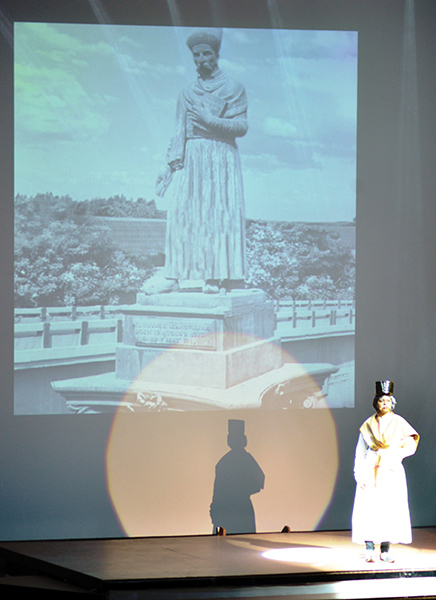
Khada Parsi statue and character recreated on stage
The story began with an audio visual of the "Khada Parsi,” the statue of Seth Cursetjee Manockjee Shroff (1763-1845), Manockjee’s father, who was a leading citizen of the time. (Located at Byculla, the statue itself is over 145 years old and, for the past few weeks, has been shrouded with gunny sacking. The Bombay Municipal Corporation, we are informed, is restoring the heritage artifact to its former glory.) In their production, Alexandrians unfolded on stage the story of the school, with the Khada Parsi brought to life as the narrator. With grand music, vivid lighting and evocative choreography, they depicted the pathetic plight of women through the ages — the practices of child marriage, female infanticide, sati (compelling widows to burn themselves on their husbands’ funeral pyres), the shunning of widows even after sati was banned and the stiff resistance to the idea of female education even in the late 19th century. The dramatic depiction left many in the audience somewhat shell shocked! "It takes a considerable leap of imagination for a woman of the 21st century to realize what her life would have been 150 years ago. We take for granted nowadays that almost any woman can have a career… can choose whether or not to marry and whether or not to have children and how many… Women of the mid 19th century had no such choices,” Khada Parsi’s sonorous voice narrated.
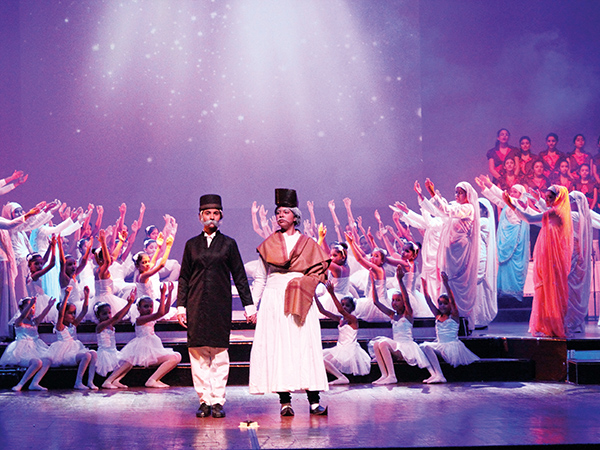
Main characters Manockjee (left) with father Cursetjee M. Shroff
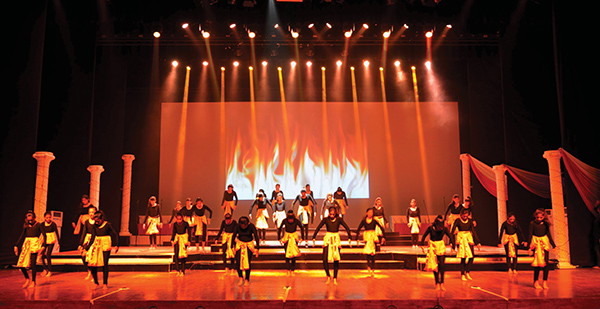
Portraying the pain of sati and oppression
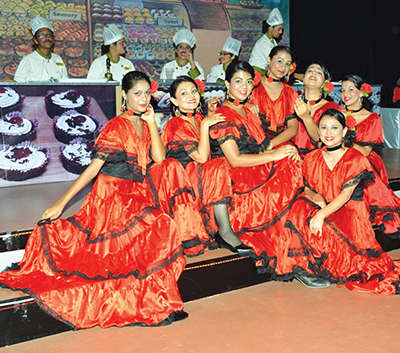
Sweet senoritas
The background
Speaking to Parsiana later, Freny Mehta, principal of the school, explained: "Over 500 students participated in this historic 150th Annual Day program. We got our school carpenter to build a stage the size of the one at the Jamshed Bhabha Theatre with four levels in the school compound so that the children could practice on it from the beginning. As mostly everything was done in-house, it was a colossal task. Right from the designing and making of the sets, the backdrop and props to tailoring the ballet costumes and ball gowns, the costumes of the ‘eggs,’ wings of the butterflies to making the accessories and headgear for the performers, everything was made by the staff of the school. It was a backbreaking and laborious job, but the result was there for all to see and admire.” What made you decide to do things yourself and not bring in an outside director? we ask. "When we have such fantastic and talented people on our staff, why would the idea of getting someone from outside even enter my mind? We have a super script writer and lyricist in Gulnar Tafti, our music teacher. Roomi Madon, our speech and drama teacher, is an excellent choreographer and directed our show. Our Alex Music Club teacher Kevin D’Souza is a wizard at training the choir and compiling the music. Our art teacher Hemal Ved and graphic designer Parwana Husain are professionals when it comes to designing and creativity and several of our teachers are excellent at craft. Thus we decided to go ahead on our own steam!” responds the lady who led from the front. In the final analysis, the thrill of creating the extravaganza was amazing, she adds. "We went as far as Dindoshi to get those pillars and chandeliers for our sets. But it was great fun too!”
Speaking to Parsiana later, Freny Mehta, principal of the school, explained: "Over 500 students participated in this historic 150th Annual Day program. We got our school carpenter to build a stage the size of the one at the Jamshed Bhabha Theatre with four levels in the school compound so that the children could practice on it from the beginning. As mostly everything was done in-house, it was a colossal task. Right from the designing and making of the sets, the backdrop and props to tailoring the ballet costumes and ball gowns, the costumes of the ‘eggs,’ wings of the butterflies to making the accessories and headgear for the performers, everything was made by the staff of the school. It was a backbreaking and laborious job, but the result was there for all to see and admire.” What made you decide to do things yourself and not bring in an outside director? we ask. "When we have such fantastic and talented people on our staff, why would the idea of getting someone from outside even enter my mind? We have a super script writer and lyricist in Gulnar Tafti, our music teacher. Roomi Madon, our speech and drama teacher, is an excellent choreographer and directed our show. Our Alex Music Club teacher Kevin D’Souza is a wizard at training the choir and compiling the music. Our art teacher Hemal Ved and graphic designer Parwana Husain are professionals when it comes to designing and creativity and several of our teachers are excellent at craft. Thus we decided to go ahead on our own steam!” responds the lady who led from the front. In the final analysis, the thrill of creating the extravaganza was amazing, she adds. "We went as far as Dindoshi to get those pillars and chandeliers for our sets. But it was great fun too!”
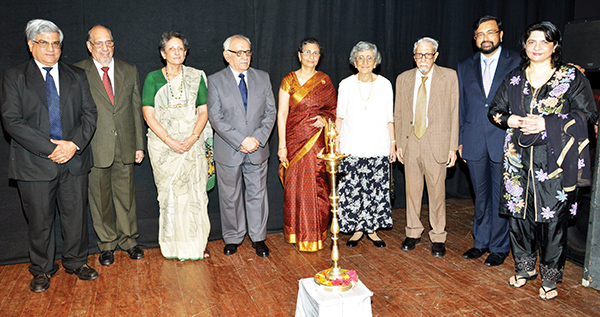
Dr Jehangir Mistry, Prof Aspi Doctor, Dr Nawaz Mody, Prof Khurshed Sheriar, Freny Mehta, Keti Mehta,
Dr Sheriyar Ookerjee, Drs Rajesh and Firuza Parikh
"Our original idea for the show was to give a small presentation of the school’s history. The second half was to be a musical like High School Musical, but adapted to our Indian schools, basically trying to show how parents push their children into fields of their (parents’) choice,” explains Tafti. Dr Nawaz Mody, one of the directors on the school board, encouraged them to work on the history of the school. "We (Madon and Tafti) went to the K. R. Cama Oriental Institute library and started our research. That was where I laid my hands on this small book by Cursetjee Manockjee Cursetjee (the founder’s son), telling us how the seed of female education was put into Manockjee’s mind when he went to the house of Capt Moresby,” Tafti relates. "Madon and I started writing the script together, with him telling me how he wanted to portray events. But it was his choreography and direction which brought the whole show alive! The contemporary choreography ideas were entirely his. The way the sati pyre was made (with dancers layered criss cross over each other), the infanticide, the child marriage…oof! It was meant to make the audience sit up and say ‘wow!’ A lot of people not directly connected to the school found the first part really moving, which is exactly what we were aiming for! And I’m really proud… For me the whole thing went like a dream,” Tafti remarks joyfully.
Madon took to theater in 1988 and says he has through the years written, choreographed and directed for more than 22 schools, as well as for colleges, corporates, etc. "I’m a self prodigy,” he grins. "Except for pure classical I know all dance styles.” This show was an experience of a lifetime, he says, because he went back in time, researching Manockjee’s roots. Bubbling with energy and enthusiasm, Madon is adept at dealing with large numbers of children at a time, molding non-dancers and non-actors into performing like professionals! "When you love your work, there is no problem. It’s my pleasure teaching children!” he declares.
The legacy
It was around the mid 1830s that Manockjee, perturbed by the great contrast between the elegant English ladies who wined, dined and danced alongside their menfolk, made it his mission to educate not just his own daughters but other native (Indian) girls as well. Resistance from his own and other communities was relentless. Manockjee nevertheless employed an English governess to educate his eldest daughter Kooverbai in English and music, but tragedy struck four years later when Kooverbai passed away at a young age.
Undeterred, Manockjee sent his two younger daughters Aimai and Serenebai to Mrs Hinton’s English School. Relatives and friends taunted him, reminding him that they were under British rule and that opening a school for native girls would require funds, permissions and licenses. But Manockjee’s efforts found unexpected allies. In a speech on March 3, 1860, Lord John Elphinstone, governor of Bombay, stated: "Manockjee has set an excellent example to his countrymen by educating his own daughters (and) moved by a generous wish that others should participate in what he feels to be the blessings he has conferred upon his own children, has set afoot a plan for establishing a school for native young ladies in his own house… and his daughters Aimai and Serenebai shall assist in the noble task … I need scarcely say that I wish him all success and all honor in his enterprise…” On June 28, 1863, Manockjee’s eldest son Heerajee died of the dreaded cholera. Distraught but determined, on the day of Heerajee’s uthamna, Manockjee started a fund with his own contribution of Rs 4,000. Liberal minded stalwarts of society supported him.
It was around the mid 1830s that Manockjee, perturbed by the great contrast between the elegant English ladies who wined, dined and danced alongside their menfolk, made it his mission to educate not just his own daughters but other native (Indian) girls as well. Resistance from his own and other communities was relentless. Manockjee nevertheless employed an English governess to educate his eldest daughter Kooverbai in English and music, but tragedy struck four years later when Kooverbai passed away at a young age.
Undeterred, Manockjee sent his two younger daughters Aimai and Serenebai to Mrs Hinton’s English School. Relatives and friends taunted him, reminding him that they were under British rule and that opening a school for native girls would require funds, permissions and licenses. But Manockjee’s efforts found unexpected allies. In a speech on March 3, 1860, Lord John Elphinstone, governor of Bombay, stated: "Manockjee has set an excellent example to his countrymen by educating his own daughters (and) moved by a generous wish that others should participate in what he feels to be the blessings he has conferred upon his own children, has set afoot a plan for establishing a school for native young ladies in his own house… and his daughters Aimai and Serenebai shall assist in the noble task … I need scarcely say that I wish him all success and all honor in his enterprise…” On June 28, 1863, Manockjee’s eldest son Heerajee died of the dreaded cholera. Distraught but determined, on the day of Heerajee’s uthamna, Manockjee started a fund with his own contribution of Rs 4,000. Liberal minded stalwarts of society supported him.
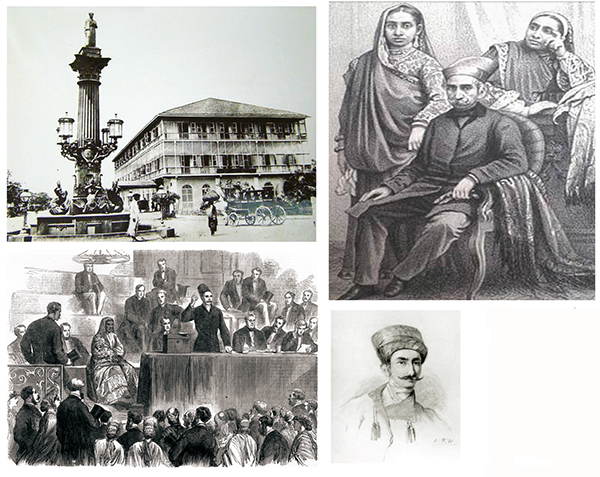
Top row: Old view of Khada Parsi memorial fountain, school founder Manockjee with daughters Aimai and Serenebai;
(second row, left) Manockjee speaking at social science congress in Sheffield and pencil and chalk sketch of young Manockjee
On August 20, 1863, he wrote to Edward Howard, director, public instruction: "What we are now attempting to achieve is to found an Institution for the first time, novel and unique in its constitution, stupendous in its importance, and noble in its designs, to bring about a thorough change — moral, intellectual and social — in our future mothers, sisters and daughters… We have oppositions to encounter; prejudice to conquer. But I trust to and my sole reliance in this (as in all my undertakings) is the great God of all nations and all beings.”
Manockjee also wrote to Queen Victoria, seeking permission to name his school after Princess Alexandra who had recently wed the Prince of Wales, receiving in response the Queen’s commendation: "I am particularly pleased to hear you have honored this day by commencing, in celebration of it, the benevolent work of establishing an English school for the native women... No more useful or charitable work could be undertaken...” The school formally opened on September 1, 1863 at Manockjee’s home known as Villa Byculla (see "Ageless at the Alexandra,” Parsiana, September 21, 2012).
Looking to move to larger, permanent premises, Manockjee was hard put to raise funds, with the American Civil War adding to his difficulties. In 1867, he sailed for England and, while he was there, organized a grand bazaar in aid of the building fund, with the Princess Alexandra herself contributing to his cause. He held yet another bazaar later on the occasion of the Duke of Edinburgh’s visit to Bombay, with the Duke gracing the occasion. The imposing Gothic school building designed by Khan Bahadur M. C. Murzban and named Albert Hall was inaugurated at 1, Waudby Road, the present location in 1881. (In the 1960s, the Gothic structure was demolished as it was declared unsafe for students and a new building was constructed.) Manockjee died on December 6, 1887. By then the school was well established and the legacy lives on…
The Cursetjee connection
As was the wont of well-to-do Parsis in colonial times, the Cursetjees comfortably bridged the divide between the British and the Indian communities. "Cursetjee Manockjee (Khada Parsi) who died in 1845 was one of the most notable men of his time in Bombay, both Europeans and natives holding him in high estimation,” notes The Art Journal (1875-1887). "By the Parsi community, he was regarded as their patriarch, having for many years held a very prominent position in their Punchyat, a tribunal for the internal government of the body.” Cursetjee was among the few who had knowledge of the English language and he began life as an English writer with Andrew Ramsay, who subsequently became the governor of Bombay. Cursetjee later became a ship-owner, trading with Arabia and Bengal and was also "entrusted by the Government with some of their important army and navy contracts. His later days were much occupied in the work of improving the domestic customs and habits of the Parsees.”
"Judge Manockjee Cursetjee… is well known in the Presidency for his love of English literature, for his travels in Europe, as he is also for his great efforts in the cause of education and reform among the natives of India, and particularly among the female population…” the Journal continues. The worldwide web mentions several publications under Manockjee’s name. A Few Passing Ideas for the Benefit of India and Indians (1862); The Parsee Panchayet: its rise, its fall and the causes that led to the same: Being a series of letters in the Bombay Times of 1844-45 under the signature of Q in the corner (though some doubt exists whether Manockjee is the author or compiler of this — editors); A fracas between an advocate and an administrator of justice in the Sudder Dewany Adawlut, Bombay, 1853 and might vs. right; Report of the bazaar on behalf of the Alexandra Native Girls’ English Institution, held at Bombay, in 1871; Correspondence between Manockjee Cursetjee and English Royal Officials Concerning the Foundation of the Alexandra Native Girls’ English Institution, Bombay and several other reports showed the sincerity of his style of functioning. He even wrote to the secretary of state for India when he felt he was being unjustly treated by one of the British advocates in his court, prompting Lord Chelmsford to take up the matter in the House of Lords in London, so that no injustice was done to one of the native judges whom he considered a "zealous and high-minded servant of the public.” "All this is entirely in character with what we know about Manockjee,” says his great grandson and present chairman of the board Dr Sheriyar Ookerjee. "But unfortunately we do not know enough about him.”
The archives of the prestigious National Portrait Gallery in London show a pencil and chalk sketch of Manockjee done by William Brockedon in 1841. An antique print of the feisty gentleman speaking at the social science congress at Sheffield in 1865 on the subject of education in India can also be seen on the web. "Manockjee visited libraries abroad, including Russia, and is said to have donated rare manuscripts to them,” adds Ookerjee.
Few are aware that the Khada Parsi is a replica of the prizewinning memorial fountain commissioned by the Chilean government that Manockjee had seen and admired at the International Exhibition in London in 1862. Manockjee ordered a similar one to be made, with a statue of his father on top instead of the original figure of Ceres. It reportedly cost Rs 20,000 at that time! It has long stood in solitary splendor at Byculla, with flyovers on each side. Cars whiz and buses whine their way up the incline of Byculla Bridge, with occupants throwing fleeting, disinterested looks at the pigeons perched on his pugree. The soaring Corinthian column still stands over 40 ft tall, but the four large ornamental lamps are missing! At the base the curvaceous figures, once the fountainheads of clean, clear water, are but pegs for the grimy clothes of pavement dwellers. The Khada Parsi stands in silence, awaiting the dawn of restoration.
As was the wont of well-to-do Parsis in colonial times, the Cursetjees comfortably bridged the divide between the British and the Indian communities. "Cursetjee Manockjee (Khada Parsi) who died in 1845 was one of the most notable men of his time in Bombay, both Europeans and natives holding him in high estimation,” notes The Art Journal (1875-1887). "By the Parsi community, he was regarded as their patriarch, having for many years held a very prominent position in their Punchyat, a tribunal for the internal government of the body.” Cursetjee was among the few who had knowledge of the English language and he began life as an English writer with Andrew Ramsay, who subsequently became the governor of Bombay. Cursetjee later became a ship-owner, trading with Arabia and Bengal and was also "entrusted by the Government with some of their important army and navy contracts. His later days were much occupied in the work of improving the domestic customs and habits of the Parsees.”
"Judge Manockjee Cursetjee… is well known in the Presidency for his love of English literature, for his travels in Europe, as he is also for his great efforts in the cause of education and reform among the natives of India, and particularly among the female population…” the Journal continues. The worldwide web mentions several publications under Manockjee’s name. A Few Passing Ideas for the Benefit of India and Indians (1862); The Parsee Panchayet: its rise, its fall and the causes that led to the same: Being a series of letters in the Bombay Times of 1844-45 under the signature of Q in the corner (though some doubt exists whether Manockjee is the author or compiler of this — editors); A fracas between an advocate and an administrator of justice in the Sudder Dewany Adawlut, Bombay, 1853 and might vs. right; Report of the bazaar on behalf of the Alexandra Native Girls’ English Institution, held at Bombay, in 1871; Correspondence between Manockjee Cursetjee and English Royal Officials Concerning the Foundation of the Alexandra Native Girls’ English Institution, Bombay and several other reports showed the sincerity of his style of functioning. He even wrote to the secretary of state for India when he felt he was being unjustly treated by one of the British advocates in his court, prompting Lord Chelmsford to take up the matter in the House of Lords in London, so that no injustice was done to one of the native judges whom he considered a "zealous and high-minded servant of the public.” "All this is entirely in character with what we know about Manockjee,” says his great grandson and present chairman of the board Dr Sheriyar Ookerjee. "But unfortunately we do not know enough about him.”
The archives of the prestigious National Portrait Gallery in London show a pencil and chalk sketch of Manockjee done by William Brockedon in 1841. An antique print of the feisty gentleman speaking at the social science congress at Sheffield in 1865 on the subject of education in India can also be seen on the web. "Manockjee visited libraries abroad, including Russia, and is said to have donated rare manuscripts to them,” adds Ookerjee.
Few are aware that the Khada Parsi is a replica of the prizewinning memorial fountain commissioned by the Chilean government that Manockjee had seen and admired at the International Exhibition in London in 1862. Manockjee ordered a similar one to be made, with a statue of his father on top instead of the original figure of Ceres. It reportedly cost Rs 20,000 at that time! It has long stood in solitary splendor at Byculla, with flyovers on each side. Cars whiz and buses whine their way up the incline of Byculla Bridge, with occupants throwing fleeting, disinterested looks at the pigeons perched on his pugree. The soaring Corinthian column still stands over 40 ft tall, but the four large ornamental lamps are missing! At the base the curvaceous figures, once the fountainheads of clean, clear water, are but pegs for the grimy clothes of pavement dwellers. The Khada Parsi stands in silence, awaiting the dawn of restoration.
◆ ◆ ◆
From the archive