
Cover Story
“The nearest and the best”
The Gamadia and Bengallee Girls’ High Schools pioneered the education of Zoroastrian girls over 150 years ago
Some didn’t finish school and were married off, others completed their School Leaving Certificate (SLC) examination and took up jobs because they could not afford higher studies. A few went on to graduate from college. They were among the lucky women to be educated in the early to mid 1900s.
On March 22, 2008 former and present students from the Bai Bhikhaijee Shapoorjee Bengallee Girls’ High School and the Bai Manekbai Nowrosji Gamadia Girls’ High School gathered at Allbless Baug to mark 150 years of the establishment of the Parsee Girls’ School Association that runs the two institutions.
"My father did not want me to study,” recalls Daulet Firoze Mugaseth (née Cowasjee Billimoria) who resides in Cusrow Baug. Her mother was illiterate and her father partly literate, she says. "A lady’s place is at home,” he believed. After completing school she worked in the finance department of the National Savings Certificate section of the Government of India. She then worked for an architect’s firm before joining ICICI where she was employed for 22 years. "I worked for 42 years on the whole.”
Her schoolmate, Khorshed Maneck Kutar (née Jamshedji Colah), who lived at Gowalia Tank, like Mugaseth could not afford to go to college and took a course in shorthand and typing. She "got a very good job in a British Company,” British Drug which later merged with the pharmaceutical giant Glaxo.
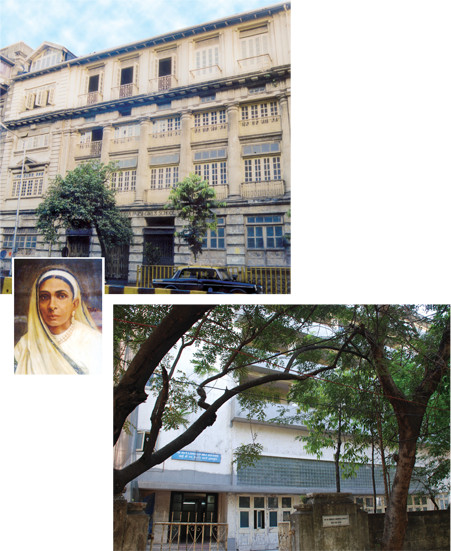
Above: Portrait of Bai Manekbai Nowrosji Gamadia and facade of the School named after her. Right: Bai Bhikhaijee Shapoorjee Bengallee Girls’ High School
Mehru Birdy who then resided in Colaba was fortunate enough to attend college. "My grandmother said women must be educated,” she recalled. "After college I joined British Airways” (then British Overseas Airlines Corporation) and remained with them till she retired 30 years later.
Mugaseth in turn says she was able to send her children "to the best of schools.” Noting how comparatively economical her school was (fees were seven rupees a month for the seventh grade, eight rupees for the eighth grade and so on) she mentions that her grandson has to pays Rs 20,000 to Rs 30,000 annually to attend a playschool. "For 25,000 rupees we could have got a daughter married” in those days, she says.
When Gamadia School started, it was basically "a training school for ladies,” says Birdy, "SSC nai hatoo (no SSC) …cooking, tailoring, singing, religion,” were some of the subjects taught. A young and an old "Dastur Kutar” taught the girls. "The younger one was more popular. He would tell us tales, show us pictures. The older one was more strict,” recalls Birdy.
Those completing the course at Gamadia had to opt for Bengallee if they wanted to complete their SLC/SSC. Gamadia subsequently added the required classes.
The Bengallee Girls’ School received a setback around 1960 when at the time of bifurcation of Bombay state into Gujarat and Maharashtra, the medium of instruction changed from English to Gujarati, says Mugaseth. And even though Bengallee’s "standard (of education) was higher,” as noted Mugaseth, Kutar and Birdy many Parsi/Irani parents pulled their children out of the School.
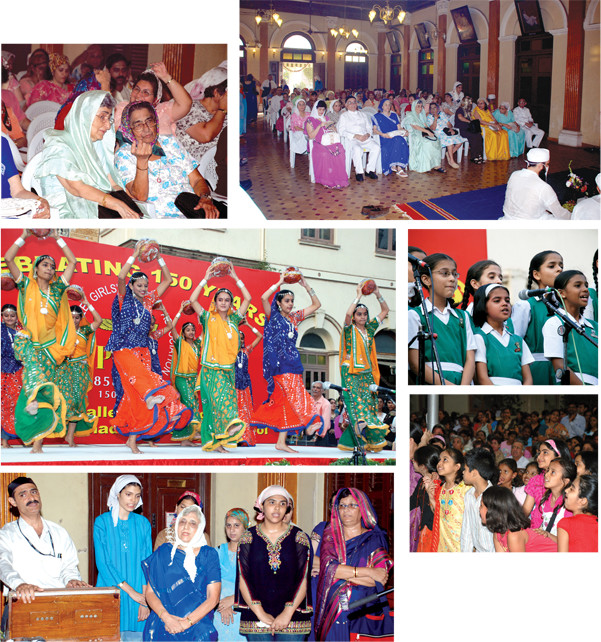
Top left: Keti Mehta and Mehroo Bengalee; Right: Audience at the jashan ; Students and others performing and enjoying the evening program
"English is most important,” they note. Employment avenues opened to those who spoke the language well, they believed.
The oldest student present at the evening gathering was 89-year-old Arnavaz Patel (née Choksi). "She is very proud of her School,” said her daughter Mehroo. Arnavaz never finished school and was married. But Mehroo notes her parents "wanted me to go to school. And Gamadia was the nearest and the best.”
The family lived at Marine Lines and Arnavaz would leave her daughter, now an advocate and notary, at the School. Unmarried, Mehroo says if she had a daughter she would have put her in Gamadia. She attributes the drop in the number of Parsi/Irani students at the two schools to the "airs” parents have today.
An anonymous ex-student of the Bengallee School of the years 1938-1945 writing in the Jam-e-Jamshed Weekly of March 23, 2008 stated, "Previously the School was situated at Sir Phirozeshah Mehta Road in a one-floor structure with balcony on both sides. In those days the School catered to only Parsi girls. A Parsi cap was compulsory. Till 1945 students did not appear for the then Matriculation exams. Though the medium of instruction was English, French, algebra and geometry were not included in the curriculum. Subjects included cookery, laundry, tailoring, embroidery, flower making, arts and crafts, etc…
"There were hardly 10 to 15 girls in a class. There was close communication between the teacher and the taught. In those days, teaching was a noble profession and educated ladies from the Parsi community mostly preferred teaching as their profession.”
Rati Wadia, former principal of Queen Mary School and a member of the Association’s managing committee said that parents today were "looking for high standards of English” when selecting schools. Parents also preferred schools that offered the ICSE course instead of SSC because the English language requirements were stricter.”
When managing committee member Keti Mehta was asked why her parents sent her to Fort Convent instead of a Parsi school, she replied, "My parents’ thinking was different.”
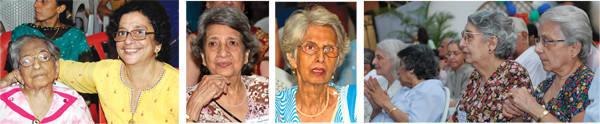
Above (left): Arnavaz and Mehroo Patel, Khorshed Kutar and Mehru Birdy; Above (second from right): Daulet Mugaseth;
Trustee Minoo Billimoria notes both schools achieved 100 percent success in the SSC examination. Gamadia School students all passed with a first or above. The two schools have a combined strength of 1,240 (Gamadia 636, Bengallee 604) girls, noted the chartered accountant.
Parsi/Irani students were "not many,” he says. Bengallee’s last two Parsi students passed out this year. There are no Zoroastrians enrolled in the School now. Gamadia has a few. "People used to live here (near the schools).” Now they go to the suburban schools, as many have shifted residence away from South Bombay.
The schools still have Zoroastrian principals and a few teachers and staff members who are Zoroastrian. The principal of the Gamadia School is Roshni Irani and the Bengallee School, Kashmira Bulsara.

Minoo Billimoria showing facsimile page of website
Two floors of the Bengallee School were rented out decades ago to the New India Assurance Company as the School required the rental income. The company in turn reportedly handed the floors over to the civil supplies department of the government. A suit has been filed for eviction. "We need the two floors badly” for developing the School, says Billimoria. There are no plans for a junior college, says the trustee.
Gamadia is a government aided school but not Bengallee. The government salary grants for teachers used to be inordinately delayed, so after securing approval from the parents, the fees were raised, notes Billimoria. A history of the Parsi Girls’ School Association by educationist Zenobia Dumasia will be brought out in the 150th year with support from the Dorab Tata and J. N. Tata Endowment Trusts and the assistance of Dr Nawaz Mody. Dumasia was former head of the history department at Elphinstone College.
"There were a number of schools in the Fort area” founded by the Association, says trustee Kersi Treasurywala. "Some could have been just one or two rooms… we don’t have any records.” The other two trustees are president Adi Mulla and Kersi Commissariat. An 11-member managing committee looking after the offices and finances of the Schools comprises: Piloo Kolah, Prof Khurshed Sheriar, Keti Mehta, Hoshang Wania, Dr Nawaz Mody, Pearl Pastakia, Rati Wadia, Dr Gulestan Kerawalla, Jimmy Khan, Zenobia Daroga and Dr Simoneel Gamadia.
The function saw the launch of three websites to cater to the alumni, parents and students of the Schools. These are: bengalleeschool.org, parseegirls.org and gamadiaschool.org.
The beginnings
(A brief history of the Schools sent by the Association)
The first girls’ schools in Bombay were set up by the Christian missionaries in 1824. However, there was considerable opposition to these schools, and respectable families refused to send their daughters to these schools because of the fear of conversion. It was left to the Parsis to take the initiative in developing female education in Bombay city and western India.
In 1848, the Students’ Literary and Scientific Society was set up under the leadership of four distinguished Elphinstonians — Dadabhai Naoroji, Nowrojee Furdoonjee, Sorabjee Shapoorjee Bengallee and Bhau Daji. Their most significant contribution was the sponsoring of female education. In October 1849, four Parsi girls’ schools together with three Marathi girls’ schools were set up by the Society. Each of these was run by two volunteer teachers recruited from among the students of the Elphinstone Institution. At first, the schools were kept open for only a few hours in the morning and the number of children attending was few (only 44 ). By 1855, the four Parsi schools had 475 pupils. It was then decided to form a separate association to look after the Parsi girls’ schools. On February 10, 1857, a provisional committee of the Parsi Girls’ School Association was formed for the purpose of arranging for their transfer, which finally took place on July 21, 1857. Eight months later, on March 23, 1858, at a general meeting of the subscribers, Kharshedji Nasarvanji Kama, Framji Nasarvanji Patel and Byramjee Jeejeebhoy were nominated trustees of the Association.
Of these schools, two became particularly important — The Bengallee Girls’ High School, which was earlier known as the Fort Parsi Girls’ School and The Gamadia Girls’ High School, which was the Chandanwadi Girls’ High School. At first, the two Schools did not have suitable premises. Therefore, in 1882, Sorabjee Shapoorjee Bengallee contributed a sum of Rs 66,787 towards the construction of a new building to be named after his mother, Bai Bhikhaijee Shapoorjee Bengallee. It was supposed to be one of the best furnished schools in those days. Similarly, in 1915, Nowrosji Jehangir Gamadia donated Rs 50,000 for the erection of a building to house the Chandanwadi School to be named after his wife, Bai Manekbai Nowrosji Gamadia.
They are amongst the oldest of the girls’ schools in Bombay.
◆ ◆ ◆
From the archive