
Education
Timely lessons
The Alexandra Girls’ English Institution ends its sesquicentennial celebrations with the burial of a time capsule
It’s a case of teaching history and making it too! As the finale of its 150th year celebrations, The Alexandra Girls’ English Institution buried in the school grounds on March 31, 2014 a time capsule, reportedly the first educational institution in India to do so. The time capsule is slated to be opened on September 1, 2062 when the school enters its 200th year!
Amidst flowers, buntings and the bright trilling of the school band, strong hands lowered the specially made container into the prepared pit to cheers and claps from excited schoolgirls, parents, ex-students and invitees, with many grey-haired seniors too braving the scorching sun of an April morning in Bombay to get a firsthand view! Live streaming of the event was watched by those seated in an adjacent hall of the school. "We had planned to do this in December ’13, but we postponed it due to the hospitalization and later the sad demise of our dear chairman Dr Sheryar Ookerjee, the great grandson of the founder Manockjee Cursetjee,” said Freny Mehta who has been principal for 19 years. "He (Ookerjee) used to call it ‘Freny nu time capsule’ and was so intrigued he would often ask me what I was going to put inside and how I was going to handle the project.” Though Keti Mehta, the current chairperson, could not attend due to ill health, directors Prof Khurshed Sheriar, Aspi Doctor and Dr Jehangir Mistry were part of the historic occasion.
Amidst flowers, buntings and the bright trilling of the school band, strong hands lowered the specially made container into the prepared pit to cheers and claps from excited schoolgirls, parents, ex-students and invitees, with many grey-haired seniors too braving the scorching sun of an April morning in Bombay to get a firsthand view! Live streaming of the event was watched by those seated in an adjacent hall of the school. "We had planned to do this in December ’13, but we postponed it due to the hospitalization and later the sad demise of our dear chairman Dr Sheryar Ookerjee, the great grandson of the founder Manockjee Cursetjee,” said Freny Mehta who has been principal for 19 years. "He (Ookerjee) used to call it ‘Freny nu time capsule’ and was so intrigued he would often ask me what I was going to put inside and how I was going to handle the project.” Though Keti Mehta, the current chairperson, could not attend due to ill health, directors Prof Khurshed Sheriar, Aspi Doctor and Dr Jehangir Mistry were part of the historic occasion.
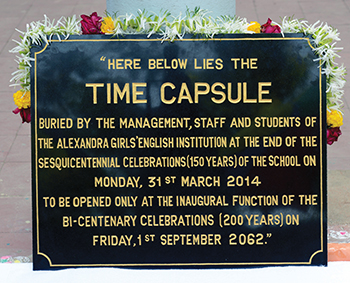
Granite plaque
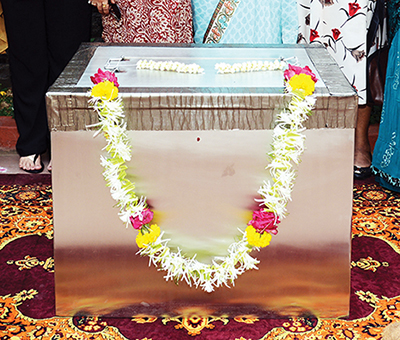
Ready container
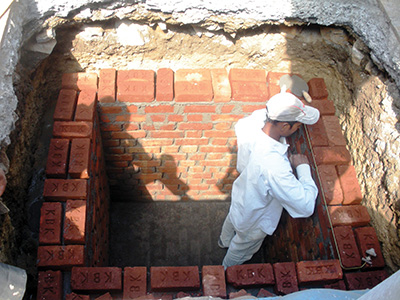
Pit being prepared
"Many of my young students and young staff members here today are the inheritors of this time capsule. They will be alive and well and can congregate here (48 years later) at the inaugural function of their school’s bi-centenary celebrations to see the time capsule being opened and will have so many memories to share with those opening it!” Mehta told the gathering. The Institution has much history to encapsulate, having maintained meticulous records in its library and history room. Among the memorabilia in the capsule are the school’s constitution, diaries, fee books and the first and last (most recent) annual reports, tracing transitions from the time it was born in 1863!
It was British Bombay and society was sternly set against female education. Implementing the school motto "Trust in God and be not daunted,” Cursetjee went ahead and started a school with 13 students at his villa at Byculla, imparting an English education to Indian girls from all communities. They came to school dressed in long-sleeved blouses and saris with heads covered! It was the time of sailing ships and steam ferries, horse and carriage and bullock carts, though the first railway line (between Bombay and Thana) had made its appearance 10 years earlier. In the words of the school song, it has stood like "a rock through storm and stress” — the bubonic plague of 1896-97, the First and Second World Wars, the stirrings of the Swadeshi and Quit India movements, the arrival of much-awaited Independence, followed by the trials and tribulations of a fledgling government trying to find its feet in a socialist era, with rules, regulations and controls, even in the educational field. The saga continues — the government’s fairly recent dictat that no pupil can be denied promotion up to Standard IX has, the principal believes, induced an indifference to studies in many pupils, till the marks mania catches up with them in the last two years!
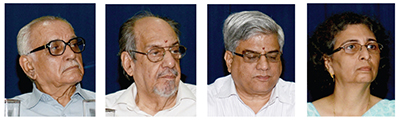
Profs Khurshed Sheriar, Aspi Doctor and Jehangir Mistry, Freny Mehta
The school’s report card is extensive, with several landmarks and lessons being recorded. Stalwarts of civil and political society like Sir Pherozeshah Mehta, E. D. Sassoon, K. R. Cama and others had served as directors on the board. Madame Bhikhaiji Cama did her schooling here as Bhikhaiji Sorabji Patel. Social reformer Maharshi Karve was a teacher of mathematics at the school for a while. Among its gamut of activities, girl guiding was introduced as early as September 1, 1924 and officially registered at headquarters in 1927, with Lord Baden Powell, the founder of the scouting movement, signing the certificate. The original framed certificate is still with the school. Dr S. Radhakrishnan, Sarojini Naidu and Dr Zakir Husain have presided over momentous events. At the start of its landmark 150th year celebrations on September 1, 2012, advocate general of Maharashtra Darius Khambata released its special postal cover.
"In the US and other countries one can register a time capsule after it is placed, but unfortunately there is nothing of the sort in our country! We have searched in vain on the internet to learn about any time capsules buried in Bombay or even Maharashtra but found none! There is one in Gujarat at Mahatma Mandir, Gandhinagar, placed in 2010 on the occasion of 50 years of the establishment of the state of Gujarat. There is also one in Sanjan at the Sanjan Stambh. We will register the Alexandrian Time Capsule with the International Time Capsule Society (ITCS) at Oglethorpe University, Atlanta, Georgia, USA.” The ITCS estimates that there are between 10,000-15,000 time capsules worldwide and that some may be lost due to thieving, secrecy or poor planning!
"Since there was no one with the experience of having actually being involved in such a project to guide us, it was a self-learning process,” Mehta told Parsiana later. "We realized we needed acid free paper and envelopes and that things printed or written on normal paper may not last five decades. We needed special long-lasting CDs, DVDs and USB chips to store data. We imported a USB drive named "Tuff-‘N’-Tiny” from the Verbatim Company, USA. This chip has a lifetime warranty and mud, dirt or water have no adverse effects on its contents. We went through the laborious and herculean task of copying and printing everything we wanted to put inside on the acid free paper. We have used gateway paper between the sheets for better preservation. All the videos, photos, files too had to be put on the pen drive, with everything labeled and listed!”
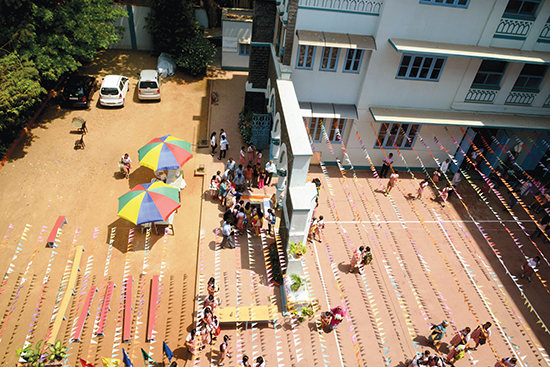
Aerial view of pit abutting Gothic arches
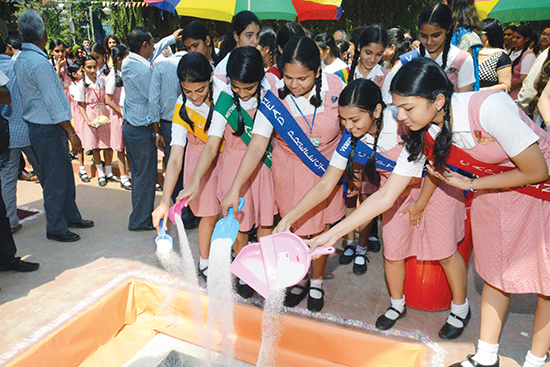
Alexandrians pouring in coat sand
Photos: Nazneen K. Vajifdar, Spectravision Labs
A special box made from 316 L grade stainless steel was fabricated and into it went a veritable treasure trove of articles – the record of celebrations of the 50th, 100th, 125th and 150th year, the logos, silver coins, mugs, keychains and mementos, pictures of present staff and students from Nursery to Standard X, list of directors and principals to date, uniforms, school magazines, sports medals, currency notes and present day newspapers and press coverage of the school’s activities and celebrations, all neatly packed in mulmul (muslin) and gateway paper! The entire container was lined with thick sheets of polystyrene (packing thermocol) with silica gel packets strewn liberally and the lid sealed with a special sticking tape made from tar. After lowering the time capsule, the specially created pit was filled with coat sand, closed with a steel lid and covered with concrete, with tiles providing the finishing. A small railing and a granite plaque mark the spot at the foot of the elegant, well-preserved arches of the old demolished Gothic building known as Albert Hall. (See "Ageless at the Alexandra,” Parsiana, September 21, 2012 and "Living legacy,” May 21, 2013.)
The principal acknowledges with gratitude the contribution of primary art teacher Parwana Chargeman Husain "without whose hours of labor on the computer, at the printers, etc, this project may not have been such a success.” "I have had the privilege of making the capsule into a celebrated event, thus creating one of the best memories of our sesquicentennial celebrations. Besides acting as a repository of current times, the contents serve as a bridge of understanding between past and future,” says Husain. Mehta mentions that all the office staff – Hutoxi Panthaki, Khurshid Dhondy, Kailash Makwana, Percy Bharucha, Tannaz Shroff – and "our secondary art teacher Hemal Ved were the other people who put time and effort into this venture.” The secondary section co-ordinator of e-learning Persis Pestonjamasp and many more added their shoulder to the wheel. Mehta also commends parent Zubin Billimoria and his family for "the magnanimous sum of one lakh rupees” donated by them for the project.
Of particular historical significance, Mehta feels, are the letters written by some of the staff and students to their counterparts of 2062. "Some of the girls’ letters are very touching, expressing immense love for the school and the teachers, some are informative and some describe the present times ‘as not so safe’ for girls and women due to deteriorating moral standards in society. Many have spoken about environmental degradation, pollution and corruption, expressing the hope that the times in 2062 are better,” she relates. Her own letter to the principal of that year makes a plea: "Let it become an Alexandrian tradition to place a time capsule to mark such historic milestones. Please do invite the students of today to the functions you plan in the 200th year. We too had invited our dear octogenarians (ex students and ex staff) for our events and felicitated them. And let the legacy really go on...” What memory is to an individual history is to a nation.
◆ ◆ ◆
From the archive