
Institutions
The girls of Girton
For over 130 years the Girton High School has imparted an all round education
At the end of the school day, as the bell rings, one does not see the usual scramble of students which one associates with youngsters leaving an institution. The girls, in an orderly and disciplined manner, descend the staircase of this large and impressive building tucked away in a corner off Naushir Bharucha Marg, more commonly remembered as Sleater Road.
"I want to turn out girls from the school who are not only well-educated and disciplined but who are also refined young ladies, not the hooligans we often encounter in the streets,” says Dr Villy Cama, chairman, managing committee of Girton High School, a demanding job she performs in addition to being the president of the Girton High School Trust and Old Girtonians’ Association Property Fund.
"I want to turn out girls from the school who are not only well-educated and disciplined but who are also refined young ladies, not the hooligans we often encounter in the streets,” says Dr Villy Cama, chairman, managing committee of Girton High School, a demanding job she performs in addition to being the president of the Girton High School Trust and Old Girtonians’ Association Property Fund.
 Over the past several years, the Girton High School for girls has not only secured 100% results in the school leaving examination but all the students have also passed with a first class; the highest marks scored has now reached an all-time record of 96.80%. Aside from academic courses, the list of facilities include classes on cookery, home science, needlework, Western and Indian singing and dancing. Sports are also encouraged and the students are coached in chess, badminton, throwball and basketball. Students have won prizes at national and state level competitions in skating, lawn tennis, athletics, gymnastics and at an international level in karate and swimming. In addition to elocution and drama, regular competitions are held in choir and solo singing, cooking, rangoli and needlework. It is no wonder that the girls leave the School with well-rounded personalities.
"If you examine the results chronologically then you will see how they have been improving every year. Classes during the vacations are held for the weaker students and strict action is taken for absenteeism and for students who fail in their unit test after the course,” says Cama. Equal emphasis is also placed on extracurricular activities. "Far more school trips are organized today than in the past,” states the present principal, Ayesha Mistry (née Bhathena), who has initiated debating, handwriting and spelling bee competitions. "For the annual day, we now have full-length musicals instead of short items. Everything is done in-house: the sets, props, music. During a performance of The Lion King, the little baby Simba, a student from the nursery, fell asleep by the end of the concert and a senior girl had to prod her to keep her awake…
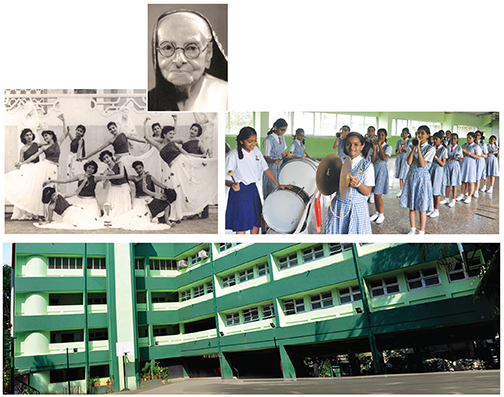
Inset: Bachoobai Moos; top: School emblem in 2013; above: Country dance (l) and School band; School building
"I joined the School as a student in 1988 when the School was celebrating its centenary and became principal when I was 27,” she recalls. However, the School is faced with a daunting task: a decline in numbers: This does not only pertain to Girton, she notes but it is a trend in schools in the area. One cause is attributed to the population shifting to the suburbs or New Bombay. "Often new schools are opened which attract students with swimming facilities, hot meals, some free books and other amenities, but the teaching may not be up to standard,” says Cama. What is even more disheartening is that last year the total number of Parsis in the school was as low as 13.
The School has not always been housed in its present, spacious and well-maintained building. In 1888, Bachoobai Moos, aged 38, encouraged and supported by her friend, Mary Prescott, the principal of the Frere Fletcher School, started Moos’s School in rented premises at Alpaiwala Building on Grant Road. The school acquired the name of Girton High School as a tribute to Prescott who had graduated from Girton College, Cambridge. As parents were reluctant to send their children to the Fort area where most of the schools were located, the need for a girls’ school in the area was acute. The School started with 10 students (some reports mention four) but they multiplied exponentially and the Government Gazette Report, 1910 mentions that the number had increased to 241. Started with Gujarati as the medium of instruction, the School soon switched to English to keep abreast with changing times.
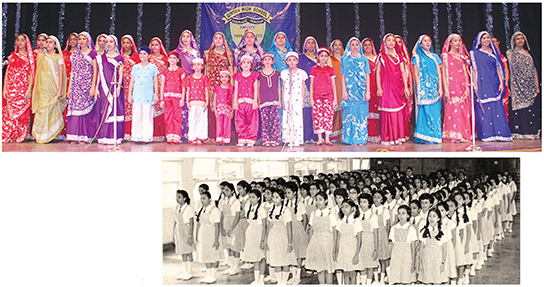
Top: The annual day choir at the 125th anniversary celebrations; above: School assembly
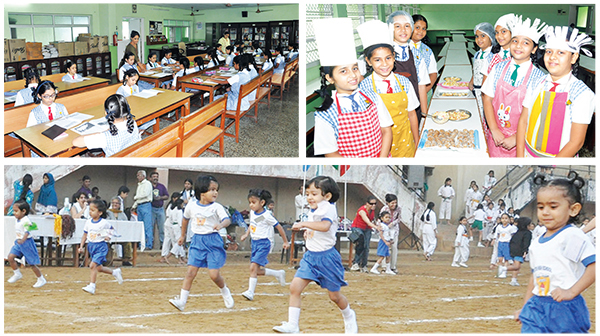
Top: library (l); home science class; above: sports day; above: old School building
The uniforms of the students at this time were old-fashioned: they were forced to wear saris or jablas (long, shapeless kurta-like tops) and ijars (pyjamas) and cover their heads. For several years, Moos ran Girton as a private school using her own funds. In 1932, she was presented with a purse of Rs 10,000 by her former students and appreciation of her dedication. In 1943, the British monarchy awarded her the Kaiser-I-Hind Gold medal for her contribution to women’s education.
Nergis Gupta (née Bharucha), who worked with Moos for two-and-a-half years, reported, "She was always the first to arrive in the morning and the last to leave at about 5.30 p.m. She had completed reports and salaries on July 30 (1946), before she left the School for the last time.” It is said that after her dinner, she fell asleep in her rocking chair and passed away peacefully at the age of 96.
Her grand-niece, Silla Ardeshir, then a young girl of 25, now a nonagenerian, who assisted Moos and taught English and French, took up the daunting task of running the School. She was trustee and honorary principal till 1996. Initially the financial position was not stable and she had to apply to the government for a grant-in-aid which was finally discontinued by the School in 1975; since then, the School has functioned as a religious minority institution and never depended on government grants.
Ardeshir made far-reaching changes. A charity school only for Parsi girls, she opened it up to all disadvantaged children. She started morning assembly and created houses (Mars, Venus, Jupiter and Neptune). She composed the school anthem which she remembers and can sing to this very day. Saris were replaced with blue and white checked uniforms, which, though marginally modified, still endure. The gym teacher taught in a sari, a practice which was immediately put an end to. Most significantly, she did away with the prayer cap as part of the uniform as this caused lice. Frequent lice inspection routines were introduced. For this revolutionary step she was termed Bhéja fatél masterji (hot tempered teacher, The Bombay Samachar August 9, 1987). The Jam-e-Jamshed was reported to have called her shaitan ni dikri (daughter of the devil). What they forgot to mention is how far-sighted she was: Girton was amongst one of the first schools to offer hands-on training to its students when computers were still in their infancy.
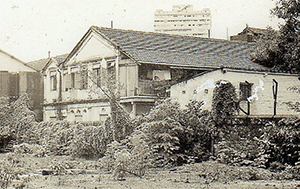 The location of the School was not ideal; the building was frequently flooded and Ardeshir as well as other teachers had to wade through the water to carry the students to the steps of the School. She acted as a part-time counsellor which was unusual for a principal. Many students came to her with their personal problems and she assisted them as best she could. Her son, Sohrab, famous theater and cinema actor, remembers, "When a student had problems at home, my family took her in and she stayed with us for almost nine months preparing for her exams. Mom spoke to the parents and finally she went back home.”
Roshan Master, an ex-student recalls the day she joined the School in the second standard: Moos had just passed away and Ardeshir had taken over on that day. "I spent my first two years at The J. B. Vachha High School and was not used to wearing a prayer cap which I hid in my hand, unwilling to put it on. Ardeshir asked what I was hiding and when she saw it was the prayer cap, I vividly remember her saying: ‘Don’t hide it; you need to wear your cap only when you say the prayers, not otherwise.’ We had excellent and dedicated teachers who took very good care of us. There was never any question of taking tuitions. There were 12 students in my class and the fees were Rs 12 per month.”
The School boasts of several eminent past students. Gulestan Billimoria worked tirelessly for the upliftment of women. She was the sheriff of Bombay in 1957, chairperson of the Maharashtra State Women’s Council and the Red Cross Society. Dr Mehernaz Irani has been a family physician in Casa Grande since 1976. She was involved in several peace projects and was named Outstanding Woman of the Year for Arizona. The list is endless.
The School could no longer be confined to the small structure it occupied in Alpaiwala Building. The Old Girtonians Association, formed to raise funds for moving the school to a larger and more suitable location, worked hard and long to buy a suitable plot of land and construct a building. However, this was a daunting process: whenever they reached the target, they found that the costs had increased. Sohrab recalls: "Mom was on a flight and was looking very harassed when her co-passenger asked her what the problem was. When she mentioned her difficulty of collecting adequate sums of money for the School, the unknown stranger, a disciple of Sri Sathya Sai Baba, wrote to him and miraculously a generous donor arrived on her doorstep and gifted her the exact amount she required.” Says Cama, "It is my fervent prayer and my ardent wish that Girton High School will have the opportunity of felicitating Ardeshir on her 100th birthday in the premises of her beloved School itself.”
While Villy’s late mother Banoo was president of the Girton High School Trust, Old Girtonians’ Association Property Fund and Old Girtonians’ Association for several years, currently serving as trustee of the Girton High School Trust with Villy and Master are Dr Gulistan Kerawalla, Jehangir Gai, Khorshed Bulsara and Dr Meher Vakil. The managing committee includes Villy, Master, Ardeshir, Gai, Bulsara, Vakil and Ayesha Jejeebhoy.

From l: Silla Ardeshir, Banoo and Dr Villie Cama, Roshan Master and Ayesha Mistry
The School comprises 13 classrooms, a library, a computer laboratory, a science laboratory, an arts room, a counsellor’s room and two halls. The total number of students for the academic year 2018-2019 is 407 with 25 teachers.
Several ex-students became teachers of the School. Roshen Bomonji, a ballet dancer and gymnast retired in 1983 after a tenure of 46 years of dedicated and unflinching service. She attended dance and gymnastic classes held by Mithoo Marzban and later by Dubash, which she continued into her late 60s. Bomonji’s daughter, Ketayun Bamji fondly remembers, "She choreographed plays and dances and won several awards at the inter-school drama competitions for Girton. The Ribbon Dances, Ball Dances, Broom Dances, Dwarf Dances (this was a puppet show), and many more were all conceived and produced by her and were performed with the dresses and trappings of ballet dancers.”
Freny Paghdiwala (née Dalal), who joined the School as a student in 1948 studied singing under Bhikhu Mehta. Though she had the potential to be a concert singer, she chose to dedicate 55 years of her life to teaching, of which over 30 years were spent teaching singing at Girton. "The first concert I gave was at the Blavatksy Lodge in memory of my teacher. Most of the girls who sang were my students from Girton High School. The president of the Lodge said he had never seen the hall so full,” she recalled. We won prizes at several inter-school singing competitions. We even sang the national anthem, without accompaniment, for the Second World Zoroastrian Congress which was held at the Sir Cowasji Jehangir Hall (now the National Gallery of Modern Art) in Bombay.” She and Bomonji formed a formidable partnership of music and dance and put up several operettas and especially the Rendez-vouz where girls were dressed like statues and put on pedestals; the statues came alive at midnight when Cupid shot his arrow. "We won the first prize in the Red Cross Competition. It was also staged for the Red Cross Ball.” With her students, she recorded four cassettes of Zoroastrian songs in Gujarati. One of these, Khushali na geet ne garba is played at weddings and navjotes.
The motto of the School, which forms a part of the school song is "Courage, Simplicity and Honour.” Also, part of the school song is the message to boldly walk through life with "good thoughts, words and deeds.” It is the preservation of these values coupled with a clear-sighted goal of creating well-balanced, educated and culturally aware students which has always been the hallmark and tradition of the School.
◆ ◆ ◆
One reader wrote
Lovely article written in 2007.
From the archive