
Cover Story
Partying at the Pole
A hundred persons from 20 countries braved the elements on an expedition to the Geographic North Pole on a Russian ship
We were at 88° North, sailing through ever thickening ice between eight to nine feet thick but still keeping up a speed of 14 knots. After lunch the mercury dropped to -16° C and the level of noise and vibration noticeably increased as the ship 50 Years of Victory plowed through the ice cap on June 30, 2012. This did not last long as a very thick fog came up accompanied by winds creating leads (channels of water through a field of ice) and melt-pools (pools of melted ice and snow that form on the surface of the Arctic Sea), allowing our ship to pick up to 19 knots.
.jpg)
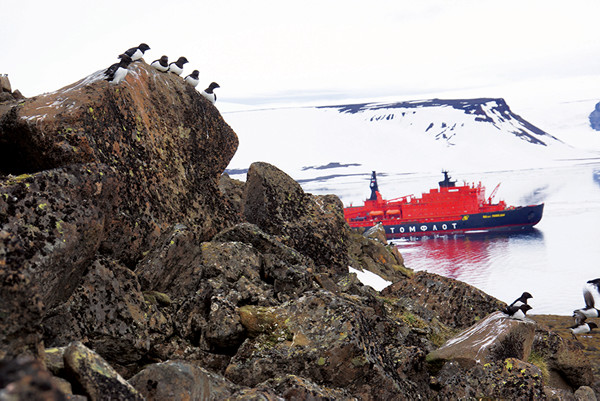
(Above) Sumptuous barbecue on ice; (top) little auks peer at 50 Years of Victory;
When the magical spot of 90° North was reached at 21:10 hours, the ship was stopped on the ice and a long blast on the ship’s horn announced we had arrived at the Geographic North Pole (different from the magnetic North Pole that keeps shifting). Speeches were followed by hot snacks, champagne, vodka and assorted alcohol to keep us warm. For the next two hours loud pulsating music and dancing took place after which the party continued for the night owls for another hour in the bar. I went to the radio room and called my wife Perin on the Iridium phone to share the good news with her. (Having accomplished my mission on this expedition I could not help comparing it with my experience six years ago when within 98 km of the South Pole we were compelled to return due to bad weather conditions.)
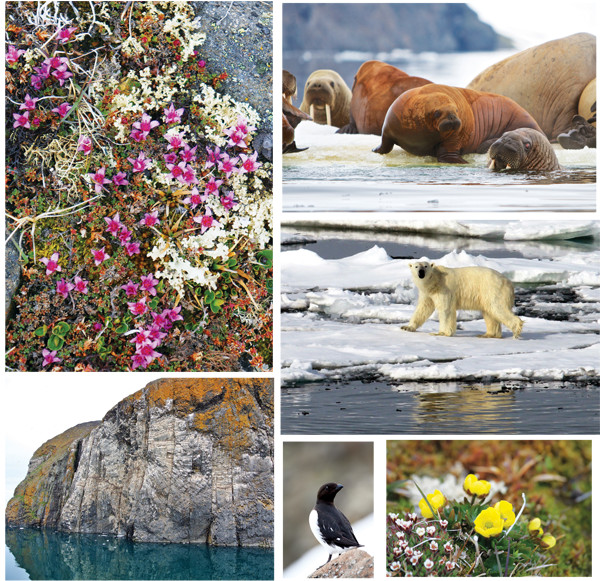
flora and fauna in the Arctic region
Whilst the 100 passengers representing 20 nations were happily partying, the 140 members of the crew and staff were busy making preparations for our disembarkation the next morning. They set up a huge circle of armed guards to protect us against polar bears which are known to be in the area but were not sighted by us. A suitable marker was stuck into the ice and we all formed a large circle around it. The expedition leader made a solemn speech about conflicts world-wide and said a short prayer for peace for us all. Included in the circle were all 100 of us, plus the expedition team members, lecturers, ship’s officers, engineers, and senior members of the hotel, room and crew staff, etc. We all responded with a resounding "Amen.” After the welcome speech we all walked around in a circle for four minutes — a symbolic depiction of our having walked around the world within that brief time! Thereafter I was keen to get myself photographed holding a farohar pennant for even though I know for sure that I am the first Parsi from Hong Kong to stand on the North Pole I wondered if there have been others before me from other countries.
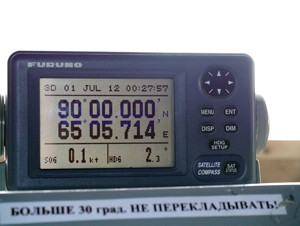
satellite compass showing 90° N latitude;
Walking on the surface around the ship was a bit difficult at first as due to the warmish wind of the previous day, it varied from fresh snow two feet deep, to icy mush or shallow melt pools. Many of us took home liter bottles of fresh snow melt. Nothing could be purer than that.
At the rear of the ship a large ice-free area was formed by keeping the ship’s propellers turning over very slowly into which about a dozen hardy souls took a quick plunge. Securely belted and attached to ropes, their safety and well-being was assured by the two crewmen standing by to pull them out in case of emergency. Thankfully none of them required these services nor of the ship’s doctor but stocks of vodka were rapidly depleted.
Many had brought religious symbols and personal artefacts to be dropped into the sea at that point which was 1.74 miles deep. I dropped a five-rupee coin minted in honor of Dadabhai Naoroji and recited a short Tandorosti prayer for the future well-being of all Parsi Zoroastrians, especially those in Hong Kong.
Quite a few of us had our own Global Positioning System units and our compasses, magnetic and digital, all pointed due south no matter in which direction we turned.
Lunch was another sumptuous barbecue on the ice alongside the ship, starting with a very welcome concocted brew made up of strong tea suitably enhanced with whisky and flavored with cinnamon, cardamom and cane sugar. It went down all too easily and helped keep the cold at bay.
The next day saw the crew begin to pack up all the gear from the ice and by afternoon we pulled away to start the trip back south towards our next destination, the Franz Joseph Land Archipelago. As the ship could still use the original track it had made earlier, we could maintain 18 knots. That afternoon we were given a recap of our adventure with a Power Point presentation of pictures taken by the ship’s photographer when one of the lecturers stood up and proclaimed, "Adventure is another name or excuse for bad planning.”
.jpg)
.jpg)
Noshir Pavri with the ship’s eight tonne anchor on ice; barbecue on ship
Early evening saw us beached on the last huge floe (approximately 180 sq km) we would come across so a second helicopter tour and tethered hot air ballooning activities took place. (The day prior to anchoring at the North Pole we were taken for 15-minute chopper rides in small groups to witness the ship crashing through the ice cap.) This was the first North Pole journey offering the experience of hot air ballooning. During our six hours on the ice, walking was easy as the surface had two inches of crystalline snow. We were asked to stay within a perimeter of 1.5 km from the ship where armed guards were posted to watch out for hungry polar bears but they were not sighted here either. Due to an unusual weather pattern, we experienced the coldest temperature of the entire trip at -24° C. After pulling off the floe at 20:00 hours, we were in the open sea once again, having left the last of the ice cap behind and were soon making 21 knots in open water. We all had a very restful night’s sleep on July 2, relieved that the loud grinding noise and vibration of the ship that had commenced four days earlier when we entered the Polar Ice Field had finally come to an end. Sleep on the first few nights was made further difficult due to the bright sun which never set.
Frequent sighting of walruses, whales and lots of assorted birdlife marked the next day. They were so plentiful that the decks were soon covered in white guano. Our first landing was on Jackson Island to see the ruins of the hut where Norwegian explorers Fridtjof Nansen and Hjalmar Johansen spent eight months from September 1895 up to the summer of 1896. Thanks to their good supply of rifles and ammunition, they were able to hunt polar bear and walrus for their meat and use their skins to make a tent after fortunately finding a single log on the beach that served as the center pole for their tent to shield them from the severe cold. They had spent the winter in total darkness, using melted blubber to ignite lamps which whilst giving light covered them with a large residue of soot they found difficult to wash off. Once they were miraculously rescued they earned international recognition for reaching a record northern latitude of 86°14’ during their North Pole expedition.
When the ship was within 50 m from the cliff face of the treeless Rubini Rock the following day we were witness to an audiovisual experience of hundreds of thousands of birds like gulls, auks and Arctic terns flying around. The same afternoon of July 4 saw us take a two-hour Zodiac tour of the nearby islands and floes on which were resting families of walruses which took no notice of us at all but gave us a chance to observe their behavior. In the evening we made the last wet landing on Hooker Island where the remains of a Russian meteorological station still stands. It was built in 1922 and abandoned in 1963. The many wooden structures filled with kitchen and tableware still stand as wood does not rot easily in the intense cold and near zero humidity.
July 4 being Russia Day, the ship’s public rooms were suitably decorated with Russian themes, the restaurant staff were dressed in colorful Russian costumes and we were greeted by the girls at the door handing out tots of vodka. The dinner comprising sevruga caviar and sumptuous seafood was a gourmand’s delight.
The last two days were spent fully at sea, used for final lectures and recapitulation of our adventure, captain’s farewell cocktails where yet more caviar, vodka and champagne were served and another five star dinner. On the morning of July 7 we docked in Murmansk at 06:30 hours and after an early breakfast made our way to the airport from where we got a flight back to Helsinki. Lodged at the Crowne Plaza hotel for the night, a few of us who had bonded well on the trip, went to a nearby Finnish restaurant for the traditional reindeer steak and other delicacies, ending a great trip with a great meal.
Preparations for the Pole
Reservations for 50 Years of Victory have to be made 12 months prior to departure if one wants to book a cabin of one’s choice. Russian built, owned and operated, it is the strongest, fastest ice breaker with the highest rating in the world, powered by two nuclear reactors producing 74,000 HP, giving it a speed of 21 knots in open water and 14 knots through the ice pack 3.5 m thick. Its home base is Murmansk. Construction was begun in St Petersburg in 1989 and it was launched in 2007.
In winter the primary function of the ice breaker is to keep open the commercial shipping lanes in the eastern and western passages of the Arctic Ocean. In summer it makes two 14-day trips to the Geographic North Pole for intrepid travelers. The cost of the 14-day expedition from Murmansk to the North Pole can range from $ 23,995 to $ 34,995 with passengers being given the option of a standard twin cabin, mini suite, suite, victory suite or Arktika suite. Cabins are offered at a discount against last minute cancellations but by then there is no choice of location or who one can share it with. The Helsinki-Murmansk return airfare is an additional $ 1,690.
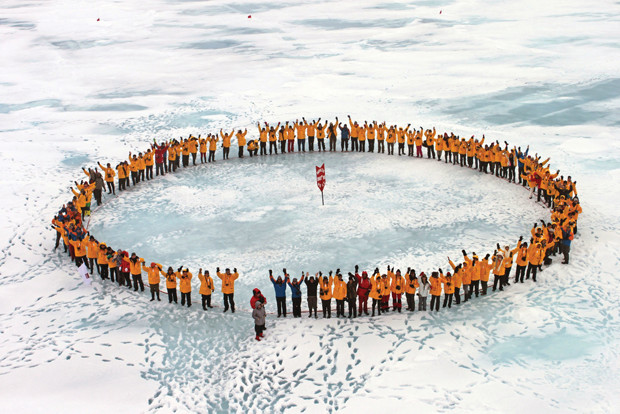
Expedition members in a circle at the North Pole;
Before reservation is confirmed passengers need to provide the organizers with a recent detailed physical report from their general practitioner and cardiologist with a list of the medications they take on a regular basis. Although a doctor and a registered nurse on board can treat minor aches, pains and injuries, in case of emergency there are no provisions for a medical evacuation beyond the flight range of a helicopter and even the cost of that would be prohibitive. It is mandatory therefore to get an insurance policy to cover medical evacuation fees and subsequent cost of hospitalization and treatment from an insurance company recommended by Quark. In spite of my contacts in Hong Kong, I could not get a single insurance agent to give me this cover. On receiving approval from the company’s doctor the initial deposit needs to be paid.
Our expedition commenced on June 25 when all passengers were expected to register their presence at the Crowne Plaza hotel in Helsinki and were issued the necessary travel documents, beginning with the flight to Murmansk the next day. At the end of our one-and-a-half-hour chartered flight by FINNAIR we got our first experience of personal security and document checking by Russian authorities, way higher than any other place. In our half-day tour of Murmansk, a city founded in 1917, we got to see impressive monuments in stone and bronze, the centerpiece being a 40 m concrete statue of a seaman on a hill overlooking the city and harbor with an eternal flame burning at the base, commemorating all the sailors that were lost at sea. The most interesting part was a complete tour of the first nuclear ice breaker, Lenin, which is now a floating museum.
On boarding 50 Years of Victory we were given time to settle into our cabins and then followed an orientation of the ship. The next day was spent on life boat and emergency drills and mandatory briefings on safety issues over the use of helicopter and Zodiacs to be used for wet landings, informative lectures and presentations on the vista that would unfold before us. At the welcome party and dinner organized by the captain, champagne and vodka flowed like water, with great snacks and speeches.
Over the next two days as the temperature started falling and we witnessed heavy snowfall we were invited to the bow deck to witness the ship’s progress through increasing ice when we would be served hot chocolate generously laced with Bailey’s or coffee with rum or Bailey’s accompanied by tarts, cakes and biscuits. Although difficult to spot at first against the icy white background, we were able to sight the first of many polar bears. When we had an open air barbecue on the rear deck it was a tight fit on the tables and benches as we were all wearing our heavy parkas.
The day before we reached the Geographic North Pole, we were all summoned to the Bow Deck to request King Neptune’s permission to enter his domain. He and his wife, along with members of the staff and expedition team were suitably dressed in colorful costumes. After speeches by the captain and team leader promising we would behave ourselves and do no harm to the creatures, we were duly inducted with generous tots of vodka and allowed into his realm!
The entire trip was made even more enjoyable thanks to the informal atmosphere pervading the ship with the pilot and the crew making the passengers feel welcome and keeping open the bridge (barring the three hours it took to sail in and out of Murmansk harbor), navigation, radio and even the engine room open for us to visit at any hour of the day.
◆ ◆ ◆
From the archive