
Education
“The power of the mind” - I
The K.R.Cama Oriental Institute hosted a two-day seminar to highlight the community’s role in the creation of educational institutions in India in the 19th and 20th centuries
"Understand why contributions were made in this particular field… It follows from the tenets of the religion. Knowledge, wisdom, intelligence are greatly lauded in Zoroastrianism. Good thoughts, good words, good deeds emanate from wisdom and knowledge and lead to good existence whereas lack of knowledge and wisdom lead to worse thoughts, words and deeds…Vohu-man is the power of the mind (leading) through the Amesha Spentas to perfection and immortality. Hence the education field comes naturally to Parsis.”
Ervad (Dr) Rooyintan Peer, speaking in his capacity as chair of the session on "Religious education, libraries and archives,” on the second day of the two-day national seminar on "The contribution made by the Parsis to the development of different aspects of education in the 19th and 20th centuries in Western India” organized by the K. R. Cama Oriental Institute (KRCOI), January 17 and 18, 2009, set the mind-boggling contributions of the community in perspective. Added Dr Shashikumar Chitre, former professor at Tata Institute of Fundamental Research (TIFR) and Scientist at the University of Mumbai, "If a history of the 19th and 20th centuries were to be compiled, it would be a series of biographies of innumerable Parsi families…”
Beginning with school education and going on to higher and technical educational institutions, initiatives in special and integrated education, and specialized institutions like the Tata Institute of Social Sciences (TISS), TIFR and the Indian Institute of Science (IISc), the papers traced the impact of individuals passionately committed to the cause. In terms of corporate philanthropy the Tatas dominate the scene as much by their recognition of the needs of the country and its people as by their largesse. At a time however when other corporate entities had not entered the fray, another industrial house made its presence count through its support to adult and child education and thence the understanding and appreciation of the need for family planning among its own workforce — the house of Godrej.
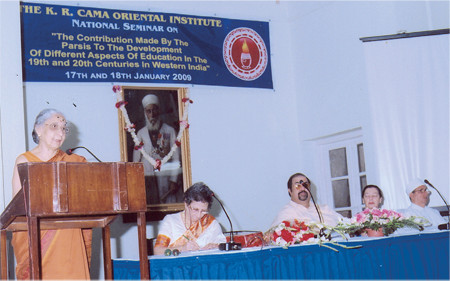
Dr Armaity Desai delivering her inaugural address. (L to R): Dr Nawaz Mody, Muncherji Cama, Homai Modi and Dr Rooyintan Peer
In his welcome address KRCOI president Muncherji Cama referred to the Parsi Girls’ School Association, indentured in 1862 when it was thought that only boys needed to be educated. Then the great majority of people thought that all girls needed to be taught was to read and write the name of their father and husband and their residential address and to know enough arithmetic to count the items sent for washing and understand the daily bazaar expenses! "What would our forefathers have thought of the present inadequacy of Parsi boys to match Parsi girls’ education?” wondered Cama.
An outstanding feature of the seminar which commemorated the great foresight of Parsi forebears was the amazing contribution of contemporary Parsis in the fields of special and integrated education, carrying forward the community’s unwavering commitment to good causes.
In her inaugural address former director of TISS and former chairperson of the University Grants Commission Dr Armaity Desai noted that while Parsis pioneered female literacy, Parsi institutions no longer seem to serve the Parsis. Referring to the TISS research on behalf of the UNESCO (United Nations Educational, Scientific and Cultural Organization) sponsored Parzor Project Desai said that "education, employment and emphasis on a separate house after marriage have led to late marriages and in many cases no marriage” and a declining population. She addressed the two issues faced by the community: "What needs to be done with our schools that were set up and are still run by Parsi trust funds?” and "What happens to admissions, especially to institutions of higher education originally endowed by Parsis, most of these being now in the hands of the State or Central Government? Hence the Parsis are beginning to demand a share in reservations as their minuscule size is squeezing them out of the system by the large numbers from the majority community that compete for admission at all levels plus the statutory reservations for specific communities.”
Though Parsi children are often enrolled in non-Parsi schools, the Parsi schools as "cosmopolitan institutions are making a major contribution to the children of the city of Mumbai and other towns in which they are located (and) must continue to provide the service,” Desai said. But she also advocated that at least a few of the Parsi trust schools "upgrade their standards…We need to make an assessment of the quality of education we offer today, the type of salaries we pay our principals and teachers to attract the best and even make a shift to offer certification of the more attractive boards such as ICSE (Indian Certificate of Secondary Education) and CBSE (Central Board of Secondary Education).
Alternatively, Desai suggested that school trustees consider rechannelling of the funds at their disposal, originally meant for the free education of Parsi children or school meals, to finance their education in "quality schools of their choice so that they earn good grades and have better chance to compete for entry at higher levels… If we want to increase the capacities of our children to compete for access to better quality higher educational institutions without necessarily emphasizing reservation, we need to catch them young and provide strong foundations at the school level.” Another route Desai indicated was the sponsoring of Parsi children in coaching classes. She urged the school trusts to seek cy pres permission from the courts if necessary to use their funds more productively. The vision of Parsi youths also tended to be narrow, she said, and advocated a systematic widening of perspective with vocational guidance and short audiovisuals.
Noting that Parsi students at TISS, TIFR, IISc or the J. J. School of Art and Architecture were either "non-existent or insignificant in number,” she asked, "Even if we were to reserve seats in higher education institutions endowed by Parsis, would we get applicants unless the mindset of our young is shifted to fields beyond the beaten path? Would they be interested in teaching and research? How many would be interested in working with nongovernmental organizations which do not guarantee job security or on issues such as poverty, development, planning or social entrepreneurship?... Education ultimately has to serve the larger purpose of livelihood…Community funds should be mobilized and support given for undertaking research studies which would give us the clues to our present and future requirements tailored to the needs of the 21st century...”
"School Education”
The first session on school education with Perin Bagli, principal of the Activity High School in the chair, was flagged off by Louiza Rodrigues’ recount of Nowroji Furdoonji’s dedicated and pioneering role in the education of Parsi women. A product of liberal western education at the Elphinstone Institution and a professor there, he took a leading part in the educational movement that produced a new school of native leaders which included such stalwarts as Dadabhai Naoroji, Bhau Daji Lad and Sorabjee Shapoorjee Bengali. He supported the Institution’s Students’ Literary and Scientific Society (SLSS) which pioneered female education in Bombay and went on to create and serve the Parsi Girls’ School Association as its secretary for a number of years.
Rodrigues, a lecturer in history at the Ramnarain Ruia College, spoke of Furdoonji’s contribution to Gujarati and English literature and journalism, his founding of the Jam-e-Jamshed to defend Zoroastrianism against attacks from Christian missionaries, the starting of the Rahnumae Mazdayasnan Sabha to cleanse the religion from ignorant accretions in the face of community opposition, presiding over it until his death. The man whom Rodrigues called the guiding spirit behind the Parsi Law Association — "it was mainly through his exertions that the Parsi community secured a Matrimonial and Succession Act of its own. He played a vital role in the emancipation of women as bigamy was abolished and the woman got one share of the property intestate” — had been appointed interpreter at the Supreme Court of Bombay in 1845 and served until his retirement in 1864. A Justice of the Peace, popularly hailed as the "Tribune of the People,” Furdoonji was bestowed the CIE (Companion in The Most Eminent Order of the British Empire) in 1864.
Retired reader and head of the Department of History at the Elphinstone College Dr Zenobia Dumasia spoke of the establishment of the Parsi Girls’ School Association whose two main bastions have survived as the Bhikhaijee S. Bengali Girls’ High School and Bai Maneckbai N. Gamadia Girls’ High School. Though a few girls’ schools were run by missionaries in Bombay in the early decades of the 19th century, they were looked upon with "hostility and disfavor, fearing the ‘vices’ which such education would bring with it.” The young Dosebai Cowasjee Jessawalla who was sent by her mother Meherbai Hormusjee Cursetjee to a school run by an English school mistress Ms Ward provoked outrage from the community and the threat of excommunication from the Parsi Punchayet.
At the second session of theSLSS set up by two Elphinstone professors an essay on female education by Behramji Khurshedji Ghandhi met with the response, "let us teach the schools ourselves and show that we are in earnest,” records Dumasia. In a matter of three months (August to October 1849) four Parsi girls’ schools and three Marathi girls’ schools were opened. They were conducted by volunteer teachers from the Institution. The Parsi schools, numbered one to four and known by their location were manned by third year students Behramji Khurshedji, Jehangir Hormusji, Palanji Framji and Edulji Nasawanji, fourth year student Jehangir Burzorji together with assistant master Ardeshir Framji and assistant professor Dadabhai Naoroji, two per each school. There were 44 pupils attending on the first day. By the end of 1850 the number had risen to 203.
Initially the classes were held at the home of the members. Jagannath Sankarsett offered a rent free cottage to be used by all the seven schools. But it was four Parsis — Nasarvanji Muncherji Kama, Dhanjibhai Nasarvanji Kama and Khurshedji Nasarvanji Kama together with Framji Nasarvanji Patel — who provided the Society Rs 4,800 to maintain the schools, both Hindu and Parsi, for two years. Such was their progress that in 1851 Lord Falkland regarded the spontaneous setting up of these schools as "an epoch in the history of education in the Bombay Presidency,” Dumasia quotes D. F. Karaka. By the end of 1852 the SLSS was managing eight girls’ schools — three Marathi, one Gujarati and four Parsi. The vernacular remained the medium of instruction. There were 475 pupils in the Parsi schools as against 265 in the five Hindu schools by 1855.
The strong community support encouraged the SLSS to transfer the Parsi schools to a separate managing body. When a provisional committee was formed in 1857 with four members plus president Framji Nasarvanji Patel and secretaries Nowroji Furdoonji and Sorabjee Shapoorjee Bengali, member Khurshedji Nasarvanji Kama undertook to meet all deficits up to Rs10,000 for a period of three years. (He was later appointed treasurer and accountant.) After a special general meeting took the necessary resolution, the schools were handed over to the provisional committee. Eight months later a 12-member managing committee was formed which, apart from the four earlier stalwarts mentioned, included Byramjee Jeejeebhoy, Heerjeebhoy Hormusjee Sethna, Pestonji Hormusji Cama, Dinshaw Manockjee Petit, Bomanji Framji Kama, Dosabhoy Framji Kama, Cowasji Shapoorji Mehta and Cooverji Rustomji Mody. An indenture in 1862 formalized the arrangement.
Instruction in arithmetic, reading, writing, useful knowledge, industrial occupations and pursuits, handiwork and arts, domestic economy, principles of morality and of Zoroastrianism, grammar, geography, history and science was imparted exclusively in Gujarati. Initially the service was free "but from 1862 a monthly fee of one rupee was charged from girls coming from well-to-do families and from 1873 a monthly fee of eight annas was charged even from girls whose parents enjoyed limited means,” noted Dumasia. She quoted W. Lee-Warner, a member of the Hunter Education Commission, "…female education here has a value and parents are prepared to pay for it. There is no more practical test of the existence of a real demand for education than the fact that people will make a pecuniary sacrifice to secure it. I doubt if any state school would continue to exist if girls were charged the fees which here are readily paid…”
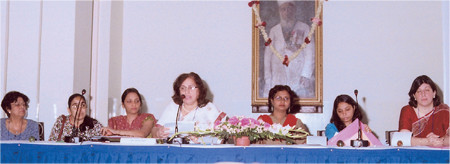
(L to R): Silloo Commissariat, Dr Zenobia Dumasia, Dr Preeta Nilesh, Perin Bagli, Louiza Rodrigues, Meher Mistry and Rashna Poncha
A serious problem faced by all the girls’ schools was the early withdrawal of the pupils between the ages of 10 and 12. This was attributed to the schools being staffed by male teachers. So the first priority became the appointment of female teachers. The solution began with the start of a Normal Class in 1861 to train older girls as teachers for their schools. The scheme evoked the admiration of educational authorities, noted Dumasia, quoting Dr W. W. Hunter, president of the Education Commission, who remarked in 1882, "I was much struck by your system of training up your own teaching staff. You educate little girls; then you select the most promising of these girls and train them as teachers; finally, you take the best of your teachers and appoint them your headmistresses and your inspectress of schools…”
The want of suitable accommodation for its schools was supplied by philanthropic community members. Bengali, a man of moderate means who wished to endow such an institution devoted an unexpected and sudden profit in a business deal, contributing Rs 66,787. He obtained a suitable plot at half its market value from the government plus a grant in aid and met the remaining cost himself to establish the Bai Bhikhaijee Shapoorjee Bengali Building for the Fort Parsi Girls’ School in honor of his mother. Similarly the Chandanwadi School came to be housed in the Bai Maneckbai Nowrosji Gamudia Building thanks to a donation from Nowrosji Jehangir Gamudia.
Though the addition of English to the curriculum was only effected in 1914 the schools of the Association served as models for other girls’ schools run by native agencies, notes Dumasia. Their one failing however was that they did not teach up to the Matriculation class. It was only in 1944 that the first batch of girls appeared for the examination.
Silloo Commissariat, whose association with the Bai Ruttonbai Framji Dorabji Panday Girls’ High School spanned more than half a century as student, teacher and principal, recounted the genesis of the institution. Panday, daughter of Sir Dinshaw Petit (1st Baronet) died in 1885 whilst giving birth to her fourth child — Meherbai, the future mother of atomic scientist Dr Homi Bhabha. To commemorate his daughter, Petit allotted Rs 22,100 to form a corpus of the Garib Zarthostiona Rehethan Fund which would manage a girls’ school within walking distance of their homes in Tardeo. Petit wanted to educate the girls to run their own home, so apart from the academic subjects they were taught cooking, laundry, needlecraft and house budgeting. For 30 years Petit contributed an annual sum towards the upkeep of the school where the pupils also got porridge in the morning and milk in the evening apart from a simple lunch, noted Commissariat, adding, "As students of the school we were fortunate to be invited to witness Shakespearean plays performed by a British company in the beautiful gardens of Petit Hall.” Other highlights were geological excursions with Prof Sukheswala and botanical excursions with Fr Santapau of St Xavier’s College.
In the 1970s the school became cosmopolitan with a surge in the number of pupils. Now she estimates about 1,000 are on the rolls.
Never a "Parsi school” in the traditional sense though with an overwhelming majority of Parsi students in the past, the Alexandra Girls’ English Institution is the earliest girls’ school in Bombay Presidency to impart education in English. Discussing the vision of its founder Manockjee Cursetjee, Dr Preeta Nilesh, a reader in history at the V. G. Vaze College noted, "He did not seem to be in the conflict most social reformers of the period were caught in. His preachings were exactly what he followed in his personal life. Convinced that he was right, Manockjee gave shape to his ideals by first imparting English education to his own daughters. With generous donations from Parsi philanthropists as well as Hindu and Muslim donors, Manockjee set out to realize his dream.”
Convinced that the regeneration of a nation necessitated taking the women of the country along, "Manockjee aspired for a moral and intellectual transformation of Indian girls,” stated Nilesh. He was criticized as an iconoclast and a revolutionary by the orthodox who believed that educating women would lead to the destruction of the home and family. Undaunted, he set up a small school with half a dozen girls studying under an English lady superintendent Ms Smith, in his own home ‘Villa Byculla.’
Three months later Manockjee lost his eldest son to cholera. On his uthamna he created the nucleus of a fund for the establishment of a girls’ school with Rs 4,000. Other enlightened men like Cursetjee Cama, David Sassoon, Cowasji Jehangir, Premchand Roychand, Jagannath Sankarsett, Gokuldas Tejpal and others joined him in the venture so that the corpus of the proposed school had reached Rs 60,500 by September that year.
So began the Alexandra Native Girls’ English Institution in 1863, named not after Manockjee as his supporters desired but after Princess Alexandra of Denmark who was married to the Prince of Wales because "Manockjee wished the girls of the school to have some idol to follow and Princess Alexandra had been extolled as a noble woman,” as noted Nilesh. The school was renamed Alexandra Girls’ English Institution in 1916.
Paucity of funds was one of the major problems of the School in its early years, functioning from rented property in the Fort area as Byculla was deemed too far for girls to go. When the Prince of Wales visited India in 1876, Manockjee started a building fund. The Bombay government granted a free plot of land on the Esplanade as well as a building grant and the foundation of Albert Hall was laid by Sir Richard Temple, governor of Bombay in 1878. The building designed by Khan Bahadur Mancherjee Murzban, the executive engineer of Bombay, was built in gothic style — a beautiful and conspicuous edifice, noted Nilesh. (Albert Hall was demolished and replaced by a more practical but prosaic structure in the 1960s.)
Manockjee, his son Cursetjee, his daughters Amy and Serene were all involved in the working of the school. And the attachment of the family continued down the generations. "In 1890 the first batch of students was sent up for the matriculation examination of the Bom-bay University… thereby opening the doors for Indian women to respectable and independent professions and livelihood.” The school’s motto, "Trust in God and be not daunted” inspired generations of students. Today about 1,158 students, a majority of them from the Muslim community, benefit from an institution officially recognized as an experimental school by the education department of the state since 1956.
Lecturer in history at the Sophia College for Women, Rashna Poncha gave brief insights into the two schools for girls associated with the Petit family — the Bai Avabai Framji Petit Girls’ Orphanage/High School and the J. B. Petit High School. When Hamabai sold her jewelry to generate 1.2 lakh rupees to found an orphanage for girls dedicated to her mother Avabai, her aim was to "educate them to be future wives and mothers, but also to be self-reliant if circumstances so decreed; to enable them to rise in society but also to make the poorest home happy,” noted Poncha. Its medium of instruction was Gujarati but a knowledge of English was also deemed essential. And the future mothers were also taught infant care. All the teaching staff had to be Parsi ladies and lived on the premises and the trust performed the navjotes of the orphans — and also the funeral if no one from the family was forthcoming, noted Poncha.
In contrast, the J. B. Petit School was set up by Mary Prescott who devoted her life to the education of Indian children irrespective of caste or creed. Self expression and the freedom to think for themselves was encouraged. It was only later that the institution was taken over by the Petit family. Today both schools have carved a niche for themselves in the life of the city.
Meher Mistry, a lecturer in history at the Ramniranjan Jhunjhunwala College, surveyed the ideas prevalent in the community in the 19th century and how they are reflected in the curricula designed for Parsi girls. "The efforts of the Parsi reformers to introduce education among their womenfolk were guided more by considerations of improving the domestic happiness as they could no longer bear the intellectual inferiority of their wives and also by the fact that the Parsis wanted to be considered among the civilized communities of the world. The western educated youth as well as the sethias were increasingly interacting with the Europeans and they were forced to conform to European norms and values particularly with respect to women.”
Education was seen as a means to bring about social reform especially regarding the problems of child marriage and polygamy prevalent in the community. So though the textbooks had a reformist slant, girls were essentially trained in domestic skills and virtues to increase the family’s comfort level and just enough English and British history to enable the women to mingle with the Europeans, noted Mistry. Putting them through examinations was supposed to upset the delicate mental balance of adolescent girls. Nor was it necessary for them to matriculate. What career did they need to make or livelihood to earn? Hence even a reformist institution like Alexandra had a plethora of domestic skills in its curriculum.
Again and again the orthodox gentry and community journals castigated the intellectual growth of women as being likely to make them less responsive to traditional feminine duties as wives and mothers, as Mistry’s paper demonstrated. Though the social climate has radically altered since then, one wonders if in a sense time has proved them right. Though no woman would agree to go back to the intellectual blinkers of the 19th century, the higher education of women has made them more choosy of marriage and averse to large families as the current demographic statistics show.
To be continued
◆ ◆ ◆
From the archive