
Seminar
Enigmatic epic - IV
The image of Alexander in history, in the Shahnameh and as seen by a subsequent poet
The Shahnameh’s (SN) many facets were examined by international scholars at the seminar hosted by the K. R. Cama Oriental Institute on January 8 and 9, 2011. Parsiana presents synopsis of their papers in six installments beginning with a review of the many celebrations of the epic a thousand years after it was composed (August 7, 2011), the Parthian influence and the poet’s concept of evil (August 21, 2011) and some of the sub-plots in the poem that spans human memory from prehistory to the fall of the Sasanians (September 7, 2011). This installment discusses the conflicting perceptions of Alexander. The art and illustrations that the epic spawned and the treatment of some of its themes from different perspectives, different cultures and why an epic is an epic will be addressed in subsequent issues.
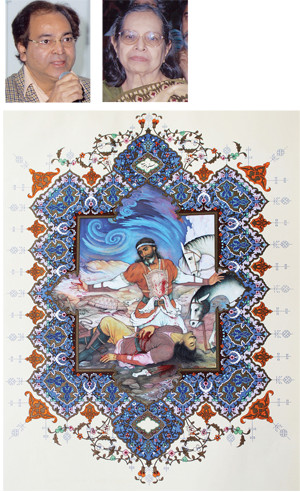
Above: Dr Syed Akhtar Husain (left) and Prof Sabar Havewalla. Alongside: Typical elaborate painting illustrating the Shahnameh (Tableaux from the Shahnameh; courtesy: K. R. Cama Oriental Institute)
According to Dr Syed Akhtar Husain, associate professor at the Jawaharlal Nehru University’s Centre of Persian and Central Asian Studies, Alexander the Great’s "chief fame rests on his attempt to unite the West and Central Asia during his seven year rule in Iran 330-323 BC.” The topic of Husain’s paper was "Alexander in History and Literature.”
Despite the fact that Ferdowsi had no access to Greco-Roman sources of history, nor was historiography that advanced in his time, his delineation of Alexander in 2,000 couplets remains true to Alexander’s career as known to us now, argues Husain. Allowing for differences of time (Ferdowsi believed he ruled Iran for 14 years) and name (Darius III is not mentioned in the SN. Instead it is Dara. Similarly, the names of Darius’ assassins are not the same), the occasion for the revolt of Alexander’s army (in the SN it is placed before Alexander’s advent into India and his victory at the Battle of Hydaspes against King Porus, whereas history tells us that it happened thereafter when Alexander wished to advance further into India), "the poet adhered to historical developments in Iran in delineating the life and character of Alexander. As the historical era of Iran begins in the SN, Ferdowsi adorns Alexander on the Achemenian pedestal and depicts him and not Dara as the hero of the epic (just as) the chief protagonist of Milton (in Paradise Lost) is Satan and not Adam.”
A pupil of Aristotle, Alexander sought to end Iranian political and economic hegemony over the Greeks which he accomplished in two successive battles. He held the royal family hostage and laid siege to Istakhr. Dara sued for peace and was prepared to yield his untold wealth and his domain of West Asia up to the Euphrates to Alexander. Dara fled to Kerman where he was murdered by "his greedy clergies Mahyar and Januspar,” recounts Husain. "Alexander held them guilty of regicide and hanged them, and gave a state funeral to the tragic king. Thereafter he married Princess Raushanak and donned the mantle of an Iranian king. He held the customs and rituals of the land sacred and treated the conquered peoples as his own subjects. Having conquered the lands from the Nile to the Indus, he breathed his last in Alexandria. Ferdowsi ends the episode on a didactic note which is reminiscent of the teachings of Aristotle: Man is mortal and the hands of death take away all the worldly possessions from him and eternally consign him to a small coffin and finally reduce him to dust,” notes Husain.
Influence on later poets
Speaking about the influence of SN on the Panj Ganj of Nezami Ganjavi, Prof Sabar Havewalla noted that later poets selected cameos from the SN to create their own masterpieces, unlike Ferdowsi’s massive recount from prehistory to the fall of the Sasanian empire. Writing almost a century after Ferdowsi, Nezami’s love poems relate three episodes from the SN: Alexander, Bahram Gur and Khosrow Parweez.
"Time, place and circumstances were quite different for Nezami,” noted Havewalla, the Arabs having influenced his philosophy, though he did not deviate from the purity of the Persian language, simplicity of diction and art of narration that Ferdowsi had established. "For Ferdowsi, the king’s statesmanship, valor and interaction with people are very important, whereas Nezami entertains readers with the king’s romantic love life. Perhaps he chose such a pattern to provide some relief and divert the Iranians’ attention from the complete chaos, unrest, anarchy and barbaric subjugation” during the Saljuq period in which he lived.
Khosrow-Va Shirin is the story of the last major Sasanian king when Iranians were buffeted by the preceeding autocratic monarchs and the irrational demands of the priests. Though a kind, just and benevolent ruler, Ferdowsi shows that Khosrow was obliged to keep on the move and make a lot of compromises for his own survival dictated by the prevailing political instability, noted Havewalla. Nezami on the other hand portrays him as a fun-loving, arrogant and selfish lover with only minor references to the odd circumstances of his life. He loved Shirin, a princess of Azerbaijan, but dropped her twice when she did not respond to his erratic whims and in tune with political expediency married Maryam, Caesar’s daughter. A woman of great beauty, self-restraint, fidelity, kindness and chastity, Shirin would not succumb to Khosrow until they were legally married after Maryam’s death and committed suicide when Khosrow was murdered by his son Shiruyeh.
In Haft Peykar (also known as Bahram Nameh) Nezami portrays Bahram-e-Gur, a peace loving king who showed extraordinary bravery when his kingdom was attacked, as a romantic who falls in love with almost every beautiful woman he sees. Ferdowsi’s account of Bahram is more balanced, notes Havewalla. Alert, intelligent and skilled in the arts of hunting and warfare, Bahram is said to have provided peace and prosperity to his people and, at the age of 60, renounced the world at the peak of his glory.
In Eskandarnameh Nezami reveres Alexander as "not only a perfect human being but also as a prophet,” says Havewalla. Nezami had claimed that he had studied the life of Alexander from Arabic, Greek and Hebrew sources, apart from Iranian. "Some of the western poets like Nezami were staunch Muslims and could not tolerate any favor shown to the ancient religion of Iran. Nezami justifies Alexander ruining Zoroastrian temples and defends him (by saying) that otherwise Alexander respected all other Iranian traditions… Ferdowsi’s reverence for the ancient Iranian religion runs through the SN which was not at all appreciated by Nezami,” she adds.
To be continued
◆ ◆ ◆
From the archive