
Law
Truth and tolerance
Inspired by his eminent predecessors Jamshedji Kanga and Hormasji Seervai, Darius Khambata speaks of the importance of Zoroastrian values
To felicitate Darius Khambata on his appointment as advocate general of Maharashtra, the Bombay Parsi Punchayet held a function on April 27, 2012 at the Cusrow Baug Pavilion (see "Leader of the Bar,” Parsiana, June 7, 2012). The text of his speech on that occasion is reproduced here:
Today I propose to speak on two great qualities and two great people. The qualities are truth and tolerance. The two people were the two greatest advocates general of Bombay, who embodied these virtues.
Herodotus (the Greek historian) in his Histories said that between the ages of five and 20 every Persian boy was taught only three things: how to ride a horse, how to use the bow and to speak the truth.
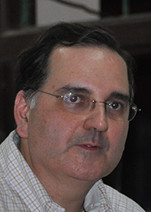
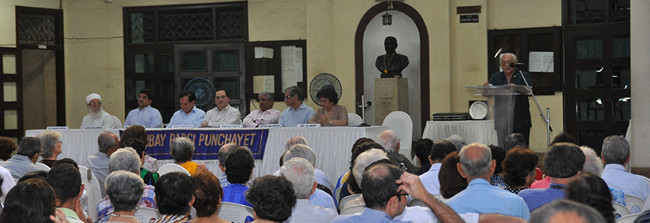
Darius Khambata being felicitated by the BPP (above) and top
Our basic Ashem vohu prayer tells us that the path to happiness is by truth ("Asha”) and by truth alone.
The second noble quality imparted by Zoroastrians is the concept found in the Gathas of freedom of choice. Our religion respects the complete freedom of choice of the individual to choose his path, only guided by Zarathushtra. But to be able to choose wisely you must first be able to accept different and differing points of view. I also call that tolerance.
The office of the advocate general was established in 1802 or some say 1807. The office has been occupied by the likes of Motilal Setalvad, C. K. Daftary and Sir Nusserwanji Engineer.
To my mind the two greatest of them were Parsis and both embodied Zoroastrian virtues of truth and tolerance: Sir Jamshedji Kanga and Hormasji Seervai.
Jamshedji was, in the words of Chief Justice Chagla, "the uncut diamond of the bar” one to whom the bar and the bench "instinctively turned” for support in times of distress.
Jamshedji started practice in 1903 as a "devil” to the then advocate general, Sir Basil Scott. Within a few years he had amassed a large practice as a junior at the bar and had ignited that legendary rivalry with the brilliant young Bhulabhai Desai. Bhulabhai was the more persuasive and suave advocate but Jamshedji had a monumental memory for case law.
That rivalry was a healthy one with mutual respect and bonhomie. In 1920-21, Jamshedji and Bhulabhai, by then the two stars of the Court, opposed each other daily in literally dozens of suits in Justice Macleod’s Court where swift justice was dispensed in breach of contract cases concerning speculation in the cotton market. In his Reminiscences Jamshedji recounts how once on a last day of the May term (when tradition had it no judge sat for more than an hour or maximum till 2 o’clock) he, Bhulabhai Desai and Vicaji Taraporevalla went out to a hearty lunch at Green’s Restaurant accompanied by a bottle of fine champagne. When they returned to Court they found, to their horror, that Justice Macleod had decided to sit after 2.45 p.m. and to complete four outstanding matters. They looked at each other and asked whether they were really in any condition to appear in Court. Jamshedji doesn’t share the answer with us but he tells us that they finished the matters and went home for a much needed rest!
In 1921 after just 18 years of practice Jamshedji was appointed a judge of the Bombay High Court. His judgments were precise and innovative. Thrice he was upset in appeal but on all three occasions his judgment was restored by the Privy Council. A landmark judgment of his was in Fazal Allana’s case where he held that title to shares passed to a buyer having committed a fraud in causing performance of the contract — as long as the contract itself was not vitiated by fraud. This was to protect the rights of bona fide purchasers… and to preserve the sanctity of the stock market. This judgment was relied on years later before Justice Sam Variava in the Special Court and before the Supreme Court.
Jamshedji’s wish was that he should spend the rest of his career on the bench. But that was not to be for the call of duty came when in 1922 Chief Justice Macleod requested him to step down (telling him "Don’t be lazy!”) and accept appointment as the first Indian advocate general — an appointment that Justice Macleod requested the Government of Bombay to make. He answered that call and was advocate general for 13 years till he voluntarily relinquished that position in 1935 at the age of 60.
Jamshedji’s written Reminiscences disclose his syntax to be simple and direct, almost staccato like sentences. He may not have had the eloquence of a Bhulabhai or a (Nani) Palkhivala and his command over English was never masterful but this was more than made up by his phenomenal knowledge.
He was gifted with a perfect recall of the precise authority on the point. Even when he was in his 90s, stories abound about how he was able, at will, to recall not only the relevant authority but even where the required passage was to be found in it.
As Palkhivala said of him "as on a photographic plate, facts fell upon his mind in their legal aspect.” Once he had read a judgment his mind retained it forever. His grasp was as quick as lightning. Before you had stated your case he had seen the point of it and before you saw the point, he had decided it.
Jamshedji the man was even greater than the lawyer. He retained a childlike innocence and simplicity. Unspoiled by success he remained modest and unassuming. His was a completely transparent personality, full of generosity and affection particularly for his juniors — in whose successes he revelled. Sir Harilal Kania (the first Chief Justice of India) who Jamshedji used to refer to as "a nice industrious boy,” Rustom Kolah, Seervai, Murzban Mistree, Jal Vimadalal, Khurshedji Bhabha and Palkhivala were but some of his "devils.” He modestly put down their success to his chambers being lucky.
In 1935 he exchanged his role as the ex-officio leader of the bar for one as the undisputed de facto leader and doyen of the bar till his death at the age of 94 in 1969. In his last years he attended chambers religiously, to the delight of a new generation of juniors that filled his chambers. These included Fali Nariman, Soli Sorabjee, Iqbal Chagla, Avinash Rana, Obaid Chinoy, Sam Bharucha, Sam Variava and my father Jangoo.
He was a trained priest and wore his priest’s headgear for every day of his 65 years of practice. It is said that when he returned from court each evening he would allow himself the luxury of one cigarette — but always after he had removed his headgear and placed it, for that moment of heresy, on his desk. But his devotion to religion never resulted in any dogma or intolerance. Far from it. His chamber was the most pleasurable and irreverent place at the bar.
I must say we continued that tradition of revelry till the day his chambers finally closed on May 31, 1987. On that day we opened a bottle of whiskey that had been a last gift to Jamshedji from an affectionate junior — he had passed away before he could enjoy it. So in a surreal celebration we savored that whiskey and imbibed the aroma of an age gone by.
In my opinion a great lawyer must combine an aggregate of qualities including intellect, zeal, advocacy, generosity of spirit, fairness and sincerity. By these tests Jamshedji was probably the greatest lawyer we have ever seen. This is a view shared by many. C. K. Daphtary rated Jamshedji as the finest lawyer he had ever seen.
Jamshedji’s great junior was Hormasji Seervai. He was Bombay’s advocate general from 1957 to 1974 — a record 17 years. His conduct of the office of advocate general has, without doubt, been the greatest of any law office in India and I daresay one that will never be excelled.
Seervai was a Dickensian lawyer. Bhabha used to address him as "Serjeant” – not a sergeant of the army but a serjeant at law, a breed of barristers of the highest rank that practiced in the Chancery Court and which had died out by the arrival of the 20th century.
I had the chance to work closely with him in his last matter — a challenge to the Public Premises Act. What a sight it was — this constitutional giant striding the corridors of the High Court in his long tailcoat — the only lawyer who still wore one — and who lectured — he did not address — the Court on constitutional law in his inimitable sharp high-pitched voice.
He was also extremely generous of heart. At the end of a section of his argument, which I was helping him with, he told the Court that his argument was founded entirely on my research – that of a junior with six years’ experience. I still get goose bumps when I recall that.
His memory was formidable and he constantly tested it as if to keep it in shape. Whenever we tried to discuss a judgment with him he would put up his hand to stop us from stating its facts and ratio. He would then proceed to recount this from memory.
In the late 1940s and 1950s Seervai helped establish constitutional law in its formative years in India. He used to assist first Daphtary and then M. P. Amin both advocates general, in important constitutional matters. When the Bombay Prohibition Act (F. N. Balsara’s Case) was challenged, Daphtary (who enjoyed his evening peg) arguing in defence of the Act, couldn’t resist a jibe at the Act: he said that if you take the pub out of a republic all that is left is a "relic.” Word of this reached Morarji Desai the then chief minister who was not known for his tolerance. He insisted that conduct of the matter pass to Seervai!
Seervai’s great performance came in The Parliamentary Privileges (Keshav Singh’s) case (a conflict between the legislature and the court) where he told Justice Subba Rao that were the Court to pass an order the Uttar Pradesh Legislative Assembly would ignore it as being without jurisdiction. No other lawyer would have had the courage to say that to the Supreme Court. Another great performance of his was in Kesavananda Bharati’s case (the fundamental rights case). It is remarkable that the most important constitutional case in our history (and one of the most important in all jurisprudence) was argued by two of Jamshedji’s juniors who had shared the small rooms that were once his, in the High Court — Seervai and Palkhivala. The Government of India wanted Seervai to argue in preference to the then attorney general.
Seervai’s monumental contribution to jurisprudence is his Constitutional Law of India. It represents the toil and labor of a lifetime. It contains the collective wisdom of a commission of jurists, yet it is the product of one man’s dedication. Seervai famously turned down the attorney generalship of India and twice judgeship of the Supreme Court in order to devote himself to his book and to his family — a supreme sacrifice. His speeches and writings reflect a fierce independence and the indomitable will to speak the truth — howsoever unpalatable.
That was Seervai — a monument to truth and principle.
My father tried to instil in me the importance of speaking the truth and of humility and my mother emphasized the virtues of seeing the other point of view and being able to laugh at one’s self. Later when I joined the bar my senior Iqbal Chagla, whom I dearly miss today, also taught me the value of going to Court primarily to speak the truth and only then to win. Nothing spoken or written about me would be complete without a reference to Iqbal Chagla. He fights for causes that are just, not those that are unjust.
They all taught by example, but I cannot claim to always have been a model pupil!
I think Kanga and Seervai would have spoken today of the specter that is haunting every section of society in India including our community and that is the specter of intolerance.
When I was growing up in the 1970s Parsis were known for two things — their honesty and Parsi nataks. Strangely the two are not as divorced from each other as might seen. Several honest truths get uttered during a jolly evening at a Parsi natak.
Today, sadly, there are no more great Parsi nataks to be had and much less tolerance within our community for things said and done. Division and exclusion rather than acceptance and tolerance are the order of the day. I look to the Punchayet to encourage rather than discourage contending points of view and to act as an impartial arbiter rather than as a protagonist.
I have been blessed with a wonderful wife and children. It sometimes takes a bit of tolerance with a teenage daughter and a footballer son but the truth is that it’s worth it! It is they who give me the strength that I need. I cannot speak today without expressing my boundless gratitude to them.
I am inspired, as was Seervai, by lines from Lord Wavell’s A Viceroy’s Journal, and I will leave you with them today: "Without courage there cannot be truth and without truth there can be no other virtue.”
◆ ◆ ◆
From the archive