
Cover Story
The chemistry of Gharda
The octogenarian founder chairman of Gharda Chemicals leads a full and active life and looks forward to more innovation
He’s nearing 82, but time has not withered nor custom staled the infinite agility of his mind! "I’m a simple person with a complicated mind,” says Dr Keki Hormusji Gharda, founder, chairman and managing director of Gharda Chemicals Limited (GCL), one of the largest and most reputed chemical companies in India. GCL manufactures agrochemicals (insecticides, herbicides and fungicides), intermediates, veterinary drugs and high performance polymers. At an age when most people prefer R&R (rest and recreation), Gharda prefers path-breaking R&D (research and development)!
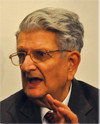
"Innovation gives me the most satisfaction,” says the chemical engineer, chemist (scientist engaged in chemical research) and doughty entrepreneur, who started his business in a small way over 40 years ago and has built it into a strong, indigenous, research-based company with a turnover of over Rs 1,000 crore. "GCL is internationally known. People recognize it for its quality products, reliability and reasonable prices. We export to North and South America, Europe, Africa, Middle East, Australia, Asia including China… what China doesn’t make, we supply. Japan is the one country we don’t export to. It is a closed economy, with invisible barriers. It is impossible to register your products there.”
The company’s footprint is large. It has manufacturing plants at Dombivli in the suburbs of Bombay, Lote Parshuram in Ratnagiri district, Maharashtra, Ankleshwar (wholly-owned Gujarat Insecticides Limited) and Panoli in Gujarat and a service unit in Jammu. Headquartered at Gharda House at Bandra in Bombay, the company’s sales are spread all over India. It also has a Group European office at Croydon in England and a US office in Pennsylvania, as per its website www.gharda.com
Gharda built his venture through the traumatic times of the ’60s, ’70s and ’80s in India with its plethora of controls and regulations. But for him, he says, stress is alien! "I don’t fret. I am a person who works hard, enjoys what he’s doing and doesn’t care whether he’s successful. I’m a peculiar person, I can laugh and joke, be a ‘jolly good fellow,’ but I’m self-contained. I can be alone, by myself, with my books. I’m not desperate for company,” he tells us in his forthright manner. "I’m an Indian. I just happen to be born a Parsi. I always joke that 95 percent of Parsis are cracked in the head, two percent are geniuses! The future of the community should not be measured in numbers. There will always be the stray Parsi — bold, innovative, and clever, the Shapoorji Pallonjis, Tatas, Godrejs and Gharda…!”
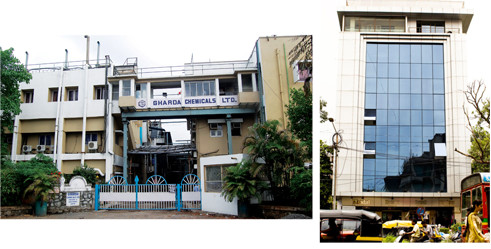
Dr Keki Gharda (top); R&D department at Dombivli factory (left); Bombay headquarters at Gharda House
(Photo: Kainaz Amaria)
Being resolute and resilient is also part of his personality! With his relatives he shares family DNA, not chemistry! Rumors have been doing the rounds in business circles for years that Gharda wanted to sell his 60 percent plus stake in GCL as he and his wife Aban have no children. But his nephew Darius Kavasmaneck who (along with some others) holds 33 percent in GCL, has for decades sought to prevent him from doing so, filing cases with the Company Law Board, up to the Bombay High Court. "He has no case. He is filibustering me, waiting for me to die. But I will live longer than him…” Gharda fires off his reaction. Three weeks ago, Kavasmaneck’s petition was dismissed by the High Court which however granted him six weeks’ time to appeal to the Supreme Court, if he so wished. (Parsiana contacted Kavasmaneck’s office but he was unavailable and did not return the call.)
For Gharda the scientist, the Eureka syndrome is still strong! "I have to live just three years more, which I will, and I will be the mover and shaker of the iron and steel, power and aluminum industries,” he asserts. For the last few years, his mind has been igniting with new and bold formulations — making iron and steel without coking coal, aluminum without red mud (which is an obnoxious waste), creating a titanium industry parallel to the aluminum industry. "After lab testing, I have to build demo plants, show that the idea can work. This requires an investment of Rs 500 to 600 crore. But the improvements will not be marginal, they will be revolutionary! This will be like the world before Darwin came on the scene and after he left!” These being not new but mature industries with production worth billions of dollars, the resultant savings in cost of manufacture will be remarkable, he adds. (Methods of producing steel without coke are already under development in the world, as coke manufacture is a highly polluting operation and coke cost is one of the major expenses in operating a blast furnace. Red mud is a bauxite residue and though it is not a hazardous waste, its disposal remains important as the worldwide annual production of the alumina industry is 70 million tonnes. Titanium can be alloyed with iron, aluminum and other elements to produce strong lightweight alloys for use in aerospace, military and industrial processes, orthopedic and dental implants, mobile phones, etc – editors.)
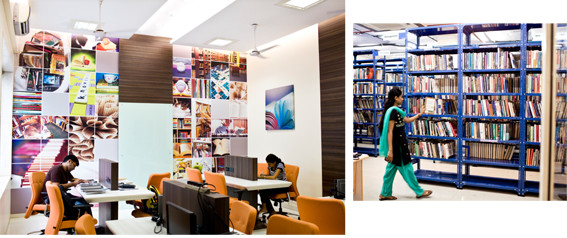
Sections of the Bai Ratanbai Gharda Memorial Library at Gharda House
Photos: Kainaz Amaria
Gharda has transferred his stake in GCL to the Aban and Keki Gharda Memorial Trust, but "I’m waiting to monetize it.” There will, however, be some conditions attached to the sale of his majority shareholding in GCL, he declares, including retaining the company’s identity. The names of prospective buyers like United Phosphorus, Rallis, Tata Chemicals, DuPont, etc and private equity players like Blackstone have been bandied in the Press for years, but Gharda is playing his cards close to his chest.
What he is certain about is future focus in two areas — the Gharda Foundation, through which corporate social responsibility is undertaken, and the Gharda Scientific Research Foundation which will do innovative technical research through the entity he calls Gharda Advanced Technologies. The return on intellectual capital will be enormous, he declares. With huge funds required and risk inherent in research, Gharda believes he can gamble with his own money, not with other people’s which is one of the reasons why he has never offered shares to the public. GCL is an unlisted, deemed public limited company. It began in 1962 as a partnership under the name of Gharda Chemical Industries. The original partners were Gharda, his mother Ratanbai and sister Coomi Warden, who held small stakes, and his second sister Jer Kavasmaneck’s husband Rutton who held around 30 percent. The partnership was reconstituted in 1965 after Ratanbai’s death. In 1967 it became a private limited company and a deemed public company in 1990. The main litigant is Jer’s son Darius who himself owns Western Chemical Industries Private Limited, also at Dombivli. His (Darius’) stake in GCL has multiplied manifold and is worth millions of rupees, states Gharda, and since he (Darius) has had no part in building GCL, he should not be asking for more. A very small percentage of shares are held by Gharda’s friend Hoshang Patel’s family. Godrej has a lien on around seven percent through Darius, says the chairman.
Gharda was born in Bombay into a middle class, athornan family. His father was a government servant, mother a housewife. His maternal grandfather was a doctor, an erudite man with a superb collection of books. He was also charitably inclined, not only not charging poor patients any fees but in addition aiding them with money to buy food, etc. After his schooling at St Stanislaus at Bandra, Keki joined the Elphinstone College and then the Royal Institute of Science, in the area known at that time as Kala Ghoda (Fort). Independent and outspoken, clashes with professors were not uncommon! "When a college professor does not know what he’s talking about, he talks a lot!” Keki had told a gathering of the World Zarathushti Chamber of Commerce (WZCC) on April 30, 2011 when the organization honored him with the Outstanding Zarathushti Entrepreneur of the Year award for 2010. The spark of enterprise was lit when chemical reagents he asked for were not available in the college laboratory, probably due to the fact that the British had been at war with Germany and supplies were scarce. Purchasing from his pocket money chemicals like sulphuric and nitric acid, Gharda experimented and succeeded in making reagents which he sold officially to the college!
After his graduation in chemical engineering, Gharda proceeded to Ann Arbor, Michigan, USA. Though he had obtained admission in the Massachusetts Institute of Technology and the University of Michigan, both of which had excellent chemical engineering departments, he joined the latter as the fees were more affordable and the admission was immediate. After the first year, during which fees had to be paid, he appeared for a tough examination to qualify for a scholarship. "It was a peculiar exam because they could ask you any random questions — physics, chemistry, mathematics or even local politics. They basically tested you if you had an inquiring mind. Coincidentally, during those exam days an ‘art’ cinema showed operas and ballets. Since I didn’t expect to succeed — nobody usually succeeded the first time — I used to visit the cinema almost every other evening,” Gharda had narrated the story of his life to MONEYLIFE editors Sucheta Dalal and Debashis Basu, published on May 10, 2007. Gharda passed at the very first attempt, getting scholarships in different years from companies like Dow, Monsanto and DuPont, chemical and agro giants GCL started competing with later!
A Masters degree was followed by a PhD from the University of Michigan. He then started teaching at the University of Oklahoma. Visiting India after a long gap of seven years, Gharda discovered his father was in hospital, a fact his mother had not told him lest he worry. Hormusji died soon after and the young man stayed back as he believed his mother would not be able to cope alone, as both his older sisters were married. The University of Oklahoma offered to hold his post for a year, but Keki did not go back. He taught for a while at the UDCT (University Department of Chemical Technology) in Bombay. "There too like in the US I followed an unorthodox teaching method. I said, ‘I won’t teach you what is in the text books. You are all going to hold responsible positions in the chemical industry, where there will be a huge price to pay for any mistakes that you may make. So I will not give you any special credit for the right answers, but heavy penalties for the wrong ones,’” he told MONEYLIFE.
Alongside part-time teaching at the UDCT he "fiddled around” doing consulting work for the chemical industry, solving the client’s problem first and asking for payment later, with the result that he often didn’t get paid! Marriage to Aban Mehta, who has a PhD in sociology, followed in 1962 and the couple continued to live with Keki’s mother. He set up shop by renting a shed at Vakola which had erratic water and electricity supply. Using a drum as a desk and a carboy as a seat, Gharda worked long hours aided by 10 uneducated workmen. His first pioneering product was phthalogen blue, popularly known as German blue, which was a dye pioneered by multinational (MNC) giant Bayer. He was the second in the world to make this product, Gharda related at the WZCC meet. Because of the low cost he made it at, Bayer’s product lost popularity within a couple of years. Initially, though, trying to convince customers to accept an Indian-made product versus one made by an MNC was a tough task!
GCL’s strengths have always been in making import substitutes and products going off patent, developing them much more cost effectively, with a quality as good as or even better than the original product, saving significant foreign exchange. Around five percent of sales revenue is invested into R&D. The company employs around 200 chemical engineers and chemists amidst its large workforce of around 1,700. In 1970, GCL received the prestigious Sir P. C. Ray Award for Development of Indigenous Technology from the Indian Chemical Manufacturers Association, an honor the company was to receive again in ’73, ’78, ’79, ’85, ’88, ’99, 2002-’03 and ’04-’05! Awards for exports, energy conservation and management, etc from the Government of India and industry bodies like FICCI (Federation of Indian Chambers of Commerce and Industry) are included in the list on their website.
Personally, Gharda was honored with the "Chemical Pioneer Award” from the American Institute of Chemists, Philadelphia, USA in 2004. Three out of 10 awardees from this Institute have gone on to win the Nobel Prize, he informs us. A gold medal in 2008 from the Society of Dyers and Colourists, UK, for "outstanding contributions to the dyestuff industry in India,” the Chemical Industry Stalwart Award from Chemtech Foundation "in recognition of outstanding contribution rendered to the Indian process industry” and many other honors have been bestowed upon him.
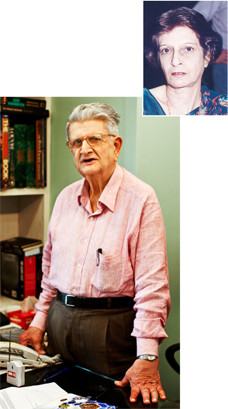
Dr Keki Gharda in his book-lined office (Photo: Kainaz Amaria), wife Aban (inset)
But the ride has often been rough. In the 1970s, the imposition of a 35 percent excise duty on dyes and intermediates suddenly turned their existing product range unprofitable, resulting in a big loss that fiscal. But within a year, capitalizing on the company’s inherent R&D strengths, they switched over to agrochemicals. In the late 1990s, they started selling Chlorpyrifos, an insecticide, and Dicamba, a herbicide, which were the monopolies of Dow and BASF, paying them around five million dollars each as data compensation. GCL is the only Indian company to receive US registration (Environmental Protection Agency approval) for sale of these two products in the US, states their website.
There have been other points of peril. In March this year a huge fire engulfed a section of the Dombivli plant. Despite the best of knowledge and skill accidents happen (due to the hazardous nature of chemicals, the interaction between complex technology and the human being), says Gharda. "It’s a saddening thought. There must have been a spark. Everything around is flame proof. Cell phones are strictly not allowed within a plant. Perhaps someone sneaked in a cheap cell phone… difficult to pinpoint exactly. It’s like if there is gas leaking from your gas cylinder and someone strikes a match, it’s going to explode.” With work spread across many locations, there are other living-in-a-real-world problems. "Some years ago, I was being quietly swindled (by some officers). We got to know when the union wrote me a letter with details.”
The Gharda Foundation encompasses the art of giving. A non-profit philanthropic organization, it was set up in 1996 with a two crore rupee donation from GCL. The Foundation runs the Gharda Institute of Technology (GIT), established in verdant Ratnagiri district in 2007-’08, which has its first batch of 360 students graduating this year. GIT runs four-year degree courses in civil, mechanical, chemical, electronics and communication and computer engineering under the All India Council of Technical Education. The Foundation also runs a 20-bed rural hospital, mobile dispensary, conducts AIDS awareness and family planning, health camps, etc. It provides microfinance and promotes self help for village women — sewing and production of natural fiber articles, agarbattis, hand painted cards, etc, as per its website www. ghardafoundation.org Mobile libraries, a mobile laboratory, setting up of balwadis (child centers) with toys and teaching aids, advice to farmers… are among its programs.
In memory of his mother, Gharda has very recently opened the Bai Ratanbai Gharda Memorial Library on the ground floor/basement of Gharda House. Amidst the sound of silence, seated in air-conditioned comfort, medical and management students are provided the facility to study for long hours in the reading room, insulated from the cacophony of honking and hawkers on the ever busy Hill Road. The Library itself is open to the public and charges but a small membership fee. Gharda has donated his own collection of thousands of books on a variety of subjects to the Library.
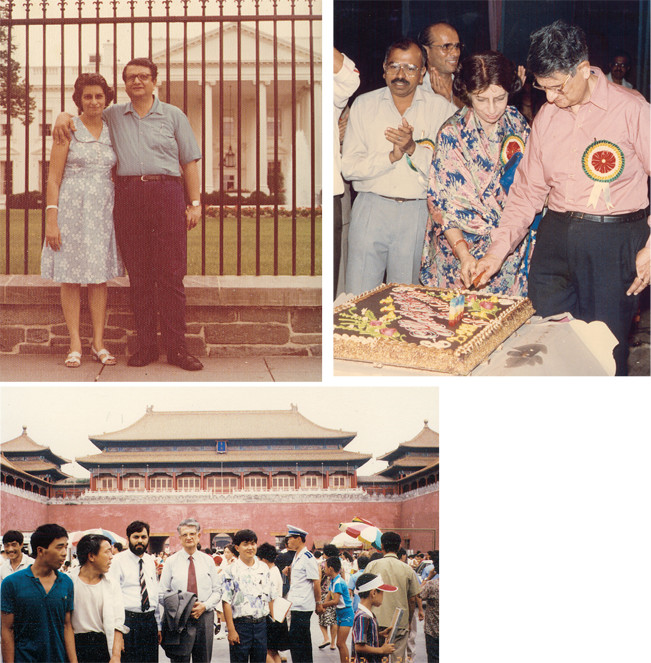
Their younger days: Aban and Keki Gharda outside the White House (above left), celebrating their special occasion with the staff and (alongside) on a visit to China
For Keki and Aban, home is located just above the office. Glitz and glamor are not in their lifestyle; the household is run simply and economically. "My wife still does the cooking herself,” he tells us conversationally. Though from a priestly family, "I’m an agnostic, not an atheist. I’m saying I don’t know if there is God.” People use God as a crutch; they tell lies, cheat… all in the name of God, he amplifies. Not involved in community affairs, he says he has no opinion to offer on matters like intermarriage, etc convulsing the community at this time. "I’d prefer to be cremated rather than consigned (to the dakhma). What you are doing now is only baking bodies in the sun,” he asserts, adding that GCL had provided Doongerwadi an ozonizer [a gaseous disinfectant, which releases ozone (a form of oxygen) into the air] some years ago "but I don’t know if they are still using it.”
How would you like posterity to remember you? we query. "I would like my head to be kept alive,” he states matter-of-factly, as we gape at him dumbfounded! "Why not?” he repeats. "This is not from the ego point of view. I’m extremely useful. It can be done by a supply of oxygenated blood passing through the brain. The heart is taken out and placed in a neutral saline solution, so there’s no reason in science why the head can’t be kept alive, except that there’s no skill at this point.” But how would your brain be able to communicate? we ask. Oh, that can be managed, he shrugs. "A voice synthesizer or something” (what is used by Stephen Hawking, eminent physicist and cosmologist who suffers from a degenerative motor neuron disease which has left him paralyzed and unable to speak). Awaiting more science fiction turning into science fact, Gharda says he’s really not bothered if he’ll be remembered. "My work will be remembered,” he asserts.
◆ ◆ ◆
One reader wrote
India should award Bharat Ratna to Respected scientiest Keki Gharda, his name was also nominated in the list of noble prize award winners of the world.He is one of the best Chemical scientiests in the world.
From the archive