
Zoroastrians Abroad
“Equal rights for men and women”
The Karachi Parsi Anjuman Trust Fund grants parity to the children of Zoroastrian women married to non-Parsis
As long as one of the spouses is a Zoroastrian and still professing the Zoroastrian faith, the children of such unions can be initiated into the religion was the unanimous view of the Karachi Parsi Anjuman Trust Fund (KPATF) board. Further KPATF permits last rites on their properties to all Zoroastrians, even those buried or cremated. Their response to a query by Bombay Parsi Punchayet trustee Khojeste Mistree was reported in the chairman’s review for the year ended June 30, 2010.

ByramAvari: steering progress
In response to our e-mail queries, Byram D. Avari who was reelected chairman of the KPATF for a five-year term last August wrote: "The view expressed regarding children born of one Zoroastrian parent is new and was specially discussed and recorded because of the controversy going on in Bombay. We wanted to clarify the situation in Karachi. It was not previously approved or documented and being a progressive religion we felt it is necessary for us to give equal rights to men and women... Naturally, as soon as a child is admitted into our faith, he or she is a Zoroastrian and has all the rights, privileges and responsibilities of being a Zoroastrian and therefore, can enter any fire temple. Regarding the last rites on KPATF properties, this has always been recognized in Karachi but has never been documented and recorded.” Assisting Avari in his endeavors are honorary secretary Rustom Sethna, honorary treasurer Homi Khambatta, manager Farrokh Mavalvala, and trustees Soli Parakh, Nergish Jamasji and Ardeshir Marker.
Catering to a community of under 1,500 Zoroastrians, the KPATF felt obligated to support Ervad Godrej Sidhwa who had spent "70 years of his life in community service” and his wife Dina who had been hospitalized since many months (Godrej passed away on June 4, 2011). After the demise of Dastur (Dr) M. N. Dhalla, Sidhwa had taken up his duties in the religious as well as social areas. For many years he was honorary secretary of KPATF, Karachi Athornan Mandal, and joint honorary secretary of Dastur Dr Dhalla Memorial Institute. Having lectured on the religion under the auspices of many organizations in Pakistan and overseas, he was also a jury delegate of the Karachi Parsi Matrimonial Court, as notes an introduction to him on Wikipedia. In fact when a thief broke into the Sidhwas’ house and was subsequently arrested but released on bail, the KPATF engaged a lawyer to get the bail cancelled in the High Court of Sindh. However "being connected with the police, he escaped from the High Court of Sindh” after confessing, states the report.
The community in Karachi witnessed 20 navjotes, eight weddings and 39 deaths last year as against 16 navjotes, five marriages and 22 deaths in 2008-09. During the year 2009-10 there was only one birth that is known to have taken place. KPATF assists two families with psychiatric treatment to facilitate their rehabilitation. Besides looking after the community in Karachi, the KPATF also extends help to the Lahore and Rawalpindi Anjuman by lending the services of their priest when needed.
The 108th anniversary of the atash adarian and the 141st anniversary of the Seth Dossabhoy Merwanji Wadia Dar-e-Meher (Gari Khata Agiary) was celebrated on April 24, 2011 (roz Adar, mah Adar) with a function and dinner attended by around 315 Zoroastrians. The function included benediction and prayers by the panthaky of the Agiary Ervad Kaikobad Dastur followed by brief speeches by the president of the Young Mazdayasnian Zoroastrian Association (YMZA) Shahpur Maneckji and joint honorary secretary Kaizer Irani. "This is the first time that there has been a formal function to celebrate the anniversary of the Agiary,” writes Byram’s son Dinshaw Avari. At the celebrations organized by the recently merged YMZA and Dastur Dr Dhalla Institute all the nassessalars and mobeds of Karachi were invited.
Founded in 1965, "The Dastur Dr Dhalla Memorial Institute was officially wound up and merged into the YMZA so that younger members of our diminishing community can look after both these institutions jointly,” it was reported in the chairman’s review for the year ended June 30, 2009. The funds of the wound up Institute were transferred to the Nirashit Fund of KPATF and the library shifted to the sezdegah at Doongerwadi.
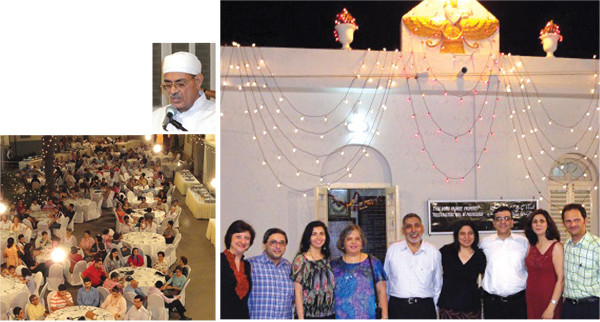
(Clockwise from top left) Ervad Kaikobad Dastur ; enthusiastic committee members at the Wadia Dar-e-Meher ;Karachi community enjoying dinner organized to celebrate the anniversary of the Wadia Dar-e-Meher
The history of the Wadia Dar-e-Meher as culled from a book written by Jahangir Framroze Punthakey in 1919 indicates that the Dar-e-Meher with an atash dadgah was consecrated on May 28, 1869 with funds collected from Bombay and Karachi amounting to Rs 15,720. The utensils and implements for the Dar-e-Meher were imported from China by Bejonji Khurshedji Golwala. Thirty-five years later the dadgah was upgraded to an adarian with costs borne by Khan Bahadur Cowasjee Katrak. Three priests from Udvada were specially brought in to serve the sacred fire — Ervads Muncherji Gorana, Navroji Gorana and Bhicaji Sidhwa. Ervad Shapurji Katila came with them as a cook. The longest serving priests at this Agiary were the Katalia family who have been with the Karachi community for over 50 years. Beginning 1940s, the cost of the kathi at the Wadia Dar-e-Meher has been borne by the Avari family, presently by Byram and earlier by his father Dinshaw.
Popular in Karachi are the humbandagi prayers, financed by different trusts and the magnanimous Patloo sisters. In 2009 when the trustees sought to restrict the humbandagi prayers from 10 muktad days to five Gatha days, Shaveer Byramji assured the support of his Mehta Trust to finance the prayers.
It was in the 1950s that a housing complex in the Agiary compound started taking shape with the construction of the Khajurina Building and Kothari Building, both of which were handed over to the KPATF. This was followed by the Anjuman Building.
Since the properties maintained by the Anjuman had a number of flats unused by tenants living abroad, the KPATF succeeded in getting them to surrender their flats, as stated in the report for the year ended June 30, 2008. The law and order situation in Karachi being sensitive, there is continuous concern to improve security on Anjuman properties.
Drawn to Damavand
The white tablecloth laid on the slopes of Mount Damavand looked like an extension of the snow covering the peak. Standing out in contrast were the fire afarganiu, lork (dry fruits) and other items traditionally laid out at a gahanbar celebration. On May 14, corresponding to the Fasli mah Ardibehest (associated with growth), roz Ashishvang, a gahanbar was organized, attended by nearly 80 Zoroastrians from India, notes a report by Mitra Dehmoobed in the Amordad newsletter.
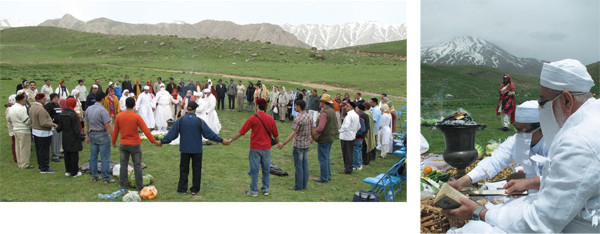
Gahanbar and hamazoori on the slopes of Mt Damavand
Photos: Gata Ziatabari
Damavand Mountain continues to draw Parsis, irrespective of the number of times they have visited the place before, states the write-up. To the devout this Mount symbolizes the victory of good over evil because the Shahnameh narrative refers to the wicked Zohak being held captive here. Zohak represents falsehood and deceit and through hamazoori during a gahanbar it is believed that the wicked will be destroyed to permit purity and righteousness to raise its head.
After the Arabs attacked Iran, some Zoroastrians migrated to India. Those who stayed behind reportedly fled towards the mountains. Among them were said to be two groups, Mas Mogan, meaning mobeds, and Sepahabaddinesti. The prayers at Mount Damavand are thus considered a memorial service to these two groups, it was reported in Amordad news.
◆ ◆ ◆
From the archive