
In Memoriam
“Lady of learning”
Died: Deena Minoo Mistri, 85, eminent educationist of Pakistan and longest serving principal of the Bai Virbaiji Soparivala (BVS) Parsi High School, and trustee of the Karachi Parsi Anjuman Trust Fund, on January 27, 2011 in Karachi following a stroke which led to cardiac arrest.
In keeping with her wishes the cortege made one last stop at the BVS School, halting near the dais where Mistri had delivered countless speeches and presided over innumerable prize distribution functions. For the funeral there were over 2,000 mourners — past and present students, parents, colleagues, friends — who had come to pay their respects. It was not only the priests who were her former students, even the nassessalars had been taught by her for she believed in imparting education to all strata and communities. In fact conceding to the request of her legion of admirers from all denominations and faiths, her sons Farhad and Afshad permitted them to have a final glimpse of their dear teacher even after the geh sarna prayers were completed.
"She was an icon in the world of education, a personality of whom the community has always been proud, a lady of immense substance who has been acknowledged from President John Kennedy to the President of Pakistan for her meritorious and dedicated services to education and to humanity…with her strength of character, positive thinking and religious zeal,” noted a condolence letter signed by Byram Avari, chairman of the Karachi Parsi Anjuman Trust Fund. "She was not only a pillar of strength but the foundation for many who came in contact with her,” he added.
During her 55 years at BVS teaching three generations and working as principal for over three decades she came to be recognized as the guardian and guide of her "boys,” inculcating in them values which they appreciated years after passing out from school. Loved and feared, "when she entered a room, the noise would just die, no fading out, just die,” recalled her grand-nephew Yashaan Mavalvala referring to the "cane in her office which everyone talked about; it kept everyone in line.” The first and second graders though would run to her car to greet her when she arrived.
Her successor Kermin Parakh noted that Mistri’s "was a very hard act to follow.” When Parakh told Mistri that her shoes were too big to be filled, the senior advised her to create shoes of her own instead of fitting into others’. "We could just walk into her office at any time, even with personal problems,” stated Mehernaz Bharucha, headmistress of the primary section. Another colleague Nighat Razzaq recalled how all her teachers were expected to tutor at least three to four children of the custodial staff at the school and she herself never differentiated between the son of a custodian and the son of a minister. During the revolution in Iran when many Zarathushtis chose to make Karachi their new home the boys were given free education in her School and offered free tuitions at home to help them cope with the demands of a new education system. The same generosity was extended to non-Parsis too and one such student, now a successful physician in Houston, publicly acknowledged her largesse at a felicitation function organized by the students in Houston in 2007. Despite demands from parents she refused to introduce the Cambridge system of education in addition to the matriculation syllabus on the rationale, "I cannot have class difference within one boundary wall.”
She did not subscribe to the view that imparting formal education was enough and always sought to inculcate the values of honesty, discipline and courage in her students too. Having declared that no arms were to be brought into the School premises, she refused to make concessions for even a minister who came with his armed guard. In strife torn Karachi, every time there was a disturbance in the Saddar area where the School was located, she would stand at the gate and ward off miscreants, giving the children and their parents a sense of security.
An obituary write-up on Mistri featured on the website of The Express Tribune earned scores of comments from her ex-students and their parents, all appreciating her disciplining and teaching of English in grade 10. "If I had a chance to come back in this world, I would wish to be your student,” remarked a student. "A life changer….an ‘Iron Lady,’” commented another. "Lady of Learning,” declared an alumnus. "Her admonishments and constant care have improved the lives of a generation of men!” summed up yet another.
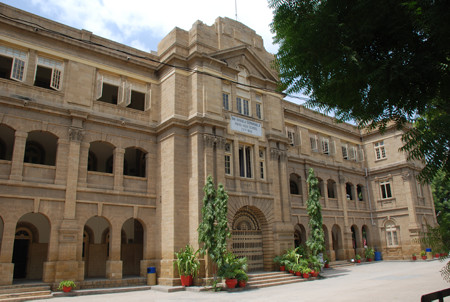
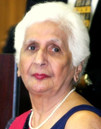
Deena Mistri (top) and (above) Bai Virbaiji Soparivala Parsi High School in Karachi where she taught for 55 years
"A born teacher”
Her tryst with education commenced in 1950 when Behram Rustomjee, then principal of BVS asked her to substitute for the School’s English teacher. While Deena was happy to associate herself with the School founded by her great-grandfather Shapurji Soparivala, her father Pestonjee Soparivala was not keen that she teach in a boys’ school. Expecting it to be a brief commitment, Pestonjee relented. She thus became the first woman to teach the secondary classes in those days. A year later she married Minoo, an architect of repute, who firmly believed in women pursuing careers of their choice. Thus after marriage she earned her degree in education, and qualified for a Fulbright Scholarship for one year to study for a diploma in education in the United States. Subsequently she briefly taught at the University of Athens in Ohio and at the University of Austin in Texas and had the privilege of being invited to the White House to meet President John Kennedy just a year prior to his assassination. She was also given honorary citizenship to Texas by governor Price Daniel. On her way home from the States she was invited by the British Council to observe the British teaching system in London. Having benefited from her exposure to the western system of education she sought to widen the horizons of her students. From 1972-2004 she served as principal of the School and refused to slow down even when she was diagnosed with breast cancer in 1992. After her retirement from BVS, Mistri served as chairperson of the Westminster School and College and was consultant to Accel School until her demise.
Viewing herself as "a born teacher” she took on the mantle of tutoring the children of her domestic help at age 10 while yet a student of St Joseph’s Convent. And after completing her BA from the D. J. College she tutored BVS boys in English and readied them for elocution and debating activities. To keep alive her memory, the BVS Alumni Association with the help of The Citizens Foundation plan to build a school in a slum area of Karachi to be named The Deena Minoo Mistri Campus which they envisage will cost PKR 1,50,00,000.
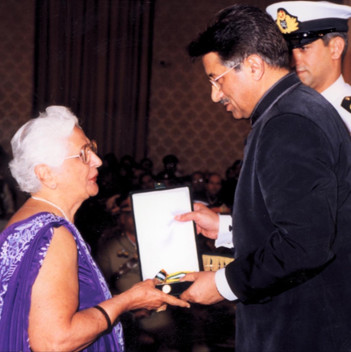
In 2002 she was awarded the Pride of Performance by the government of Pakistan in appreciation of her contribution to the field of education. The medal though was robbed two years later in a house burglary. Around 10 years ago when she was on Karachi’s M. A. Jinnah Road while son Afshad was parking the car, she was mugged by miscreants demanding she part with her valuables or face death. The intrepid pedagog is known to have fought back saying "Tum kya mujhé maarogé jab tak uparwala mujhé zindaa rakhéga (until God looks after me how will you succeed in killing me)!” In the ensuing scuffle the villains managed to escape and she was left with a few bruises.
With her "immense faith in her religion,” she would be "one of the first in the agiary on hamkaras or for the muktad prayers.” In 1991 when one of her relatives passed away in Washington during her visit there, in the absence of a priest she recited all the prayers for the deceased, recalls Afshad.
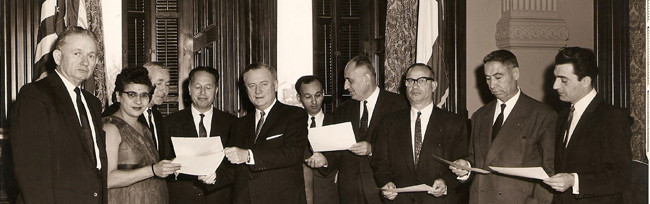
Deena Mistri being conferred the honorary citizenship to Texas and (above) receiving national award from Pervez Musharraf
Education was always a source of strength to Mistri, during her illness and in recent times following the demise of her husband five years ago. Indian soap operas on television helped her relax in the evenings. Fond of both Parsi and Pakistani food, she was content with whatever she had. Flowers though brought her immeasurable pleasure, recounts Afshad.
A role model to many she was considered "a source of inspiration and support,” by the trustees and managing committee of Karachi’s Bomanshaw Minocher Homji Parsi General Hospital as acknowledged the condolence letter in honor of the Hospital’s vice chairperson and managing committee member. When the Hospital needed the influence of some government official they had only to call her and the silent worker would recommend the name of some ex-student who would promptly redress the grievance. "She was a woman of caliber and endearing qualities,” they appreciated.
There were several other community institutions with which she was connected. Until her death she also served on the managing committee of the Rajkotwala Baugh Fund and the committee of the Parsi Colony housing complex. At the Karachi Zarthosti Banu Mandal she had served as chairperson of the education subcommittee for six years and as noted a tribute to the "exemplary educationist” by Parakh in their newsletter What’s On (March 2011), she will be remembered as "stern yet caring, tough yet loving and vivacious yet humble.”
The endearing educationist is survived by her sons Farhad and Afshad.
◆ ◆ ◆
From the archive