
Awards
“PIL is not a pill
Soli Sorabjee explained what judicial activism is all about in the fifth Nani A. Palkhivala Memorial Lecture Soli Sorabjee explained what judicial activism is all about in the fifth Nani A. Palkhivala Memorial Lecture
"People’s lack of interest in civil liberties led Nani Pakhivala to despondency… This award is meant for activism, for enhancing the culture of civil rights not only by lectures and seminars (but by) needful action to back them up. Shailesh Gandhi gave up his business to work for the country. He used the Right To Information (RTI) law as a powerful tool. He motivated others to do likewise…”
Former Supreme Court (SC) judge Sujata Manohar, who along with retired SC judge Sam Variava and former chief justice of India M. N. Venkatachaliah decided the winner of the third Nani Palkhivala Civil Liberties Award, complimented awardee Shailesh Gandhi, convenor of the National Campaign for People’s Right To Information. A first generation entrepreneur, Gandhi was chairman and managing director of Clear Plastics Limited till last year when he sold his company to concentrate on social activities.
The citation along with the cheque for one lakh rupees that Manohar presented to Gandhi on behalf of the Nani A. Palkhivala Memorial Trust (NAPMT) notes, "He understood and foresaw well before others what an invaluable instrument the Right To Information law was. It confers on the people the power not merely to get information, but through that to secure civil liberties for millions who are denied information and their rights behind the closed doors and iron curtains of the authorities.
"Shailesh has with missionary zeal carried out campaigns, held workshops and talks and has extensively written on the Act to spread its message to thousands of persons who otherwise were defeated by the complexities of the system. His work has inspired many other persons, associations and trusts to carry forward the significance of this law to the masses.”
The citation, signed by NAPMT chairman Yezdi Malegam, further notes, "When the Right To Information Act was sought to be curtailed by the Government in 2006 which wanted to amend it to prevent the public from having access to notes on Government’s files which would show how decisions were made, Shailesh successfully led the opposition to this retrograde amendment. His disarmingly simple theory was that if you have nothing to hide, why should you be wary of anyone seeing how and why a decision was arrived at? Transparency and accountability in the working of the Government ensures the rule of law and civil liberties.
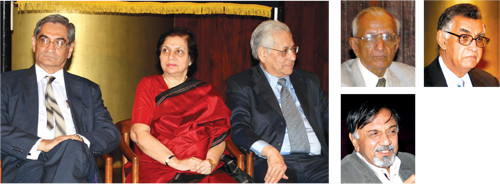
Clockwise from left: Sam Variava, Sujata Manohar, Soli Sorabjee, M. N. Venkatachaliah, Yezdi Malegam, Shailesh Gandhi
"As Shailesh has said, ‘A true democracy will remain a myth without transparency.’ In a word, this law reduces the propensity for corruption and nepotism and salvages civil liberties for everyone. Now even the Official Secrets Act behind which many Government bodies take shelter is being questioned as anachronistic and public opinion is being created to ask Government to accept the supremacy of the Right To Information Act. There could be no better commendation for Shailesh’s work.”
Deeming it a "privilege and honor” to receive the Award instituted in memory of the late Nani Palkhivala whose insistence on values and truth placed him in a special position in the Indian political arena, Gandhi recalled the start of the campaign in rural Rajasthan in 1999 and credited social activist Anna Hazare for spreading the message of RTI as a public movement in Maharashtra.
"Lokmanya Tilak had said ‘Swaraj is my birthright.’ But the swaraj we dreamt of never came. We have an elected democracy, not a participating democracy. In a democracy the individual is sovereign …He parts with some of his sovereignty in exchange for the rule of law… But the individual in India is helpless. If a citizen approaches an elected representative, he may or may not get a hearing in 24 hours; if she writes to a public servant she may or may not get an answer in 12 days; and if she approaches the Courts …the final decision will probably be obtained after a decade,” Gandhi etched the Indian national scenario.
"Six decades after Independence, India is seeing a reincarnation of the princes and zamindars in their new avtars: as monopolists and SEZ owners who actually dictate policy and implementation. The State provides the …armies for these,” he continued.
He noted that "the Right To Information Act provides an avenue for the common citizen to question his government, get accountability, find out about policy implementation, expose corruption and get respect for the majesty of the Indian citizen. The elegant law provides an inexpensive, timebound and simple instrument to citizens, which can be used by them from their own house with an input of less than an hour and around Rs 50,” Gandhi maintained that the RTI had provided a possibility of gaining swaraj after all and acknowledged the help of friends, well-wishers and family in the work he had undertaken. "Accepting the award on behalf of the common citizen of the country who is now empowered to question the government of this country,” Gandhi urged the audience in the Tata Theatre on January 11, 2008 to "share the opportunity to be the agent of change we desire, (join in the) search for transparency and truth.”
Boon or bane
The second part of the program comprised the fifth Nani A. Palkhivala Memorial Lecture. Noting that the causes Palkhivala espoused were still relevant five years after his death, Malegam said that the Trust’s mission was to continue the jurist’s role to awaken the public conscience by provoking debates on national issues. Hence the subject of the day’s lecture by eminent jurist and former attorney general of India Soli Sorabjee was "Judicial Activism – boon or bane?” "When the nation is on an escalator of anarchy, inaction and silence can be culpably wrong,” maintained Malegam. "Has the public interest litigation (PIL) led to judicial activism? Perhaps there is no other individual so uniquely qualified to speak on the issue as Soli Sorabjee.”
In a lecture rich in the history of judicial activism in the UK and US, Sorabjee began by quoting dictionary definitions of activism. He said he was following the practice of the late jurist Hormasji Seervai. According to those definitions, "judicial activism would denote a judiciary in which judges discharge their functions in a vigorous and decisive manner to achieve an end. What is that end? Dispensing justice with a view to righting wrongs or fashioning remedies where none exist,” he noted.
"The thinking in the past was that the traditional role of the judiciary is to merely declare the law and not to make law. This fairy tale about judges not making law according to one jurist, is a childish function and it has now been discarded. A certain degree of legislative activity is inherent in the process of interpretation. In support of his contention Sorabjee quoted the celebrated Justice Holmes of the US Supreme Court who recognized "without hesitation that judges do and must legislate, but they can do so only interstitially; they are confined from molar to molecular motions.”
Even private litigation has led to judicial activism, noted Sorabjee. He cited the "snail in the ginger beer case” as proof. A dead snail in an opaque bottle led to a serious illness. The judge upheld the consumer against the manufacturer. "Lord Atkin enunciated the legal principle in his inimitable way: ‘The rule that you are to love your neighbor becomes in law: You must not injure your neighbor. Who then, in law, is my neighbor? … The answer seems to be persons who are so closely and directly affected by my act that I ought reasonably to have them in contemplation …’ Lord Atkin in Donoghue evolved the ‘neighbor principle’ which created a duty of care emanating from a general relationship of proximity based upon foreseeability of harm.”
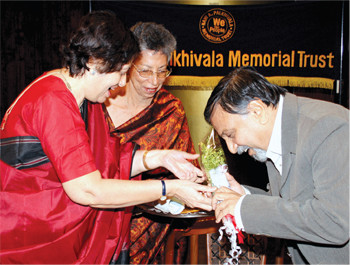
Manohar presenting award to Gandhi. Shirin Bharucha in background
Another striking instance of judicial activism is the rule about giving reasons for a decision even when the statute does not expressly so provide, said Sorabjee, relating how in 1992 Master of the Rolls Lord Donaldson invoked the common law to require tribunals to give reasons for their decisions. "The Privy Council in a judgment in 1999 opined that although there was no express obligation to give reasons in the statute or the rules, such an obligation may nevertheless be found to exist by operation of the common law and as a matter of fairness.
"The rule evolved by the judiciary about giving reasons promotes good governance and fair administration because it ensures transparency and openness in decision making. A non-speaking unreasoned order is like the inscrutable face of the sphinx. Above all it satisfies a basic requirement of fairness and natural justice because the person who is adversely affected must know why his application has been rejected or the reason why his license or permit has been cancelled. This salutary development would not have been possible but for judicial activism displayed by activist judges.”
The US Supreme Court deduced the right of privacy on the reasoning that various guarantees in the Bill of Rights create zones of privacy, Sorabjee said.
These examples were meant to "dispel the alarm bells which have been ringing in some quarters… that judicial activism is an infectious disease which has recently afflicted our judiciary or that a bunch of maverick judges has descended upon us with disastrous consequences to our nation. This hullabaloo is totally misplaced.”
Noting that the freedom of the Press, the right to privacy, the right to travel abroad, the right to education, freedom from cruel and inhuman punishment or treatment have all been evolved by activist judges on the basis of such fundamental rights as the freedom of speech and right to life, Sorabjee asked, "Can anyone seriously object to this activist judicial approach which has enlarged the fundamental rights of our people?”
The famous Keshavananda Bharati case which Palkhivala fought in the Supreme Court – with Sorabjee as his junior – has established that the innate structure of the Indian Constitution cannot be amended by Parliament, no matter how strong the majority in favor of such a change. In Sorabjee’s words: "The Supreme Court ruled that the power of amendment was not absolute but was subject to an implied limitation namely that the power of amendment cannot be exercised so as to abrogate the essential features of the Constitution thereby damaging the basic structure of the Constitution. According to the Supreme Court some of the essential features of the Constitution are the rule of law; democracy; secularism; federalism and judicial review. The decision in Keshavananda Bharati’s case was the zenith of judicial activism…
"Thanks to the basic structure doctrine provisions for free and fair elections cannot be repealed from the Constitution, nor can it be provided that elections would take place if and when Parliament determines instead of every five years and thus make a mockery of democracy. Thanks to the basic structure doctrine the judiciary cannot be deprived of the power of judicial review nor can the rule of law be abrogated. Again thanks to this doctrine federalism cannot be obliterated and States made vassals of the Centre. These, to my mind, are tangible and substantial benefits. In my view the basic structure doctrine has certainly been a boon.”
But the Court cannot and will not enter into the domain of public policy making nor will it rule on which is a wiser or better option. It will only give a ruling on whether or not a particular government policy or action contravenes the Constitution or statute. However, "where state policy is in conflict with the Constitution, courts have to determine whether the state has failed to give effect to its constitutional obligations. If in a given case the state has failed to do so, the court is obliged by the Constitution to so declare. If that constitutes an intrusion into the domain of the executive, that is an ‘intrusion’ mandated by the Constitution itself. Invocation of the separation of powers doctrine in such cases is misconceived and the Hon’ble Speaker Somnath Chatterjee’s periodic salvos against the judiciary are unwarranted.”
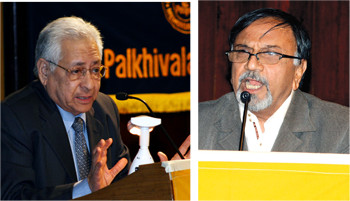
Sorabjee (left) and Gandhi: quest for justice
Can the judiciary make a law where none exists? Confronted with the persistent and pervasive problem of sexual harassment in the workplace with no legislation dealing with this evil, the Court referred to various international covenants and issued several directions. These directions included definition of sexual harassment, the preventive steps that can be taken, the disciplinary action and criminal proceedings that may be adopted for sexual harassment. The Court also devised a complaints mechanism and a complaints committee. The Court emphasized that these directions would be binding and enforceable in law until suitable legislation is enacted to occupy the field. "This judgment, no doubt laudable in intent and content and also beneficial to the victims of sexual harassment, is a classic instance of pro tem ad hoc judicial legislation. It is a matter of regret and shame that as yet no legislation has been enacted by Parliament,” noted Sorabjee.
It is the often controversial orders passed by the Court in PIL cases that cause judicial activism to be most criticized. "Some orders and directions which have been passed are beyond the judicial sphere. The judiciary cannot direct the administration to construct roads and erect buildings, to beautify a dilapidated railway station, to secure lands in a particular locality for accommodating certain persons, to appoint managers at a remuneration fixed by the Court or to give ad hoc directions for huge monetary payments for victims of riots or natural calamities. Such orders are in the realm of the legislature and the executive and have serious fiscal and budgetary implications and can be regarded as baneful.
"The reason for such indefensible orders is the belief some judges have instilled in themselves that the judiciary can solve all the problems that afflict our nation. It must always be remembered that PIL is not a pill for every ill. Every matter of public interest cannot be the basis of a PIL, e.g. increase in the price of onions or revision of railway fares or the problem of trains not running on time. It is also necessary to ensure that genuine PIL does not degenerate into Private Interest Litigation, Political Interest Litigation and Publicity Interest Litigation…
"It must be remembered that perfection is not the attribute of common humanity and judges are after all human beings. They are not celestial bodies endowed with the gift of infallibility… It is noteworthy that vociferous criticism of judicial activism and activist judges stems from bureaucrats and ministers and wielders and holders of power who resent criticism of their actions and are furious when their orders or decisions are set aside by the courts. The public has no complaint or grievance about judicial activism. In fact, public opinion is strongly in favor of it except when some judges pass some fanciful orders…
"Quest for justice, especially social justice and relief of human suffering is the paramount motivation for judicial activism… Judicial activism will certainly be a boon if there are sensitive, sensible and courageous judges who do not flinch in deciding against the government of the day, judges who are not swayed by popular praise or resentment, judges who do not make judicial restraint a pretext for self-abnegation, judges who exercise judicial power actively, vigorously, not extravagantly, and without straying into forbidden fields. Blessed is the country which possesses such judges. And I venture to say that, occasional judicial aberrations apart, India is one such country…”
◆ ◆ ◆
From the archive