
Awards
“The extraordinary in the ordinary”
Empowering the weakest of Indians was the theme of the fourth Nani A. Palkhivala Civil Liberties Award as well as of the sixth Nani A. Palkhivala Memorial Lecture
"I do not know in what capacity of mine the trustees thought that I was qualified to deliver the lecture. Nani Palkhivala was a legal giant, a successful business leader, a diplomat and a powerful advocate of noble causes. I am no longer a practising lawyer, I have never tried my hand at business, I have never been a diplomat, and I often find myself as a target of advocates of noble causes. The last of course, is the occupational hazard of being a minister!” smiled P. Chidambaram, home minister of the government of India, as he began the sixth Nani A. Palkhivala Memorial Lecture at Bombay’s Tata Theatre on October 5, 2009.
The event, normally held on January 16th each year — Palkhivala’s birth anniversary — had been postponed to accommodate Chidambaram’s grueling schedule. As noted lawyer Homi Ranina mentioned in his vote of thanks, the minister had been traveling through the day and was to catch the 9 p.m. flight back to Delhi.
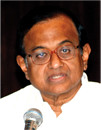
P. Chidambaram: "share my optimism and belief”
The evening also witnessed the conferment of the fourth Nani A. Palkhivala Civil Liberties Award in the individual category to social activist Aruna Roy, an officer in the Indian Administrative Service (IAS) who gave up her coveted position to work for people at the grassroots, and to the Public Concern for Governance Trust (PCGT) in the NGO (nongovernmental organization) category. Both awards include a citation and one lakh rupees in prize money. In his welcome address at the start of the evening Yezdi Malegam, chairman of the Nani A. Palkhivala Memorial Trust (NAPMT) which has instituted the lecture and the awards, noted that the winners had been selected from among the entries received in answer to their advertisements by a panel comprising former Chief Justice of India M. N. Venkatachaliah, and retired judges of the Supreme Court Justice Sam Variava and Justice Sujata Manohar, the latter announcing the winners.
Addressing his subject — "The emerging challenges to civil society” — Chidambaram documented them, beginning with the need to crystallize "the idea of India.” Illustrating how the ‘idea’ varied with birth, family, upbringing, education and the like among the country’s one billion plus citizens and innumerable schools of thought, Chidambaram noted, "It is perhaps ambitious or naïve to expect that we can fashion an idea of India that we can all share. But, I am afraid, without such an idea of India, and without a shared idea of India, it is not possible to build a modern and strong India. However many and deep-rooted our differences may be, it is imperative that we identify common strands that will bind us together as one nation and one people.”
Without such a common base he felt it would be impossible to attain any of the ideals enshrined in the Constitution. "Of all the pillars that hold up the democratic system, I cannot think of anything more important than equality of status and of opportunity. Yet, to my dismay, our social, economic and political systems continue to deny equality of status and of opportunity to millions of our fellow citizens. Any attempt to correct this distortion is met with stiff resistance. What is reservation in educational institutions and jobs if not an instrument to correct the historical denial of opportunity to many sections of the people, especially dalits, scheduled tribes and the backward classes? Reservation may be a blunt instrument, but no one has suggested anything better.” Ruing the opposition to a manifold expansion of the capacity of educational institutions as "dilution,” to reservation in jobs as being antithetical to merit, Chidambaram asked "How can merit among vast sections of first generation job seekers be discovered if they are denied the opportunity of holding jobs?” He blamed "the persistence of historical inequalities (for) the conflict and tension in our society.”
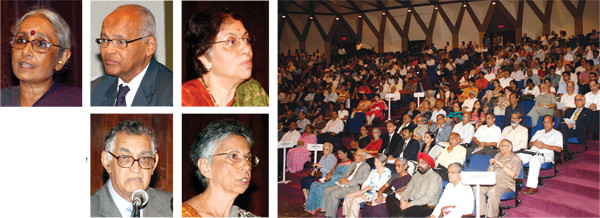
Clockwise from above: Aruna Roy, B. G. Deshmukh, Sujata Manohar, the audience, Shirin Bharucha and Yezdi Malegam
Detailing his concept of an "inclusive India” in order to keep the country’s population together as one people, the minister said, "My idea of India is an India where we make a conscious effort to make our society more equal and more united. It will not be easy. It will mean that those who have enormous wealth must be willing to share with others who have little or nothing. It will mean that those who have large incomes must be willing to pay more taxes. It will mean that we frown upon ostentation and vulgar display of wealth and endorse austerity and simplicity. It will mean that we amend the rules to accommodate more dalits, scheduled tribes and minorities. It will mean that we consciously forsake any claim to a religion or language or caste being superior to any other. It will mean that each one of us has to give more before we ask for more.”
Referring to the higher rate of growth that has occurred since the liberalization process began, Chidambaram emphasized its limitations — "Growth does not automatically trickle down to those at the bottom of the pyramid” — and spoke of the obligations that go with inclusive growth: food and fuel subsidies, the pressing need to write off farm loans worth Rs 65,000 crore. "It was resisted, initially, by the bankers. It was severely criticised by the economists. It was lambasted by the opposition as a populist and vote-catching measure. Few among them paused to ask the question how many crores of rupees of non-performing loans were written off for big industries. Let me give you the answer. Between 1999 and 2004 alone, banks wrote off Rs 47,123 crore that had been given to industries. It benefited a few hundred industrialists and maybe a few thousand jobs too were saved. On the other hand, the much criticised loan waiver scheme benefited 36.8 million farmer families and lifted a huge burden off their shoulders,” especially beneficial when viewed in the light of the poor monsoon that followed, he added.
Chidambaram spoke of the challenges to internal security from insurgency in the north-east and the Naxalite movement of the Communist Party of India (Maoist). He referred to the abysmal condition of the police system that is expected to contain them, a system that is "completely outdated… our police forces are ill-trained, ill-equipped and ill-paid. Adding to these woes are the shortsighted policies followed by governments with the objectives of control and patronage. Let us take the average constable. He is perhaps the most used, misused and abused person ever to wear a uniform. He works, on an average, 12-14 hours a day; generally seven days a week, and throughout the year. Since he is drawn from the common stock of people, his behavior and attitude reflect that stock… He is perhaps the most reviled public servant in India.” Even so Chidambaram was quick to praise the heroism of the police against overwhelming odds as during the terror attacks in Bombay, adding, "In the first eight months of this year alone 320 men and women belonging to the security forces have laid down their lives in the course of discharging their duties.”
Referring to India’s increasing vulnerability to terror attacks the home minister was indignant that "there is a not-often-noticed significant flaw in our approach to terror. While there is no ambiguity or doubt in anyone’s mind when it comes to cross border terrorism, when we apprehend home grown boys who are suspected to have committed terrorist acts, to my great dismay, I find that civil society is divided into two camps. On the one hand, there are people who will pronounce them guilty even before a trial and, on the other hand, there are people who will spring to their defence even before the investigation is completed. Both are wrong. Both take apparently righteous positions even without knowing the facts.”
India is "not yet a nation that has found peace and harmony. Nor is it yet a fair and just society,” admitted the home minister but described the condition as a challenge to the will and determination of the people. Just as the US emerged stronger after its civil war, Britain fought off the might of Nazi Germany and Japan recovered from abject defeat in World War II to become a leading economic power, Chidambaram declared, "Our challenges — formidable as they are — can be overcome. We can forge a united vision of India. We can succeed in our unique model of inclusive growth. We can vanquish the forces that threaten our internal security. That is my belief, and I ask you to share my optimism and belief.”
Chidambaram’s ideas, rational and convincing as they were, nonetheless raised as many questions as they answered but there was no provision for a question hour after the speech.
Awards
During her tenure Roy "observed from within the cynical, rampant bureaucratic inertia and indecisiveness among the higher-ups and juniors who were denied and discouraged from independent functioning. She left to become the tireless campaigner who took up cudgels for India’s millions of villagers to improve their living standards, and exposed the corruption and inefficiency of local officials. Her weapon to bring to book the erring machinery was campaigning for transparency and accountability,” noted the Award citation read by Trust secretary-trustee Shirin Bharucha.
Resigning from the IAS Roy joined the Social Work and Research Centre in Tilonia, Rajasthan, where for eight years she witnessed the conditions of the people. Branching out independently thereafter, she established the Mazdoor Kisan Shakti Sanghatana, creating "a grassroots movement that triggered a nationwide demand for the right to scrutinize public records, which is a crucial check on arbitrariness,” records the citation. The enactment of the Right to Information Act in Rajasthan was a direct result of this endeavor. Along with others, Roy founded the ‘Barefoot College’ to impart rural self sufficiency and through public hearings taught villagers the values of transparent functioning in government.
When Roy won the prestigious Ramon Magsaysay Award for Community Leadership and International Understanding in 2000 she put the prize money into a trust to support the process of democratic struggles and dedicated the Award to "the ordinary people” in keeping with her belief that "a perception of the extraordinary in the ordinary is critical to bring about value-based change today. Leadership has to be redefined to include the collectiveness of ordinary people and the ideas they generate…
"Aruna Roy’s persistence from an unassailable platform of integrity has made a difference. She has been able to ensure that villagers in the states where the Right to Information Act has been implemented have all become adept at questioning bureaucrats about financial transactions, forcing them therefore to be accountable to the people… Her struggle against a corrupt and inefficient bureaucracy continues… Aruna Roy, to adapt Mahatma Gandhi’s words, is the change she wishes to see,” adds the citation.
Accepting the Award "on behalf of thousands of people who have worked and died to ensure civil rights,” Roy said "The Right to Information (RTI) is really a challenge to government” and an opportunity for "an open society to build a better India.” She referred to the three names she had repeatedly heard as a child — Nani Palkhivala, C. K. Daftary and M. C. Setalvad — adding that Palkhivala’s life is a source of courage for all those who seek ethics in public life for "civil liberties can exist only if there is ethics. The onus of public ethics lies on the state and government, to ensure that there is no difference between what is said and what is done.” Noting that the last 15 years had seen the growth of major inequalities not only in financial terms but in terms of caste and religion, Roy said, "Gujarat left us almost in a state of coma; whether the state would recover its democratic ethics? But it has.”
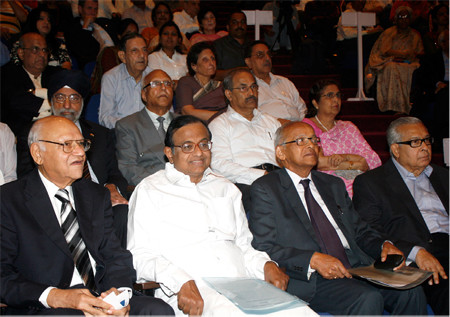
L to R: Julio Ribeiro, P. Chidambaram, B. G. Deshmukh and Dara Gandhy
Roy spoke of Sushila, a village woman whose education had ceased at Standard IV, who had been fielded at a press conference in the capital. Sushila was asking for the government’s records. The media suggested she stick to items like food and water. Countered Sushila in her native tongue, "When I send my son to the market with Rs 10, I ask for an account. I am asking for the government’s records because in 1992 lakhs of rupees went into punchayet tills but when I want to know what was done with it, I am threatened by my own caste and village!”
Notwithstanding her success in tutoring the villagers to ask relevant questions to the authorities Roy ended on a cautionary note: When the Supreme Court was asked to disclose some minor papers it had sought the Delhi High Court’s intercession against the RTI authority. When the High Court upheld the RTI authority "the Supreme Court appealed to itself!” The scandalized Roy referred to the situation as something out of Alice in Wonderland, adding, "It’s a shame that keepers of the law are saying they are above the law!” Quoting South African writer Jeremy Cronin she concluded, "Democracy is speaking truth to power, making truth powerful and making power truthful — and that’s what RTI is all about.”
The NGO PCGT was founded in April 2002 by three leading public spirited citizens of Bombay — former chief secretary to the Government of Maharashtra B. G. Deshmukh, outstanding police commissioner Julio Ribeiro and paediatrician and author Dr R. K. Anand — to complement the leadership of the country in fighting corruption and to ensure the enactment of laws and policies which promote honesty, transparency and accountability in government, as notes their press release. The NAPMT citation recognized its work in its chosen field: "It has mobilized public opinion and worked to make India a value based society, fought the exploitation of public lands, empowered and spread the reach of RTI, changed the mindset of police officers and helped honest officers find space denied to them.”
Acknowledging the award Deshmukh, the PCGT chairman, referred to the philosophy of Mahatma Gandhi regarding inclusive governance and stressed that "there is good governance only if there is public concern for it. It needs an enlightened citizenry. This public concern should not be only academic but should be activist.” Deshmukh noted that the PCGT’s attitude was one of co-operation with the government, pointing out its faults and defaults. "But if necessary we can be firm with the government and if necessary, take recourse to the PIL (public interest litigation).”
Noting that public concern must be made manifest to government, Deshmukh urged the audience, other NGOs and the citizenry at large to take interest in what’s happening around us, ensure delivery of social services. "Are the public systems of education, health and public distribution functioning as they should? We can’t live as an island of prosperity in a sea of poverty.” Saying that the philosophy of the PCGT is to make people aware of what is wrong and rectify it, Deshmukh urged people to contribute expertise and money and take part in the NGO movement.
Appealing to people to join the PCGT Ribeiro noted, "People in government only take notice when there are numbers. Please join us.” He announced a meeting convened by his NGO on November 26 at the Shanmukhananda Hall where the accent will be on police reform. "Swaraj has no meaning unless there is swaraj for everybody, especially the weakest of the weak.”
◆ ◆ ◆
From the archive