
Religion
Motivation at Mahuva
The small Shree Mahuva Parsi Anjuman celebrates in style 100 years of its fire temple
"Ours is a very small anjuman. In the village there are only four Zoroastrian homes. Two others are closed. In Mahuva taluka however there are 35 Zoroastrian houses,” says Hoshi G. Bajina, president of the Shree Mahuva Parsi Anjuman which celebrated the centenary of its dadgah on October 29-30, 2010.
Located in south Gujarat, about 28 km from Navsari and 50 km from Surat, Mahuva is known for its verdant fields. "We (local Zoroastrians) are into agriculture, mainly sugarcane and paddy cultivation,” Bajina explains. The Mahuva Parsi Anjuman is a registered trust and Bajina has been its president for 16 years.
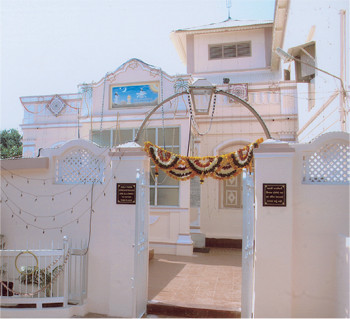
The Mahuva daremeher was originally established in 1859 by the then local anjuman. It was in the year 1910 that Seth Ardeshir Bhikaji Patel of Andheri, Bombay built a new building for the daremeher as well as a community hall named Maneckwadi on an appeal by the Mahuva Parsis. The fire was reenthroned on October 29, 1910 (roz Srosh, mah Ardibehesht, 1280 AY). "My grandfather had earlier built the Seth Pirojsha Ardeshir Patel Daremeher, popularly known as the Patel Agiary opposite the Andheri railway station, which was consecrated on May 19, 1908 (roz Adar, mah Adar, 1277 AY),” states Adi Patel, the Andheri agiary’s present chairman who attended the Mahuva celebrations with his wife Arnavaz, son Maneck and Andheri trustees Sam Patel (who is a retired assistant commissioner of police, Bombay) and businessman Viraf Irani. "It is so good to see that the descendants of the Parsis who lived in Mahuva in 1910 are still looking after the fire. I was amazed and impressed to see how beautifully the renovations have been done, despite the very small population. Bajina has made Herculean efforts,” commends Adi Patel.
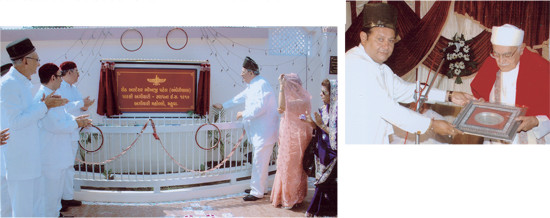
(Top) Mahuva fire temple entrance; (above) Adi Patel unveiling plaque; and (above) Hoshi Bajina (left) presenting memento to Dastur Kaikhusroo N. Dastur Meherjirana
The dadgah has no permanent priest. "We look after the fire ourselves. There is no manager but we do have a man to take care of things. Every month we have a maachi in a convenient gah. Each year on roz Fravardin, mah Farvardin we have a meeting where we present our audit report, followed by a jashan and gahanbar. The priests are called from Navsari and Surat when required,” explains Bajina. Was it difficult to get donations for the repairs/renovation? we query. "No,” he replies. "We put in some press advertisements and many people who have their ancestral roots in the area contributed their time, effort and money. A good proportion of the donations amounting to Rs 19 lakhs came from Bombay, the rest from other sources.” A plaque on the premises mentions a five lakh rupee donation from the Seth Jivanji Jamasji Mistry’s Surat Adarian Fund, two lakhs from the Soonabai Pirojsha Godrej Foundation, two lakhs from Minoo F. Mehta of Bombay, one lakh from the descendants and trust fund of Seth Ardeshir Bhikaji Patel and a total of almost nine lakhs collected from a variety of individuals and trusts from Mahuva taluka and outside. The maintenance, including the cost of kathi, etc is managed from the income of the trust itself, including small donations. The other trustees are Dr Hoshang F. Mogal, his brother Rohinton Mogal, Pervez Bacha and Maneck A. Mogal.
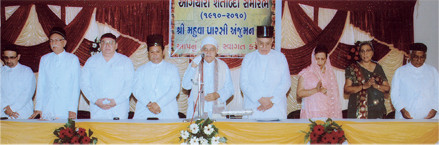
At the centenary celebration (from left) Maneck Patel, Dr Hoshang Mogal, Darayas Master, Hoshi Bajina, Dastur Meherjirana, Adi and Arnavaz Patel, and Marukh and Homi Mistry
The centenary celebrations commenced on October 29 with the fire reinstalled after the requisite ceremonies, followed by a felicitation function at Maneckwadi. Old trustees, donors and well-known people like Nalinbhai Vyas, chairman of a high school and Janakbhai Desai, chairman of a cooperative credit society, were honored, as were others like Dinyar Tampal, Rusi Besania and Adar Bhoja for their special efforts. Dastur Kaikhusroo N. Dastoor Meherjirana of Navsari was the chief guest at a function the next morning. Darayas Master, president of the Surat Parsi Panchayat (SPP) was among the honored invitees on the dais, as was Homi Mistry of the Surat Adarian Fund, the largest single donor. A centenary granth (memorial volume) compiled by Dr Hoshang Mogal was released by Meherjirana who also paid tribute to the bravery of Hoshang and Rohinton Mogal’s nephew 36-year-old Lt Cdr Firdaus Mogal of the Indian Navy who laid down his life as he battled the rough sea while trying to save his junior sailors of the submarine INS Shankush off the coast of Bombay. Commending the Mahuva Parsis for their commitment, Master also mentioned that the SPP had already built and allotted a large number of flats to eligible young couples at a very moderate rent and several babies had been born to these couples. More flats are in the pipeline, he added. Besania compered the function, which saw a good turnout of 300 plus people at the Jain Dharamshala Mandal hall. Nozer and Freny Daruwala catered lunch.
Hoshang, who has a doctorate in microbiology and is a retired principal of the Burjorji Pestonjee Baria Science Institute run by the Sorabji Burjorji Garda College Trust in Navsari, narrated the history of the Mahuva Parsis — the original consecration of the fire in 1859, the construction of a dakhma in 1833 by the Poonjiaji family and then in 1885 by Sir Dinshaw Petit. The Tampal, Mogal and Besania families had given land for the construction of Maneckwadi. "My grandfather used to come in a tonga from Navsari to personally supervise the constructions. He was a strict disciplinarian,” notes Adi Patel who is also the chairman of The Salsette Parsis Association, Andheri (East) in Bombay. Patel displayed a scroll given to his grandfather in appreciation in 1910 which contained names of dozens of local Zoroastrians. The agiary building was renovated in the 1930s by the Choksi Trust of Navsari and again partly repaired in 2002 by the Zoroastrians of Mahuva and 29 surrounding villages, as per a report in the Jam-e-Jamshed Weekly in January 2003.
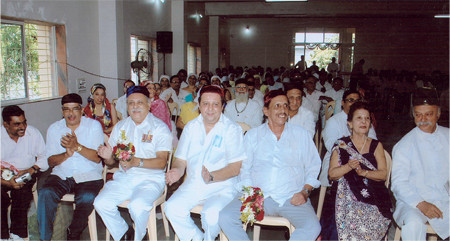
Guests from Bombay and other invitees at the felicitation function
Hoshang says it took him six months to compile the centenary volume. "I did this as I wanted something to remain as a historical record. I have myself seen the taklif (hardships) the people of Mahuva have undergone through the century. The journey from Navsari, which now takes around 45 minutes, used to take eight, yes eight hours during the monsoons as a longer route had to be traversed,” he says. Three takhtis (marble tablets) in the dadgah complex provided the documentary evidence. "I also researched the Anjuman account books. The Deboo family served as the panthakies for three generations. Of the two dakhmas, one was in good condition, one in very bad condition. For the last 30-35 years these are not being used. We have no priest to take care of the prayers. Bodies are taken to Navsari or Surat.”
Hoshang has also included pages on the Shahnameh. "UNESCO (United Nations Educational, Scientific and Cultural Organization) had directed that the year 2010 be celebrated as the Shahnameh Millennium (1,000 years of the composition of the Shahnameh by Firdausi Toosi). I got this from the Internet,” he explains. Hoshang also manages a small trust known as Mahuva Vibhag Garib Parsi Zarthosti Madad Fund that provides medical and educational help to people of the taluka. "There are behdins who are very poor, particularly the ones with small agricultural plots,” he states. For the ones with larger holdings there is some hope that future generations will continue to look after these. The young and the elderly are compelled to go to the larger towns, for education and medical relief.
It is Bajina’s fervent hope that in the next five years they will be able to find a mobed to live there and tend the fire. "Bajina is a very honest and hardworking person. He will not waste a penny of the Anjuman’s money. In fact, we often dip into our own pockets for smaller expenses, rather than charge the Anjuman,” Hoshang remarks. For the time being, the dadgah is locked at night, the key remaining in the village with Rusi Kodia or with Rohinton.
With a rapidly dwindling Parsi population the future picture looks dark, Hoshang says. "But even through 1,000 nirashas (disappointments), we must always keep up at least one ray of hope,” he adds.
◆ ◆ ◆
From the archive