
Seminar
From antiquity to anarchy: the growth of Bombay – IV
Indo Saracenic and Art Deco buildings changed the Bombay skyline
This is the fourth part of the story of the building of Bombay that emerged from the papers presented at the K. R. Cama Oriental Institute seminar reflecting the ideas of town planning, the available techniques as well as the circumstances that necessitated construction activity. The report has been serialized by Parsiana in five parts. The first dealt with the legacy of the Portuguese and the needs of the early British colonists that led to the building of the Bombay Fort (Parsiana, September 21, 2010). The second installment dealt with the growth of the cotton mills on which the prosper- ity of the city was founded (Parsiana, October 21, 2010). The third installment discussed the laying out of the govern- ment buildings of South Bombay after the Fort walls were demolished and the role played by the major bureau- crats and architects in the de- finitive style of development (Parsiana , November 7, 2010). The last part will ac- quaint the reader with off-the- mainstream papers and the conclusions of town planner Shirish Patel as he views the onslaught of chaos over the city.
The third architectural style to make its advent into the construction of public buildings in Bombay was the Indo Saracenic — a term used by British professionals like architects, historians and archeologists to define the use of well known Islamic features and motifs in the current building practices according to well-known conservation archi- tect Vikas Dilawari.
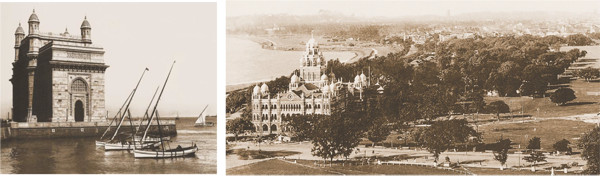
(Left) The Gateway of India and (alongside) the Western Railway (BB & CI) headquarters.
Photos courtesy Bombay: the Cities Within
"Initially, the term Indo Saracenic was used by the British to describe what they saw as a hybrid of Hindu and Is- lamic styles, particularly during the Moghul dynasty (Akbar’s Fatehpur Sikri being a defining example), which they felt was the most appropriate union of the two styles. On a political level also this union appealed to them, as it sym- bolized the coexistence of two diverse faiths and by adopting this style as their own, the British wanted to show they now ruled over a united India with both Hindu and Islamic people,” noted Dilawari, adding, "Eventually the term Indo Saracenic came to refer only to buildings built under the British in India, while the earlier group is now referred to as Indo Islamic.”
As the British Empire established it- self, several scholars began to study In- dian art and culture. Aquatints of promi- nent Indian religious sites and James Ferguson’s pioneering study of Indian architecture along with architectural il- lustrations of the buildings of Bijapur, Ahmedabad and Mysore, raised aware- ness of their grandeur among British architects and influenced their work, noted Dilawari. The publication of Swinton Jacob’s Jeypore Portfolio of Architectural Details, in six massive vol- umes in 1890, announced that "the Brit- ish had now made India’s architectural heritage their own… the British began to construct for themselves a notion of empire in which they were not merely foreign conquerors like the Romans, but legitimate, almost indigenous rulers, linked directly to the Moghuls and hence to India’s own past,” commented Dilawari.
"Though Madras was the place of Indo Saracenic architecture, this style became fashionable in Mumbai in the
early part of the 20th century and some good examples of it are the Bombay Municipal Corporation headquarters and the Anjuman-e-Islam School,” he notes,adding, "These buildings were a hybrid of Gothic and Saracenic and were fol- lowed by the more pure architecture style expressed in the General Post Of- fice (GPO), the Prince of Wales Mu- seum, the Gateway of India, the BB&CI (Western Railway) headquarters, the Majestic Hotel and the KEM Hospital.” With the setting up of cement plants in India in 1905, construction technol- ogy saw a shift away from stone load- bearing walls and jack arches to rein- forced cement concrete, said Dilawari. A successful blend of the new technol- ogy with the popular old style is evident in the GPO building and the Gateway of India, he added. Eventually, the eco- nomic recession of the early 20th cen- tury, two World Wars and the advent of the new Art Deco style which was now prevalent internationally and had the added advantage of being more eco- nomic in cost and time schedules, all led to the fading out of the Indo Saracenic style, noted Dilawari.
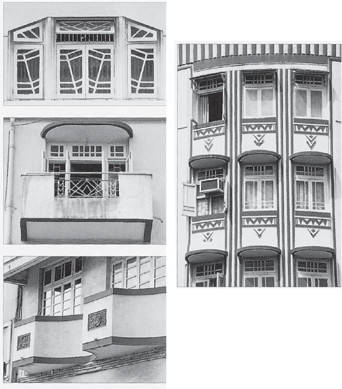
In the last two or three decades of British rule, while the imperial architec- tural activity concentrated on creating the governmental edifices of New Delhi, "Bombay’s home-grown architectural fraternity (from the Sir J. J. School of Art and Architecture) embraced Modernism with a design that was both international in outlook and contemporaneous in sen- sibility. Their architecture incorporated emerging materials and construction technology to create buildings for their time, incorporating the latest services to cater to the urbane lifestyle… These buildings… display a functional pur- pose, creating neighborhoods and busi- ness precincts in the metropolis. As a collective, these buildings, interwoven within the older areas of the city and providing newer edges to it, created a fresh urban fabric that united the city visually, giving a sense of place to its inhabitants,” averred Prof Mustansir Dalvi, professor of architecture at the Sir J. J. College of Architecture.
Once the grand public buildings were in place, con- struction on government account came to an end. "By this time the commercial clout of the city, (its) wealth was in the hands of affluent Indians rather than its colonial masters,” said Dalvi pointing out the symbi- otic nature of the relationship between the major Indian trad- ers and the British. The short- age of land, despite the emer- gence of new northern suburbs and the schemes of the BIT (Bombay Improvement Trust) resulted in these western edu- cated, upwardly mobile, globe trotting cosmopolitan citizens of Bombay choosing to reside in apartment blocks in elite resi- dential precincts.
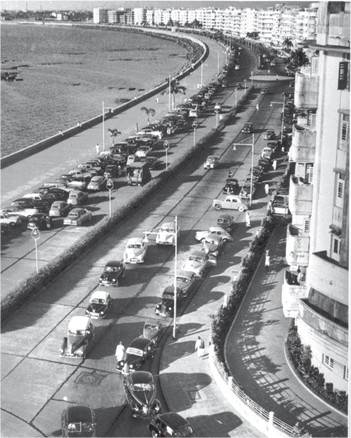
Art Deco residences facing the Oval (above) and Marine Drive: Bombay’s Art Deco promenade Photos courtesy Bombay: the Cities Within
The BIT was constituted by an Act in 1898 to repair the ravages of the bubonic plague of 1896. Its brief included the making of new streets, the opening out of crowded localities, reclaiming land from the sea to provide room for the expanding city and the building of hy- gienic homes for the less affluent, Dalvi informed the audience. Middle class colonies came up for the Hindus and the Parsis in the Dadar-Matunga area. Vari- ous charitable trusts also began to build for the lower middle class members of the community, said Dalvi, using the Cusrow and Rustom Baugs, the Gamadia and Cowasji Jehangir Colonies as ex- amples.
The BIT areas were governed by plan- ning norms and restrictions which were strictly enforced, noted Dalvi. Thus, a fourth of the area was reserved for roads and open spaces. Only one-third of the plot area was permitted to be built. The height and proportions of the building walls had to be uniform. Thus the buildings, though designed individually, ensured visual har- mony. Playgrounds and recreation areas as well as paved footpaths were also provided by the Trust. "The creation of this architecture at a domestic rather than a monumental scale laid out over vast areas of the city changed its image into an all inclusive, dynamic metropo- lis. Buildings from the 1930 onwards, built in the contemporary architecture of the day would give Bombay its lasting cosmopolitan image of urbanity that one associates with it even today,” com- mented Dalvi.
The 1930s were prolific years for construction in Bombay, noted Dalvi, quoting Lovji Shroff, president of the Indian Institute of Architects (IIA), who had stated in his address in 1934, "The blocks of buildings at Colaba Causeway known as Cusrow Baug re- cently erected by the trustees of the Nowroji N. Wadia Trust from the de- signs of Messrs Gregson Batley & King show remarkably well what a layout for a housing scheme should be like from the hygienic point of view… Amongst works of architectural merit recently erected in Bombay may be mentioned the Regal theatre… by Charles Stephens and A. E. Ghas- wala’s building at Pherozeshah Mehta Road by Messrs Bhedwar & Bhed- war.” Naming an array of buildings Shroff noted, "We welcome the marked advance in architectural qual- ity in the designs of the buildings. This has been partly the result of sound architectural education that is being imparted to students at the Sir J. J. School of Art under the able guidance of our vice president Prof Claude Batley.”
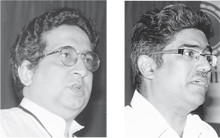
Prof Mustansir Dalvi (left) and Vikas Dilawari
By 1937 Bombay witnessed feverish building activity, es- pecially at Cooper- age, Pherozeshah Mehta Road and Ma- rine Drive. Even public buildings like the Reserve Bank of India and the Electric House at Colaba — a first class building built on modern lines with up-to-date arrangement and airconditioned thoughout — had begun construction. "These new constructions were fuelled by the increasing influence of two entities — the predominance of new building materials, viz cement and its offshoot technologies, and the edu- cated professional architects to create and oversee their constructions,” ob- served Dalvi.
The literature of Modernism included the rational theories of Le Corbusier and other European designers. Dalvi quoted from a comment by M. J. P. Mistri and H. J. Billimoria in 1942: "It is not enough that our architects are free from the vanity of ‘styles.’ They must learn to exploit and apply the fruit of scientific research in their day-to-day problems… The building is a machine to live, work or play in… Architecture has changed from the art of two-dimensional pattern making to the science of the relation of space and movement… Orderliness is the beginning of everything.”
"This New Architecture is in one sense the nudist movement in our pro- fession,” a return to primary essentials, Dalvi quoted from Batley’s IIA lecture of 1934. It was, he said, the outcome of changed ways of life and strained cir- cumstances which resulted in greater gender equality and the need to incorporate technological ad- vances and labor sav- ing devices. Func- tionalism was in; or- namentation was out.
Beautiful efficiency was the new mantra.
Cement had begun to be manufac- tured in Kathiawar in 1914. Soon, the well organized publicity departments of the cement manufacturers released bro- chures and folders of compiled photo- graphs of newly finished buildings both public and domestic, in the major cities and princely states of India to promote RCC (reinforced cement concrete) con- struction as versatile and cheap. "Archi- tecture constructed in RCC would soon become the standard, whether for bun- galows, apartment blocks, office buildings or palaces, noted Dalvi. Flat, con- crete roofs replaced the old, tiled roofs of the earlier constructions.
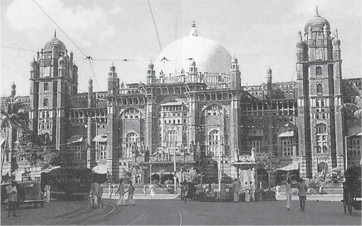
The Indo-Saracenic General Post Office (GPO)
Photos courtesy Bombay: the Cities Within
This ‘New Architecture’ had its ad- vocates and its critics. Eventually known and remembered as Art Deco, the style had developed in the US and Europe between the two World Wars. The name was derived from the Expo- sition Internationale des Arts Decoratifs Industriels et Modernes held in Paris in 1925. "Art Deco designs emphasize crisp geometric patterns, surface orna- ments and exotic materials often combined with vibrant colors and simple shapes.” Eros, Regal, Metro and Broad- way theaters represent the more ornamental form of Art Deco imported from Hollywood. The more muted Modern- ism can be seen in the residences and offices along the Oval, the Queen’s Necklace at Marine Drive and the buildings of the BIT. "Architects, users and commentators at large were aware of the past,
and yet they, in the wisdom available to them two de- cades before nationhood, with the knowledge of what was imminent, chose to align themselves with an international future,” commented Dalvi.
To be continued
◆ ◆ ◆
From the archive