
Education
“The power of the mind” - II
Community stalwarts played a major role in the establishment of the University of Bombay and the institutions for medical, technical and art education
The first instalment of the Parsiana report on the two-day seminar organized by the K. R. Cama Oriental Institute (KRCOI) dealt with the establishment of schools for girls, both Parsi and cosmopolitan, in the teeth of orthodox opposition. The third part of the report will feature the role of the madressas and the J. N. Petit Library and the amazing contribution of contemporary Parsis to bring education to lives blighted by physical or emotional dysfunction. The last part will deal with the creation of postgraduate institutions that have altered the national intellectual landscape.
The second session of the KRCOI seminar on Parsi contribution to Indian education concentrated on its higher and technical phase. Chairing the session Dr Fr Frazer Mascarenhas, principal of St Xavier’s College, spoke of the "specific and critical contribution (of the) large number of Parsis on its faculty, doing their duty in an extraordinary manner.” He referred to the critical contribution of Prof Jehangir Mistry who retired after several years as the institution’s vice principal for science: "I feel one of the pillars of the building has gone.” He also cited Prof Sam Taraporevala, long standing instructor in sociology, and noted that there were over a dozen names to whom he wanted to pay tribute.
Dr Aravind Ganachari, professor of history at the University of Bombay, traced the intellectual and social forces which led to its establishment. In his paper "Ushering India into modernity and nationhood: Parsis in the University of Mumbai,” Ganachari noted that as trading activity shifted from Surat to Bombay, "the merchant sethias of which the Parsis, though a small community, formed a major section, took upon themselves the task of shaping the economic, political, educational and cultural aspects of emerging Bombay… They shared their economic wealth with the people… and also persuaded the hesitant British administrators in supporting public welfare measures.”
The historian notes that while these benefactors were open to liberal progressive ideas they were not swept away by all things western, remaining Indian at heart. In their zeal to modernize the Indians they pursued their demand for a university, one that would rival Oxford and Cambridge, under the agency of the Bombay Association. Hence the names of Jamsetjee Jejeebhoy and Bomanjee Hormusjee are inscribed into the 1857 Act of Incorporation of the University of Bombay along with Jagannath Shankarsheth, Dr Bhau Daji Lad and Mahomed Yusoof Moorgay. It was this dissemination of education that finally brought the people of India to the threshold of nationhood, said Ganachari.
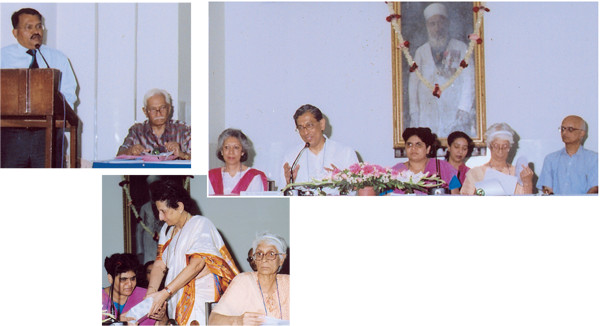
Clockwise from top left: Aravind Ganachari and Vishwas Yande; Vispi Balaporia, Frazer Mascarenhas, Abhidha Dhumatkar, Zarine Sethna, Shubhada Pandya and Sunil Pandya; KRCOI honorary co-secretary Nawaz Mody acknowledging the two paper presenters
This spirit of benevolence continued with the establishment of the Institute of Science, the Sydenham College of Commerce and Economics, the University Department of Chemical Technology, the Victoria Jubilee Technical Institute (VJTI), etc that became cornerstones of India’s modernization. Ganachari spoke about Parsi personalities like Dadabhai Naoroji, Sir Pherozeshah Mehta, Sir Dinshaw Mulla, Sir Jivanji Modi, Dr Homi Bhabha, J. R. D. Tata and Nani Palkhivala whose contributions to the nation were acknowledged by the University with the conferment of Doctor of Laws (Honoris Causa). He also traced the contribution of the Parsi vice chancellors — Sir Pherozeshah Mehta, Sir Rustom Masani, Sir Bomanji Wadia, Sir Naoroji Wadia, Dr Mehroo Bengalee — as well as registrars Khan Bahadur Furdunji Dastur and D. J. Wadia "in creating a liberal, secular, democratic, multicultural and pluralistic Bombay, a minuscule India.” Nor did he forget to acknowledge the contributions of the distinguished faculty members including K. T. Merchant, P. A. Wadia, Dr Aloo Dastur, Dr Kamal Wood, Dara Marshall, Dr Nawaz Mody who toiled to bring these ideals to fruition.
Neurophysiologist Dr Shubhada Pandya’s paper dealt with "Parsi physicians: teachers, healers, activists 1860-2007.” Of the four protagonist physicians of whom she wrote, K. N. Bahadurjee and N. H. Choksy were the non-IMS (Indian Medical Services) western medicine trained professionals of the late 19th and early 20th century who "lobbied, petitioned and agitated against the IMS’s fiercely-guarded monopoly on important civil medical posts. Choksy, she noted was an expert in infectious diseases and a recognized authority on plague, leprosy, tuberculosis and cholera. Both of them were active in promoting the cause of the ambitious, independent practitioners of western medicine, "Bahadurjee through combative polemics, Choksy through medical journalism,” noted Pandya.
In the later years obstetrician and gynecologist Dr B. N. Coyaji and plastic surgeon Dr N. H. Antia represented the practitioners of western medicine who, having made their careers in the hospitals of those times, broke away to reach out to rural communities, focusing on the health of rural women and their empowerment, added Pandya. They demonstrated that high quality work could be accomplished even in unsophisticated set-ups with excellent results despite the limitations of convenience and money. Antia’s tryst with leprosy — he applied his expertise to restore the damage caused by leprosy — led to a lot of opposition in the Grant Medical College as doctors did not want lepers admitted in the wards, said Pandya who had worked under Antia. He was considered a "maverick and an iconoclast” and was known to say, "I give the tais (female grassroot workers trained by him) knowledge but they give me wisdom.”
"On learning of the plan by Sir Robert Grant, governor of Bombay Presidency, to remedy the lack of medical education for Indians, Sir Jamsetjee Jejeebhoy volunteered a donation for the establishment of a hospital to be attached to the proposed college,” mentioned neurosurgeon Dr Sunil Pandya.
Jamsetjee purchased the land on which the college and hospital were to be built and bore much of the escalating cost of the project. Later he also contributed land and funds for the establishment of the Sir Jamsetjee Jejeebhoy Obstetric Institution, the first hospital for women in Bombay presidency, noted Sunil Pandya.
Though Grant did not live to see his dream fulfilled, the college named in his memory became the first in India to have an affiliated hospital where the students could pursue their clinical studies. This made it a unique institution at the time. Several months before the construction commenced in 1842 the governor had stated in his minute of September 6, 1841 "…in consideration of Jamsetjee Jejeebhoy’s munificence to the whole of this proposed institution and structure…the hospital should be called the Jamsetjee Jejeebhoy Hospital…” Sunil Pandya’s paper included several such details from the communications between Jamsetjee and the British administration from the inception of Grant’s idea to its fruition in 1845 with the opening of the combined institutions.
In a brief discussion following the presentation Dr Ketayun Dinshaw, former director of the Tata Memorial Center, asked, "How do you bring the J. J. Hospital back to its days of glory?” Listing the ills affecting the institution today — falling standards, nepotism, not keeping pace with modern developments — Pandya responded, "It would take Hercules to bring J. J. back to what it used to be. Perhaps we need people like you to come back…” He also noted that a group under neurophysician Dr Noshir Wadia was trying to save a building on the J. J. campus.
"The incomplete dream of Sir Jamsetjee Jejeebhoy” is how writer and poet Prof Vishwas Yande, former head of the drawing and painting department of the Sir J. J. School of Art, described the institution. Inducted as member on the first board of education formed by the British government in 1840, Jamsetjee was later invited on a committee of 20 persons to select art objects for the exhibition in London to be held in 1851. Himself a scion of a family of master weavers, he could perceive the fast deteriorating condition of Indian master craftsmen, noted Yande.
Visualizing a center for the arts and art-crafts education and manufacture, Jamsetjee offered a donation of Rs 1,00,000 to the government of Bombay to start a series of art craft workshops. He expected the center to become self-supporting through the profits earned by the sale of the art products created by the students. Once this stage was reached, the interest generated by his endowment was to be used for encouraging art-related research. The J. J. School of Art was established in 1857 but the development and sale of arts and crafts did not come to pass. Master craftsmen have continued to flounder.
Dr Abhidha Dhumatkar, lecturer in history at Sathaye College, spoke of the versatility of Parsis vis à vis technology: Ardeshir Cursetjee (1808-77) was the first Indian engineer. He manufactured the first one horse power engine to pump water from the well to a small fountain; he introduced wood cutting machines, photography and electroplating. When the Poona Civil Engineering College started in 1854 it was in a property leased by the Padamjees to the PWD (Public Works Department) and Cowasji Jehangir Readymoney donated Rs 50,000 towards the construction of the college building.The first director of technical education in Bombay presidency in independent India was Jahangir Tarapoorwala.
The VJTI was established in 1888 (marking the golden jubilee of Queen Victoria’s reign) from monies provided by the Royal Jubilee Fund (Rs 80,000), and the Ripon Memorial Fund (Rs 1,50,000), earmarked in 1886 by the citizens of Bombay. The J. J. School of Mechanical Engineering was constructed from the Rs 46,000 J. J. Memorial Fund raised in honor of Sir Jamsetjee Jejeebhoy, Second Baronet. Sir Dinshaw Petit provided a plot worth three lakh rupees at Fort to which the Elphinstone College shifted and its original premises at Byculla became the first campus of the VJTI. The Bombay Millowners Association, the Bombay Municipality and the government of Bombay Presidency were other donors. A decade later Petit provided financial assistance to start a sheet metal working and enamelling school.
Nowrosjee Nusserwanji Wadia, its honorary secretary through its first decade of existence organized the VJTI curriculum and believing that technical education needs practical training, arranged for the donation of textile equipment from Lancashire. His efforts ensured employment to VJTI graduates in the railways, mills and factories. Sir Dinshaw Wacha served as its honorary trustee secretary for 46 years. Of the 14 members on the board of management four were Parsis, noted Dhumatkar.
The VJTI shifted to Matunga in 1917. By then it had been elevated to the status of the Central Technological Institute, advising all technical schools in Bombay Presidency on educational matters. "While the Poona Civil Engineering College, controlled by the PWD, mainly turned out civil engineers and surveyors, the VJTI, owing to its leadership by the Parsi capitalists of Bombay trained youth for the skills required by industry. Cusrow and Ness Wadia, M. M. Cama and Sir Tehmulji Nariman’s huge donations were pivotal in the erection of a new building for textile manufacture in the 1930s…With affiliation to the University of Bombay, degree courses were introduced. The post independence period witnessed the growth of various VJTI departments but the decline of Parsi influence in the Institute” whose name was changed to the Veer Jeejamata Technological Institute in 1998, stated Dhumatkar.
A merchant prince of Bombay, director of several banks, railway companies and mills who co-established the first local fire insurance company, Byramjee Jeejeebhoy was a member of the Bombay Legislative Council who argued relentlessly for the betterment of the common man. A month before his death in 1890 he vested government papers of the face value of 3.5 lakh rupees for the establishment of an institution to provide free education to the children of poor Parsis: the Byramjee Jeejeebhoy Parsee Charitable Institution, recounted Prof Vispi Balaporia, adjunct professor of English in the University of Bombay. The commitment of his grandson Rustomjee brought the project to fruition on the first death anniversary of the founder, serving as chairman of the trustees for more than 30 years. The number of students on the roll in 1891 was 214, which rose to 320 by the end of the year. Fifty years later it had risen to 450 Parsi boys. The enrolment for 2008-09 stood at 605 of which only 59 were Parsis, boys as well as girls, she pointed to the demographic decline. In 1900 the trustees introduced special commerce classes to fulfil Byramjee’s objective to equip Parsi youths with the knowledge required to earn a living. It took the University of Bombay another 30 years to introduce the course.
According to a government report in 1911 the Institution had four departments: the primary teaching up to the Gujarati fourth standard; the middle school comprising Anglo-Gujarati standards I-III; the commercial high school comprising Anglo-vernacular standards IV-VII, preparing the pupils for the school final examination with commerce as an optional subject; the commerce college preparing them for the London Chamber of Commerce examination. Games and gymnastics, elocution and public speaking, moral and religious education helped to round off the personality. Balaporia went on to recount the commercial and social success of each generation of the Jeejeebhoy family and their various philanthropies.
Zarine Sethna, lecturer in psychology at the S. S. and L. S. Patkar College recounted the life and work of the two sons of Hormusji Patuck — Rustomji and Nowroji. Rustomji was the first Indian to open an office in Manchester, the heart of the English cotton textile industry, in 1888. With tact, diplomacy, will and perseverance he established his own flourishing business there for over 35 years, amassing great wealth which he put into nation-building according to his own assessment.
During his trips home he had observed that unity among the various castes and communities of India would be of paramount importance when the country gained its independence. He also noted the Indian distaste for manual labor which did not exist in England and "could foresee an acute problem of the shortage of labor on one side and educated unemployment on the other,” noted Sethna. To address both issues simultaneously, Rustomji or Rustomba, as he was popularly known, visualized a residential institution where boys from all castes and creeds could gain technical education and practical training along with academics, thereby equipping them for technical manual jobs infused with the dignity of labor.
The "Model Industrial Home and School” became functional in 1936. Located in a group of buildings lying unoccupied in Kandivali, supported by Rustomba’s trust of £ 40,000 (about five lakh rupees), he led the boys by example to live as one family and do all their work themselves. "They wore simple, cheap but practical clothes, cooked their own food, washed ther own clothes and made their own beds. They slept on the floor, and cleaning and sweeping was a part of their duties. Mr Patuck wanted that everyone must learn to work with their own hands and never be ashamed of soiling them,” noted Sethna. There were regular classes in the usual academic subjects. Carpentry, smithwork, mechanics and handweaving constituted the technical/industrial section of the school. Education was imparted free of cost for children of poor families. For Parsi students it is still free of cost, noted Sethna.
Rustomba died within six months of establishing his School but the principles on which it had been founded continue to flourish. Though they passed out with a mere trade certificate and not a matriculation certificate, the school graduates were quickly absorbed as foremen, instructors and supervisors in industry. With donations came expansion and the addition of various courses so that the Patuck Polytechnic Trust now offers the Patuck Kids Play School, Preprimary School, Primary English School, Technical High School, Junior College with commerce, science and vocational degrees, the Patuck-Gala College of Commerce and Management, the Patuck Industrial Training Centre and the S. K. Gala Infotech Centre. All courses are free for Parsi students. Regrettably, Parsis have hardly availed of them because of their preference for degree courses and the professions, Adil Patuck, grandson of Rustomba’s brother Nowroji told Sethna.
"The Bubonic Plague of 1896 left a large number of Indians dead and an equally large number of survivors, helpless,” wrote Sethna. The following year Nowroji Patuck helped establish the Parsi Plague Hospital and donated much of his land to the Parsi Punchayet to build temporary shelters for those who had to be evacuated from plague infested areas. At the same time rural Gujarat was struck by famine leading to the influx of Parsi families into Bombay. In 1899 Nowroji started a work class in his home to impart useful skills to the women and help them to be gainfully employed. By 1903 the class had gained in popularity and there was need for an organized institution. Thus in 1903 the Stri Zarthosti Mandal was born to enable Parsi women to earn an honest living.
Any Parsi woman over the age of 24 paying a fee of one rupee a month could join the work class as a working member or at two rupees a month as a helping member, the membership fees being used for the welfare of the members of the work class who were encouraged to send their children to school, the association sponsoring fees and books for the indigent. Medical advice was provided to women and children who were sent to hospitals, sanatoriums and convalescent homes if required. Tonics and nourishment was supplied to the weak. They were rested for a fortnight annually and taken out of town for a change of air.
More and more women clamoring for employment resulted in a space crunch so the Mandal started a building fund and collected Rs 1,31,531 as donations. When they found the amount insufficient to construct a building, Lady Ratan Tata and her trustees donated a building to the Mandal in 1928 on the condition that henceforth the Mandal would be named after Sir Ratan Tata. Thus was born the Sir Ratan Tata Institute (RTI). There the women learnt cookery, hand and machine embroidery, tailoring, laundry and handweaving.
Nowroji’s daughter Dinbai Patuck was associated with the work class from its inception, closely involved with the running of the Stri Zarthosti Mandal and later as honorary general secretary cum elected trustee of the RTI — a service that extended to 69 years, noted Sethna. Only 35 percent of the present RTI staff is Parsi. The senior ladies are too old to work and the younger girls being highly educated have better job opportunities elsewhere. An institution which provided yeoman service at a particular time in community history is slowly getting phased out. To be continued
◆ ◆ ◆
From the archive