
Welfare
Archiving women’s voices
Celebrating Avabai Wadia’s legacy with increasing appreciation of the work of women in India
The Research Centre for Women’s Studies at the SNDT University’s Juhu Campus celebrated the first anniversary of the establishment of the Dr Avabai and Dr Bomanji Khurshedji Wadia Archives for Women on September 24, 2010 with readings — by noted thespian Dolly Thakore — and visuals from Wadia’s autobiography, The Light is Ours.
A stalwart in the women’s movement, especially concerned with their reproductive and familial health, Avabai was one of the founders of the International Planned Parenthood Federation, a founder member of the Family Planning Association of India and long term president of both organizations. It was her bequest and mandate to SNDT "to establish and operate an archive for research devoted to the life and achievements of women in India and the institutions they have generated,” that led to the creation of the archives that is referred to in short as AWA (Avabai Women’s Archives). Dr Gita Chadha, associate project director of AWA who organized the event, has been overseeing the cataloguing and documentation of Wadia’s own papers.
Avabai’s mandate also urged the Centre to research into the life of 20th century women "to recover and institutionalize these voices in public discourse and popular culture” and to preserve documents, films, news clippings, etc. Researchers in some of the ongoing projects provided glimpses into their work.
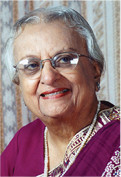
Avabai Wadia: concerns for women
Thus the invitees in the SNDT’s Mini Auditorium heard Geeta Seshu, a former principal correspondent of The Indian Express, speak about the Forum Against Sex Determination and Sex Selection which brought together people from various campaigns, culminating in the legal ban on sex determination tests. The overall issue being survival of women and misuse of technology in the social context led them to ask other questions e.g., should women be penalized for undergoing such tests? Should they be held responsible for the social aspects and the declining sex ratio? These questions are still relevant in 2010 though they raised their head in the 1980s noted Seshu who is working in this area with Chanika Shah and Meena Gopal. She referred to the urgent advocacy with bureaucrats, lawmakers, doctors and the media in those pre-internet, pre-computer days when skits, street plays and booklets were deployed to carry the message to the people. Under AWA they are now recording oral narratives of key members of the campaign who educated themselves on technology and its socio-legal effects, collecting press photos, posters, journals and minute books.
Bombay University Professor of Sociology Kamala Ganesh spoke about her work in progress: The legacy of excellence and outreach — archiving The Cancer Institute, Madras. Ganesh, who began as a patient of the Institute, described its fairly austere but reasonable efficiency with competent doctors, whose emphasis on outreach was evident in the crowds visiting it every morning.
Dr Muthulakshmi, the first woman doctor in South India, was a "battleaxe for her causes,” one of which was her campaign for a separate hospital for cancer in the 1930s and 40s. With its foundation stone laid by Jawaharlal Nehru, the pioneering institution had its heyday in the 1950s and 60s. Imbued by the "ethos of reform, nationalism, emancipation of women and girls,” its underlying philosophy and history are responsible for it being still affordable for people, providing "not just cancer treatment, but cancer treatment and care… one of the last bastions offering a humane and intermediate way between extremes,” as noted Ganesh. Muthulakshmi’s work was carried on after her by her son Dr J. Krishnamurthi.
Ganesh referred to the "principle of personal passion in the development of institutions… and the problem of conveying (this) idealism to another generation not imbued with such ideas,” a problem with which the Institute and its current chairperson Dr V. Shantha now seem to be grappling. Shantha was honored with the Magsaysay Award in 2005.
Rohini Sahni, a senior economist from Poona University and author of Prostitution and Beyond, spoke about her work in archiving titled ‘From Nobody to Somebody: The VAMP Collection.’ Noted Sahni, "With the onset of HIV, sex workers were supposed to be one of the villains. These are chronicles of women who have no voice even in the feminine discourse of our society.” Referring to the difficulty of negotiating the "private space” between a man and woman even in marriage, she highlighted the difficulty of the sex worker in getting the client to use a condom when she "depends on her work to feed her children and old people and there are no guarantees for tomorrow.”
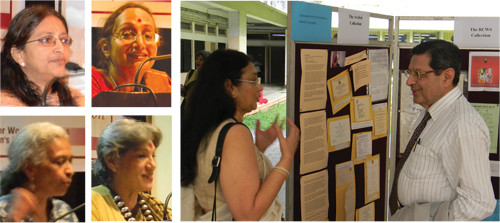
Far L to R (top): Gita Chadhaand Veena Poonacha; (below) Susie Tharu and Dolly Thakore Alongside: Drs Asha Kapadia (left) and Rustam Soonawala
The efforts of such women to come together to negotiate their own space began in Sangli in 1992-93 when Veena Seshan began her work to distribute condoms. In 1995-96 VAMP (Veshya AIDS Muqabla Parishad), an organization of sex workers, came into being and spread to Sholapur and Kohlapur in Maharashtra and to northern Karnataka. Until then one or two women died of HIV-Aids every day in this semi-urban patriarchal area, noted Sahni, adding, "Nobody would come forward to cremate the body. The earlier hype was that society had to be protected from these women. But the women needed to be protected from the society which brought HIV to them.” VAMP’s success is reflected in the the statistics: from the late 1990s to date, hardly anyone dies of HIV-Aids in the area; the initial demand for 500 condoms grew to eight lakh per week in 2008-09. VAMP renamed Veshya Anyay Mukti Parishad in 1998, conducted workshops for the sisterhood, went out and told stories to familiarize society with their burden. It is a story of women and their courage who went from battling HIV and police harassment, to fighting for liberation and justice.
Professor emeritus at the Central Institute of English and Foreign Languages, Hyderabad, and editor of two volumes on women’s writing in India, Dr Susie Tharu presented "Medicine and Government — Histories in the Present,” part of a joint project with the Christian Medical College, Vellore and Anveshi Research Centre for Women’s Studies — to study the crisis of medicine today.
Tharu differentiated between clinical medicine with its one-on-one approach and public health initiatives, with their huge administrative element, designed to improve the health of the nation. "But we never know who this nation is. Often, individuals administered under such programs are bleeding from these ministrations,” she noted, underlining the urgency for a social debate about medicine.
Has corporatization, a result of the increasing advent of technology in medicine and pharmacology, led to problems or improvement? How do you decide on the effectiveness of a drug?
"At the moment, India is a hotbed of medical testing,” she averred. "Our bodies, our cells are being subjected to various kinds of procedures… The commercial medical system is very keen on (being a part of) government programs… To sell to a single government window is a great inducement as for example, biscuits with nutrients in the school lunch” while whole body testing keeps the patient coming back again and again as any difference from the normal is being pathologized, increasing the person’s insecurities.
While the whole of medicine works on targeted populations, both state and commercial, in India it is possible to look at the actual practice of doctors, nurses and pharmacists who tailor the treatment to the medical and financial needs of the patient, providing an older but effective remedy, simpler drugs instead of the latest innovations. They are often told their approach is unethical, but they are doing a difficult job in difficult circumstances and hence it is their practice that is truly ethical, noted Tharu, adding that we need to help shore up the knowledge of such people.
A vote of thanks from Chadha was followed by lunch in the foyer of the Mini Theatre.
◆ ◆ ◆
From the archive