
Books
Creating happy families
The Light is Ours: Memoirs & Movements by Avabai B. Wadia. Published in 2001 by the International Planned Parenthood Federation, Regent’s College, Inner Circle, Regent’s Park, London NW1 4NS, UK. Pp: xiv + 706. Price: Rs 850.
"When I was asked to write my memoirs, I found that my own life has been so intertwined with my work with people and organizations that I find it impossible to detach the two. I could write about the organizations without mentioning myself; but I cannot write about myself without tracing organizational developments since I was always there, somewhere. Especially in the founding and in the growth of IPPF (International Planned Parenthood Federation) and FPAI (Family Planning Association of India), I was always involved in some capacity or the other, mostly in the background, and sometimes in the foreground,” states Wadia who was honored as the IPPF’s founder member in 1973 at its 21st anniversary, was its president for six eventful years (1983-89) when the organization received the United Nations Population Award in 1985 and the Third World Prize in 1987.
"It seems my life work presented itself to me rather than my consciously searching for it, even when I made a choice between a career in law or in voluntary service. It was an acceptance of opportunities and events, with a certain tranquil acquiescence. This was influenced by my early upbringing with its strong emphasis on idealism (to which I still unashamedly hold, old fashioned though it may sound) and in striving to achieve the goals set out, even if success be limited.
"In many ways my legal background colored my approach to social work. I tried always to be relevant, brief, unambiguous and objective. As president, I kept in mind the dictum of Lord Acton that ‘there is no worse heresy than that the office sanctifies the holder of it.’”
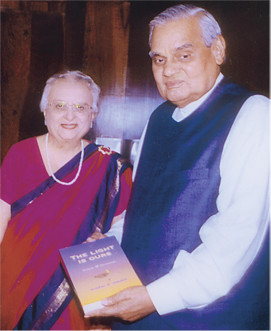
Wadia with Prime Minister A. B. Vajpayee who released the book on August 23, 2001
The citation that the FPAI presented to Wadia when she laid down office as president in 1998 after 34 eventful years notes that the Government of India, which frequently drew on her expertise and experience awarded her the Padma Shri in 1971 and the Padma Bhushan in 1981. Among several other awards that this "indomitable champion of family planning” received were the Sanjay Gandhi Award for Science and Technology in 1983, the Woman of the Year Award in 1985 and the Mahila Shiromani Award in 1990. The influential Earth Times of New York billed Wadia among the Top One Hundred outstanding personalities of the world, describing her as the "founder of the family planning movement and the grand dame of the establishment.”
In an easy, unhurried style Wadia traces her long and committed life from a sheltered childhood in Colombo where "beauty was a natural right of existence and did not need to be sought,” the murder of a beloved hen by the cook led to a lifetime of vegetarianism. The nostalgia of gentler ways in gentler times come home to the reader. Though generally indulgent of Avabai’s childish escapades, an occasional complaint found its way to her father Dorabji’s ears. "On such occasions his face turned serious and he just looked at me with a stern eye — and my knees buckled.”
Wadia was in England when Margaret Sanger, the American family-planning pioneer addressed the All-India Women’s Conference (AIWC) in 1935 and a resolution favoring birth control measures for the benefit of women’s health was passed by a majority.
"The first time I heard the words ‘birth control’ I was revolted. This was at a meeting held in a women’s club in London and the speaker had gone on to refer to the ‘yellow peril’ of the teeming millions of Chinese and others and the need to keep down such a menace. This was in the early 1930s when all sorts of ideas were milling around in confusing profusion... I never came across the concept again until nearly 20 years had passed and I was in India and an active volunteer in the AIWC.
"Even at that later period, I gave the matter long thought. Was it natural, was it ethical, was it moral, was it healthy, did it encourage selfishness, promiscuity, salacity? But what finally decided me was its utility as a means of helping women to get out of the trap of biological compulsion and of the societal pressures for frequent childbearing which could ruin their health, cause neglect of their children, impoverish families and keep women tied to procreation. I was deeply affected when I read a speech of Dr Lakshmi Joshi (who later married General Raja Rajwade) who said that Indian women were fated to a life that ‘oscillated between gestation and lactation until death wound up the sorry tale.’”
Reading up on the history and philosophy of the concept of birth control Wadia found Egyptian papyri, references in the Brihadranayaka Upanishad, the Kamasutra and the Dharmashastras, the Old Testament of the Bible, the Islamic Hadith and the writings of Confucius, Kautilya, Plato and Aristotle, Ricardo, Malthus, John Stuart Mill...
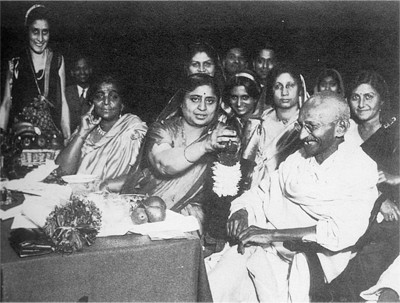
With Mahatma Gandhi in London in 1935 (centre row, 4th from right)
"Practical steps to try to help parents came a little later when some bold pioneers began to advocate the use of devices to prevent the conception of children. Their chief desire was to do something to help in the alleviation of abject poverty and to raise the brutish level at which the poor, and particularly women, lived. These pioneers who tried to improve women’s conditions were misunderstood and had to face continuous fierce attacks on so-called moral grounds, but they did not flinch from their humanitarian task,” learnt Wadia. Marie Stopes in England, Sanger in America, Elise Ottensen-Jensen in Sweden tried to provide simple sex education and the early techniques for the control of fertility.
The Swedish National Association for Sexual Knowledge organized a conference in Stockholm in 1946 to reestablish international links disheveled by World War II. It was followed by an international conference in Cheltenham, England 1948 when Lord Horder, the King’s physician, in his presidential address noted, "As with food, so here the road is a long one, but somewhere down that road is a gate marked ‘Biological Control.’ Open it, and we shall begin to substitute design for accident, and happiness for misery...” The selection of a name for the international body proved divisive until a compromise British suggestion — International Committee for Planned Parenthood — was provisionally adopted. When Sanger realized that the FPAI was making headway and that India was emerging as an Asian leader on the world stage, she sought FPAI commitment to organize their Third International Conference in Bombay in 1952. Notwithstanding "the post-war situation in India with food rationing and other shortages, our comparative inexperience in preparing for a world conference, lack of finance, the newness of family planning programs and our need to develop our own local programs,” the FPAI swung into action. They booked the Cowasji Jehangir Hall — the best in the city at the time — invited delegates from all over the country, kept the Press informed, and set up office in a room at the Greens Hotel provided free of charge by J. R. D. Tata. Prime Minister Jawaharlal Nehru sent a special message stating, "In a country like India, with a very large population, this question has an even greater significance than elsewhere. It deserves, therefore, the fullest study here and the application of such methods as are found suitable from all points of view.” Vice President of India Dr S. Radhakrishnan’s speech "became famous and was quoted everywhere.” Though the Press took substantial interest and reported the proceedings in depth, "We were totally unaware then that we were history makers... We did not think to collect Press cuttings or arrange for photographs to be taken,” notes Wadia.
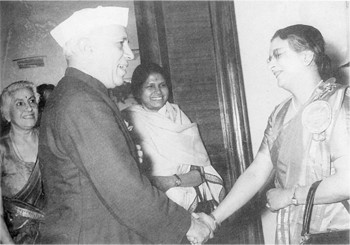
(L to R) With Lady Rama Rau, Prime Minister Jawaharlal Nehru and Laxmi Menon, Dy Min of External Affairs
Wadia traces the growth of the IPPF, the beginning of government grants from a number of countries, the strong support of outstanding doctors and scientists, the invention of various contraceptive devices. The IPPF maintained its distance from the manufacturers, carrying out its own independent clinical trials where feasible to avoid any allegations of the organization making money.
Abortion remained a bugbear for the IPPF. "Induced abortions, legal or illegal, were prevalent and the struggle to change laws to legalize abortion on broad-based humanitarian grounds was at times bitterly waged against religious dogma and even politico-military prejudices.” The European region, fearful of any practice that was reminiscent of Nazi practices, was generally uncomfortable with demographically driven ideas. "When India adopted voluntary sterilization as a method of family planning, there was a certain inhibition in countries like Sweden in approving the measure. In Sweden an Institute of Racial Biology had been established in 1921. In 1926 a law was passed allowing sterilization without the patient’s consent in the belief that social misbehavior could be inherited, and in 1941 a Sterilisation Act was passed under which the operation could be carried out under certain eugenic, social or medical (often psychiatric) grounds. Politicians also argued on economic grounds that it was important to limit the size of families, especially those with a history of antisocial behavior. It was many years later that the Swedish Government investigated why thousands of women were forcibly sterilized on eugenic grounds between the 1930s and 1970s,” writes Wadia. The Roman Catholic Church continued to be staunchly anti-abortion in its preaching. As late as 1993 Pope John Paul II urged the 30,000 to 70,000 estimated rape victims in former Yugoslavia not to abort but to "accept the enemy... transform an act of violence into an act of love.” The Swedish Family Planning Association protested the Pope’s "inhuman attitude...
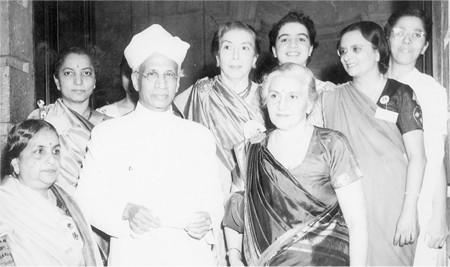
L to R (1st row): Kamaladevi Chattopadhay, Dr Radhakrishnan, Rama Rau (2nd row) Vaidehi Char, Mithan Lam and Wadia. Two friends in the rear
ignorance and lack of empathy” as did the IPPF’s European Network. Indeed, it was in the Catholic countries of South America and Mexico where illegal and often fatal abortions were endemic though some pioneer doctors risked their reputations and medical practice to help the poor women "desperately seeking a way out of pregnancy.” The formation of Latin America’s family planning association in the teeth of religious, political and cultural factors traced by Wadia make for fascinating reading. Similar problems were also faced — and overcome — in Buddhist and Islamic countries.
China addressed its problem by raising the statutory age of marriage — 23 and above for women, 27 and above for men — while giving boys and girls equal opportunity to study, to work and be productive. It also provided contraceptive services.
The first UN Population Conference was held in Rome in 1954. At the IPPF’s sixth conference in New Delhi in 1959 the pro and anti sterilization lobbies nearly had a head-on collision. "In the FPAI, our small paid staff was confined to doctors and paramedics and some office help; policies and directions and even implementation depended greatly on volunteers who had come together in a democratic system... Family planning was still a controversial and certainly not a popular cause, and did not attract even seasoned social workers and doctors, let alone newcomers, who preferred the well-beaten paths of welfare work and medical relief.”
Wadia is wont to intersperse humorous personal anecdotes to liven the saga of intellectual and political confrontations that dogged the movement over the years. During a sight-seeing tour of Belgrade after an IPPF conference Wadia found herself jammed in a lavatory. "I called out, and the local waiters and even some delegates tried to open it from the outside, to no avail. They could not break down the door, especially as the lavatory was so small. Fortunately, it had a ventilator opening over the door and a small, narrow chair was lowered inside; I climbed onto it and eased myself out of the ventilator, crab-wise, with my sari riding above my knees. Many hands helped me down and escorted me with exclamations of sympathy to a table, where I was offered a glass of cherry brandy. Unwittingly, I took one sip, and the fire it caused inside me gave me more than total recovery!”
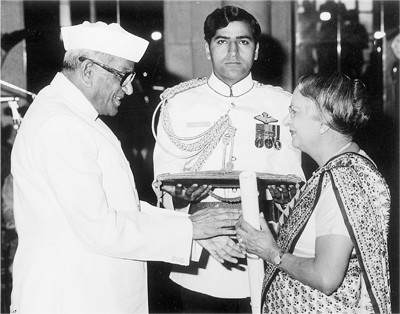
Investiture of the Padma Bhushan by President of India B. Sanjiva Reddy
A particularly stressful chapter opened for the IPPF at the UN International Conference on Population in Mexico City in 1984 when Wadia was president of the body. Even as the Israeli and Arab delegations threatened to clash in an unseemly import of local politics into the international conference, the US’s Reagan administration announced that "the United States would not contribute to those programs of which abortion was a part nor would it any longer contribute directly or indirectly to family planning programs funded by governments or private organizations that advocated abortion as an instrument of population control. (Moreover) United States would no longer contribute funds to private organizations that performed or actively promoted abortion as a means of family planning even with their own funds, and that it would require assurances from governments that US aid was not being used for abortions. It also applied these principles to the funding of UNFPA (United Nations Family Planning Association).”
Though abortion was not considered a family planning method by IPPF, this US assertion was resented as impinging on national sovereignty since even the use of non-US funds for abortion programs would bar an organization from receiving US funding.
"At the request of USAID (United States Agency for International Development), IPPF had adopted a system of not using US funds for any abortion-related purpose (even for discussions on it) and it kept a separate financial account which was audited by the US Agency. In India, for example, where abortions were permitted under the Indian Medical Termination of Pregnancy Act of 1971, the FPAI was allocated funds by IPPF from its other sources, specifically excluding US funding. IPPF could not go any further and allow US policy to veto all national and legal activities of its affiliates around the world in respect of abortion.”
The Population Crisis Committee dubbed it "voodoo demographics.” London’s Sunday Times stated that "Two immensely powerful leaders, the Pope and President Reagan, are combining to do mankind a profound disservice.” And the World Bank president A. W. Clausen offered to "at least double” the Bank’s aid for population programs. The outcry resounded around the world.
"(The) IPPF stood firm so, when its existing contract came to an end in December 1984, the USAID funding stopped and IPPF lost the US $ 17 million grant (including commodities). The momentous decision was arrived at after due consideration. It was felt that the Federation and its member associations stood for certain fundamental principles and the possibilities of grants could not be allowed to shake them.”
Eventually a shortfall in funds was averted by private foundations like the Rockefeller, Hewlett, Mellon and Packard and the governments of Japan, Sweden and UK increased their grants. The US policy changed with the coming of President Bill Clinton.
Wadia describes the glitter of the ceremonial presentation of the UN Population Award for 1985 which she received at the UN headquarters on behalf of IPPF. Standing next to the tall, dignified UN Secretary General Javier Pérez de Cuéllar, the diminutive Wadia believed she was "hardly visible!” But the New York Times noted, "When it comes to promoting family planning world-wide, Avabai B. Wadia, the president of IPPF, has few equals.”
She describes the UN Conference on Women in Nairobi in 1985 where 12,000 delegates attended (by then IPPF had won the Category I Consultative Status with the Economic and Social Council) and a number of other international meets up to and including the Fourth World Conference on Women in Beijing in 1995. In the meantime Wadia had completed her second term as IPPF president and in 1989 at a conference in Ottawa stepped down and was honored with the designation of Patron.
The latter half of the book deals with the establishment and history of the FPAI where she started and carried on as "honorary general secretary and unpaid chief executive rolled into one,” until she was elected president in 1963.
Wadia describes her style of functioning: "As president, I tried to draw the best available talent and encourage teamwork. It was my good fortune that I had the privilege and support of these stalwarts who did a magnificent job and ensured that the FPAI earned its reputation for forward thinking, excellent programs, transparent accountability and wise spending...I must have given thousands of speeches and written countless papers. It was a constant exercise and I did not trot out a standard speech but attuned myself to the occasion, although I sometimes laughed at myself silently for all the solemn words I was uttering!...I was first among equals rather than maintaining a pyramidal hierarchy.” Her motto was, "Angels can fly because they take themselves lightly.”
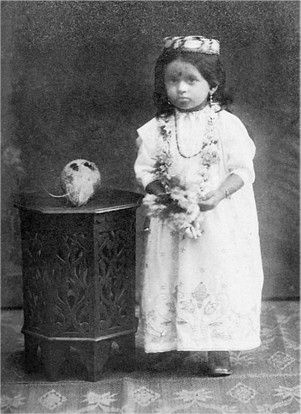
Avabai on her second birthday
The FPAI worked closely with the government’s development bodies and though it received grants from the government its autonomy and style of functioning were zealously guarded. Slowly, deliberately, the FPAI established a presence in India’s many backward areas, using ingenious ploys to reach out to the ignorant women. It was in Belgaum where, unable to breach the shyness of the womenfolk, the volunteers went from house to house, inviting the ladies to a social gathering. They were requested to bring an earthenware lamp with them. When they gathered with their diyas, the many flickering flames became "a festival of lights and they exclaimed, ‘The lamp is mine, but the light is ours!’”
Simultaneously FPAI’s own volunteers and staff continued to undergo medical, clinical and training programs based on which they spread the message to the people. Not only the containment of fertility but vital information for the children was very much a part of the scheme and mothers and mothers-in-law brought their daughters and daughters-in-law to be taught the rudiments of a safe and happy marital life. The FPAI also worked in harmony with government’s environmental policies, using their own resource base to widen the villagers’ scope of knowledge in preserving the world around them. It helped them develop subsidiary sources of income, trained local midwives, fostered various skills and the will for self-help.
Thanks to technology the world is changing and, ever alert, Wadia can discern the problems generated by technology. New answers are needed but the measure of commitment remains. Writes Wadia: "Today’s young people are the new pioneers and they have enormous challenges to face. New advocacy is needed for the dawning technological age where the labor of man, his touch with the earth and the elements, the human feelings of compassion and service, seem to be giving way. In the new technological and space age, there will be reproductive and health challenges awaiting the young of a different kind — such concerns of human life as genetics, cloning, reproduction without sex. But they may still feel they need to be ‘concerned,’ ‘committed’ and ‘volunteers’ in some sense, that is, still be the pathfinders of their age and the solvers of its problems.”
An esoteric subject, a multitude of people, places and ideas, Wadia has skilfully collated an 80-year-canvas into a very readable book that addresses the heart as well as the head.
◆ ◆ ◆
From the archive