
Demography
Children for happiness
Avabai B. Wadia’s contribution to the country’s family planning program was recalled on her first death anniversary
"Avabai’s life and work stand as a bright affirming flame in the sea of despair we see amidst us. From 1952 up to her demise in 2005 she nurtured the Family Planning Association of India (FPAI) with great devotion and distinction. More than anybody else, she knew that if our population policies go wrong, nothing else will have a chance to go right.”
Prof M. S. Swaminathan, father of India’s green revolution, chairman of the National Commission on Farmers, paid affectionate tribute to the late Avabai Wadia who personified the cause of happy, planned families not only in India as FPAI’s president for 35 years and president emeritus thereafter until her death, but on the world stage as president of the International Planned Parenthood Federation (IPPF) for eight momentous years. Magasaysay award winner Swaminathan — who was introduced by FPAI president Dr M. N. Tavargeri as the current president of the Pugwash Conference on World Affairs and the man who TIME magazine has included among the 20 most influential persons in the world — was delivering the first Mrs Avabai B. Wadia Memorial Oration instituted by FPAI at Bombay’s Indian Merchants’ Chamber on her first death anniversary, July 11, 2006. The day, coincidentally annually celebrated as World Population Day, acquired an added unhappy significance for Bombayites later that evening as seven bomb blasts on one of the city’s main suburban railway lines — stuffed beyond capacity with the city’s mushrooming population — took their toll in death, destruction and trauma.
According to Swaminathan, India’s population in 1900 was only 200 million. Currently over a billion, he anticipated the figure to reach 1,264 million in 2016. With a large segment – 50 percent – under 25 years of age we already have a "built-in momentum to reach 1.5 billion before we reach a plateau…Our country has now the highest annual net increase in population in the world,” he noted. Added to the numbers is the declining sex ratio (the ratio of female to male infants at birth) because of sex selection in the affluent states of India and low birth weight with its adverse impact on brain development and general health, all because of inadequate nourishment for the expectant mother. He quoted French mathematician Marquis de Condorcet who wrote in 1795, "Population growth can be limited if people have a duty towards those who are not yet born; that duty is not to give them existence but to give them happiness.”
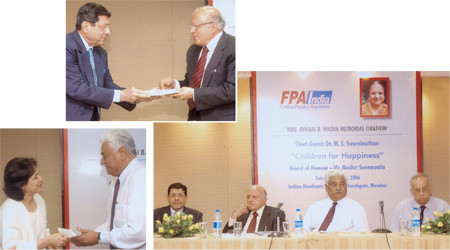
Above (L to R): Soonawala with Swaminathan; Below (L to R): Banaji handing over cheque to Tavargeri; Soonawala, Swaminathan, Tavargeri and Mistry
Noting that "gender justice and social and economic equity are vital for success in achieving a balance between human numbers and the supporting capacity of our life support systems,” Swaminathan spoke of the Government of India (GOI) committee for drafting a national population policy statement in 1994 which had included Wadia and of which he had been chairman. With the goal of a national total fertility rate of 2.1 by 2010 to maintain a steady population instead of a growing one, the group had stressed the need for "pro-nature, pro-poor, pro-women and pro-democratic choice.” It was meant to help reduce infant and maternal mortality rates and address the low birth weight problems by ensuring "work for food security at the level of each individual, since the household is not a homogenous unity with reference to nutrition. Women and girl children often tend to be relatively under-nourished.” Alas, as noted Swaminathan, the GOI "did not implement the recommendations of the expert group and remained content with adopting the rhetoric.”
Extolling Bhutan’s emphasis on the "economics of human dignity,” using a gross national happiness (instead of a gross domestic product) index which includes, among other things, nutrition, food security and good drinking water for a productive and healthy life, as well as culture, Swaminathan also provided a glimpse of corporate initiatives in improving the quality of life in rural India: The J. N. Tata National Virtual Academy for Rural Prosperity instituted in 2003 is a combination of radio, TV and mobile phone technologies providing knowledge of entitlements and schemes instituted by the government; the Tata Consultancy Services together with the Azim Premji Foundation provides software for joyful learning; the Bill and Melinda Gates Foundation’s Potential Unlimited project aims to leapfrog into literacy using technology, among others.
Child friendly villages, balanced sex ratios, the preservation of biodiversity, the elimination of child labor – are all goals which cannot be attained through legislation alone. Laws need the support of civil society, emphasized the scientist noting that "99 percent of human genome is the same, distinctions of creed and caste are manmade. He also stated the need for the second green revolution to occur in dry farming areas which are dependent on the rain and the addition of a nutritional dimension in the public distribution system by the addition of bajra, jawar and ragi to the grains supplied in the government ration shops. Swaminathan ended his dissertation with a quote from Mother Teresa which he said Wadia had adopted as her personal philosophy: "What we are doing is just a drop in the ocean. But the ocean would be less because of that one drop.”
Swaminathan ended his oration marveling at Wadia’s impish humor and unflagging energy, describing her as "terrific and terrifying, an encyclopedia of idiomatic expression and anecdotal reference with a recall and repartee few could match.”
For the next half hour Avabai’s colleagues provided insights and sidelights on the personality of the lady who had epitomized the family planning movement. Dr Nina Puri who had succeeded Wadia to the presidency of the FPAI as well as the IPPF recalled her fondness for perfume and cosmetics and sari shopping in Bangalore. Wadia, a vegetarian by choice from her youth, had a fondness for eggs and omelets, Puri noted. Dr Roshan Rishna of the FPAI, Bombay, emphasized Wadia’s eye for detail: "If there was a single grammar or spelling mistake in a report, she would notice it!” For FPAI honorary treasurer A. J. Deshmukh, "To observe her actions and reactions was an education in itself.” "You knew you were in trouble when she addressed you as ‘my dear’ in a meeting,” added senior volunteer Dr P. K. Sarkar from the FPAI Calcutta.
Famed gynecologist Dr Rustom Soonawala recalled his first meeting with her and Lady Dhanvanti Rama Rao, who was then leading the women’s movement in India, in Korea in 1965, and how the two ladies kept protecting him during their journeys together. "Avabai’s whole life was dedicated to the cause of women’s freedom,” he noted, adding that she was very careful in spending not only her own money but FPAI money, leaving a legacy for women’s welfare and education. Her bequests, according to her last testament, included 10 lakh rupees to the FPAI (the first installment of which was handed over by Soonawala’s daughter Jenai Banaji, one of Wadia’s executors, to Tavargeri), the institution of a foundation for women’s health and the creation of archives dealing with all aspects of the cause of women at Bombay’s S. N. D. T. University.
In his vote of thanks FPAI secretary general J. E. Mistry recalled how he and Avabai had shared lunch together every day, how the "authoritative yet democratic” lady had taught them all to "work without self-interest, without expectation.” As a measure of their affection, the library at the Bombay office of the FPAI has been named in her honor, he noted.
◆ ◆ ◆
From the archive