
Welfare
Remembering Avabai
Memorial lectures established by the Family Planning Association of India and the K.R.Cama Oriental Institute evoke Avabai Wadia's unique contribution to the upliftment of women
"In her lifetime she showed us the light…She showed us the way…” Dr Saroj Pachauri began her Avabai B. Wadia Second Memorial Oration instituted by the Family Planning Association of India (FPAI) at Bombay’s West End Hotel on December 15, 2008.
An institution within an institution, Wadia was a founding member and president of FPAI for 38 years. On September 18, her 95th birth anniversary was celebrated by the NGO’s (nongovernmental organization) many branches all over India with seminars and orations wherein 1,200 people participated and 35 branches were named in her memory, noted FPAI’s current national president, gynecologist Dr Usha Krishna.
The community health physician and internationally acclaimed researcher who, like her Nobel Laureate husband Dr Rajendra Pachauri, has worked with international agencies, recalled her impression of Wadia when she as a young girl first saw the family planning stalwart inaugurate a major conference in 1973: "Mrs Wadia arrived right on schedule. She walked confidently through the crowds in all her glory...a beautiful woman, immaculately dressed, not a hair out of place. She wore a gorgeous silk sari with a beautiful brooch to hold her pallav in place. The crowds receded as Avabai majestically walked to the conference venue. She was garlanded. She was applauded. She rose to the dais and began her speech. There was pin-drop silence as the audience listened. Her words flowed effortlessly but authoritatively. She was surrounded by an aura of grandeur.”
The once overawed Pachauri grew into a colleague: "We had become comrades as we strived to achieve common goals. We worked on the same issues…We battled incessantly for women’s empowerment. We fought tirelessly to improve women’s health. We began to draw closer to each other. The distance that had separated us because of age and experience had been bridged. We could now chat, gossip and giggle like friends. I was no longer in awe of this magnificent woman who carried the torch and shed the light…
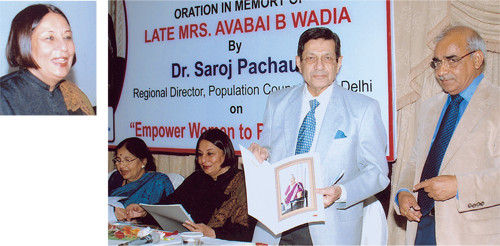
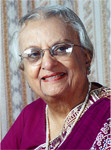
Dr Saroj Pacha-uri (above left) and with Drs Usha Krishna, Rustom Soonawala and Mahinder Watsa. (Top: Avabai Wadia)
"Avabai strived tirelessly to fight for women’s reproductive rights. When family planning was completely unacceptable, Avabai made it acceptable. Her skills and courage led her to take on many difficult and controversial issues. During her lifetime, Avabai pioneered several initiatives to make the world a better place for women. So many of us have since continued to work on so many of these issues. Avabai had the foresight, the vision to lead the way. Avabai prepared a road map for us many years ago: gender equity and social justice; educational and economic empowerment of women; women’s control over their own fertility; saving the lives of women and children and many more. While we have come a long way in this journey globally and nationally, I believe that we still have a very long way to go. Perhaps an even longer road lies ahead,” noted Pachauri as she presented her paper, "Empower women to empower India,” citing dismal statistics from a recent study by the World Economic Forum on gender equality round the world that places India 113th among 130 countries.
"This study also measured the incidence of paternal versus maternal authority. Not surprisingly, India was awarded the worst possible score on that account reaffirming its reputation as an extremely patriarchal society…Sex ratios are most skewed in favor of males in some of the richest parts of the country showing that economic growth alone cannot result in better lives for Indian women.”
Noting that the empowerment of women is intimately tied to the achievement of national and political power, Pachauri presented a series of linkages between women’s health and the country’s development, between income, education, health and development, stressing the need to educate women in order to reduce the high levels of morbidity, mortality and fertility that plague them. "India has the highest burden of maternal mortality in the world. Of the global toll of 529,000 maternal deaths each year, India accounts for one-fourth (136,000). One woman dies every five minutes in our country from causes related to pregnancy and childbirth. India’s maternal mortality ratio is 50 times higher than that of many developed countries and several times higher than that of Ceylon, Malaysia, Thailand and other Asian countries…
"Women should not have to die just because they are women! To make safe motherhood a reality, we must redefine maternal mortality as a human rights and social justice issue rather than just a health issue… There is a wide gap between the goals enunciated in the Constitution, legislation, policies, plans, programs and related mechanisms on the one hand, and the situational reality of the status of women on the other.”
Speaking of India’s vast and expanding population of young people — "an enormous national resource… which comes but once in the history of any nation” — Pachauri demonstrated the dangers of youthful frustration: "The perpetrators of (the terrorist attacks on Bombay) were young boys in their 20s. The energies of these young people were successfully harnessed by those who strategically and meticulously planned the horrific terror attacks. They took advantage of the frustrations in their lives and gave them a purpose — which they were made to believe in and for which they were willing to die...
"India is committed to achieving the millennium development goals by the year 2015: to eradicate poverty and hunger, achieve universal primary education, promote gender equality and empower women, reduce child mortality, improve maternal health and combat HIV/AIDS, malaria and other major diseases… A country that can now compete economically and technologically with the most developed nations in the world must certainly ensure that it also achieves these social goals…
"Avabai spent a lifetime striving to achieve these goals. Many of us marched along with her…Today, India is poised for change. Let’s make it happen!”
Even in death Avabai has continued her mission by leaving a financial legacy to FPAI and detailed instructions on how to carry on. "Avabai Wadia is a legend in everything connected with development,” noted Krishna citing the 35 closely written pages of instruction that Wadia has left behind on how to create a team of workers, educate them in the cause of working for women. "Her expectations are very high. Her objectives very clear. A thorough lawyer (Avabai had all her education in England and was a barrister from Lincoln’s Inn at the age of 19), she corrected every comma and full stop. It was wonderful to work with her but also very worrying,” said Krishna, recalling how she had been invited along with her husband for tea where she was instructed in detail on how to work for FPAI!
Noted gynecologist and inventor of contraceptive intra uterine device (IUD) Dr Rustom Soonawala recalled his trip to Seoul to attend an international planned parenthood conference in 1965 where he first met Avabai — and returned as member of her NGO. Their long years of association and friendship resulted in he and his daughter Jenai Banaji being appointed executors of her will by the aging philanthropist. "What impressed the international gatherings and made India shine was Avabai’s skill at drafting. Overnight she could come out with a resolution covering every aspect of what was discussed. She could win over even the Pakistani delegates! There was never anything on her mind as much as women’s health and empowerment,” he noted.
Dr Mahinder Watsa, former president of FPAI spoke of Wadia as "always smiling. But behind her eyes was such a sharp brain!” And also a great love of fun. "In Madras she asked me, ‘Don’t you know the foxtrot?’”
FPAI’s consultant sexologist Dr Brahma Bhatt noted, "Today it is easy to talk about sex, but to think of it three decades ago?... She inspired her team, always had the right people around her. I used to envy (Wadia’s secretary) Arnavaz (Jal) that you are working with a legend day in and day out!”
To FPAI’s assistant secretary general Dr Kalpana Apte she was a role model who always led by precedent, doing what she preached. Current secretary general V. M. Koliwad recalled her sharp memory and quest for perfection.”
Air Vice Marshal (retd) Lala had been secretary general of the organization (1984-99) while Wadia was president. "She was the mother of the FPAI and IPPF (International Planned Parenthood Federation) and like my own mother! I traveled with her — and got an occasional firing for my habits!” Recalling the parties Wadia held at her residence, Lala said, "She was a hostess in her own inimitable way — and made me a host by telling me to look after the bar...”
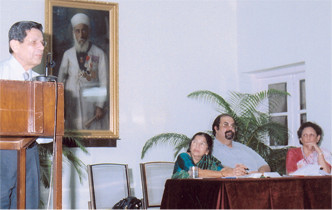
Soonawala speaking at the KRCOI. Seated (from left): Krishna, Muncherji Cama and Dr Nawaz Mody
Knowing Wadia was a "learning experience” for Dr Nina Puri who was FPAI president when the organization celebrated Wadia’s 90th birthday. She recalled their togetherness at a conference in Colombo where they had enjoyed dancing and jiving in the evening. Wadia had become unwell and "had a little murmur. We debated whether she should be hospitalized. She refused. She said she hadn’t come to Colombo to die!” Referring to the respect with which she was treated by the Government of India and her "occasional brawls with Pakistani delegates,” Puri noted, "She captured audiences, whether people agreed with her or not, because she was very courageous. I haven’t come across a nationalist the way she was — so balanced. Empowering women did not mean disempowering men!”
"The core of the problem”
The K. R. Cama Oriental Institute (KRCOI) where Wadia had been a regular member of the audience is another beneficiary of Wadia’s posthumous largesse. Its First Avabai Wadia Memorial Lectures were delivered by Soonawala and Krishna, appropriately on her 95th birth anniversary on September 18, 2008.
"Who else but Avabai Wadia showed us what a mission is,” noted Krishna, an award winning doctor and honorary gynecologist to the governor of Maharashtra, the subject of whose lecture was "The lady with a mission: Avabai Wadia and the Family Planning Association of India.” Describing Wadia as "very strong, but also very gentle and very sweet, she knew how to convince anybody.” FPAI’s 40 branches were established while Wadia presided over the organization for 34 years. "She stabled them all, in remote, way out places, but where people are doing great work. She made the FPAI very professional, brought in the concept of volunteering.”
Krishna recalled that in 1940 women used to be paid one-third of the pay men were paid. "Fourteen women died when they were locked up in a mill for asking for equal pay with men!” Wadia "touched the core of the problem and that is women’s education. She used to tell us, ‘Think great, work great. Satisfaction lies in the effort, not in the achievement.’” Krishna noted that Wadia’s endowment to FPAI is for education, training and research centers, for more branches and medical centers. She has suggested the institution of regular workshops to disseminate these ideas.
"Some people wake long before the world and they are the ones who change the world,” Krishna noted in tribute to her mentor and urged the largely Zoroastrian audience present to join the FPAI: "We need people who can teach — it doesn’t matter what…”
"Avabai knew how to improve the life of the underprivileged.” Soonawala recalled in his lecture titled "My reminiscences of the Grand Old Lady of Family Planning.” He described how he had gone to Seoul as the inventor of the IUD where Avabai sidetracked every attempt by others to discredit him and ensured that the credit for the IUD remained with him.
Joining Wadia on many of her international trips to attend planned parenthood conferences, Soonawala remembered some zany experiences which the doughty lady took in her stride. For example, the beds in Copenhagen were like coffins! They went night-clubbing in Santiago, a Catholic country where abortions were banned so only hysterectomy could be advocated to limit the size of families. "Committed to be guest speaker in Washington on one occasion, Wadia had stopped over in London to meet her brother and his family and sustained a fall that strapped her to a wheelchair. Undaunted, that’s the way she went to Washington and delivered her lecture! In Kuala Lumpur she gave an extempore talk when the designated speaker couldn’t come,” said Soonawala.
"Preaching family planning in 1969 before the Termination of Pregnancy Act came into being, the fiery Lady Rama Rau and Wadia left no stone unturned. By 1972, the laws changed… Fifteen to 20 years ago Avabai was advocating population control and environmental preservation as top governmental priorities. In January 2005 while in and out of hospital (Wadia was constrained to undergo repeated dialysis) she wrote in detail how people should be trained in contraceptive procedures,” Soonawala noted.
Welcoming the distinguished speakers KRCOI president Muncherji Cama had recalled the "indomitable lady with a lovely sense of humor. Presiding over a meet to celebrate the birth anniversary of K. R. Cama she had asked tongue-in-cheek, ‘President of the FPAI celebrating Cama’s 10 children?’”
Born Avabai Mehta in Colombo, Ceylon, September 18, 1913 she was married to Dr Bomanji Wadia. She died in Bombay July 11, 2005. Apart from the annual lecture series in her name the KRCOI has committed itself to research into the works of her late brother Pirojsha Mehta, concert pianist, lecturer and author of five books on philosophy and religion. It has also instituted a scholarship for research named after her.
◆ ◆ ◆
From the archive