
In Memoriam
The mother of family planning
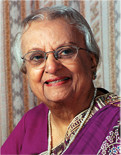
Died: Dr Avabai Bomanji Wadia (91), founder, former president and patron of the International Planned Parenthood Federation (IPPF) and the Family Planning Association of India (FPAI) and matriarch of the family planning movement worldwide, of renal failure in Bombay on July 11, 2005.
Died: Dr Avabai Bomanji Wadia (91), founder, former president and patron of the International Planned Parenthood Federation (IPPF) and the Family Planning Association of India (FPAI) and matriarch of the family planning movement worldwide, of renal failure in Bombay on July 11, 2005.
"She was my mentor and role model… Her name and fame is sung not only by us but by organizations around the world who recognized her immaculate regal presence, oratory, depth of knowledge of reproductive health and family planning, humbleness, determination and courage to fight adversity and all things wrong,” noted Dr Mahinder Watsa, president of the FPAI at the special memorial service held on August 17.
"It does each one of us proud who had the privilege of coming in contact with this great lady in our country and throughout the world…It was because of her that consciously and unconsciously one has imbibed certain characteristics and strengths that have brought me to where I am today,” acknowledged Dr Nina Puri, president of the IPPF and past president of FPAI.
"Who could not be inspired by the dedicated life of Avabai Wadia? This brave and dynamic woman put her considerable talents and warm heart of compassion to work in the service of all of humanity. Her pioneering work in family planning and her contributions have helped shape the lives of millions of women in some of the poorest and most marginalized communities,” wrote Thoraya Ahmed Obaid, executive director of the United Nations Population Fund.
"Sitting in the large armchair was a small lady, strangely towering above us all. She seemed content, she looked distinguished… having left behind her the baggage of egoism, of power politics, of anger, of hate – all that make the most towering of us seem so small.” Madhu Bala Nath, regional director of the IPPF South Asia described the nonagenarian a few weeks before she passed away.
"As the secretary general of the FPAI in 2001-02, I was extremely privileged to have her sitting next door as president emeritus. Always dressed to kill, in her beautiful silks with matching jewelry, she remained young in heart and spirit – ready to argue for the cause of the disadvantaged; unhappy to see colleagues and volunteers unhappy; and ready to fight for their rights. She always added color to our surroundings,” recalled Dr Vimla Nadkarni, professor and head of the department of medical and psychiatric social work at the Tata Institute of Social Sciences.
"She had given so much to her friends, her colleagues, the FPAI, the IPPF, to India and to the world that we have no way to describe this. It was she who initiated me into FPAI. I remember every step of how she single handedly converted at one meeting a whole country from a pro-natalistic policy to a policy supporting family planning in Burma. I saw how easily she brought both Iran and Burma into the IPPF,” recalled Prof Ranjit Roy Chaudhury, emeritus scientist at the National Institute of Immunology.
Wadia was instrumental in ensuring the inclusion of family planning in India’s first five year plan, notes the tribute from the IPPF which had been established in Bombay in 1952 at the end of the Third International Conference on Planned Parenthood when eight existing family planning associations and such luminaries in the field as Margaret Sanger and Elise Ottesen-Jensen had come together. Due to an oversight no resolution had been drawn up to establish the new federation. "Realizing this, Avabai Wadia and three colleagues quickly wrote a resolution on a scrap of paper in the wings of the stage. It was unanimously passed and the delegates voted the IPPF into existence,” records the tribute.
It was during Wadia’s two terms as president of the IPPF that it became the first non-governmental organization to be awarded the UN Population Award in 1985 and the $100,000 Third World Prize in 1987 and the New York Times noted, "When it comes to promoting family planning worldwide, Avabai B. Wadia…has few equals.” The Earth Times had billed her among the top 100 personalities of the world, describing her as "the founder of the family planning movement and the grand dame of the establishment.”
It was at the same time that US president Ronald Regan, attempting to impose religious dogma, reversed US funding policy, denying aid to foreign organizations that provided abortion services or even information about it. "IPPF policy had always been, and remains, that the lives of thousands of women are lost unnecessarily through unsafe abortion while the provision of safe abortion facilities saves lives.” Acknowledging Wadia’s "steadfast leadership at this time,” the press release notes, "Knowing that it would lose $17 million in US funding, IPPF stood firm and refused to change its policy.”
Born in Colombo, Ceylon, on September 18, 1913, the daughter of Pirojbai and Dorabji Mehta had moved with her mother to join her brother Pirojsha in London and pursue her education at the age of 15. After her schooling she joined the Inns of Court, emerging as the first lady barrister-at-law from Ceylon. In her book The Light is Ours: Memoirs & Movements published in 2001, Wadia describes her professors there, retired members of the judiciary, "old, stooped with learning, but absolute stalwarts in upholding the majesty of the law as they perceived it and especially the rule of law, that bastion of the British judicial and political system. There was a strong sense of the law being a guide towards what was right, ethical and moral and an absolute belief in these attributes. It was this absolute belief that rubbed off on us students.” This, she wrote, colored her approach to social work. "I tried always to be relevant, brief, unambiguous and objective. As president I kept in mind the dictum of Lord Acton that ‘there is no worse heresy than that the office sanctifies the holder of it.’”
It was through her involvement with the women’s movement in England that Wadia became aware of the theme that dominated her subsequent life. "The first time I heard the words ‘birth control,’ I was revolted,” she wrote. The initial suggestion had been in the context of racial prejudice. When she encountered the concept again 20 years later it led to prolonged introspection: "Was it natural, was it ethical, was it moral, was it healthy, did it encourage selfishness, promiscuity, salacity? But what finally decided me was its utility as a means of helping women to get out of the trap of biological compulsion and of societal pressures for frequent childbearing which could ruin their health, cause neglect of their children, impoverish families and keep women tied to procreation,” she wrote.
Wadia’s concern for the welfare of women, especially the poor, is reflected in her will wherein she has charged her executors to use her substantial assets for the benefit of women’s health and education and the establishment of a women’s archive – a repository for all the work done by Indian women, well known gynecologist Dr Rustom Soonawala informed Parsiana. Having been involved in FPAI work for 40 years, Soonawala had been Wadia’s friend and confidante as well as colleague. The proposed library at S.N.D.T. University is a work in progress, having begun in her lifetime, he added.
Describing her as "very self-sacrificing,” Soonawala said Wadia was particularly circumspect with other people’s money, eschewing business class travel in favor of economy and often spending from her own pocket except when the IPPF or the Indian government reimbursed her expenses.
What emerges from messages and statements from IPPF members around the world is that she had an unmatched memory for names, dates and events and was wont to speak extempore for over half an hour with accuracy. In the words of Dr Nozer Sheriar, "Her involvement and fierce commitment to our cause, her encyclopedic, institutional memory, meticulous preparation for meetings with underlined notes and practical and irrefutable argument taught generations of our members a lot.”
Charming yet outspoken, Wadia defied all manner of cant. In an interview with Parsiana in 2003 she had noted, "I believe in my community; I’m proud of my community and very proud of being a Zoroastrian — but not fossilized, not embedded in stone! …If priests want to influence the community they should be leaders in tackling real problems.” A strong and expressive supporter of the DDD-AG (Disposal of the Dead with Dignity-Action Group), she had given in writing, two years ago, what she wanted done at the time of her death, notes Arnavaz Jal, her personal secretary at the FPAI for the past 20 years. Accordingly, her paidust was held in a special room in Las Palmas, the building that had replaced the ancestral property where she and her dear husband Dr Bomanji Wadia had lived, before her body was consigned to the electric crematorium. Ceremonies, as prescribed by her, were held at the Mithaiwala Agiary at Grant Road.
Physically frail, she maintained poor health in the last year of her life and, since October 2004 had to be on dialysis twice a week. Even so, she attended the FPAI office two to three times a week, says Jal. By the end of May 2005 however she had started to give up. Spending two to three hours at each session of dialysis was becoming too tedious for her, and she eventually lapsed into coma five days before the end, notes Soonawala.
Despite all the awards that came her way — the government of India recognized her with a Padma Shri and a Padma Bhushan in 1971 and 1981, The International Institute of Population Sciences conferred its first ever Doctor of Literature (Honoris Causa) on May 7, 2005, she received the Y. B. Chavan National Award 1999 for national integration, democratic values or social and economic development in India, the Lifetime Achievement Award in 1999 from the Population Institute Inc, Washington DC, the Sat Paul Mittal Award on Population and Environment 1999 and a dozen more including the Tercentenary Award from the Bombay Parsi Punchayet in 1982 and the Federation of Parsi Zoroastrian Anjumans of India Award for Excellence in 2004 – Wadia lived by her motto: "Angels can fly because they take themselves lightly.” At work there was no pyramidal hierarchy; she was first among equals. When the FPAI saluted her on her 90th birthday she was graceful, grateful and witty: "It was worth being 90 to listen to these speeches. It didn’t sound like I knew this person but it did my heart so much good!” And, at the end of it all, she reminded her staff, colleagues and fellow volunteers, "When you hear a lot of praise, savor it, enjoy the flavor, but don’t swallow it.”
Wadia is survived by her nephews John and Robert Mehta, sons of her late brother Pirojsha.
◆ ◆ ◆
From the archive