
Books
Mithan’s minimal memoir
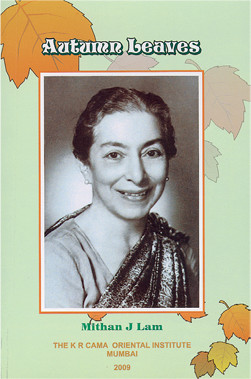
Autumn Leaves by Mithan J. Lam. Published in 2009 by the K. R. Cama Oriental Institute, 136, Bombay Samachar Marg, Bombay 400023. Pp. 76. Price: Rs 300.
Mithan Lam’s autobiography Autumn Leaves makes interesting reading on several counts. She spent an extremely eventful life and made a contribution to whatever field she chose to engage in whether it was education, voting rights for women, improving the conditions of the poor or amending the Parsi Marriage and Divorce Act. Not many people have the chance to meet the plethora of interesting people who crossed her path — the list is never ending: Sarojini Naidu, Annie Besant, Madame Bikhaiji Cama and Lady Rama Rao to name a few.
Lam was not born to a family of great wealth and power along with the privileges such a position brings with it. Her father, Ardeshir Tata, was a liberal who not only encouraged Lam to pursue her studies but also insisted that his young wife whom he had married at the age of 16 continue with her education. Mithan was a very perceptive child and even at an early age was able to comprehend the dual standards which were applied to women. Women were praised in the Koran and the Hindu religious texts, yet she could not fathom why the priest constantly spoke of "sacrifice and self-negation” being the mandatory requirements of a woman’s life and "never of her privileges or rights or equal position with men.”
This early questioning led to her becoming a foremost champion of women’s rights and equality before law. Her mother was a Theosophist and it was at the Theosophical Lodge at Adyar that she met Margaret Cousins who along with Besant demanded that women should have equal rights with men. She even travelled to England with her mother to give evidence before the Royal Commission on Indian Reforms to grant more political rights to Indians and particularly to demand more rights for Indian women where she met several leaders of the British Suffragette movement who offered the Indian deputation every help to further their cause. She became a member of the Bombay State Women’s Council which later became the Maharashtra State Women’s Council and played a very important part in the All India Women’s Conference (AIWC) which was started by Cousins in 1928.
When Lam was in England she continued with her studies in Economics with the London School of Economics. A year later when the Inns of Court and the practice of the Bar opened for women for the first time, she stayed on for another two years to study law, becoming one of the first 10 women to be called to the Bar. She enrolled in the Bombay High Court in 1924 and became the first woman to be allowed to practice law. She was appointed a member of the committee to amend the old Parsi Marriage Act of 1896 which "contained one or two obnoxious sections and bring the divorce sections up to date.” It is solely through her efforts that the amended Parsi Marriage and Divorce Act was passed in 1936.
Interested as she was in the question of women’s rights she did not alienate herself from the poverty which stared her in the face and worked along with other women in the Matunga labor camp which along with Dharavi had the reputation of being one of the worst slums in Bombay. At first they were rebuffed but they did not give up the struggle but persisted in their efforts. It is only through this persistence and the fact that they had no ulterior political agenda that they were successful in bringing a change in the lives of the slum dwellers by providing them with electric lights, a dispensary, a small nursery school and a sewing class for women.
The brief autobiography of 76 pages includes an index and photographs, which are well selected and which give a visual image of her life and her times and the people she met. But as a consequence only 52 pages are devoted to this very exciting life. One often wishes the memoir could have been longer.
Another shortcoming is that the autobiography is not chronologically arranged and the life has been divided into chapters which have been organized thematically, individual chapters being devoted to her social work, her fight for equality for women, her legal career and her travels. The chapter on "Travel” is particularly trying as it seems to be an endless list of people whom Lam met and a catalogue of the various places she visited. One often wishes that she had dwelt more and elaborated on these encounters and visits as she does in the case of her visit to the USSR where she is very quick to observe the positive aspects of life which the political system has brought to the people of the country. She gives a very lively and endearing portrait of life in the USSR and is amazed to see that there are no signs of poverty, the houses are clean and electricity is available in most of the villages. She is also very pleased to note that the revolution had brought equality of rights between men and women and is very impressed with the working of the collectives which provided the members with schools, well stocked libraries, maternity homes and doctors.
In spite of the briefness, one gets a fascinating picture of the career of this amazing woman; one regrets that we know so little about her private life. Through the first few chapters we learn that her father was an assistant manager of a textile mill and her earliest memories recorded in this memoir are those of a large bungalow at Phulgaon near Nagpur where she spent a rather lonely childhood with books as a constant companion.
Apart from these early chapters about her youth and growing up there are occasional references to her son Soli and her husband Jamshed but one generally misses the personal aspect of her life which would have given the reader a more rounded portrait of this remarkable lady.
It is strange that we learn more about this aspect of her personal life through a foreword written by Lakshmi Menon who was her colleague at the AIWC and who mentions the happy times spent at Lam’s flat along with friends amid much camaraderie and laughter and briefly touches upon her’s illness and subsequent death at the B. D. Petit Parsee General Hospital in February 1981. It is through this brief introduction that we learn about her extremely generous nature and the fact that she insisted her contributions to the Conference Building Fund should remain a secret. Whereas one encounters the public persona in this brief memoir how one wishes one could have met through these pages the Lam Lakshmi describes as "generous, thoughtful, affectionate, who had secured an abiding place in the hearts of her colleagues and her friends.”
FIRDAUS GANDAVIA
◆ ◆ ◆
From the archive