
Cover Story
Stalwart of social work
Avabai Wadia, Ceylon's first lady barrister, became the international face of the family planning movement
"Parsis are a community, not a race. There is no such thing as a pure race anywhere in the world. You can make out a Parsi by looking at him. But you can also make out a Bengali or a Tamilian by looking at him!” says Avabai Wadia, president emeritus of the Family Planning Association of India (FPAI), founder member and patron of the International Planned Parenthood Federation (IPPF).
Over 70 years of work in the battle to establish women’s rights to education, a life beyond the kitchen stove and the drudgery of housework; over 60 years in changing mindsets around the world in favor of healthy families with well-spaced children and mothers with the strength and ability to look after them. At the age of 90 Wadia may well survey the past with satisfaction but is far from ready to call it quits. A lifetime of advocacy for concepts then repugnant to the status quo has sharpened her perceptions and bolstered her natural instinct to identify and defy religious cant when she sees it. And she sees it in the fundamentalist Parsi self-righteousness about the ‘purity’ of our blood and our claim to be the sole repositories of the Zoroastrian faith.
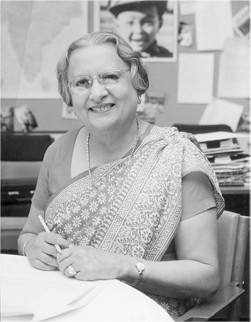
Wadia: "The law was a guide to what was ethical and moral”
"I believe in my community: I’m proud of my community (and) very proud of being a Zoroastrian — but not fossilized, not embedded in stone! Ours is a living community, advancing in many ways, existing in harmony with everything around us. (We have a) fine traditional background... The priests cannot dictate to the community. We don’t have (a system of) religious fatwas... We need germs of realization, we need to invest research in madressas... If priests want to influence the community they should be leaders in tackling real problems... Parsis have the opportunity to be leaders of thought in many directions if they get out of their narrow thinking,” notes Wadia.
Drawing a parallel between Parsis and the western world on the demographic stage where too native populations are declining because of improved economic conditions and the accent on keeping families small and educating them well, Wadia notes that governments there are permitting increased immigration to take care of jobs for which local labor is unavailable. And "the status of the immigrants is growing... We should also be bringing something into the community (to maintain its size). One way is through intermarriage and their children.” A lifetime spent in the service of family planning — both, to help restrict the size of families as well as to enable the childless to avail of technological aids to fertility — have convinced Wadia that the birth rate remains within the power of the couple. If they choose to contain their fertility "no one can stop them.”
Multi births that are said to occur (or may even be induced) in cases of in vitro fertilization (test tube babies), Wadia dismisses as "accidental events,” emphasizing that a proper partner in the rearing of a family is much more important in the long-term health of the community. She would much prefer to allow Tajiks, who seek to return to the Zoroastrian fold, to be absorbed into the community. "I have not worked to decrease births but to ensure the health of women. A major reason for fertility control was also to give children a better life — by planning births at the pace and number you want. There is nothing to stop Parsis from having more children (except) the obligation to the children that are born, to bring them up well. That is the essence of family planning work.”
Wadia believes that Parsis have the ability to get on with people, to react positively to their environment. "Deep down, our culture doesn’t reject people, it accepts people... We are sensitive to our environment for the betterment of the country,” she notes, citing the adaptation of the early Zoroastrian settlers to the local customs of Gujarat, even joining the Hindu armies in their defence against the invading Mogul battalions. "We did not necessarily fall into British laps (when they came). But when they provided opportunities for education and trade we took them and didn’t feel subordinated.” And, in the germ of the national movement, in the enunciation of India’s right to self-rule, Parsis like Dadabhai Naoroji and his generation played a substantial part. Even in South Africa the local Parsis helped Gandhi in his struggle against apartheid. "We don’t create barricades,” Wadia rested her case.
In 2001 the IPPF published The Light is Ours by Wadia, a personal memoir that co-extends and co-exists with the history of the family planning movement around the world. 2001 was also the Year of the Volunteer as declared by the United Nations and the book celebrates the contributions of men and women around the world who used their time, talent and personal resources to propagate the cause of emancipating women from their own fertility. Wadia, who describes herself as "a magpie for collecting papers” though she never kept a diary, says it took her two years to write the book, piecing these papers together and authenticating her memories with reference to various minutes and records.
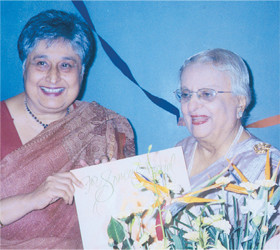
FPAI president Dr Nina Puri felicitating Wadia on her 90th birthday
The daughter of Dorabji Mehta and his wife Pirojbai was born in Ceylon where she schooled, growing up in natural harmony with the environment and her brother Pirojsha, 11 years her senior which, she writes "gave me great advantages... I exploited his good nature to the full and this became a lifelong habit.”
As Dorabji was occupied for long hours at his work at the Ceylon Wharfage Company, his wife spent her leisure hours reading. Avabai notes that her mother found sustenance in Theosophy which enjoined universal brotherhood unfettered by race, creed, color or sex, encouraged the study of comparative religion, philosophy, science, the unexplained laws of nature and the power of the human mind. She attended The Theosophical Society meets in Adyar with her children. There they not only heard and met Dr Annie Besant but came to know, among other protagonists of Indian independence, a gangly youth deputed to escort them — Krishna Menon, who later became Nehru’s friend and India’s not-too-popular defence minister. Wadia credits Menon with performing yeoman service in London for the cause of Indian independence. "To most people he was very irascible but he was always gentle and polite with my mother and me,” she recalls.
In the book Wadia recalls her sense of contentment at Adyar with its atmosphere of plain living and high thinking. Her membership of the Society’s Youth Lodge in Ceylon where she was appointed secretary and kept minutes at the age of 12, learnt to write and give speeches, laid the foundation of a "lifelong career in communication and in promoting causes.” Besant suggested an education in England for the young Avabai and Pirojbai, who had been deprived of education in her childhood and despite her own poor command over the English language set sail for England in 1928 "with a naive 14-year-old in tow.” The sari-clad Avabai attended the Brondesbury and Kilburn High School for Girls and matriculated two years later. Joining Lincoln’s Inn in the face of social scepticism — "girls simply did not become lawyers!” — but with her mother’s encouragement, Avabai sat for her law exams at the age of 19, secured a first class and was called to the Bar — the first girl from Ceylon to do so. She describes the professors, retired members of the judiciary, "old, stooped with learning, but absolute stalwarts in upholding the majesty of the law as they perceived it and especially the rule of law, that bastion of the British judicial and political system. There was a strong sense of the law being a guide towards what was right, ethical and moral and an absolute belief in these attributes.
"It was this absolute belief that rubbed off on us students... To develop beliefs based on reason and rationality embodied in law was a way towards leading a life with justice and fairness.”
It was with some difficulty that Avabai found her place as a ‘devil’ (as law apprentices are known) in the chambers of a barrister of the Inner Temple, cutting her legal teeth on divorce cases. But as a lady barrister she was "something of a celebrity” in the community and asked to stand for election to the committee of the Parsee Association of London (forerunner of the Zoroastrian Trust Funds of Europe). She won the poll and was appointed honorary treasurer. "As is usual with Parsis, the committee members had diverse views about burial, cremation and dakhmas and argued at length about these. But in London, Brookwood was the place and either burials or cremations took place there,” she writes.
Avabai says she had to practice ritual purity in Ceylon where too Parsis observed these customs "but it was not possible in the UK, practically or conceptually.” Her mother as well as some of her contemporaries strongly felt that girls should be educated and they were not prepared to let these customs detract from that mission. Avabai recalls that when her grandmother wrote to reinforce this old custom, her mother impatiently replied, "Jamano badlai gayoch. Jamana pramané chalvanu ché (Times have changed. We have to move with the times).”
But even in the 1930s and 40s the traditional Parsi view regarding intermarriage prevailed. "Shapoorji Saklatvala was married to a European lady. They used to come to Zoroastrian House and people were friendly, but there was no general approval of intermarriage. When my brother married a British lady (Silvia, a medical doctor) our parents were taken aback but later (my mother) stayed with them and was won over. I was also devoted to my sister-in-law and she to us. The happy relationship, the successful marriage changed mother’s views,” Avabai told Parsiana. In her book too she has recorded the ready and generous hospitality she enjoyed from her brother and his family on her frequent trips to London as an office bearer of the IPPF.
When Sir Sorabji Pochkhanawala decided to open a branch of the Central Bank of India in the City of London he offered Avabai the position of confidential secretary to the manager. It was her first job and for a year she handled confidential correspondence, wrote minutes of board meetings and "signed innumerable cheques for large amounts jointly as one of four designated signing officers” at a time when there were very few, if any, women who were bank signatories in the City of London, she writes. With Pochkhanawala’s death and the distant rumble of war, the branch was closed and eventually in 1938 the Mehtas returned to Ceylon.
Avabai was 16 when she was invited to join the newly constitued London committee of the Women’s Indian Association where a "handful of Indian women banded together to articulate Indian women’s rights.” Among the other 10 women were Hannah Sen who later became the first principal of Delhi’s Lady Irwin College for Home Science, Dhanvanthi Rama Rau, Feroza Dastoor, Jerbanoo Vakil and Lady Frene Ginwala. They advocated adult franchise, women’s equal rights to education, the professions and business and to inherit and hold property. They won the sympathy of leading members of British women’s organizations who "felt some responsibility... for the rights and wrongs of British rule in India,” notes Avabai.
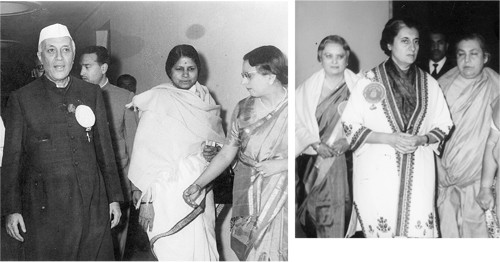
With two Prime Ministers: Jawaharlal Nehru (left) and Indira Gandhi (below)
In her book Avabai traces the hard fight of British women for an equal place under the sun and quotes from the autobiography of the leading intellectual figure of the time, philosopher Bertrand Russell: "It must be quite impossible for younger people to imagine the bitterness of the opposition to women’s equality” and the "savagery of the males.” "It was quite awesome to see some of the old and redoubtable fighters in the evening of their lives. There was humor and reminiscence and, at the same time, dismay as to how the young women of the day did not even know of, let alone appreciate, the grim struggles (including jail and force-feeding) that this earlier generation had undergone in order for them to enjoy the freedom and equality that had come their way. I have subsequently seen that this is a development that comes in the wake of every great wave of reform and change,” writes Avabai. And from her memoirs one can discern these ladies’ qualities of unselfish help, unassuming commitment, courage and perseverance in the pursuit of a cause that Wadia imbibed and internalized so that on her 90th birthday she was gloriously felicitated and eulogized for her dedication and devotion, sense of humor, wisdom, knowledge and experience at a function at the FPAI headquarters in Bombay.
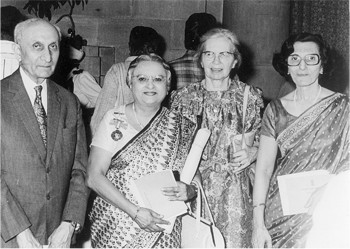
At Rashtrapati Bhavan after receiving the Padma Bhushan with (L to R) brother Pirojsha, his wife Silvia and Gool Kermani
Avabai recalls the fierce nationalism of the early 1940s in Bombay where the family resettled in 1941 and where her friendship with Dr Bomanji Wadia — one of the first few Indians to graduate cum laude from Harvard followed by a doctorate from Columbia University — burgeoned into romance and marriage. The staunchly nationalist six-footer with wide-ranging intellectual interests invited her for a walk. And with each long walk Avabai learnt something of the history of Bombay. Their exemplary partnership lasted until he passed away at the age of 79 leaving her lonely and bereft. The lady who spent a lifetime in the cause of creating happy families had been unable to bring her own pregnancies to fruition.
The Women Graduates Union, the Federation of University Women, the All-India Women’s Conference (AIWC) (of which she became secretary in 1945) — were the overriding interests that decided her in favor of voluntary work as against a career in law. Every week she hammered out a column "A Woman Speaks” for the Blitz and edited the AIWC monthly magazine Roshni. When UNESCO offered her the position of leading its Education Department in Paris, she declined as she did offers of political postings and government jobs post Independence. It was as editor of Roshni that Avabai became conscious of and concerned for the poor health partly caused by having too many children too frequently and the women’s organizations became interested in introducing birth control services. When the Bombay Municipal Corporation agreed to introduce family planning in two of its maternity centers and a women’s organization, Bhagini Samaj, started a clinic, they sought publicity in Roshni. "But we realized that we would not reach underprivileged and largely illiterate mothers in this way. As a result, we got together a group of experienced social workers and medical practitioners, both men and women, and formed the Family Planning Committee, which soon became the Family Planning Association of India” in July 1949. Dhanvanthi Rama Rau was its first president, Avabai the founding secretary who succeeded Rau after eight years and continued as president, reelected uncontested, for 34 years. "I tried to take myself lightly, keep a sense of humor and not allow any praise I received to go to my head,” she writes.
Women’s groups on either side of the Atlantic and in Europe sought to overcome the problem of enervating frequent pregnancies in the face of obdurate opposition from traditionalists. For example, in the US the Comstock laws prevented doctors from giving or mothers from receiving advice on contraception and the doughty Margaret Sanger, who opened the first birth control clinic in 1916, was jailed for a month. She advertised the clinic by handbills in English, Italian and Yiddish saying, "‘Can you afford to have a large family? Do you want any more children? If not, why do you have them? Do not kill, do not take life, but prevent.’ Women started flooding to the clinic,” writes Wadia.
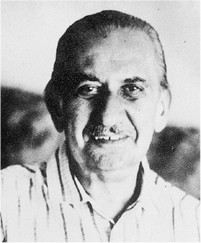
Husband and nationalist Dr Bomanji Wadia
When these disparate groups of the western world became aware of the Indian Government’s advocacy of family planning and of the FPAI, they, under Sanger’s leadership, sought to hold their Third International Conference in Bombay. It was inaugurated by vice president of India Dr S. Radhakrishnan and a total of 412 delegates attended. Resonantly advocating the planning of families for the benefit of mothers and children as well as the social need to contain population growth, Radhakrishnan had noted: "The question is sometimes raised whether it is not true that God sends children into this world and we should not interfere with the Will of God — that is the way in which it is put. I may tell you that if God has given us any intelligence, he has given it to us to be used... These are things which we are called upon to adopt because the human mind is a gift of the Divine... We have inherited not only great areas of light, but we have inherited large tracts of darkness and ignorance.” The conference adopted six resolutions, among them the name: The International Planned Parenthood Federation.
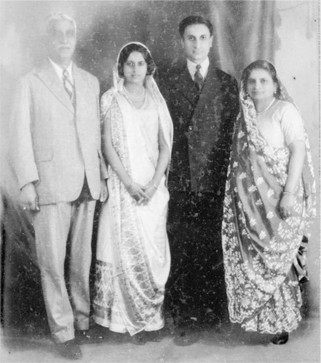
In London with father Dorabji, brother Phirojsha and mother Pirojbai
This first organization of an international conference was an experience repeated dozens of times as Avabai meshed with people and movements round the world, attending IPPF meets where she initially represented FPAI. Being invited to innumerable conferences organized by the various bodies of the United Nations, hobnobbing with national and international civil servants, heads of state and governments became a way of life. In 1983 Avabai was elected president of the IPPF and reelected for another three years. During these six years the IPPF won the UN Population Award in 1985, the Third World Prize from the Third World Foundation in 1987 and the World Health Medal from the World Health Organisation in 1988. When she stepped down from the presidentship the IPPF elected her one of its four Patrons — an honor given with judicious care.
Recalling the various phases of post-Independence development in India Avabai defends Nehru’s approach to the population problem. "He wasn’t lukewarm about population. He considered it a component of development.” While the government provided facilities, it remained a "voluntary approach” with government "neither controlling nor punishing. The Emergency (under Indira Gandhi) was hated because government rode rough-shod over people. Indian people are not amenable to force. The movement is based on persuasion therefore it is slower.” China enacted a single-child national policy with incentives and disincentives "but it also provided improved educational and labor benefits among the people and "it did not forego persuasion,” she tells us.
J. R. D. Tata had also been concerned about India’s growing population and hence had often interacted with Wadia. When he established the Population Foundation of India, he invited Wadia to join the board of trustees. Recipient of the UN Population Award, Tata "was always very pleasant, our ideas blended quite a bit. But it was one of his interests. I knew more details and didn’t agree with his ideas about providing incentives for (sterilization) operations,” says Wadia.
Many doctors helped the family planning movement forward. Outstanding Parsis among them were gynecologist Rustom and surgeon Furdoon Soonawala and the latter’s son Phiroze, also a urologist. Rustom "joined us more than 40 years ago. He has given a lot of free service to family planning, infertility, reproductive health. He is one of our stalwarts,” she notes. Furdoon and Phiroze helped with the FPAI’s vasectomy camps. "Even in the very backward district of Tonk in Rajasthan which registers barely a couple of vasectomies a year, there were more than 100 at our camp when Phiroze came,” she notes appreciatively. All this professional service is provided free of charge, at considerable cost of time to their private practice, she notes of all the medical volunteers who have served the organization. At Avabai’s birthday celebration at FPAI Rustom Soonawala recalled his first meeting with Wadia and Rama Rau in Korea in 1965: "I found them very involved,” referred to the "team spirit” which has been a consistent attribute of FPAI and acknowledged the tremendous experience he had gained by working with the organization.
Avabai views the community’s rising divorce rate in the general sociological context: the growing rights of the individual as against the rights of society — as represented by the joint family or community elders — which had traditionally had the upper hand. "Under those circumstances institutions should also change,” she opines. "It also depends on how seriously individuals take their (marital) commitment. They are more relaxed when they know that an exit is possible. But individualized thinking is gaining ground.”
She is more concerned about the impact of today’s TV programs on young minds. "The frequent advertising breaks lead to limited concentration. Young people will have very short concentration periods.” She also rues the "obsession with marriage” in the popular Indian serials — the lack of any worthwhile professional or working women among the protagonists means that "girls are being brought up to look only at marriage, are satisfied with even second class marriage!” On the other hand, "it’s a great thing that we have mothers and mothers-in-law to look after children” — an invaluable support for those who desire to do more.
"It was worth being 90 to listen to these speeches. It didn’t sound like I knew this person (but) it has done my heart so much good!” Wadia told her staff, colleagues and fellow volunteers who had gathered to bestow cards, flowers, gifts and tributes of love at the FPAI’s Bajaj Bhavan office. "Whatever little work I’ve done has got results because of all of you,” she noted, urging FPAI to remain in the vanguard of the country’s social development. Then, before proceeding to press the button that would inaugurate FPAI News Net, the internet edition of the organization’s monthly bulletin, Planned Parenthood, she reiterated her personal dictum, "When you hear a lot of praise, savor it, enjoy the flavor, but don’t swallow it.”
◆ ◆ ◆
From the archive