
Issue and issues
Eminent members of the community sought the involvement of the Ministry of Minority Affairs to resolve their concerns
Observing "a sense of dissonance” within the Parsi community, he briefly recapitulated how the "Hindu society was forced to reform itself” after the emergence of other faiths like Buddhism, Jainism and Sikhism, and how even in Islam the permission for four wives was considered reformative at a time when women were treated as slaves and men could enjoy 500 women in their harem. "Today Islamic countries have reinvented themselves.”
Urging the Parsi community to likewise "renew itself,” Mayaram repeatedly enquired of the assembly, "Do we have the will to live? And if we have the will to live, do we have the resilience to move with the times and survive?...What is it in our practice of the religion that inhibits the growth of the community in this manner?”
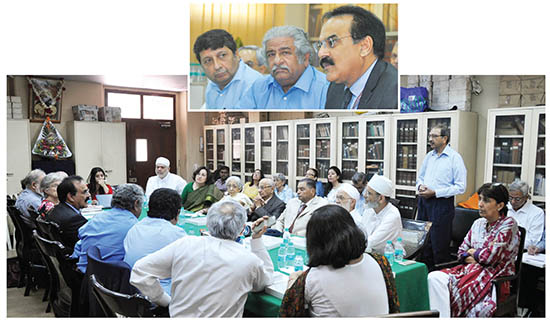
(From left) Maneck Davar, Dinshaw Mehta, Arvind Mayaram; distinguished gathering at the BPP boardroom
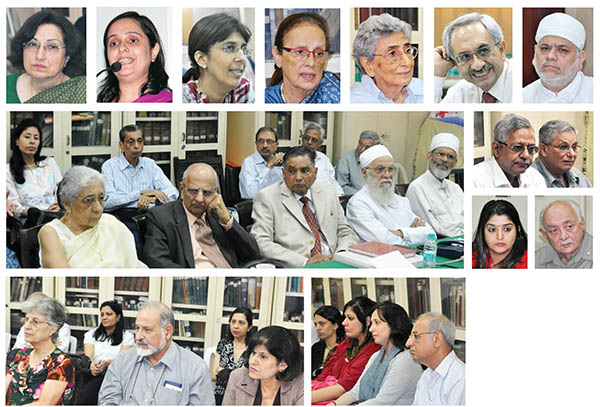
Community members should "marry at the right age and expand their family to the right size,” recommended Dastur (Dr) Peshotan Mirza. "Individuals cannot do this. A central body should look into that; find out the difficulties of youngsters from the middle class and lower middle class.” Interjected Mayaram, "Sir, that is the cure. I am asking whether there is a will to survive.”
"Of course there is a will to survive,” confirmed Dr Shernaz Cama, the Delhi based director of the Parzor Foundation who had taken the initiative for this meeting. Dr Anahita Pandole who is rendering honorary gynecological services to the Jiyo Parsi project, run conjointly by Parzor and the BPP with funding from the Government of India (GOI) added: "The couples who come to us are desperate for children; some at the age of 20/22 and others at 40/41.”
The nearly two-hour discussion started with a brief presentation by the Jiyo Parsi counsellor Pearl Mistry who highlighted the relevant community statistics in India and declared that with the current low fertility "only 19,000 (Parsis) will be left by the end of the century.” She reported that since the inception of Jiyo Parsi in 2013, the community has already benefitted from three babies and some pregnancies, and following the Jiyo Parsi advertising campaign, 10 couples have come for treatment. The highlight of the PowerPoint presentation was the first slide which showed Dr Hemant Morparia’s cartoon in the Mumbai Mirror where one panda complains to another: "So much pressure on us to breed – what do they take us for, Parsis?!”
Based on the studies conducted by her team at the Tata Institute of Social Sciences (TISS), Prof Armaity Desai opined, "The issue is not religious... but social, cultural... Today’s Parsis want to have a certain standard of life... They say ‘we want our children to have the best of schools and hobbies/extracurricular development... and we can’t have the best if we have more than one or two children.’ In the two-salary families where women are also working they won’t have too many children... The educated working woman takes longer to complete her education, (pursue) a career and settle down.” They find the BPP monthly subsidy for the second and third child "too little. They want a complete package.” Binaifer Sahukar who has been conducting a series of workshops on attitudinal change mentioned how her sessions for couples and parents try to induce "a work-family balance.”
"We have no reservation of seats in the higher education institutions endowed by Parsis,” pointed out erstwhile BPP chairman Minoo Shroff who recommended two-three percent reservation since Parsi students with even good percentages are unable to secure admission through the few open seats. "How do we unscramble the egg?” enquired Shroff. Only the Engineering College at Sangli has two degree and two diploma seats for Parsis. Among the few institutions that had seats reserved for Parsis earlier were the Victoria Jubilee Technical Institute (since renamed Veermata Jijabai Technological Institute), mentioned Dastur Khurshed Dastoor who lamented that "Even at TISS there is no reservation for Parsis.” Considering that the management quota at these institutions was surrendered to the government years ago and the seats have subsequently been set aside for several other categories, it is doubtful anything can be done now, observed Mayaram. If at the time of handing over the management a condition had been made to reserve some seats for Parsis, that would have been a different story.
"There is a complete brain drain,” stated Farrokh Rustomji of the R. D. Sethna Scholarship Fund who narrated the woes of Parsi students when, unable to get admissions in India, they are forced to take loans and go abroad to pursue studies in their chosen field. Could Parsis being a minority community be clubbed with linguistic minorities? he wondered. Would it help if the current family members of those who had endowed the institutions write to the government that they would like some seats to be made available to their own community? enquired Maneck Davar, proprietor of Spenta Multimedia.
Believing that this could "open a pandora’s box in a country like ours,” Mayaram suggested that instead of government institutions, the community should identify certain private medical/engineering/management institutions and pay a premium by way of capitation fees for some seats that could be reserved for Parsis. With several new institutions coming up, the capitation component has gone down, he observed. The second alternative Mayaram recommended was setting up of new institutions where several seats could be reserved for the community.
BPP’s past endeavors to procure reservations were referred to by BPP public relations officer Godrej Dotivala who recalled Shroff and him meeting the then chief minister of Maharashtra Vilasrao Deshmukh. BPP chairman and Zoroastrian representative on the State Minorities Commission Dinshaw Mehta referred to a meeting he and Keki Daruwalla (former Zoroastrian representative on the National Minorities Commission) had with then chief minister Prithviraj Chavan who suggested the community could create a new institution on five acres of land gifted by Godrej.
Managing director of Godrej Industries, Nadir Godrej sought to explore the possibility of creating a new minority institution at minimal cost on assets previously created by the community. Mayaram agreed that there could be "various creative ways of doing this... by building new institutions (whilst) sharing the facilities with existing ones.”
When noted solicitor and former BPP trustee Burjor Antia remarked, "What about reservation in government services?” Davar specified that there is no Parsi left in the IAS (Indian Administrative Service) and other services. Mayaram, an IAS officer himself, asked, "Why is it that they don’t take the exam?” before jesting how certain communities want their brightest son to become an industrialist, the second in intelligence to start an agency business, and the dullest to join the IAS! "Unfortunately the community does not give premium” to this sector, stated Mayaram.
The MOMA website refers to different schemes for education, for the elderly, for those in the rural areas, but this information is not known to minority communities. How can such information be disseminated to the common Parsi? enquired Freyan Bhathena, editor of Parsi Times. Supplemented Desai, "All our studies show that no Parsis use any government scheme.” Mayaram offered to have Bhathena as content advisor for their website, a responsibility she consented to undertake considering that she "already runs a branding company.” The websites run by Yazdi Tantra, director of On-lyne, could also be harnessed to reach the message to community members through their daily broadcasts, it was recommended. "My problem is what news would be important? What is of interest to Parsis?” stated Tantra.
To match the government schemes with the population profile, assistance could be taken of the Federation of the Parsi Zoroastrian Anjumans of India, suggested Cama. Regarding government schemes for senior citizens, BPP trustee Arnavaz Mistry lamented the excessive details sought from applicants which dissuades them from applying. Information regarding the online scholarship schemes for students could be circulated by Zoroastrian Youth for the Next Generation (ZYNG), recommended Cama. "The main problem is we need children first,” commented Mehta, making Mistry add, "We need our youth to get married before that.”
The Government of India 2011 census figures for the Parsis having not yet been announced, the MOMA secretary was asked whether religion was factored into the last census. Cama reported that the Parsi community being too insignificant, she was told that they would be counted after the tribes. Even TISS has not been given the census data, regretted Desai.
For Pakistani expatriates who have difficulty getting an Indian visa as had happened at the time of the 10th World Zoroastrian Congress in Bombay in 2013, Mayaram assured, "If you tell us in advance, we can resolve this issue.”
Pushing for parity
"Gender discrimination is bothering certain sections of the community,” more so when the outmarried woman’s children "are not allowed to be part of the community,” Davar conveyed to Mayaram. Since this criticism also applied to the Jiyo Parsi initiative where an outmarried Parsi man and his wife can avail of the fertility assistance but not an outmarried Parsi woman and her spouse, Cama maintained that they are following the patriarchal law prevailing in India. "Our response has always been ‘bring a case forward and we will take it up (with support assured by legal luminaries like Soli Sorabjee and Fali Nariman)... It is not within our ambit” to change the definition of a Parsi. She claimed that "We don’t have proof or methodology whether children (of outmarried Parsi women) will be raised as Zoroastrians,” and was supported by Mehta who declared, "There is no guarantee that these children will be raised as Zoroastrians.”
"Neither is there a guarantee that children of a Parsi father and non-Parsi mother will be brought up as Zoroastrians,” pointed out the editor of Parsiana, Jehangir Patel, referring to the Delhi Parsi Anjuman, the Karachi Parsi Anjuman Trust Fund, the Zoroastrian associations in North America and the Zoroastrian Trust Funds of Europe that grant parity to outmarried males and females. Considering that the Federation of Zoroastrian Associations of North America and the World Zoroastrian Organisation stipulated that their donations to the Return to Roots program promoted by Parzor was on the condition that there would be no gender discrimination, Patel advocated that the GOI too should adopt a similar stance. Cama who would have liked to find "an amicable solution” to this problem maintained, "We would welcome gender equality if there was true concern to preserve the Parsi culture,” but cited the instance in Delhi where a Parsi mother’s daughter was navjoted but not the son lest he lose his share in the property of the Hindu Undivided Family.
Mayaram was not interested in discussing "what the law and courts can do but what you want to do... If there is no dispute, you don’t require any law or court. Laws are not necessary for a community of 65,000. Laws are necessary for 65 crores.”
Whilst gender equality and adoption are issues that continue to vex the community, a rising number of drop pregnancies and the consequent loss of children is a cause for concern. This made the Jiyo Parsi core team members appeal to MOMA to sanction surrogate motherhood. As long as the donor sperm is from a Parsi, most were willing to give their sanction to surrogacy irrespective of the ovum or female womb hired to carry a baby to term being that of a Parsi or non-Parsi. Explaining the need for surrogacy, Pandole referred to some couples "begging” her to consider surrogacy as the last option for them.
ZYNG representative Pearl Tirandaz referred to a new trend developing in the community where young women have unabashedly told her, "We don’t want to marry but we want to have children.” Commented Mayaram, "It is a very poor reflection on the men in the community!” The Jiyo Parsi team was therefore inclined to accept the children of single women as legitimate Parsis. BPP trustee Khojeste Mistree asserted, "We need to study the whole issue. What percentage are we talking about? The issue has a religious firmament.” When he was assured that the sperm will be of a Parsi father he had no objections although Mirza expressed that this was not an answer he could give over the table.
"It is easy to say ‘let us have gender equality’ without understanding the history of the community,” declared Mistree who felt "one of the things we need to focus on is religious education... What would be important is to bring scholarship into the community... Earlier St Xavier’s College used to offer courses in Avestan and Pahlavi studies.” These subjects can now be studied at the J. J. Madressa but we need "structured education... How do we help to build a Parsi identity? We have an ethnic identity which people are trying to change... (our) society is patrilineal... We need to bring about a cultural awareness. Wanting to preserve our identity then becomes stronger... If the identity is strong, (there will be a greater willingness) to have more children.” Mistree was hopeful MOMA would "help us develop a museum.”
As subsequently elaborated by art curator Pheroza Godrej, the Alpaiwalla Museum owned by the BPP is being re-established. "We have spent over a crore of rupees.” But since there is "need for documenting hundreds of artefacts that belong to the world” she urged MOMA to support their venture. She also referred to another exhibition being planned at the National Gallery of Modern Art in Delhi. Mayaram though deflected the financial appeal by telling them to approach profit making corporate houses who are mandated to spend two percent on CSR (Corporate Social Responsibility) initiatives. "I have never seen any work stop because of lack of funds, if there is commitment and intent,” he noted. Observing the community’s manifold philanthropic initiatives for the betterment of the country, Mayaram stated that he considered the purchase of a Tata car as "giving to charity” knowing that Tata Sons which is supportive of many charities has a major stake in Tata Motors.
Mooting for a single chair for intercultural studies, preferably at TISS, Pheroza Godrej’s suggestion found other supporters. But as expressed Antia, "The primary thing is to grow. How do we grow?” Commented Pheroza Godrej, tongue in cheek, "Otherwise we will only grow in museums.” "Why is the community not saying ‘We are important for this country and humanity?’” wondered Mayaram. Reiterating the "commitment of the government,” he added, "It is fully behind you… We want to ensure that the Parsi community grows, remains prominent... a jewel in the crown of India.”