
History
Women in the Gathas and the later Avesta – II Veneration of women
Female deities were worshipped with animal sacrifices in the hope of receiving boons
This series deals with the role of women in the region of the Iranian Plateau where the Zarathushtrian religion originated. The Gathas accord man and woman total parity, even more than is evident in modern "advanced” societies. The position was altered in the post-Gathic period in favor of male authority, though there is not a single sentence in the Avesta that belittles women.
The first of the three-part series covered the period from pre-Zarathushtrian times up to the end of the Prophet’s successful mission and showed how women held their own despite social and religious taboos. The second installment refers to the growing popularity of female deities in the Gathic and later Avestan period whom even the kings and heroes sought to propitiate.
A founder director of the Zarathush-trian Assembly and a founder trustee of the Cyrus Society, Dr Ali Jafarey’s fields of specialization include Indo-Iranian history, geography, culture, religion, linguistics and literature. Author of 16 books in Persian and English on the Zarathush-trian religion and Iranian culture, Jafarey has taught at various universities and institutions in Iran and Pakistan.
The Haptanghaiti of seven short "yasnas,” next in importance to the Gathas, further clarifies the position held by woman in Gathic society. Advocating learning, practicing, and preaching, it says: "The more a man or woman knows the truth, the better. He or she should zealously practice it and preach it to others so that they practice it accordingly (H 1 = Y 35, st 6).” It venerates the "womenfolk... who belong to You, God, on account of their righteousness (H 4 = Y 38, st 1).” Indeed, it venerates the helpful law-abiding righteous, "born in whatever land, both men and women, whose good consciences are growing, have grown, or shall grow ... good men and women (who are) incremental, eternal, ever-gaining, ever-growing ... who live a life of good mind (H 5 = Y 39, st 2-3).”
Zarathushtra prayed: "May good rulers, not bad rulers, rule over us with actions of good understanding and serenity (S 13 = Y 48, st 5),” and his immediate successors rightly added: "May a good ruler, man or woman, rule over us in both the (mental and physical) existences (H 7 = Y 41, st 2).”
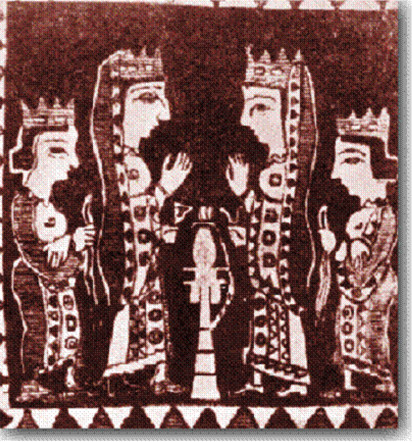
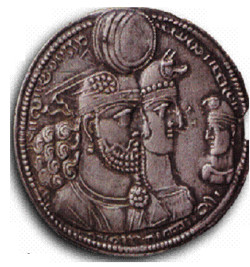
(Top) Sassanian King Bahram II (276-293), Queen and Crown Prince (coin); (above) Achaemenian Women (Woolen Carpet, Pazyryk, Hermitage Museum, St Petersburg, Russia)
It was this extraordinary love and respect shown by Asho Zarathushtra to his men and women that created the tradition of commemorating outstanding men and women on the Memorial Day, the Farvardegan or muktad, at the end of the year. The Farvardin Yasht, a post-Gathic Avesta text, venerates the names of 261 persons, 16 of whom are married women and 11 are maidens. This gives us a much higher proportion of women in the front lines of a religious order than in any other religion in its very early stage, or even today. Keeping in mind the universality of the Zarathushtrian message in view, the Yasht then turns to the human beings of every land and states in separate paragraphs: "We venerate the righteous men ... we venerate the righteous women of the Aryan countries ... the Turanian countries … the Sairimyan countries ... the Saini countries ... the Dahi countries ... and of all the countries ... the righteous men and women, who (were) foremost in accepting the divine doctrine and first to listen to the divine teachings, who won for the cause of righteousness, who have been successful in establishing homes, districts, settlements, countries, who have been successful in learning the thought-provoking message, who have been successful in improving their souls, and who have been successful in obtaining all that is good (Yasht 13.143-151).” The Yasht is a unique collective prayer in venerating both, men and women, a true proof of the divine doctrine of Asho Zarathushtra.
Erpatistan is a book for the priestly class. It has not reached us in full but fortunately has the part dealing with woman officiants at rituals. It belongs to a time when every person was engaged in his or her livelihood profession, generally agriculture. One could only leave the job if another person was available to take over without a possible loss in property. Man and woman both officiated, whenever invited, as priests in a ritual. If invited to officiate at a ceremony, husband and wife had to consider who was needed more to attend the profession so that the other was spared to proceed to the ritual scene. Women were at liberty to go to officiate at a ritual without the prior consultation of their husbands. The officiant, more needed to attend to his or her daily profession, could only be absent for a total of six nights in traveling and officiating at the ceremony. It may be noted that those willing to become priests had to undergo a three-year rigorous course of learning, memorizing, comprehending and expounding the Gathas and the Haptanghaiti, till then the only guiding "principles of life” and the only prayers used in rituals. All non-Gathic texts now used in rituals are later, some very late, additions. The Avesta does not speak of the yasna or the vendidad ceremonies performed in present times in India (see Aerpatastan and Nirangastan by Sohrab J. Bulsara, Bombay, 1915, and Erbedestan, an Avestan-Pahlavi text by Helmut Humbach and Josef Elfenbein, Munich, 1990).
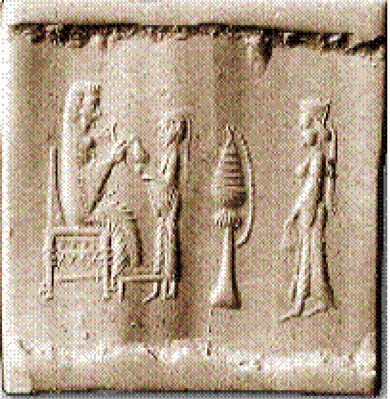
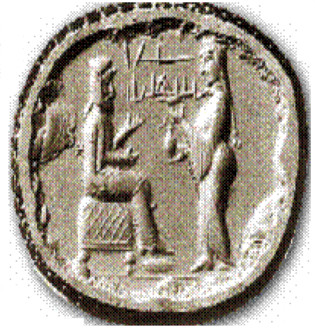
Achaemenian Queen with female and male attendants; (below) Achaemenian King with female attendant
The Vispered is a booklet devoted to the seasonal festivals of gahanbars. It shows that eight officials, each responsible for a specific function, took part in the ritual. In addition to the eight priests surrounding the holy fire, there were representatives of all the religious and social units of the locality to stand "prepared” to participate in the ritual, a procedure now out of question in present-day rituals performed by the priestly class while the laity attendants remain low and silent. The zaotar (literally "invoker”), the chief officiant, summons each of his or her seven colleagues as well as the representatives of the priestly, warrior and prospering professions as well as the representatives of the house, district, settlement, the youth devoted to further the religion, the teaching priest in the district, the roving preacher outside the district, and the house mistress. It is then that woman and man of extraordinary talents, given in the stanzas quoted at the beginning of this essay are summoned to participate. We may note that a woman is called hush-hâm-sâsta (literally well-instructed in religious lore) and ratu-khshathra (rite-authority). The latter title is used for Ahura Mazda as the supreme authority (Vispered 11.1) and the Gathas as the foremost authority of all scriptures used at ratu, rightful rituals (Y 54.2, 55.1, 71.11, Vispered 11.1, Afarin-e Gatha 2.3, Vendidad 19.38). It may be pointed that due to a wrong rendering in Pahlavi, some have translated the above ratu-khshathra as "obedient to husband” without taking into view the other instances quoted above, particularly the one in which Ahura Mazda is ratu-khshathra!
The Gathas are addressed as prayers to God and as guidance to mankind. Yet, as we have observed, the Gathic texts go a little further to mention both men and women so that it is fully understood that both the sexes enjoy equal rights in every spiritual (Gathic mental) and physical phase of human life. No priority or supremacy is given to any of the two. The two are free to emulate each other in matrimonial union in order to win each other in righteous service.
Later Avestan period
We have left the pristine Gathic era and the immediate post-Gathic period behind. Centuries have passed. Changes have set in. Certain Gathic concepts have been personified under a new term "yazata,” meaning the "venerated, revered.” Daenâ, conscience, religion, Chistâ, perception, another term for Daenâ, and Ashi Vanguhi, meaning good reward, all grammatically feminine, are among the personified concepts.
The Din Yasht in honor of Chistâ and the Art Yasht in honor of Ashi, provide us with the names of two stalwarts of the good religion. They are Hvovi, wife of Zarathushtra, and Hutaosa, wife of Kavi Vishtaspa. In the Din Yasht (16.15), Chistâ is approached by Hvovi. She, "the righteous, the knowledge-seeking, wished (to join) in good share with the righteous Zarathushtra in thinking, talking and acting in accordance with the Daenâ. It shows that she wanted to marry Zarathushtra to serve the religion better, an act her daughter Pouruchista followed later on the occasion of her marriage. In the Art Yasht, it is Zarathushtra who prays to Ashi Vanguhi to grant him the boon that "the good, independent Hutaosa think, talk and act in accordance with the religion so that she believes in and comprehends my Mazdayasni religion and brings good fame to my community (Yasht 17.46, also repeated in Yasht 9.26).” Her conversion, according to the composer of the Yasht, to the good religion was of special importance to Zarathushtra.
Ashi Vanguhi has the Art or 17th Yasht in her honor. This personification of a Gathic abstract is, in her yazata role, what Lakshmi is to the Hindus, deity of wealth and prosperity. Contrary to Ardevi Surâ Anahitâ, a pre-Zarathushtrian deity of which we will speak later, she is not offered any animal sacrifices but is simply praised by pre-Zarathushtrian and Zarathushtrian kings and heroes to grant boons. She is highly aggrieved, we are told, to see three women: a barren jahika, a woman who delivers her husband a child conceived from a stranger, and a maiden seduced to bear child without marriage. She bars "impotent men, past-menopause jahi, children, and virgins,” from partaking her libations (Yasht 17.54, 57-58). It means that the participants are told that she accepts only able-bodied men and women of mature and reproductive age in the rituals performed in her honor.
Although composed posthumously, the two Yashts not only echo two important events in the promotion of the religion, but also reveal the importance of women in the mission. They also show that women still enjoyed high status although the marshal phase of the Good Religion had begun with the ascendancy of the conquering warriors and the advent of epical yashts. The epical yashts are mostly dedicated to pre-Zarathushtrian deities (Ardevi Surâ Anahitâ, Tishtrya, Mithra, Varethraghna and Dravaspa). Although edited and augmented to suit the Zarathushtrian environment, they have much of the pre-Zarathushtrian material in them.
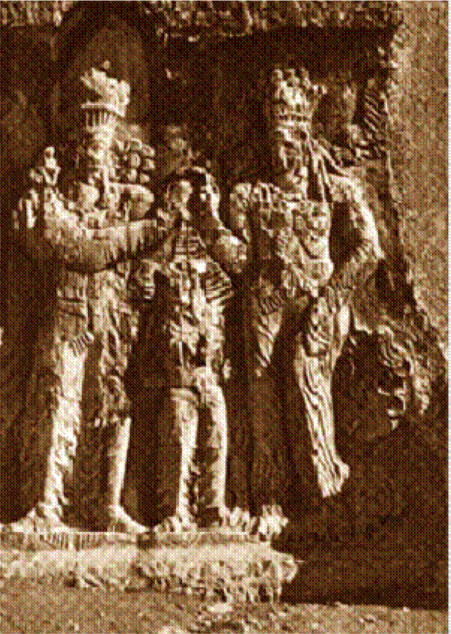
Sassanian King Narse (293-302 CE), Queen and Crown Prince, Naqsh-e Rostam (close to Persepolis)
Here, the first thing one observes is the dominating figure of Ardevi Surâ Anahitâ. Originally a river goddess with a probable name of Harahvati/Sarasvati, she is known in the later Avesta by her titles as Ardevi Surâ Anâhitâ, freely rendered as the "Unpolluted Heroine Humidity.” She provides us with the description of a beautifully attired lady, whom kings and heroes of pre-Zarathushtrian days approached with ritual sacrifices of hundreds of large and small animals for helping them to accomplish certain tasks. The description runs: "Ardevi Surâ maiden, independent, tall, upright, well-shaped and beautiful. Her beautiful white arms resemble the forelegs of a mare. She wears a crown of gold with hundred stars, octagon in shape, shining circle, with ribbons flowing and flying. She has square-shaped golden earrings. Her lovely neck is adorned by a gold necklace, her breasts made prominent by her tight belt glittering with ornaments. She wears a costly gold-embroidered gown with many folds. Her fur coat of 100 female beavers shines like gold and silver woven together. Thus attired, she rides a chariot with reins in her hands. Her chariot is drawn by four white horses of the same breed. They are the wind, the rain, the cloud and the hail.” She is called the healer; promoter of herd, home, country and the world; purifier of male seed and female womb; facilitator of child birth; increaser of milk in breasts; and above all, the Guardian of Waters (Yasht 5.1-1342). Strangely enough, it is this female yazata who prohibits women from partaking in the offerings made in her honor. All those who pray to her for boons are male. However, the high popularity enjoyed by her and other female deities to whom kings and heroes turned for help reveals the feminine position.
Dravaspa (literally healthy mare) is another pre-Zarathushtrian female deity. Although she is the guardian of the animal world, she too accepts sacrifices of hundreds of animals by the kings and heroes approaching her for boons. A description of the wives and daughters, given in the Dravaspa Yasht, reveals how the upper class women lived. The wives reclined on beautiful couches with beautiful cushions. They were well-attired, with square-built earrings and gold necklaces. They waited for their husbands to come and make love to them. Their daughters had narrow waists and were beautiful in body. Their shape was wishfully pleasing to those who looked at them (Yasht 9.1-3).
The male yazatas, Tishtrya and Varethraghna, both pre-Zarathushtrian gods, bar "the robber, the jahi, the person who does not chant the Gathas, and the antagonist to this religion which is divine and Zarathushtrian” from partaking their libations.
Jahi or jahika (the second is diminutive and derogative) is generally rendered as "whore.” But the context in which the terms are used show that ordinarily it should mean a female vagrant. Other instances show that, in addition to being a vagrant, she is said to be barren, "past her menopause,” and engaged in prostitution and witchcraft (Yashts 3.9, 12, 16; 8.59; Vendidad 18.62; 21.1, 17 for jahi, and Yasna 9.32; Yasht 14.51; 17.54, 57.58; Vendidad 18.54 for jahika).
To be continued
◆ ◆ ◆
From the archive