
Cover Story
The mystic dastur
A slew of responsibilities, ecclesiastical and secular, face the new dastur of Navsari Kaikhushro Navroz Dastoor Meherjirana
"You cannot acquire the whole truth intellectually. It is not possible. Only one percent of the universe is observable. The rest is not visible to the limited mind,” states the 17th dastur of Navsari, Kaikhushro Navroz Dastoor Meherjirana. The 83-year-old lawyer and disciple of the Ilm-e-Khshnoom (IK) school of mysticism, anointed as the High Priest of the Navsari Bhagarasath Anjuman on January 25, 2010 two days following the death of his predecessor Dastur Meherji Kekobad Meherjirana spoke at length to Parsiana on March 29 at his Kala Ghoda advocate’s chambers.
"You cannot learn the truth through science,” the physics major emphasizes. Scientific models are not "the ultimate truth about nature. The quantum theory has its own inconsistencies. Science is not in touch with reality.” He shows a copy of the September 2009 issue of Discovery, a reputed scientific magazine and a book by physicist John Gribbin, Q for quantum in which the authors state their reservation about scientific theories fully explaining natural phenomena. "Gribbin states ‘we don’t know,’” notes Dastoor adding, "mysticism is the science of all sciences.”
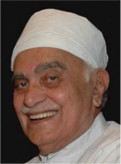
New vada dastur Kaikhushro Navroz Dastoor Meherjirana
IK is the "mystical branch of Zoroastrianism. Every religion has its own mystical” aspect. "For Jews it is the kabala. In Islam it is Sufism. Yoga is the mystical side of the Hindu religion.” Khshnoom means "bliss, satisfaction and spiritual knowledge.” That knowledge provides the insight to understand the aspects of the universe that are not discernable to the human eye. Ilm means knowledge. Hence Ilm-e-Khshnoom is the "knowledge of bliss,” the one-time teacher explains.
He lists seven "institutions” through which Parsis can have a fuller understanding of the universe. These are the sudreh kusti, the manthric Avestan prayers, worship of fire, kriya kaam (rituals and ceremonies), dakhmas, preservation of the racial genes — "if you want to survive then no mixed marriages, either by men or women. There is no distinction in religion” — and finally Meher patet or truth and justice.
These seven virtues or values is what can save humankind from the forces of evil which he lists as carnal passion, greed, attachment to worldly objects, ego, envy, din dushmani (opposition to religion), shamelessness, fraud and blasphemy.
"All people are inclined toward evil…the mind and the five senses get carried away. The human mind is like a boat that flows with the downstream current. We need energy to resist. Religion gives us that energy.” The willpower to turn against the tide is generated by the seven institutions.
Dastoor believes the Charles Darwin’s theory of evolution cannot explain the origin of species. He espouses instead the theory of creation. "Sixty-five percent of Americans are creationists,” he claims. When asked for the Zoroastrian theology about creation, the priest replies, "It’s a big story,” and proceeds to show several pages with notes and diagrams on the theory. He hands over a copy of Silloo Mehta’s illustrated book Thus spake the Magavs to which he has written the foreword.
The universe is divided into three parts, the spiritual, the non-physical or evanescent and the physical, says Dastoor. After creating the universe God put man in it and "men have prophets. Each prophet says he has talked to God…
"Ahura Mazda has a plan for different religions. The ultimate beginning and the end of each religion is the same… Good thoughts, words and deeds are not a Zoroastrian monopoly.”
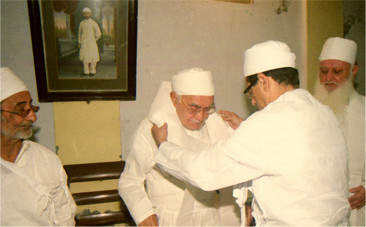
As per tradition the newly appointed head priest is felicitated with a pichori by Ervad Khurshed Desai Photo: Noshir Desai
"Religions create energy that results in currents or frado,” says Dastoor. Each religion’s current is different hence when people argue that an illiterate, impoverished Parsi may view the fire in an agiary but a highly spiritual person like Swami Vivekananda may not it is because the currents of each religion differ. "If non-Parsis look at (an agiary) fire a disturbance is caused… there must be some mystical reason behind the rule that non-Parsis cannot enter.” He cites the example of mobile phones being ordered to be switched off in airplanes as they may cause a disturbance in the functioning of the aircraft.
What about the fire temples in Iran permitting non-Zoroastrians admission? "It is wrong. That is why we came here (to India) to preserve our religion in its original purity. We wanted to avoid their example.”
What happens when a Parsi enters a mosque or a church? "The converse does not apply. We do not have currents that disturb.”
According to him, as per the original tenets of our religion, if persons "born of Parsi parents marry outside the faith they are not to enter a fire temple.” Dastoor does not accept the legal distinction that the child of a Parsi father wed to a non-Parsi is considered a Parsi but not the children of a Parsi woman married to a non-Parsi. According to him the definition provided in the Petit vs Jeejeebhoy case is obiter dicta (an observation by a judge on some point of law not directly in issue in the case before him and thus neither requiring his decision nor serving as a precedent, but nevertheless of persuasive authority). He feels both the children of men and women married outside the faith should be considered non-Parsis. Their children may profess the Zoroastrian faith and practice it at home — "you can’t stop them” — but they should not enter a fire temple or have their bodies consigned to the towers of silence. "The best religion is the one you are born in. There should be no conversion,” he affirms. "Groups of humanity were divided into different religions. The Hindu group’s DNA is different.”
In the case of the two priests termed "renegades” and barred by the Bombay Parsi Punchayet from performing religious ceremonies at Doogerwadi and elsewhere, Dastoor believes "the courts cannot interfere. The court is bound to respect religious beliefs.” While Article 25 of the Indian Constitution enshrines the right to freedom of religion, Article 26 gives citizens freedom to manage their religious affairs, he notes pointing to the relevant clauses in his copy of the document.
Dastoor is pessimistic about the future of the Parsi priesthood. He views the "position” as being "hopeless…there are no real mobeds. People do not understand this is a spiritual vocation. Giving a good compensation alone does not work. Job satisfaction su (what)? There are very few agiaries in which the right rituals and ceremonies are performed.” At one time to qualify for the priesthood an initiate had to memorize the 72 has. Now the number is two, he laments. "They are doing things the wrong way. The training is not there. Children want to understand…I have tried (to teach). I have put my views before the community since the last half century.” But some of his ideas have been dismissed as "nonsense chhè,” he bemoans.
"But we believe in the coming of a savior,” says Dastoor. "The time is very near.” He notes that this belief occurs in most religions.
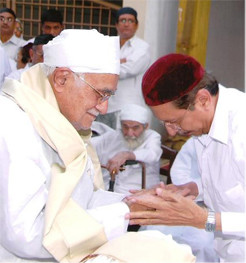
Kersi Deboo (right), trustee of the Malesar Behdin Anjuman, welcoming the initiate Photo: Soli Buhariwalla
Though his father, Navroz, was a priest at the Bhagarasath Anjuman Agiary near Dasturwad in Navsari and performed around 80 rigorous nirangdin ceremonies, he "deliberately saw that none of his three sons became mobeds.” The earnings were so meagre "he felt we’d die of hunger. He was anxious to give us a modern education. When his father bought an HMV radio for Rs 330 there was much "ho ha in Navsari. Karko mobedé radio lidho (a broke priest has bought a radio),” people remarked.
His father was "psychic” and had a vision of locks being placed on agiary doors, recalls Dastoor. A few years ago in Khambat the agiary was closed, the fire extinguished. In Bharuch some of the agiaries "are in the doldrums.”
Dastoor was born on January 11, 1927, the same year that Behramshah Shroff the renowned mystic who popularized Khshnoom died. Kaikhushro’s mother, Manekbai, played the harmonium and her young son picked up a six anna (around 38.5 paise today) flute. "Within a couple of years,” he was playing on All India Radio receiving Rs 30 per recital. He never took music lessons. "Music is a matter of consciousness,” he avers.
After completing his schooling at the Sir C. J. N. Z. Madressa he attended the M.T.B. College in Surat before taking up law at the Sarvajanik Law College in Surat. After completing his first LLB exam in 1949 he came to Bombay and studied for his second LLB examination at the Government Law College. With hardly any income he stayed for seven years at the Jeejeebhoy Dadabhoy Agiary at Colaba, praying in the mornings before attending college and practicing law under Jehangir Chiniwalla who also edited Parsi Avaz of which Dastoor was the sub editor. The journal ceased publication in 1974 but Dastoor revived the journal two years ago by combining the publications Dini Avaz and Parsi Pukar. Chiniwalla’s older brother, Dr Framroze wrote prolifically on Khshnoom.
Economic considerations led Dastoor to take up a job to ensure "a steady income.” He worked as secretary for the Bombay Zoroastrian Cooperative Life Assurance Society Limited and in 1956 when insurance was nationalized his services were transferred to the Life Insurance Corporation of India. He then joined Bank of India before switching to Bank of Baroda as chief legal advisor and rose to the general manager cadre. He authored Case book on the law of banking which was published in 1980 by C. C. Shah and Co. He retired in 1985 but continues with banking law and documentation which is his specialization. He also lectured on law in Bombay University and was a "demonstrator” in physics at the S. D. Garda College in Navsari.
Dastoor did not encourage his two sons, Sarosh, a chief marine engineer and Meheryar, a financial advisor in Florida, to take up the priesthood. His daughter, Kashmira Sadri, has settled with her family in Switzerland. His wife Dolat expired in 1988.
The lawyer-cum-priest was reluctant to take up the Meherjirana gaadi but was coaxed by Dastur (Dr) Firoze Kotwal to do so. Kotwal himself was not eligible as he is not from the Meherjirana family. After consulting his two brothers, Behramgore and Homi (he also has a sister Homai) Dastoor took the plunge. He visits Navsari once a month and stays with a friend. He has an affinity for the priestly role but finds the other trusts on which he becomes an ex-officio trustee more burdensome. The Bhagarasath Anjuman has not held an election since 1996. The matter is pending before the Charity Commissioner. He terms his new lay responsibilities an "uphill task.” But as his great ancestor the first Meherjirana who took office in 1584 went to the Moghul emperor Akbar’s court and according to family legend performed miracles, maybe his 17th descendent may also work wonders.
◆ ◆ ◆
From the archive