
Books
The good, the bad and the not-so-beautiful
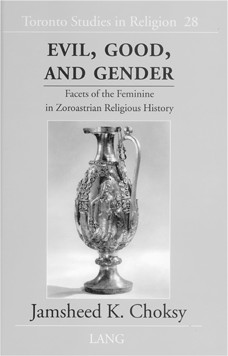
Evil, Good and Gender: Facets of the Feminine in Zoroastrian Religious History by Jamsheed K. Choksy. Published in 2002 by Peter Lang Publishing, Inc., Acquisitions Department, P. O. Box 1246 Bel Air, Maryland 20104-1246, USA. Pp: 166. Price: Not mentioned.
This monograph published by the Toronto Studies in Religion, Vol 28 presents a difficult task of evaluation to a reviewer who is equally interested in the field of Zoroastrian studies and gender studies since the book is uneven in the depth and level of attention it devotes to some of the major topics that are of concern to this volume. According to the author Jamsheed Choksy, the "book examines doctrinal, theological, ritual and socioreligious developments over time in the relationship between evil, good and gender — within a context of malevolence and benevolence attributed to the feminine, the masculine, the female and the male by Zoroastrians.” In the three realms — doctrinal, theological and ritual — in the Zoroastrian tradition as it examines facets of the feminine, the book succeeds marvelously in guiding the reader to specific primary sources, especially those that are grounded in the religio-historiographical system. Choksy displays a remarkable grasp of his material, focusing for the most part on texts, artworks, coins and other items that explore the implications of the religion’s attitudes towards gender-related issues. In fact, the book is so rich in thick descriptions in these areas, that an explanatory paragraph at the end of each chapter might have helped in analyzing the implications of the numerous examples that are presented to illustrate a particular line of thinking. In this regard, a more general point can also be made at this juncture that as a contribution to the scholarly and academic understanding of religion, the book is a tour de force in what the Series calls "surface” and "depth” description. Where it falls short, at times, is in achieving the second task: "the search for explanation and the development of theory to account for religion and for particular historical traditions.” Perhaps this problem could have been avoided by relying more heavily than the author prefers on theoretical paradigms drawn from other disciplines to analyze the source materials that Zoroastrianism provides, and to augment the work of scholars who are so intimately involved in Zoroastrian studies that they often tend to provide a benign explanation for some of the religion’s questionable beliefs and traditions that affect women.

Choksy: discoursing on gender-related issues
However, it is in the realm of socioreligious development during modern times that the problems with the book are most evident and where it fails to meet the high standard of scholarship that it achieves in the other three areas. This is particularly disappointing in view of the fact that the introduction promises an exploration of the premise that "images of the female and male in theology (italics mine) were fundamental in defining both women’s and men’s cultural roles and statuses.” Instead, the discussion on socioreligious transformation of Zoroastrian women’s lives during modern times concentrates more on putting a positive spin on "changing contexts” — communal responses to general, western-style social and educational influences, while curiously omitting the mention of some systemic problems in religious thinking and practices that have discriminated consistently against Zoroastrian women. Even in this context, Choksy seems more at ease in discoursing on gender-related issues when he returns to the old, familiar territory of describing the decline of diabology, and less in control of his material when he strays into the world of cultural roles and statuses.
Specifically, the monograph contains five chapters and a brief introduction. The introduction provides a review of the main thesis of the volume. Basically, Choksy lays out the opposition between evil and good as "interlinked religious concepts,” with its origins attributed to a "non-human spiritual being, with ancillary spirits and mortals acting as evil’s agents — all in opposition to a spiritual entity who supposedly represents order and good.” In many societies, gender, along with aspects of sin, sex and impurity came to be associated with evil, and Choksy draws on this connection to demonstrate how the notion of the feminine, which was believed to be more evil and distinct from the order of goodness and good, became a perspective of the Zoroastrian religion. Generations of clerics (all male) transformed this concept into yielding demonic female spirits. Placing the blame on the feminine made it easy to depict them as the agents of disorder, and provided a means of externalizing the chaotic evil within humans in female demons. At the same time, Zoroastrian beliefs did not exclude the feminine from goodness. Mazdean rites included several female spiritual beings who played important roles in expelling evil and serving as the role models for mortal women.
In elaborating the above theme, the author introduces many other topics that are dealt with in later chapters. These include doctrinal notions from the Old Avestan, the impact of dualism, gender-related consequences of the concepts of sexuality, avidity, imperfection and death, and the effects of belief and practice on the lives of women in past and present Zoroastrian communities. At the outset, Choksy acknowledges that this study places a heavy reliance on the source materials that Zoroastrianism provides. He also recognizes that these source materials reflect male discourses — a particularly troubling bias when the topic of interest is the image of the feminine, but no female input is available. In view of these facts, it is unfortunate that in backing away from viewing "gender-related issues of the past as misogynist,” the author does not differentiate between a misogynist and a broader, feminist perspective. Without such a framework, Choksy often leaves the reader with meeting only one of his goals in dealing with differential aspects of gender: describing "what seems to have taken place,” leaving the question of explaining "why it took place” (italics mine) at a more generalized and less nuanced level.
Chapter 2 provides a straightforward discussion of the rise of Zoroastrianism, including details about the Prophet’s life, the Zoroastrian scripture, dualism, spiritual entities, the sectarian sacred history, Zoroastrian beliefs regarding death and its aftermath, the belief about the saviors, initiation, worship and death rituals and the emigration of Zoroastrians to India. The author then goes on to discuss the international dispersion of the community during the last few decades. Choksy ends the chapter with a short but interesting discussion of dualism and the feminine, pointing out how a male dominated society ensured that in Zoroastrianism, the origins of good and evil were both attributed to male entities. Needless to say, the dynamics of power prevented the female from being named the "top dog,” although it can be easily understood why a societal fear of the feminine mystique would lead to the female being blamed for furthering the cause of evil. Of course, this interpretation also succeeded in taking away the blame from men, and helped support the thesis that the "demonic feminine was more powerful than the divine feminine.”
Chapter 3 takes us into the domain of female demons and beneficent female spiritual beings, elucidating the gender-specific linkages of notions like deceit, discord, sexuality and avidity that are embedded in the faith’s symbolism of the demonic female entities, while the female divinities are depicted as working to ensure that cosmic order is upheld. Moreover, male dominance over the female in preserving the socioreligious order is demonstrated by the might of the male spiritual beings who are responsible for casting aside the ill effects of female demons on individuals and the power that they exercise over female spirits who help them to fulfil their tasks. Choksy presents a long list of female demons to demonstrate the association of gender and evil, particularly the specific manifestation of the disorder that is tied to a certain entity. He uses myths from the Bundahisn to elaborate his points. He again ends the chapter by submitting how the contrasting notions of order and disorder and the connection between evil and the feminine found an easy answer in the faith’s dualistic system which insisted on the maintenance of cosmic order through appropriate actions.
Chapter 4 carries us more specifically into the male dominated religious and societal world-views that linked feminine as a gender to being weak willed and easily led astray by the devil’s menagerie. In fact, women were not considered evil by nature but were thought to be misguided by evil beings into performing sinful actions. This Mazdean belief is illustrated by the myth in the Bundahisn regarding the act of the first woman, Mashyana. The image of the primeval woman thus created was projected upon women, and used to reinforce the belief that women, acting independently, will always end up creating the conditions that produce evil. Choksy elaborates this theme further in his discussion of sayings, literature, witches and demonesses and tales of the afterlife. The main emphasis in this section is the tie between pollution and evil, and its association with death and the feminine. The threats posed by menstruation and childbirth (some of the sources of pollution) to the cosmic order and purification rites related to neutralizing its effects all speak to the power of the connection between evil and gender in the Mazdean theology. Interestingly, the feminine connection between evil and good is continued in the afterlife in the depiction of attractive and unattractive Daenas who meet the souls of men. Even in death, however, females seem to be second class citizens since the gender and attractiveness of Daenas is considered to be an important issue, but the souls of women are not considered worthy of being addressed in the theological literature.
Chapter 5 is a historical excursion into antiquity and the middle ages for a search of available records that might divulge the socioreligious aspects of Zoroastrian women’s lives. The author covers Iran under the Achemenian dynasty, the Parthian regime, the Sasanian dynasty, the Arab conquest and the subsequent Islamization. As expected, the early periods reveal a paucity of data, with much of the meagre information focusing narrowly on the lives of female members of noble birth. There is much more available data starting with the Sasanian dynasty, although even here the focus is on the lives of elite women. Generally, the records present a mixed picture with women being able to engage in some gender appropriate work, enjoying certain legal rights, but on the whole, having their public life curtailed and mediated by their relationship with adult men. In the religious domain, purity and pollution codes continue to restrict women’s functions in the spiritual life of the community. The most interesting section of this chapter, however, is the discussion of Zoroastrian women’s lives after the Arab conquest, particularly the complex reasons and circumstances that led Mazdean women to cross religious boundaries and seek entry into the Muslim community. In doing so, these women helped temper Muslim positions with earlier Zoroastrian beliefs, creating a multicultural system that must have felt familiar to them in terms of its tone and context. As for Mazdean women’s lives, the pre-modern period saw very little significant change in the male dominated secular order that continued to be sanctified by the masculine religious tenets. Consequently, the old dichotomy between evil, good and gender as embodied in the divine and demonic spirits still functioned to restrict the socio-religious aspects of Zoroastrian wo-men’s lives.
Choksy’s concluding chapter on socioreligious development during modern times should have developed his vision of how the "images of the female and male in theology were fundamental in defining both women’s and men’s cultural roles and statuses.” Unfortunately, the emphasis on theology is often lost in the amount of coverage that he devotes to statistics on the effects of western-style societal influences that might have been responsible in bringing about some secular changes, such as a more egalitarian pattern of sex-role development. More important, he fails to make the point strongly enough that a relatively egalitarian ideal that might govern societal sex-role behavior might not provide a bulwark against continuing negative images of women in the religious texts and tradition. As a result, the chapter paints a much more benign picture of "social and religious liberalization” without any mention whatsoever of some very acrimonious issues that have discriminated consistently against Zoroastrian women. For example, the status of Parsi women married to non-Parsis, the status of their children, their legal status as Zoroastrians, etc are all subjects of vital concern that deserve particular coverage here since quoting chapter and verse from various scriptures seems to be the commonly accepted way of justifying the legitimacy of these gender-related religious laws. These problems could have been addressed very easily in the section where the author talks about the "increase in the frequency of marriage across confessional communities.” Instead, he leaves the discussion by backing away from tackling the problem when he makes a very general, nonthreatening comment that this trend has succeeded in "bringing new issues and concepts into familial settings.” A newcomer to the field could read this statement and have no inkling whatsoever about how these socioreligious developments have affected the lives of Zoroastrian women in vital ways.
A further problem with this chapter might be the fact that certain generalizations are not modified as much as they should be in order to present a more accurate and balanced picture of the level of liberalization. For example, Choksy’s assertion that "only extremely orthodox women will separate themselves from others during menses or after childbirth” is an underestimation of the strength and numbers of orthodox Parsis, based perhaps on a non probability sample study. My demographic study of 551 Parsi households does not support this claim, although the data included both urban and rural households. A different example of an overstatement, which might be a reflection of a commonly repeated assertion is the author’s reference to the following belief: recently, women’s expectations of marriage have "begun to exceed the reality represented by potential male partners within the community.” Furthermore, turning this belief into a significant factor in terms of its effects on "declining marital and reproductive rates” is a non-data based generalization that might easily take on the aura of blaming women for the community’s woes. Interestingly, contrary to even my stereotypes, my demographic study of never-married females revealed that it was an utterly traditional resource like household income which turned out to be the most significant factor in determining the prospects for marriage.
In other parts of the chapter, when the author is discussing some familiar issues, he seems to be more in charge of his material. This is true when he is dealing with the effects of the decline of diabology, giving examples from the texts of various evil spirits whose power is depicted as having diminished in value. His discourse on the use of religion as a means of legitimizing the notions of evil, good and gender, as well as the examination of texts to determine whether negative perceptions of the feminine were attempts by the Mazdean hierarchy to deal with the increasing status of women are equally illuminating. In general, Choksy seems more at ease in dealing with material from the past, and in drawing out the religious and social functions of these ideas which might be used to perpetuate or modify traditional beliefs. This is not surprising since by discipline and training, he is a historian of religion whose interest lies in furthering discussion of "continuity and change in the history of religions.” Choksy has approached the writing of this monograph with an impressive array of scholarly credentials. These attributes have enabled him to produce a highly detailed and authoritative work that should be on the shelf of any scholar who is interested in Zoroastrian studies.
◆ ◆ ◆
From the archive