
History
Women in the Gathas and the later Avesta – III Seduction and the scriptures
According to the Vendidad, prostitutes deserved a death sentence but the men who slept with them were not penalized
This series deals with the role of women in the region of the Iranian Plateau where the Zarathushtrian religion originated. The Gathas accord man and woman total parity, even more than is evident in modern "advanced” societies. The position was altered in the post-Gathic period in favor of male authority, though there is not a single sentence in the Avesta that belittles women.
The first of the three-part series covered the period from pre-Zarathushtrian times up to the end of the Prophet’s successful mission and showed how women held their own despite social and religious taboos. The second installment referred to the growing popularity of female deities whom even the kings and heroes sought to propitiate. This third and final episode explains that there was no prohibition on intermarriage in the Avestan texts although the Vendidad is explicit that a prostitute who mixes seeds deserved death penalty.
A founder director of the Zarathush-trian Assembly and a founder trustee of the Cyrus Society, Dr Ali Jafarey’s fields of specialization include Indo-Iranian history, geography, culture, religion, linguistics and literature. Author of 16 books in Persian and English on the Zarathush-trian religion and Iranian culture, Jafarey has taught at various universities and institutions in Iran and Pakistan.
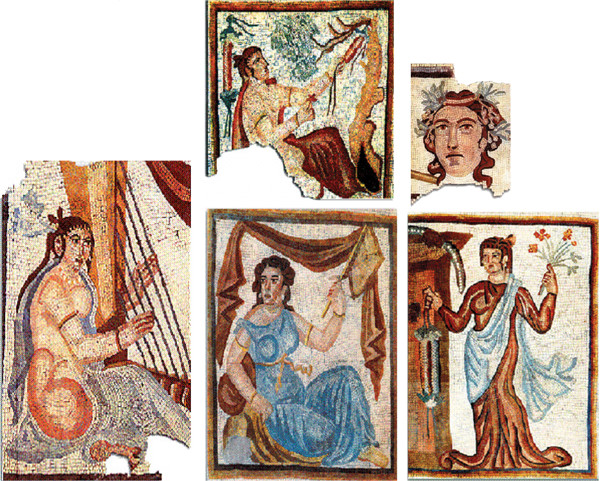
(Top, far left): Sassanian woman weaving garland, Bishapur, Iran; (left): young Sassanian lady, Bishapur; (Bottom row, from left): Sassanian harpist, Bishapur; Sassanian lady, Bishapur; Sassanian lady with bouquet, Bishapur
The Vendidad or better Vidaeva-dâta, literally "the law against the Daevas,” is mostly devoted to pollution and purification rites. Although its composition is ascribed to the Parthian period (250 BCE to 224 CE), its contents show that most of the rites go well beyond the Zarathushtrian era, even into pre-Aryan times. The Avestan renderings of many of the rites, from whatever language they originally were, are merely a screen to make it look as Zarathushtrian as possible by a third party narration of a dialog between Ahura Mazda and Zarathushtra.
Improper contact with a corpse, menstruation and stillbirth are among major pollutants. Contact with a dead body was a rare phenomenon among pollution conscious people. So, man and woman suffered less because of the proscription to touch it. But the other two naturally concern woman only. She has to experience the menstrual cycle about 12 times a year until menopause. But for stillbirth, in those remote days of lack of hygiene and health care, she could suffer it once or twice in her lifetime. A third or fourth would have taken her life too. A woman, polluted and polluting as she was considered during her period, was placed under strict quarantine and segregated from other members of the family. She was given rationed food and that too without coming into any contact with her. At the end of her period, she had to wash herself ritually with bovine urine, sand and water to regain her purified status in order to resume her normal domestic and social contacts and responsibilities. A woman with a stillborn child had to undergo a more rigorous purification rite over a longer period (Vendidad 5.45-56, 16.1-12).
Cohabitation, with a menstruating woman, had physical punishment — 60 lashes for the first time, 100 for the second, 140 for the third and 180 for the fourth time (Vendidad 16.14-16).
It may be pointed out here that the way in which menstruation is not mentioned in any other parts of the Avesta, even by the Yashts which specify those who should be barred from participating in the libations offered to them, one has to accept that it was taken quite naturally and did not pose a problem to the Zarathushtrian, or even to the earlier purely Aryan society. The pre-Zarathushtrians and Zarathushtrians took menstruation, pregnancy and childbirth as natural as they are. It is only the Vendidad which mentions menstruation and this reminds one of the pre-Aryan custom described earlier in this essay, although in a more gruesome form. The composer/composers of the Vendidad, naturally, did not know the original cause of the menstruation taboo and adopted it when it had already become a social practice in the non-Aryan society of the Plateau and neighbors.
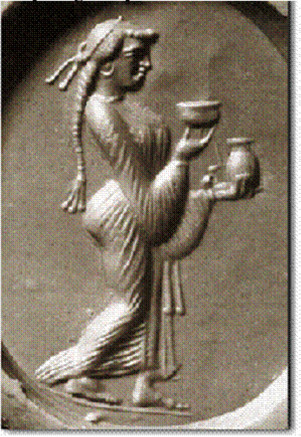
Woman attendant (Achaemenian period)
Prostitution and seduction
It is again the Vendidad which states: "Indeed the jahi intermixes the seeds of the genius (a term used for a scholar priest) and a non-genius, Daevayasna and non-Daevayasna, and pesho-tanu and non-pesho-tanu (pesho-tanu was an extreme sinner whose body was ‘forfeited’) (Vendidad 18.62).” In other words, jahi is a prostitute who sleeps with men of "opposite” classes and creeds — scholarly priests and non-scholarly priests, Daeva worshiping laymen and non-Daeva-worshiping laymen, sinners of a special class and non-sinners. It may also mean that a woman who sleeps with more than one man of the same class would not be termed jahi. The jahi who mixes the seeds is a vicious person whose look "dries up one-third of waters, plants, and good thoughts, words, deeds and strength of a righteous man.” But while the Vendidad prescribes a summary death for jahi, nothing is mentioned about any punishment for those males, priests or not, who sleep with her. They are not termed as prostitues. Men do not blame and punish themselves when it comes to adultery!
There is another Avestan passage found only as a quotation in the apparently out of context Pahlavi commentary under the chapter on Education in Erpatistan. Here is how it has been rendered by Sohrab J. Bulsara: "... And to (cohabitation) with adulterous ignoble barbarians and those of the worth of death, those of wicked creed we declare to be degrading as (cohabitation) with females of quadrupeds. These (facts) can be manifested from the passage in (the Avesta) "whereof then (is) a woman among ‘Mazdayasnians’ (who) adulterates the (seeds) of Mazdayasnians and the demon-worshipers.” (Aerpatastan, bk I, ch V, para 9). The same is rendered by Prof Helmut Humbach and Prof Josef Elfenbein as: "It is offence to cohabit with a whore, with a non-Iranian woman, with a Tanapuhr, and with one of evil religion.”
It is this passage on prostitution which some interpreted to mean that intermarriage is strictly prohibited, and that it is an act of adultery and the child an illegitimate product.
There is nothing in the Avestan texts that would prohibit and discredit a marriage between a Zarathushtrian and a non-Zarathushtrian. Mixed marriages took place. The Shahnameh has many instances of them. All know that the sources of that wonderful record are Pahlavi writings passed on to Ferdowsi by mobeds. Iranian history, particularly from the Achaemenian days down to the Sassanian times, shows that Zarathushtrian kings, chiefs, and definitely following them, other notables married outside. It does not seem to have posed any problem. Otherwise all that was required was a commandment to have declared in clear terms: "Thou shall neither marry a non-Zoroastrian woman nor marry your woman to a non-Zoroastrian man!” There is not a single commandment and not a single report by Iranian and foreign historians regarding the prohibition of mixed marriage. Therefore, all the uproar to stop it comes through twisted translations by 20th century guardians of self-styled "traditional” Zoroastrianism.
While the Gathic and other texts use nâiri, genâ and ghnâ for "woman,” the Vendidad is fond of nâirikâ, a diminutive form of nâiri, obviously in a contemptible sense.
Seducing and impregnating a maiden outside marriage was considered a heinous crime. However, the Vendidadic society was broad-minded enough to declare that "if a young woman, belonging to a family or independent, married or not, conceives by a man,” she should not feel ashamed and should not resort to abortion, because "it is murder committed by both the man and the woman.” The man was commanded to support her until the child was born and then support the two for seven years. If he, for obvious reasons, did not, then the community took care of the mother and the child. Generally, old women helped in abortion by means of drugs "which kills the womb ... or produces miscarriage.” The scripture also prohibits the use of drugs to stop the issue or shorten the menstruation period. A lengthy period of issue was considered a sickness and the woman is advised to be treated and cured (Vendidad 15.9-19, 45).
The marriageable age for both the sexes was 15 years all along. However, while the Gathas show that a woman chose her husband through sound consultations, the Vendidad reveals that it was the father or the brother who gave away the girl to a righteous man seeking wife (Vendidad 4.45, 14.150).
"The last resort”
The divine doctrine of the Gathas places man and woman on fully equal status in all religious and social affairs, more than what is observed and practiced in modern "advanced” societies. But the post-Gathic period, particularly when the entire indigenous population of the Plateau was completely assimilated with their age-old-hard-to-die customs, things took a turn. Women were not regarded as high by certain factions of the very late Avestan people. Chronologically the Avesta speaks about her decline in favor of an egocentric man of authority, but never to a revolting degree. Taboos could not rob her of her position. There is not a single sentence in the Avesta that would belittle woman. Even the Vendidad does not make any derogatory remarks about her. She continued to be venerated in all the daily prayers on par with man. And she continued her normal life as nmâno-pathni, the mistress of house.
Whatever the past, time has come to turn to the divine doctrine, in order to comprehend her true and rightful status. It is direly needed in order to reestablish the "fellowship of men and women of Zarathushtra ... highly regarded by Ahura Mazda” in a progressing world. It proudly and placidly places the Zarathushtrian women ahead of others and that too without resorting to any "liberation” task. The Gathas are the resort. Let us all, men and women, turn to them. Concluded
◆ ◆ ◆
From the archive